
こんにちは! Taking the Plunge into Japanese Reading
I remember the day I first tried to read a full page of Japanese. The hiragana and katakana were okay, manageable blobs of script, but then the kanji hit me. It was like a wall. A beautiful, yet utterly intimidating wall made of tiny, complex characters. If you’re currently studying for the Japanese Language Proficiency Test (JLPT) N5, you know exactly what I mean.
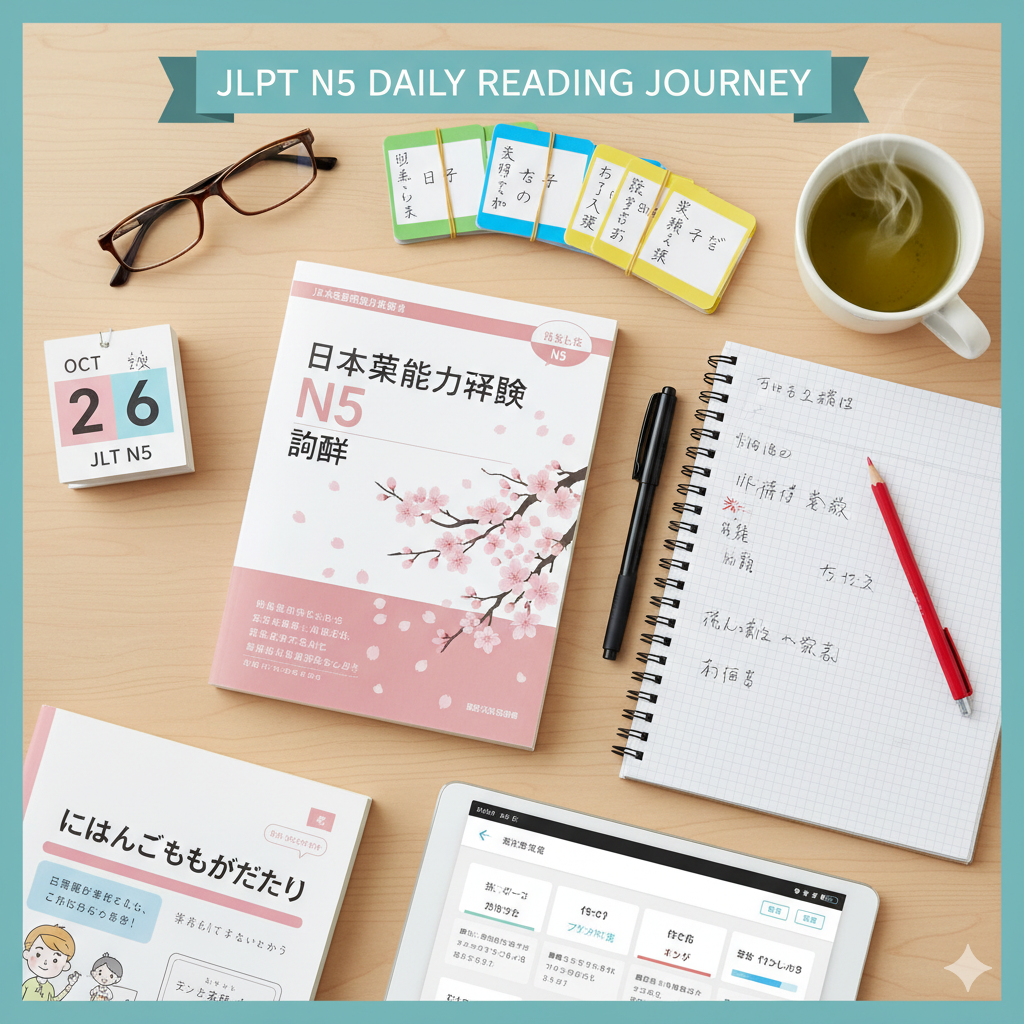
The N5, as the foundational level, is all about building that basic framework. You’ve mastered the two syllabaries, you’re wrestling with about 100 essential kanji, and you’re navigating the polite -masu form. But the reading section? That’s where the rubber truly meets the road. It tests not just your vocabulary and grammar knowledge, but your ability to process those elements under pressure and in context. It’s a whole different beast.
The good news? The reading component of the JLPT N5 is highly achievable with the right strategy and, most importantly, the right jlpt n5 reading materials integrated into your daily routine. This isn’t about cramming; it’s about building a consistent, enjoyable reading habit that makes those exam passages feel like a familiar friend, not a formidable foe.
As a Japanese language expert and someone who has been where you are—staring blankly at a page of text—I want to guide you through creating a diverse, practical, and most importantly, human approach to your N5 reading practice. We’re going to dive deep into the very best materials, how to use them, and the mindset you need for ultimate success.
The N5 Reading Challenge: Why Daily Study is Non-Negotiable
Before we get to the books, let’s talk about the unique nature of the N5 reading section. The exam requires you to:
- Read and understand short, everyday passages: Think simple notes, emails, signs, and announcements.
- Grasp the essential information: You don’t need to know every single word, but you must identify the main point.
- Process basic grammar and vocabulary at speed: The “Language Knowledge (Grammar/Vocabulary) and Reading” section is timed, demanding efficiency.
The biggest mistake learners make is treating reading as a passive skill. They think if they just learn enough grammar and vocabulary, the reading will magically fall into place. It won’t. Reading comprehension is an active skill that needs its own dedicated practice.
This is why “daily study” is the core of this post. Short, consistent bursts of reading—even just 15-20 minutes a day—are exponentially more effective than a massive 3-hour reading session once a week. It trains your brain to quickly recognize patterns, builds reading stamina, and stops the dreaded “burnout” that comes from staring at the same passage for too long.
1. The Foundation Builders: Essential JLPT N5 Reading Textbooks
You’ve likely already got a core textbook, but let’s look at the ones specifically celebrated for their approach to reading and context, which is key for the N5. These are the materials that ensure your knowledge is structured for the exam.
A. The Core Curricula with Context
While titles like Minna no Nihongo and Genki are often cited as the gold standard for learning, their accompanying workbooks and supplementary materials are where the reading practice shines.
- Minna no Nihongo (みんなの日本語): This series is highly structured, and the exercises often feature practical, short dialogues and announcements.
- The Reading Insight: The companion Reading Comprehension workbooks (separate from the main text) are fantastic for practicing the specific short-passage format used in the JLPT N5. They often use everyday settings—ordering food, asking directions, simple schedule announcements—which mirror the real-world application the N5 demands.
- Try! Japanese Language Proficiency Test N5 (文法から伸ばす日本語能力試験): As the name suggests, this series is explicitly designed for the JLPT.
- The Reading Insight: What makes Try! excellent is its focus on grammar-in-context. The reading passages are carefully written to incorporate the grammar points you’ve just learned, immediately demonstrating the practical application. This is crucial at the N5 level, where grammar and reading comprehension are deeply intertwined.
B. Dedicated Reading Practice Drill Books
If you feel your grammar is solid but your reading speed and accuracy are lagging, you need a dedicated “drill” book.
- 55 Reading Comprehension Tests for JLPT N5: This is exactly what it sounds like: a book full of short, focused reading passages.
- The Reading Insight: The beauty of a drill book is the sheer repetition of the test format. You learn to skim, scan, and identify the answer quickly. It’s like doing laps in a pool—it builds your linguistic stamina. Aim to do one or two passages every day, timing yourself to build speed.
2. The Game Changers: Graded Readers (多読 – Tadoku)
If there is one category of jlpt n5 reading materials I could beg you to adopt, it would be Graded Readers. They are, quite simply, the most human-friendly way to learn to love reading in Japanese.
What are Graded Readers?
Graded readers are books specifically written for non-native speakers, using only the grammar and vocabulary appropriate for a specific level (like N5 or N4).
The Unique Power of Graded Readers for N5: Most N5 learners get stuck in a frustrating loop: you try to read a children’s book, you look up one word, then another, then another, until you’ve lost the plot and the motivation. Graded Readers break this cycle. By limiting the vocabulary and kanji, they allow you to focus purely on comprehension and enjoyment. You can actually finish a book, which is a massive boost to confidence!
A. Highly Recommended Graded Reader Series
Look for readers that map their levels clearly to the JLPT or follow the popular Tadoku levels (Level 0 and Level 1 are typically suitable for N5 learners).
- Japanese Graded Readers (Level 0-1): These series often start with very simple stories, using high-frequency N5 vocabulary and simple sentence structures. They usually come in packs of small booklets.
- Nihongo Tokuhon (日本語読本 – Japanese Reader): Many learners find the Level 0 and Level 1 series of this resource to be a perfect bridge from textbook study to actual story reading.
- Unique Insight: The ‘Tadoku’ Philosophy: The idea behind Tadoku (extensive reading) is to read easy content a lot without using a dictionary. If you don’t know a word, just skip it and move on. Your brain will naturally pick up the meaning from context over time. At the N5 level, this seems terrifying, but trust me, it works. It changes reading from a painful task into a joyful habit.
3. The Digital Daily Dose: Free Online N5 Reading Materials
In the 21st century, you don’t need to spend a fortune to practice reading. The internet provides incredible, constantly updated, and often free resources. These are your essential tools for daily, bite-sized practice.
A. The Crown Jewel: NHK News Web Easy
If you ask any mid-level Japanese learner what their favorite reading resource was, many will point to NHK News Web Easy.
- What it is: A simplified version of daily news articles from Japan’s national broadcaster, NHK.
- Why it’s perfect for N5 learners:
- Furigana (Reading Aids): Every kanji has its reading in hiragana written above it, so you never get stuck on a character you haven’t learned yet. You can focus on the meaning.
- Built-in Dictionary/Glossary: Many versions/apps based on the site provide a simple explanation of the more difficult vocabulary.
- Audio: You can listen to a native speaker read the article, turning it into a combined reading/listening exercise. This is a powerful technique!
- Relevance: You’re reading about current events, which keeps the content fresh and interesting, injecting a dose of Japanese culture into your learning.
- Practical Application: Start by reading one article a day. First, read it silently to grasp the main idea. Then, read along with the audio. Finally, go back and look up the few remaining unknown words. This three-step process is a powerful daily study hack.
B. Language Learning Apps and Websites
Many online platforms and apps offer structured, N5-level short stories and lessons.
- JapanesePod101: While primarily known for audio and video, their website offers a vast library of reading material organized by JLPT level, including short dialogues and lesson notes.
- Nihongo Library/Similar Sites: Numerous websites have emerged offering free PDF downloads or online readers with N5-level sentences and very short passages, often categorized by the specific grammar or vocabulary they focus on. Search around, but always vet the quality to ensure the Japanese is natural.
4. The Cultural Immersion: Connecting Reading to Japanese Life
Reading for the JLPT shouldn’t just be about passing the test; it should be about opening the door to Japanese culture. Integrating cultural materials can significantly boost your motivation.
A. Children’s Books and Manga (Carefully Chosen)
While a full-length, native-level manga is far beyond N5, very simple children’s books or early-reader manga can be excellent supplements.
- Yotsuba&! (よつばと!): Many learners start with this manga series. While the language is technically above N5, the stories are very slice-of-life and the furigana is omnipresent. The visual context makes comprehension much easier than a wall of text.
- Picture Books (絵本 – Ehon): Simple Japanese picture books for very young children use minimal kanji, focusing on hiragana and katakana. They are short, often repetitive, and great for building confidence.
- Unique Insight: Do not read these materials as an N5 test. Read them for fun. Accept that you won’t know every word. Use the pictures to fill in the gaps. This casual reading is what builds your intuitive understanding of Japanese sentence flow, which is exactly what the JLPT reading section tests.
B. Everyday Japanese: Real-World Scenarios
The N5 often tests practical reading. You should seek out examples of:
- Simple Instructions: Think microwave instructions, labels on pre-packaged food, or simple signs in a park.
- Train/Bus Announcements (Text Version): Simple service announcements often use N5-level vocabulary and verb forms.
- Simple Recipes: A quick recipe for onigiri or a simple soup can be a great, practical reading exercise.
5. The Strategy: How to Build Your Daily JLPT N5 Reading Habit (The Human Way)
The biggest challenge is not finding the materials; it’s using them consistently without burning out. Here is the humanized, daily approach to conquering your N5 reading.
The Power of the “Reading Sandwich”
Don’t just read. Sandwich your reading with the skills that support it: vocabulary and kanji.
| Time Slot | Activity | Materials | Goal/Focus |
| 10 Minutes (The Warm-up) | Kanji/Vocab Review | Anki, Quizlet, Drill Book Lists | Activate the N5 vocabulary and kanji you’ll encounter. Primes the pump. |
| 15 Minutes (The Core Reading) | Focused Reading | Graded Reader, JLPT Practice Passage, or NHK Easy Article | Build comprehension speed. Focus on the main idea and context. |
| 5 Minutes (The Cool-down) | Discovery & Input | Add 3-5 new words/sentences from the passage to your SRS (Anki) deck. | Solidify new knowledge. This connects the reading to your long-term memory. |
Export to Sheets
Total Time: 30 minutes a day. That is a highly achievable, sustainable goal that will see massive results by the time you take your JLPT N5 exam.
Unique Insight: Embrace the Friction
Learning Japanese is full of friction: looking up kanji, re-reading a sentence, consulting the grammar book. At the N5 level, your goal is to reduce this friction.
- Use Furigana Liberally: Don’t toggle it off just to “test yourself” if it makes the reading miserable. At N5, your goal is comprehension, not kanji recognition. Let the furigana flow.
- Don’t Look Up Every Word: If you don’t know a word in a graded reader, can you guess it from context? If so, move on! Only look up the words that prevent you from understanding the entire sentence. This is the core of real-world reading.
The “Bridge” Principle
Think of your reading materials as a bridge:
- Pillar 1 (Solid Ground): Your main N5 textbook and drill books. These are slow, methodical, and teach structure.
- The Bridge: Your Graded Readers and NHK Easy. These are fast, fun, and build fluency. They bridge the gap between “classroom Japanese” and “real-world Japanese.”
- Pillar 2 (The Next Level): Simple native content (like those simple manga or authentic blogs). You won’t be here yet, but you’re building towards it.
For your daily practice, spend 80% of your time on The Bridge (Graded Readers/NHK Easy) because that is where the growth and the enjoyment happen.
6. Curated N5 Reading Materials and Outbound Resources
To help you get started right away, I’ve compiled a list of high-quality, trusted resources. Incorporating these into your daily routine will transform your N5 preparation.
1. Essential Online Graded Reader Portal
This resource is an incredible starting point for the Tadoku philosophy, offering many stories graded specifically for beginners (N5/N4 levels). You can read for enjoyment without constantly consulting a dictionary.
- <a href=”https://dokushoclub.com/free-reading-resources/n5-free-reading-resources/” target=”_blank” rel=”noopener noreferrer”>N5-Level Graded Reading Resource</a>
2. The Daily News Practice Lifeline
This is a must-use daily tool. It keeps your practice relevant and features the essential furigana and simplification that N5 learners need.
- <a href=”https://www3.nhk.or.jp/news/easy/” target=”_blank” rel=”noopener noreferrer”>NHK News Web Easy</a>
3. The Trusted Reference Tool
While the goal is to reduce dictionary lookups, when you must look up a word, you need a fast, accurate, and comprehensive tool. Jisho is the community favorite.
- <a href=”https://jisho.org/” target=”_blank” rel=”noopener noreferrer”>Jisho Online Japanese Dictionary</a>
4. Major JLPT Publisher (Resource Catalog)
Sometimes you just need to see all the options from a major publisher that specializes in JLPT preparation books. Check out their catalog for the latest editions of Sou Matome, Try!, and other dedicated reading resources.
- <a href=”https://japanesetesting.com/” target=”_blank” rel=”noopener noreferrer”>The Japan Times Book Store (Publisher of JLPT Prep)</a>
5. Authentic Language Acquisition Perspective (Academic Context)
Understanding the methodology behind why extensive reading works can be incredibly motivating. This links to a well-known resource that advocates for the “Tadoku” approach in second language acquisition.
- <a href=”http://www.tadoku.org/english/” target=”_blank” rel=”noopener noreferrer”>The NPO Tadoku Supporters</a>
Conclusion: Your N5 Reading Journey Starts Today
Remember that wall of kanji? You’re not going to knock it down with a single swing. You’re going to dismantle it, brick by brick, with consistent, daily effort. The JLPT N5 is your first major milestone, and the reading section is your opportunity to prove that you can take the foundational knowledge you have and apply it practically.
The best jlpt n5 reading materials are the ones you actually use, consistently, and with a sense of enjoyment. Mix your dedicated test prep books with the lighter, more enjoyable content of graded readers and NHK Easy. Commit to your 30-minute reading sandwich every day, and I promise you will not only pass the reading section with confidence, but you will also develop the foundational skill that makes all future Japanese study—N4, N3, and beyond—a rewarding adventure.
がんばってください! (Good luck!) Your Japanese reading journey begins now.
More JLPT N5 Listening Resources You Might Find Helpful
JLPT N5 Reading Guide: Practice Passages, Comprehension & Tips
JLPT N5 Past Reading Papers (Download PDF)
JLPT N5 Dokkai (Reading) Practice with Answer Keys
JLPT N5 Reading Practice with Passages & Translations
JLPT N5 Reading Test with Answers & Explanations
JLPT N5 Reading PDF with Practice Questions
JLPT N5 Reading Comprehension Practice for Beginners
JLPT N5 Reading Tips: How to Read Faster and Understand Better
JLPT N5 Reading Quiz (Free Online Test)
JLPT N5 Reading: Short Practice Passages with English Translation


