When you set out to learn Japanese, you quickly realize two things: Kanji is a mountain, and grammar is the winding, sometimes frustrating road that leads up it. If you’re aiming for the milestone of fluency—or perhaps, the coveted JLPT N3/N2 levels—you’re looking at mastering somewhere in the realm of 600+ distinct grammar points.
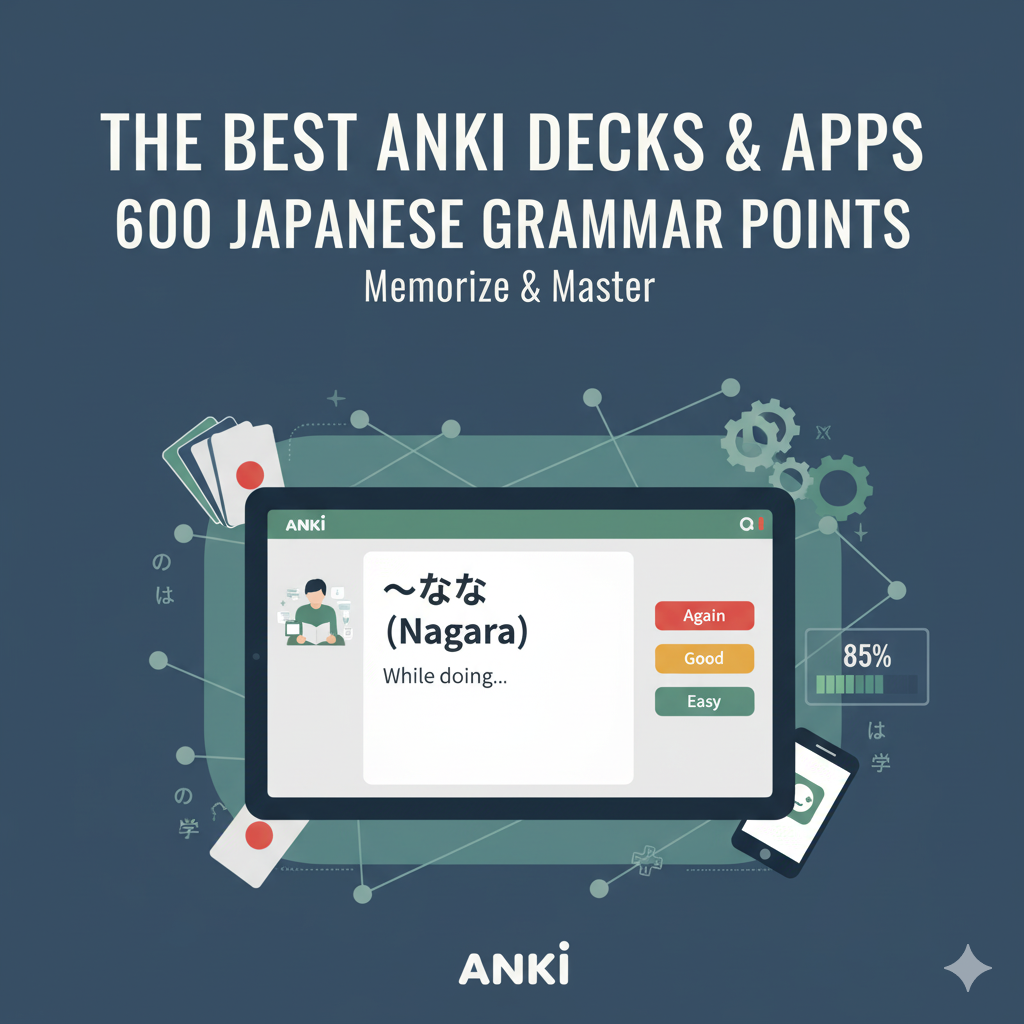
That’s a colossal task.
Rote memorization simply doesn’t work. Grammar isn’t a list of vocabulary; it’s the operating system of the language. You need to internalize it, to make it second nature.
For years, as both a Japanese learner and an instructor guiding students through the JLPT gauntlet, I’ve seen the struggle firsthand. The solution, overwhelmingly, lies in leveraging technology to deliver the right material at the right time. Enter the champions of modern language learning: Anki and dedicated Japanese grammar apps.
This post is a deep dive into the specific tools and decks that will help you tackle the N5, N4, N3, and N2 grammar points—that sweet spot of around 600 essential patterns—and move from simply “knowing” a grammar rule to using it fluently.
(This is one tool in your comprehensive arsenal. For a complete guide to all available resources, don’t forget to check out our main resource guide: The Ultimate Toolkit: Best Japanese Grammar Books, Apps, and Resources.)
🧠 The Philosophy: Why Memorization Alone Will Fail You
Before we talk tools, let’s talk strategy. As a JLPT expert, my biggest piece of advice is this: Do not study grammar in isolation.
The biggest trap in using flashcards or a grammar app is focusing only on the translation. For example, a card might show $\sim\text{ばっかり}$ and you memorize “just finished doing something.” That’s fine, but it’s only 10% of the battle.
The real learning comes from:
- Conjugation: What does it attach to? (e.g., $\text{V}$ $\text{た}$ form + $\sim\text{ばっかり}$?)
- Nuance: How is it different from a similar-meaning structure? (e.g., how is $\sim\text{ばっかり}$ different from $\sim\text{ところ}$?)
- Context: Can you use it naturally in a sentence? (e.g., is it formal or casual?)
The tools we discuss are powerful because they facilitate this contextual, nuanced learning, rather than just simple rote repetition. They use the power of the Spaced Repetition System (SRS) to ensure that the grammar point comes up for review just as you are about to forget it—the golden moment for memory consolidation.
🥇 The Anki Advantage: Best Decks for Japanese Grammar
Anki is the powerhouse of SRS. It’s not an app that teaches grammar; it’s a platform that helps you memorize and internalize the grammar you’ve already learned from a textbook or reference guide. If you are serious about targeting japanese grammar anki deck as your primary review method, these are the decks you need.
1. The Dictionaries of Japanese Grammar (DoJG) Sentence Decks
If you are a serious, long-term Japanese learner, the three volumes of A Dictionary of Japanese Grammar (Basic, Intermediate, Advanced) are the undisputed gold standard. They collectively cover far more than 600 points, but their primary utility lies in their depth and nuance.
Why the DoJG Decks Are King
The genius of the Anki decks derived from the DoJG series is that they turn the hundreds of nuanced example sentences from the books into flashcards.
- Format: Typically, the front of the card shows a Japanese sentence with the target grammar point obscured (a “cloze deletion” or fill-in-the-blank). The back reveals the grammar point, the full sentence, an English translation, and—crucially—often a link back to the page in the physical dictionary for a full explanation.
- Targeting 600+ Points: The Basic and Intermediate volumes alone contain most of the 600-ish points required for a strong N2 level. Drilling these sentences is the most efficient way to achieve mastery.
- The Crucial Insight: You shouldn’t start this deck as a total beginner. Use it to cement knowledge you’ve already gained. If you don’t understand the grammar point, you should pause your Anki session and go look up the full explanation in the physical dictionary or an online resource. Anki is the review tool, not the teaching tool.
2. The Tae Kim’s Grammar Guide Deck (An Anime-Inspired Approach)
For learners who find traditional textbooks dry, Tae Kim’s Guide to Learning Japanese is a popular, free online resource known for its clear, concise, and modern explanations.
- The Deck’s Unique Angle: Many community-made Anki decks have been created based on Tae Kim’s work. One particularly popular version is often titled something like “Japanese course based on Tae Kim’s grammar guide & anime.”
- Contextual Input: These decks excel by using sample sentences that often feel more natural and contemporary than those in older textbooks, sometimes even pulling sentences from anime or popular media. The focus is on comprehensible input, making the learning process feel less like a chore.
- Best for Transition: This deck is excellent for the transition from N5 to N4, offering a solid foundational understanding of core grammar structures before moving on to the more complex, nuanced points of N3 and N2 that the DoJG decks cover so well.
(If you are considering using the original guide, we have a complete review on that resource: Tae Kim’s Guide: The Complete Review and How to Use It for JLPT Prep.)
3. Comprehensive All-in-One Decks (JLPT-Focused)
For those who need sheer volume organized by official test levels, there are community decks that aggregate lists from various sources (like JGram and common JLPT textbooks).
- Example Deck: Look for decks like “Full Japanese Study Deck [JLPT N5~N1 vocab/kanji + more]” on AnkiWeb. Many of these contain a dedicated grammar sub-deck with 600+ grammar points clearly separated by JLPT level (N5, N4, N3, N2).
- Strength in Structure: These decks are ideal for test preparation. They provide the complete list of grammar points you are expected to know for each level, ensuring you don’t miss any required structures.
- A Word of Caution: Since these decks often pull from raw lists, the quality of the example sentences and explanations can vary. Always cross-reference any confusing points with a trusted grammar guide.
💡 My Expert Anki Tip for Grammar Mastery
Always Use Sentence Cards, Never Definition Cards: A card that simply shows $\sim\text{ようだ}$ on the front and “It seems like…” on the back is useless. The most effective japanese grammar anki deck uses a sentence with the grammar point clozed out, forcing you to recall the structure and context of the grammar in use, not just a simple definition.
📱 Beyond Anki: The Best Dedicated Japanese Grammar Apps
While Anki is a fantastic review tool, sometimes you need a resource that is designed from the ground up to teach grammar interactively. This is where dedicated apps shine, often incorporating Gamification and highly structured lessons that textbooks sometimes lack. This is also where the japanese grammar app reddit community consistently offers powerful, real-world recommendations.
1. Bunpro (The Undisputed King of Digital Grammar Practice)
If you’ve spent any time on the Japanese learning subreddits, you’ll know Bunpro is universally praised for its sole focus on grammar mastery. It is the gold standard for grammar SRS, taking the core principles of Anki and making them a structured, cohesive learning experience.
Why Bunpro is a Game-Changer
- Structured by JLPT Level: Bunpro organizes its massive library into the official JLPT levels (N5 through N1). It covers well over 600 grammar points, making it the perfect partner for your N2-level goals.
- Context and Nuance: Instead of simple flashcards, Bunpro uses fill-in-the-blank questions with multiple example sentences, forcing you to think about how the grammar point attaches to different parts of speech (conjugation) and which of several similar-sounding options is correct for the context. This is the ultimate test of nuance.
- Linked Explanations: This is its most powerful feature. Every single grammar point links directly to multiple, authoritative external sources for its full explanation: Tae Kim’s Guide, the DoJG books, Jisho, and more. You get the review and the lesson in one place.
- Human Insight: The japanese grammar app reddit community loves Bunpro because it addresses the single biggest flaw of self-study: the lack of a structured, comprehensive curriculum that builds on itself. Bunpro does the heavy lifting of curriculum design for you.
You can explore the platform’s features and pricing plans on their official site: Bunpro.
2. Human Japanese (The Engaging Textbook-App Hybrid)
For beginners and intermediates who struggle to get through dense, paper textbooks, Human Japanese (available as two separate apps: Human Japanese and Human Japanese Intermediate) provides a uniquely engaging alternative.
- A Conversational Approach: The app is written in a friendly, conversational tone, guiding you through grammar points as if you have a patient, knowledgeable tutor sitting next to you. It uses clear analogies and minimal, well-chosen examples to explain even complex structures.
- Excellent for Initial Learning: Unlike Anki, this app is a fantastic primary teaching tool. It’s perfect for the N5 and N4 levels and covers the fundamentals with incredible clarity. The Intermediate version extends this to a solid N3/low-N2 level.
- Practical Application: It integrates culture notes and practical application tips, making the learning feel relevant and less academic.
3. Obenkyo (The Free, Comprehensive All-in-One for Android)
For Android users looking for a free, no-frills, power-packed option, Obenkyo is a popular choice.
- Coverage: It includes extensive sections for Kana, Kanji, Vocabulary, and—most relevantly—Grammar, covering the full N5 to N1 range.
- JLPT Focus: It presents grammar points with example sentences and a clear focus on JLPT requirements. Its built-in quizzes and self-testing features are a great way to drill the knowledge you acquire from other sources.
🛠️ Practical Application: Integrating Anki and Apps into Your Study Flow
The goal is to master 600 grammar points, not just see them once. Here is a proven, three-step methodology that integrates these tools for maximum efficiency:
Phase 1: The Initial Encounter (The “Teacher”)
Goal: Understand the meaning, conjugation, and nuance of the grammar point.
- Action: Learn 3-5 new grammar points per day from a primary source. This could be a textbook like Genki or Minna no Nihongo, a grammar guide like Tae Kim’s Guide, or a structured app like Human Japanese.
- Critical Step: Write down the grammar point, its conjugation rules, and one clear, simple example sentence in your own notebook. Don’t move on until you can create your own sentence with it.
Phase 2: The Structured Drill (The “Reviewer”)
Goal: Reinforce the point through focused, context-specific practice.
- Action: Immediately review the new grammar points in a dedicated drilling app like Bunpro. The spaced repetition system here will immediately challenge you on the nuances and usage, cementing the information right after you’ve learned it.
- Alternative Anki Method: If you are a dedicated Anki user, this is where you unsuspend or add the relevant card from a DoJG or JLPT-focused japanese grammar anki deck. Focus on sentence recall (cloze deletion) rather than simple definition recall.
Phase 3: The Internalization (The “Immerser”)
Goal: Use the grammar in real-world context to move it from short-term to long-term memory.
- Action: This is the most important step for true fluency. The grammar point must leave the flashcard and enter your active language use.
- Reading: When you encounter the new grammar point in an article, manga, or novel, underline it and confirm its usage against your notes. This is “Confirmation from Comprehensible Input.”
- Output: Try to use the new grammar point in your daily output. This could be writing a short journal entry, composing a post on a language exchange platform, or speaking with a language partner.
- Resource: The best place to start seeing Japanese grammar in its natural habitat is by reading authentic materials. I highly recommend spending time on the official NHK News Web Easy site, which provides simplified news articles that are perfect for N3-N2 level learners.
💡 Unique Insights from a JLPT Expert: Mastering Nuance
One of the reasons students fail the N3 and N2 grammar sections is not a lack of effort, but a failure to understand nuance. Many grammar points share a similar English translation but have subtle differences in usage, formality, and implication.
Your chosen Anki deck or app must help you distinguish these tricky pairs.
| Tricky Pair | English Meaning | The Critical Nuance |
| $\sim\text{はずだ}$ vs. $\sim\text{ようだ}$ | “It must be/It seems” | $\sim\text{はずだ}$ implies a strong logical expectation based on firm evidence. $\sim\text{ようだ}$ implies a subjective conjecture based on vague appearance or personal feeling. |
| $\sim\text{ばかり}$ vs. $\sim\text{一方だ}$ | “Keep doing something” | $\sim\text{ばかり}$ often implies an undesirable or excessive focus on one thing (e.g., always playing games). $\sim\text{一方だ}$ strictly means a continuous, unidirectional trend (e.g., prices are only going up). |
| $\sim\text{ために}$ vs. $\sim\text{ように}$ | “For the purpose of” | $\sim\text{ために}$ indicates an outcome that is within your direct control (e.g., I study for the test). $\sim\text{ように}$ indicates a goal or state that is outside your direct control or a hope (e.g., I pray so I won’t fail). |
How the Tools Help: The most effective japanese grammar anki deck or app will group these similar points together, often using a cloze deletion that makes the distinction clear by changing the context of the example sentence. Bunpro, in particular, excels at this.
🤝 The Community Factor: Why japanese grammar app reddit is Your Friend
If you search for advice on which tools to use, you’ll inevitably stumble upon the japanese grammar app reddit communities (specifically r/LearnJapanese). These communities are valuable because they provide candid, unbiased feedback from thousands of active learners.
- Vetting Quality: When a new learner asks, “Is App X worth it?” the top responses almost always recommend structured SRS tools like Anki and Bunpro, precisely because the community has collectively tested and approved their long-term effectiveness.
- The “Context is King” Consensus: The most upvoted advice on Reddit consistently mirrors my own expert insight: don’t rely on flashcards for teaching. Use textbooks/guides to learn the rule, then use Anki/Bunpro to drill its contextual usage.
- Shared Decks: Reddit is often the source for finding the latest, best community-made Anki decks, including those based on the DoJG or popular textbook series. The AnkiWeb Shared Decks page is the ultimate repository of these community resources, often linked directly from these discussions.
You can find a treasure trove of community-vetted decks on the AnkiWeb Shared Decks page.
Conclusion: Making the 600 Grammar Points Stick
The journey to mastering 600 Japanese grammar points is a marathon, not a sprint. The secret weapon isn’t brute force or hours spent cramming; it’s smart repetition in context.
By adopting a structured approach—learning the grammar in a high-quality guide, drilling the structure and nuance with a dedicated app like Bunpro, and reinforcing your retention with a contextual japanese grammar anki deck like the DoJG sentences—you turn the intimidating mountain of grammar into a series of achievable, well-paved steps.
Remember: Ganbatte! Consistency is the true key to fluency.
(If you found this helpful, you might want to look at a detailed review of one of the core grammar resources that powers many of these digital tools: Is the Dictionary of Japanese Grammar Worth It? A Full Review (Basic & Intermediate). And once you’ve mastered the structures, ensure your sentences are flawless by checking out our guide on Top 5 Japanese Grammar Checkers and AI Tools for Flawless Writing.)
Ready to Start Your Grammar Drilling?
Ready to put these strategies into action and start drilling the grammar points that will push you to the next JLPT level? Download the Anki client for your desktop or mobile device and head over to the official shared decks site to find the right base for your studies.
➡️ Start exploring top-rated community decks on the AnkiWeb Shared Decks repository.
➡️ For a more structured, app-based approach that tests your nuance, check out the definitive grammar learning tool, Bunpro.
➡️ If you are looking for a free, high-quality reference to learn the grammar before you drill it, visit Tae Kim’s Guide to Learning Japanese online.
🔗 For More JLPT N4 Resources You Might Find Helpful
The Ultimate Toolkit: Best Japanese Grammar Books, Apps, and Resources – JLPT Samurai
Tae Kim’s Guide: The Complete Review and How to Use It for JLPT Prep – JLPT Samurai
Top 5 Japanese Grammar Checkers and AI Tools for Flawless Writing – JLPT Samurai
Is the Dictionary of Japanese Grammar Worth It? A Full Review (Basic & Intermediate) – JLPT Samurai