ave you ever looked at a block of Chinese text and then a block of Japanese text and felt a strange sense of déjà vu? The characters look incredibly similar, yet you know they represent two distinct, vast, and complex languages. This shared heritage, the beautiful, ancient logographic script, is both a blessing and a curse for language learners.
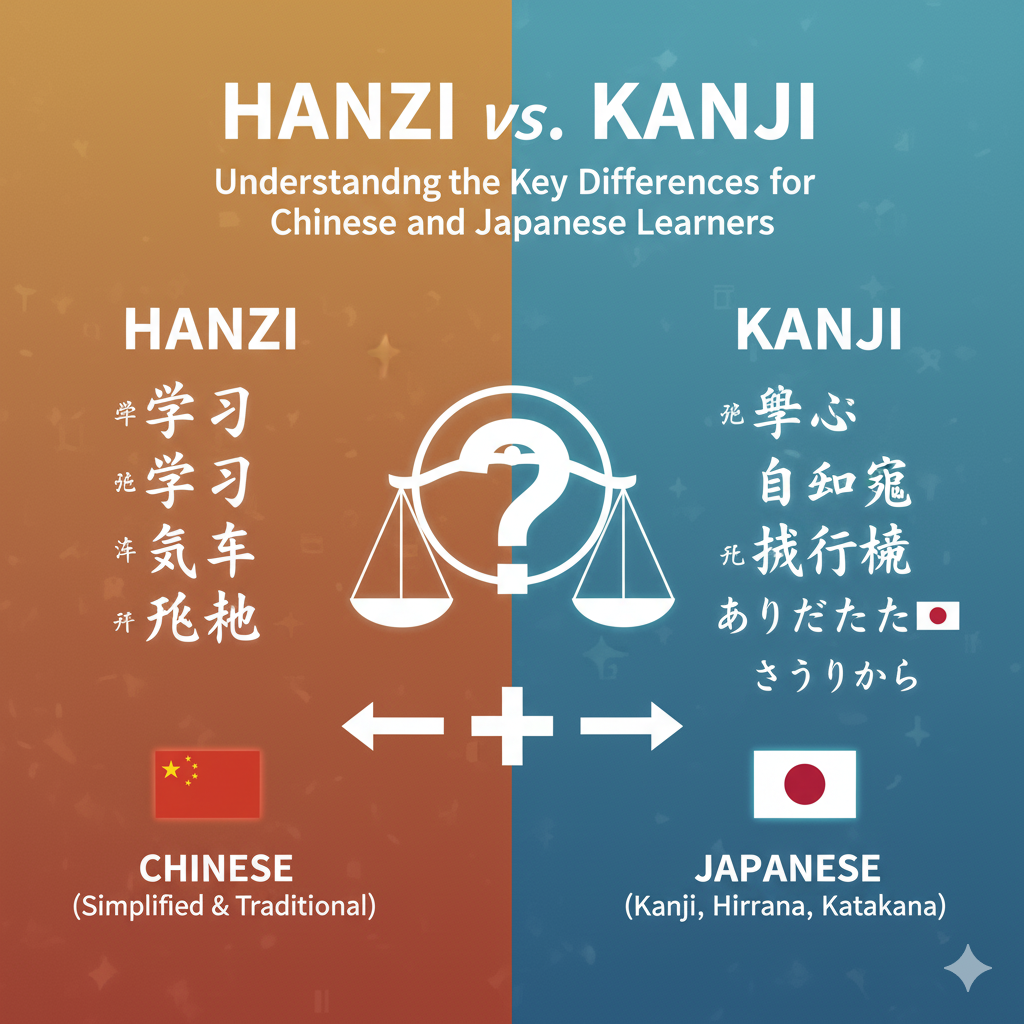
As a dedicated Japanese language expert and someone who’s spent years navigating the nuances of the JLPT (Japanese Language Proficiency Test), I can tell you that the confusion between Hanzi (漢字, simplified 汉字) in Chinese and Kanji (漢字) in Japanese is the single most common hurdle for bilingual East Asian learners.
You’re not alone if you’ve mistakenly tried to read a Japanese menu with your Mandarin knowledge or vice versa. The truth is, while they share a common ancestor, their evolution has created significant and crucial differences that, if understood, can dramatically speed up your learning journey. This post will serve as your definitive guide to separating the two, offering unique insights and practical applications to keep you on the right track.
🤯 The Core Identity: What Are Hanzi and Kanji, Anyway?
Before diving into the specifics of Hanzi vs. Kanji, let’s establish a foundational truth: both are descendants of the script developed in China thousands of years ago.
- Hanzi (Chinese Characters): The script used in Chinese (Mandarin, Cantonese, etc.). The name translates literally to “Han characters,” referencing the Han dynasty, which solidified the characters’ prominence.
- Kanji (Japanese Characters): The script used in Japanese. The name means “Han-era characters,” reflecting that they are characters borrowed from the Han-era Chinese script.
Think of it like this: they are linguistic cousins who grew up in separate countries. They share grandparents, but their local cultures (grammar, vocabulary, politics) have changed how they look, how they behave, and what clothes (or strokes!) they wear.
📝 Difference 1: The Great Simplification Divide (Form)
This is perhaps the most immediate and visible difference between Hanzi and Kanji. It boils down to Traditional vs. Simplified characters.
Chinese: Traditional, Simplified, and Mainland Policy
In Chinese, the concept of Hanzi vs. Kanji is complicated by the existence of two major character sets:
- Traditional Hanzi (繁體字 / 繁体字 – Fántǐzì): These are the original, complex forms of the characters. They are still predominantly used in Taiwan, Hong Kong, and Macau.
- Simplified Hanzi (简体字 / 簡體字 – Jiǎntǐzì): In the 1950s, the government in mainland China implemented a massive reform to promote literacy. They drastically reduced the stroke count of thousands of characters, creating the Simplified set.
When learning Mandarin in mainland China, you are learning Simplified Hanzi. If you are learning in Taiwan or Hong Kong, you are learning Traditional Hanzi.
Japanese: A Different Kind of Simplification (Shinjitai)
The Japanese also undertook character simplification, but it was entirely separate from the Chinese mainland’s efforts and occurred in the post-WWII era. The resulting set is called Shinjitai (新字体 – New Character Forms).
- The Key Insight: Japanese simplification was less drastic and less widespread than mainland Chinese simplification.
This means that for any given character:
- Scenario A: They look identical. Many characters remain unchanged across all three systems (Traditional Chinese, Simplified Chinese, and Japanese Shinjitai). Example: 人 (person), 月 (moon/month), 天 (sky).
- Scenario B: Japanese is closer to Traditional Chinese. In many cases, the Japanese Shinjitai is the same as the Chinese Traditional Hanzi, while the Chinese Simplified Hanzi is very different. Example:
- Traditional Chinese/Japanese: 國 (kuni / guó – country)
- Simplified Chinese: 国
- Scenario C: All three are different. This is where the real headaches begin! Example:
- Traditional Chinese: 龍 (lóng – dragon)
- Japanese Shinjitai: 竜 (ryū)
- Simplified Chinese: 龙
💡 Practical Application for Learners: If you are learning Japanese (Kanji), you will find it much easier to read Traditional Chinese than Simplified Chinese, as many Shinjitai characters share the same structure as Traditional Hanzi. If you learn Simplified Chinese, you will have to relearn the structure for many characters when studying Japanese.
🗣️ Difference 2: The Sound Barrier (Pronunciation)
The sounds associated with Hanzi vs. Kanji are perhaps the most definitive and non-negotiable difference.
Hanzi: One Character, One Consistent Reading (Mostly)
In Mandarin Chinese, a single Hanzi typically has one primary sound (or Pinyin reading) associated with it, although it can have multiple tones. While some characters have multiple readings depending on context (polyphony), this is the exception, not the rule.
- Example: 学 (xué – study/learn). It is always pronounced xué.
Kanji: The Multiple Reading Nightmare
Japanese Kanji are notorious for having multiple readings, a direct result of being adopted into an already existing language structure. This is the biggest hurdle for Japanese learners, especially those aiming for the JLPT.
Kanji readings are primarily divided into two categories:
- Onyomi (音読み – Chinese Reading): This reading is based on the original Chinese pronunciation at the time the character was imported (often between the 5th and 9th centuries). It is typically used when the Kanji is part of a compound word (like English prefixes/suffixes).
- Example: 学 is often read ガク (gaku) in compound words like 大学 (dai**gaku – university).
- Kunyomi (訓読み – Japanese Reading): This reading is a native Japanese word assigned to the character because the character represented that concept. It is typically used when the Kanji stands alone or is attached to Japanese grammatical elements (like okurigana).
- Example: 学 is often read まな.ぶ (mana.bu) as a verb, like 学ぶ (to learn).
💡 Practical Application for Learners (JLPT Insight): As a JLPT expert, I stress this: You must learn both the Onyomi and Kunyomi for every Kanji. The difficulty and frequency of different readings are heavily tested. Knowing only the meaning is insufficient.
🧩 Difference 3: The Grammatical Ecosystem (Usage)
This is the subtlest and, arguably, the most important difference between Hanzi vs. Kanji—how the characters interact with the rest of the language.
Hanzi: The Workhorse of Chinese
In Chinese, the characters (Hanzi) are essentially the only writing system. Every single syllable and morpheme is represented by a Hanzi. While Pinyin (the romanization system) is used for learning, all formal written Chinese is done entirely with characters.
- Role: Hanzi functions as the core, complete, and sole writing system.
Kanji: One-Third of the Japanese Trio
Japanese uses a unique combination of three scripts, making the role of Kanji distinct and limited:
- Kanji (漢字): Used primarily for lexical morphemes—the roots of nouns, verbs, and adjectives (e.g., kuni (country), tabe (to eat)).
- Hiragana (ひらがな): Used for grammatical function (verb endings, particles, adverbs, native Japanese words without a Kanji, and children’s books).
- Katakana (カタカナ): Used for loanwords (e.g., coffee – コーヒー (kōhī)) and for emphasis.
- Role: Kanji acts as a semantic signpost, distinguishing homophones and conveying core meaning, while Hiragana carries the grammatical load.
Example Comparison:
| English | Chinese (Hanzi Only) | Japanese (Kanji + Kana) |
| I eat bread. | 我吃面包。 (Wǒ chī miànbāo.) | 私はパンを食べます。 (Watashi wa pan o tabemasu.) |
Notice the Hiragana (は, を, ます) in the Japanese sentence. These grammatical markers are necessary and distinct from the Kanji (私, 食) and the Katakana (パン). This crucial difference means that a Hanzi learner trying to read Japanese will only get the noun/verb roots and miss all the grammar, while a Kanji learner will have the opposite challenge in Chinese.
🔄 Difference 4: Lexical Meaning and Vocabulary Shift
While many characters share an identical or similar meaning, a significant number have diverged dramatically over the centuries. This is known as false friends or semantic divergence.
Semantic Divergence Examples
This is where your Chinese knowledge can lead you astray in a Japanese context, and vice versa.
| Character | Traditional Chinese Meaning (Hanzi) | Japanese Meaning (Kanji) |
| 手紙 | Toilet paper | Letter (Correspondence) |
| 愛人 | Lover/Mistress (extramarital) | Spouse/Wife/Husband |
| 汽車 | Automobile/Car | Steam Locomotive/Train |
| 走 | To run | To walk (old meaning) / To run (modern usage, but context is key) |
| 湯 | Soup | Hot Water |
Imagine asking for a “letter” (手紙) in a mainland Chinese bathroom (meaning toilet paper)! These shifts are often the source of funny (and sometimes embarrassing) language mix-ups.
💡 Unique Insight: These semantic shifts often reflect cultural or historical differences in technology. For instance, the character for ‘car’ (車) in Chinese evolved with modern technology, while the Japanese term for the same concept is often the loanword 自動車 (jidōsha – automobile) or 車 (kuruma – car).
🗺️ Long-Term Learning Strategies: Bridging the Hanzi vs. Kanji Gap
For learners of both Chinese and Japanese, your shared character knowledge is a superpower—you just need the right framework to wield it.
Strategy 1: Focus on the Radicals and Components
Both systems use radicals (部首 – bùshǒu / bushu) as building blocks. Learning what these components mean and how they are written is the most efficient cross-system approach. For example, any character with the 氵 (water radical) will be related to water, liquids, or rivers (e.g., 河 – river, 海 – sea).
- Chinese Focus: Radicals primarily help with meaning and dictionary look-up.
- Japanese Focus (JLPT): Radicals are crucial for learning how to write the Kanji correctly and for understanding Kunyomi (native Japanese) compounds.
Strategy 2: Prioritize Pronunciation Separately
Never assume a Chinese reading will help you with the Japanese Onyomi, and vice versa. While they are historically linked, the phonetic shifts are too complex and inconsistent for a beginner to rely on. Treat the sound of the character in each language as a separate vocabulary item.
Strategy 3: Master the Top 100 Divergent Characters
Create a dedicated list of “false friends” like those in the table above. Actively drilling these will prevent embarrassing mistakes and reinforce the fact that, while the form is similar, the meaning in that specific context is different.
A Valuable Outbound Resource: For those serious about dissecting these forms, exploring the history of character transmission can be incredibly enlightening. I highly recommend checking out a resource that details the specific history of how different forms of characters evolved, such as the History of Chinese Characters and their Transmission to Japan. This kind of deeper understanding turns rote memorization into a logical study. You can find excellent academic resources on this topic. Click here to explore the historical evolution of Hanzi and Kanji
🇯🇵 Special Insight for the JLPT Candidate
If your primary goal is the Japanese Language Proficiency Test (JLPT), your understanding of Kanji must be laser-focused on the Japanese context:
- Focus on Stroke Order (The Kana Rule): The stroke order for Japanese Kanji is standardized (though similar to Chinese), but the presence of okurigana (the trailing Hiragana) is a unique feature. You must know which part is the Kanji and which part is the grammatical Kana.
- Jōyō Kanji: The Japanese Ministry of Education mandates a list of 2,136 Jōyō Kanji (常用漢字) for daily use. This should be your study target. The JLPT draws almost exclusively from this list.
Practical Application: If you are studying for the JLPT N4, for example, your focus isn’t just knowing the Kanji, but knowing the appropriate Onyomi for compound nouns and the appropriate Kunyomi when it acts as a verb root. You can find detailed resources on the required characters and their readings. For a reliable, comprehensive list of the Kanji needed for intermediate levels, particularly those starting to prepare for N3 or N2, a good resource is essential. Find your essential JLPT Kanji list here
🧐 The AI-Proof Learning Mindset
In the age of machine translation, understanding the subtle differences between Hanzi vs. Kanji is what separates a true learner from a casual user. A machine can translate 手紙 as “toilet paper” or “letter” based on which language it assumes, but you, the human learner, understand the context, the history, and the grammatical structure that makes that choice.
This human insight—the understanding that Japanese is a syllabic-logographic system while Chinese is a purely logographic system—is the key to mastering both languages. It’s a marathon, not a sprint, but every character you learn is an investment in two of the world’s most beautiful and influential languages.
Happy studying! Whether you’re writing a poem in Traditional Chinese or preparing for your next JLPT level, may your characters be clear and your readings accurate.
Outbound Link 3 Placeholder: For a broader perspective on East Asian languages and their shared scripts, including Korean’s historic use of Hanja (the Korean equivalent), a resource discussing the sinosphere’s influence is valuable. Learn more about the history and influence of the Sinosphere
🔗 For More Resources You Might Find Helpful
JLPT Preparation: How to Learn 15 Kanji Per Day with Component Study – JLPT Samurai
Beyond the Battlefield: Essential Japanese Vocabulary for Gaming and Anime Fans – JLPT Samurai
Kanji Spotlight: Why is Money (お金 – Okane) Written with the Gold Radical 金 – JLPT Samurai
The Ultimate Guide to Namae Kanji: How to Write and Read Japanese Names Correctly – JLPT Samurai