Ah, Duolingo. The ubiquitous green owl. It sits on countless phones, promises language fluency through quick, gamified lessons, and boasts impressive daily streaks. For many, it’s the gateway drug to the beautiful, complex world of Japanese. And for that, we owe it a nod.
But let’s be honest, for anyone past the initial curiosity phase—for the serious student, the one with an eye on the JLPT (Japanese-Language Proficiency Test) or the dream of genuinely living, working, or traveling in Japan—Duolingo can quickly start to feel like a pair of broken knees trying to climb Mount Fuji. It gets you to the base, but it simply lacks the structure and depth for the serious ascent.
As a Japanese language expert and someone who has guided countless students to success in the JLPT, I can tell you that the most common mistake beginners make is clinging to the belief that one app can do it all. The truth is, if you’re looking for a resource that truly builds a solid foundation, explains why grammar works, and prepares you for real-world complexity, you need a powerful Duolingo Japanese alternative.
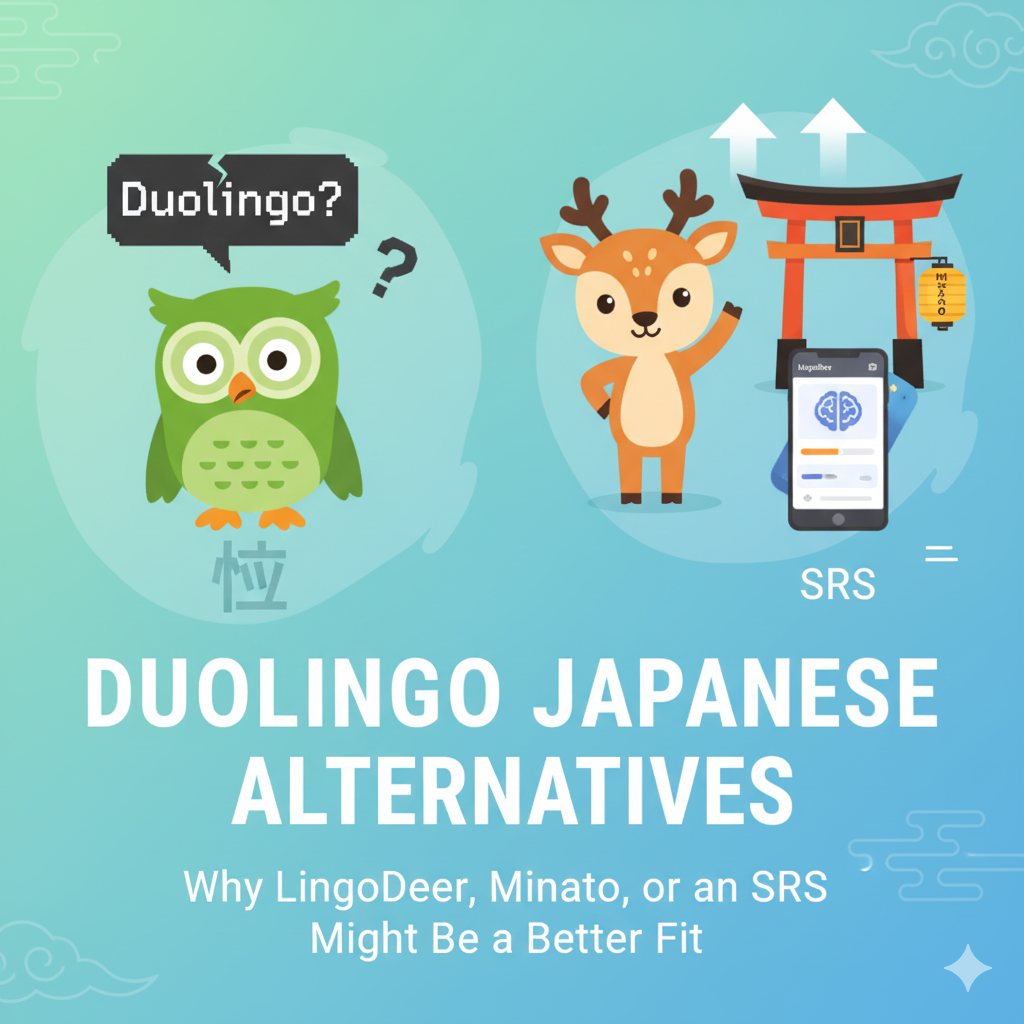
This comprehensive pillar post will dive deep into why Duolingo falls short for dedicated learners and present three rock-solid alternatives: LingoDeer, Minato, and the incredible power of a Spaced Repetition System (SRS).
1. The Duolingo Dilemma: Why the Green Owl Can’t Fly Solo
Before we look for a replacement, we need to understand the problem. Duolingo is designed for consistency and low-effort retention, not for in-depth mastery of a radically different language like Japanese. The very nature of Japanese—with its three scripts, complex particles, and demanding politeness levels (Keigo)—requires a structured approach that Duolingo’s “figure-it-out-yourself” method often fails to provide.
The Major Flaws in the Duolingo Japanese Course
| Flaw | Description for Serious Learners | Impact on Proficiency (JLPT/Fluency) |
| Lack of Grammar Explanation | Grammar is introduced implicitly, meaning you are expected to figure out the rules from sentence patterns. | Hinders deep understanding of particles and verb conjugations. Essential for passing JLPT N5/N4. |
| Ineffective SRS (Spaced Repetition) | The review system is often slow and prioritizes keeping the streak over effective, frequent recall of specific words/kanji. | Vocabulary and Kanji retention becomes shallow and unreliable. Leads to the frustrating feeling of “I know that word, but I can’t recall it.” |
| The “Tapped Answer” Trap | Forcing you to tap on word banks instead of producing the language yourself (typing or speaking). | Dramatically lowers productive skills (writing and speaking) and reading speed. You recognize, but you cannot recall. |
| Unnatural Sentences | Many sentences are machine-generated or focus on novelty (e.g., “The bear is eating a hat”) rather than practical, high-frequency conversation. | You learn quirky phrases that won’t help with genuine communication or real-world comprehension. |
| Kanji Deficiency | Kanji is introduced with vocabulary words but without a systematic, mnemonic-based learning system. | Your kanji foundation remains weak. You won’t be able to read authentic Japanese content or tackle the hundreds of characters required for N4/N3. |
If your goal is simply to learn a few phrases for a quick trip, Duolingo Japanese for travel can be an okay, low-stakes start. But if you’re asking how far does Duolingo Japanese take you, the answer is rarely past a shaky N5 level.
Expert Insight: The biggest failure of Duolingo for serious students isn’t what it teaches; it’s what it doesn’t teach—the grammatical logic. Japanese particles (は, が, を, に, で) are the glue of the language, and if you don’t receive clear, explicit explanations, you’ll be building your proficiency on a shaky foundation. This is why many experienced learners feel the need for a Duolingo Japanese alternative.
2. Alternative 1: LingoDeer – The Structured, Grammar-First App
If Duolingo is the playful, chaotic younger sibling, LingoDeer is the serious, organized older one. LingoDeer was explicitly designed to teach complex Asian languages—Japanese, Korean, and Mandarin—and it addresses nearly every structural flaw found in the Duolingo Japanese course.
Why LingoDeer is a Strong Duolingo Japanese Alternative
LingoDeer succeeds where Duolingo falters by focusing on structure, pedagogical soundness, and, critically, explicit grammar instruction.
✅ Strong Grammar Explanations
In LingoDeer, every new grammar point or particle is accompanied by a dedicated, easy-to-read “Tips” section before the lesson starts. These tips provide clear, concise explanations with multiple examples, often accompanied by cultural notes.
- Practical Application: Instead of guessing the difference between $A \text{は} B \text{です}$ and $B \text{が} \text{好きです}$, LingoDeer explicitly breaks down the topic-marking particle は (wa) and the subject-marking particle が (ga). This methodical approach is non-negotiable for students aiming for the JLPT.
✅ Systematic Approach to Kana and Kanji
LingoDeer starts with a focused module for learning Hiragana and Katakana. When Kanji is introduced, it is presented in a more organized way, often with readings (both Onyomi and Kunyomi) clearly marked. The vocabulary is generally much more practical and high-frequency than Duolingo’s often bizarre sentences.
✅ Better Review System and Exercise Variety
LingoDeer includes a dedicated “Review” mode, allowing you to specifically drill vocabulary, grammar, or kanji, or a mix of all three, using a system that feels more targeted than Duolingo’s blanket review units. Furthermore, the exercises go beyond simple translation, incorporating fill-in-the-blank, writing, and deeper comprehension tasks.
LingoDeer Quick Summary:
- Best For: Beginners to low-intermediate learners who thrive on structure and need clear, explicit grammar rules.
- Cost: Subscription-based (monthly, annual, or lifetime). A cost is involved, but the quality of the curriculum justifies the investment for serious students.
- Coverage: Excellent for the full spectrum of N5 and most of N4 grammar and vocabulary.
3. Alternative 2: Minato (The Japan Foundation’s E-Learning) – The Official, Free Resource
When we talk about official, reliable resources, few things beat the Japan Foundation. The Japan Foundation is the organization responsible for promoting Japanese culture and language worldwide, and they are the creators and administrators of the JLPT!
Minato is their online e-learning platform, and it is a phenomenal, though often overlooked, Duolingo Japanese alternative. It’s the ultimate resource for students who prioritize accuracy and an educationally sound curriculum.
Why Minato is the Gold Standard for Accuracy and Structure
Minato offers comprehensive, free, online courses based on the Japan Foundation’s own globally recognized textbooks, such as the Marugoto series.
✅ Pedigogical Integrity and Reliability
Since Minato is developed by the same body that sets the standard for the JLPT, the content’s accuracy, grammar progression, and cultural context are impeccable. There is absolutely no question about the quality of the Japanese you are learning.
- Link to Official Standards: Minato courses are often explicitly aligned with the CEFR (Common European Framework of Reference for Languages) and thus align well with the JLPT levels. This direct connection offers a clear path toward certified proficiency. To get a better sense of the official levels, you can check out The Verdict on Duolingo Japanese: Expert Review, JLPT Viability, and Top Alternatives [Pillar Post Link] for a deep dive into the CEFR and JLPT connection.
✅ A Focus on Practical Communication (The Marugoto Method)
The courses on Minato are designed with a communicative approach. This means the focus is not just on translating isolated sentences but on using the language in real-life situations. The lessons often incorporate listening and speaking practice centered around daily life topics, a stark contrast to the abstract nature of Duolingo’s drills.
✅ Completely Free
Minato offers full, comprehensive courses for free. While the platform isn’t as “flashy” or gamified as Duolingo or LingoDeer, the immense value of free, professionally vetted, high-quality content is unmatched.
Practical Application: I always recommend Minato’s free courses to my students who are struggling with basic conversational Japanese because it grounds the language in context. You aren’t just memorizing: you’re learning how to say things in a way that Japanese people actually do.
Minato Quick Summary:
- Best For: The budget-conscious, serious learner who prioritizes a university-level curriculum, accuracy, and clear connection to the JLPT/CEFR standards.
- Cost: Completely Free for many of its core courses.
- Coverage: Excellent for N5 and N4. Offers a clear and structured pathway into the higher intermediate levels.
4. Alternative 3: An SRS (Spaced Repetition System) – The Engine for Retention
If LingoDeer is the structured textbook and Minato is the qualified teacher, a dedicated Spaced Repetition System (SRS) is the high-performance memory engine that ties everything together. The most famous and powerful SRS is Anki.
Anki is not a course; it’s a customizable flashcard software that uses an algorithm to determine the optimal moment to show you a card again. The goal is to review material right before you forget it, making your study time incredibly efficient.
Why a Dedicated SRS is Crucial for Japanese
The sheer volume of vocabulary and Kanji required for Japanese proficiency is staggering. To reach a comfortable reading level (N3/N2), you need to learn thousands of words and over 1,000 Kanji. Duolingo’s built-in review system is simply too weak for this task.
This is why serious learners know that Why Duolingo Japanese Should Be Used with Anki: Maximizing Vocabulary and Retention [Cluster Post Anchor] is the key to unlocking progress.
✅ Maximizing Vocabulary and Kanji Retention
Anki’s algorithm, which implements the SRS principle, ensures that you spend minimal time on things you already know and maximal time on words that are on the verge of fading from memory.
- Unmatched Efficiency: Studies consistently show that SRS is the most effective method for long-term rote memorization of vocabulary and character sets. It’s what separates a student who remembers a word for a day from one who remembers it for a lifetime.
✅ Full Customization and Integration
With Anki, you are the master of your own study material. You can create your own flashcards based on textbooks, words you look up during reading, or grammar points from Minato/LingoDeer. You can also download high-quality, pre-made decks from the community, such as those tailored for the JLPT.
- Kanji Mastery: Anki is phenomenal for studying Kanji, allowing you to test yourself on the character, its readings, its vocabulary, and even its stroke order. This systematic approach is the only way to tackle the complexity of Japanese script, a task where Duolingo’s approach is often described as “toss it on the wall and see what sticks.”
Anki/SRS Quick Summary:
- Best For: Any serious learner who needs to master high-volume, long-term memorization (Kanji, Vocabulary, Verb Conjugations). It’s an essential supplement to any other core learning resource.
- Cost: Free for desktop and Android. Paid for iOS (but the purchase supports development).
- Coverage: Can cover all levels of the JLPT (N5 to N1) depending on the content of the decks you use.
Humanizing the Learning Curve: I remember the moment I started using Anki for Kanji. Before, learning new characters felt like trying to fill a bucket with a hole in it. The characters would just leak out of my memory. With Anki, I suddenly had a structured plan. It turned the monumental task of learning Kanji into a manageable, daily routine. It’s the most powerful tool in any serious Japanese learner’s arsenal.
5. The Question of Certification: JLPT Viability
For many, the ultimate metric of progress is passing the Japanese Language Proficiency Test (JLPT), which ranges from N5 (beginner) to N1 (native-level mastery). So, can Duolingo Japanese get you there?
The consensus from the language community and from my professional experience is clear: No, not by itself.
| JLPT Level | Duolingo’s Contribution | What You Actually Need (The Alternatives Provide) |
| N5 | Basic vocabulary and a loose grasp of sentence structure. | Clear grammar explanations (Minato/LingoDeer), dedicated Kanji study, and robust review (SRS). |
| N4 | Very little. The course tends to deviate from a structured N4 curriculum. | Explicit instruction on complex verb forms, compound particles, and a dedicated N4 vocabulary set. |
| N3 & Above | Almost nothing relevant. | Advanced grammar and vocabulary, high-volume reading practice, and sustained immersion. |
You might scrape by the N5 (the lowest level) using Duolingo, but it will be a shaky, fragile foundation. Is Duolingo Japanese good for beginners? The Ultimate 2025 Review and Reddit Opinions [Cluster Post Anchor] often highlights the frustration users feel when they hit the N4 wall and realize they lack the fundamental grammar knowledge taught by more structured resources.
If the JLPT is your goal, your primary resource must be structured around the grammar and vocabulary requirements for each level, which is why a Duolingo Japanese alternative like LingoDeer or Minato, paired with a memory engine like Anki, is the superior path.
6. Integrating the Alternatives: Your Comprehensive Study Plan
The best approach to learning Japanese is often a multi-pronged attack. Instead of looking for a single app to replace Duolingo, look to build a cohesive system.
Here is a simple, three-step blueprint for a much more effective Japanese study routine:
The Superior Japanese Study Flow (LingoDeer/Minato + SRS)
- Core Learning & Grammar: Use LingoDeer or Minato (or a traditional textbook like Genki) as your primary source.
- Action: Go through the structured lessons, making sure to read and understand the grammar explanations completely. This is the difference between Duolingo Japanese or broken knees—choosing solid ground over a wobbly platform.
- Vocabulary & Kanji Mastery: Use a dedicated SRS (Anki).
- Action: Immediately port any new vocabulary or kanji from your core lesson (LingoDeer/Minato) into your SRS deck. Review this deck daily. This ensures you’ll remember the words long after the lesson is finished.
- Immersion & Real-World Context: Supplement with real Japanese content.
- Action: Start with Graded Readers or resources designed for learners. As you progress, introduce native content. This is where you see the grammar you learned in Step 1 and the vocabulary you memorized in Step 2 being used naturally. You are now transitioning from learning for a game to learning for life.
7. Beyond the Apps: The Human Side of Japanese
Learning Japanese is not just about conjugating verbs and memorizing Kanji; it’s about connecting with a culture. The human touch—the context, the nuance, and the sheer joy of communicating—is lost when you focus solely on gamified drilling.
Learning from Native Speakers
Perhaps the most significant missing piece in the Duolingo experience is the opportunity for genuine, unscripted communication.
If you are serious, you must practice with native speakers. It’s the only way to truly master the subtleties of:
- Keigo (Polite Language): Duolingo touches on formality, but only a real person can correct your usage in a specific social context.
- Pitch Accent and Pronunciation: No app is better at correcting your pitch accent than a native speaker’s ear.
- Conversational Flow: Learning how to start a conversation, interrupt politely, or show agreement ($\text{はい}$, $\text{ええ}$, $\text{なるほど}$) only happens through interaction.
There are excellent online platforms for connecting with tutors and language exchange partners. I strongly encourage you to look at resources that allow you to practice what you’ve learned.
For those looking to bridge the gap between textbook knowledge and real-world fluency, I recommend exploring one of the world’s most popular platforms for finding affordable and reliable online Japanese tutors. Click here to Find a Japanese Language Tutor on Preply.
8. Final Verdict: Choose Your Own Path to Proficiency
Duolingo has its place as a brilliant tool for building a habit and providing a zero-pressure introduction to a new script. If the green owl is keeping you consistent, don’t ditch it entirely; just demote it from being your main teacher to being your daily warm-up.
But for the dedicated student—the one who truly wants to understand the grammar, pass the JLPT, and actually communicate in Japan—you must embrace a superior Duolingo Japanese alternative.
- For structure and paid quality, choose LingoDeer.
- For academic accuracy and a free, official curriculum, choose Minato.
- For unbeatable memory and high-volume retention, choose an SRS like Anki.
The path to Japanese proficiency is challenging, but it doesn’t have to be frustrating. By pairing a high-quality, structured course with a powerful review system, you can move past the limitations of simple apps and build the solid foundation you need for long-term success.
Ready to take your Japanese learning to the next level? Dive into our comprehensive guide on textbook learning, which is a key component of a high-achieving study plan. Explore the popular Genki Japanese Textbook Series on The Japan Times Store.
And for those who want to integrate media into their learning, finding high-quality Japanese podcasts is a game-changer for listening skills. Many language experts recommend the free, comprehensive listening and culture resources available at JapanesePod101.
🔗 Related Cluster Posts for a Deeper Dive
To fully optimize your Japanese learning strategy, explore these related topics in our comprehensive series:
- [Duolingo Japanese Accuracy: Is the Course Really Broken? (Analyzing Grammar and CEFR Levels)] — A detailed analysis of Duolingo’s grammatical shortcomings.
- [Why Duolingo Japanese Should Be Used with Anki: Maximizing Vocabulary and Retention] — A step-by-step guide to using a Spaced Repetition System with your current Duolingo study.
- [Is Duolingo Japanese Good for Beginners? The Ultimate 2025 Review and Reddit Opinions] — A look at the pros and cons for new learners and a breakdown of community sentiment.