If you’ve spent any time on LinkedIn or tech forums lately, you’ve seen the headlines: “AI is killing the translation industry.” As a Japanese language expert who has seen the transition from paper dictionaries to Neural Machine Translation (NMT), I’m here to tell you that those headlines are missing the “big picture”—especially when it pertains to the Japanese language.
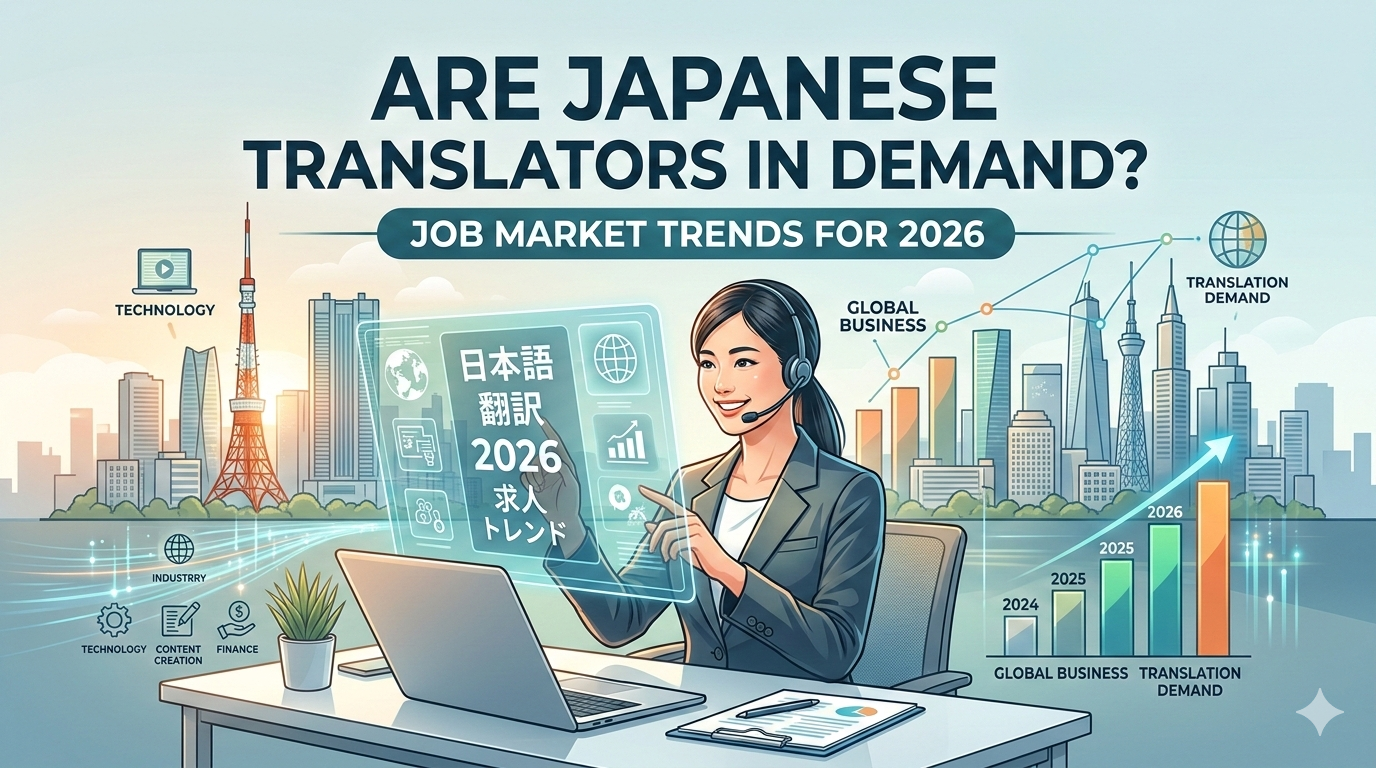
The question isn’t just “Are Japanese translators in demand?” but rather, “What kind of Japanese translators are in demand?”
As we move through 2026, the landscape has shifted. We are no longer just “translators”; we are cultural bridge-builders, subject matter experts, and AI-collaborators. Let’s dive deep into the reality of the Japanese translation job market this year.
The 2026 Reality Check: Is the Demand Real?
The short answer: Yes, the demand is higher than ever, but the requirements have become stricter.
In 2026, the global language services market is projected to reach nearly $30 billion. Japan remains the world’s fourth-largest economy, and its “soft power”—anime, gaming, and literature—is at an all-time high. However, the type of work has evolved.
1. The Death of “General” Translation
If your skill set is limited to translating simple emails or basic menus, 2026 is a tough year for you. Free tools like DeepL and Google Translate have mastered “surface-level” Japanese. Clients no longer want to pay a human for what a bot can do in seconds for free.
2. The Rise of the “Specialist”
The money and the demand have migrated to high-stakes sectors. According to recent market reports, the “Tier S” (Elite/Regulatory) sector for Japanese translation is seeing acute inflation. Why? Because a mistake in a pharmaceutical filing or a patent application could cost a company millions. Machines still struggle with the high-context, ambiguous nature of legal and medical Japanese.
Key Job Market Trends for 2026
To stay relevant, you need to align your career with these three dominant trends:
A. The “Post-Editing” Revolution (MTPE)
Over 60% of enterprise translation tasks are now handled via Machine Translation Post-Editing (MTPE). This means the AI does the first draft, and you—the human expert—fix the “hallucinations,” cultural gaffes, and politeness errors. In 2026, being “fast” is no longer a perk; it’s a requirement.
B. Hyper-Localization in Gaming and Media
Japan’s export of IP (Intellectual Property) is booming. From indie games on Steam to manga platforms, the demand for creative translation is soaring. This is a field where AI famously fails because it doesn’t “get” humor, slang, or the emotional weight of a character’s “ore” vs. “boku” pronoun choice.
C. The “Human-in-the-Loop” for AI Training
Ironically, the very AI that people fear is creating jobs. Companies are hiring Japanese language experts as “AI Trainers” or “Data Annotators.” They need humans to rate AI responses and ensure the machine understands the nuances of Keigo (honorifics).
How Much Can You Earn? (The 2026 Salary Map)
The salary for a Japanese translator in 2026 depends heavily on two things: your JLPT level and your Specialization.
| Level/Role | Entry-Level (N3/N2) | Mid-Level (N2/N1) | Expert (N1 + Specialization) |
| In-House (India) | ₹4L – ₹7L per annum | ₹10L – ₹18L per annum | ₹20L – ₹40L+ per annum |
| Freelance (Global) | $0.05 – $0.08 per word | $0.10 – $0.15 per word | $0.20 – $0.35+ per word |
| Specialized (Medical/Legal) | Rare | High Demand | Extreme Scarcity (Premium Rates) |
For a deeper dive into the financial side, check out our Japanese Translator Salary Guide 2026: Country‑by‑Country Income Comparison. Understanding the global market is key to negotiating your worth.
The JLPT Factor: Does It Still Matter in 2026?
As a JLPT expert, I often get asked: “Does a certificate matter if I can speak the language?”
In 2026, the answer is a resounding YES. With the influx of remote workers, the JLPT acts as a “trust filter.”
- JLPT N2 is the baseline for most corporate bilingual roles.
- JLPT N1 is the “gold standard” for professional translators and interpreters.
Companies like The Japan Foundation continue to set the benchmark for proficiency. Without a certificate, your resume often won’t even pass the initial AI screening bots used by HR departments.
Practical Insights: How to Thrive as a Japanese Translator Today
If you want to be in the top 10% of earners, you need to move beyond just “knowing Japanese.” Here is my “Pro-Expert” checklist for 2026:
- Master the Tools: Don’t fight AI; use it. Learn CAT (Computer-Assisted Translation) tools like Trados or MemoQ. In 2026, efficiency is your currency.
- Pick a Niche: Are you a “Medical Japanese” expert? A “FinTech” guru? Or a “Cybersecurity” translator? The more specific you are, the higher your rate.
- Humanize Your Work: Machines provide “meaning,” but humans provide “intent.” Focus on the why behind the text.
- Network in the Right Circles: Platforms like ProZ.com remain the watering hole for professional linguists looking for high-quality agency work.
Career Pathing: From Beginner to Pro
If you are just starting, the path might feel daunting. Don’t worry—everyone starts at “Arigatou.”
- Step 1: Get your N3/N2. You cannot skip the fundamentals.
- Step 2: Understand the money. Read How Much Do English–Japanese Translators Make? Career Map for Beginners to set realistic expectations.
- Step 3: Scale your skills. Learn how different factors like location and experience change your paycheck in What Influences Japanese Translator Pay? Skills, JLPT Levels & Experience.
Final Thoughts: The Human Edge
The Japanese language is unique because it is “high-context.” A single sentence can change meaning entirely based on who is speaking, their age, their social status, and the setting. This is why, despite the rapid advancement of AI in 2026, the “human” Japanese translator is not going anywhere.
We aren’t just replacing words; we are translating cultures. If you can master the bridge between the Japanese kokoro (heart) and the target language, you will always be in demand.