If you’ve reached the level of JLPT N2, you’ve likely realized that the “brute force” method of writing characters a thousand times in a notebook just doesn’t scale anymore. To pass N2, you need to master roughly 1,000 Kanji. This is the “intermediate ceiling”—the point where many students lose momentum because the characters become more abstract and the readings become more nuanced.
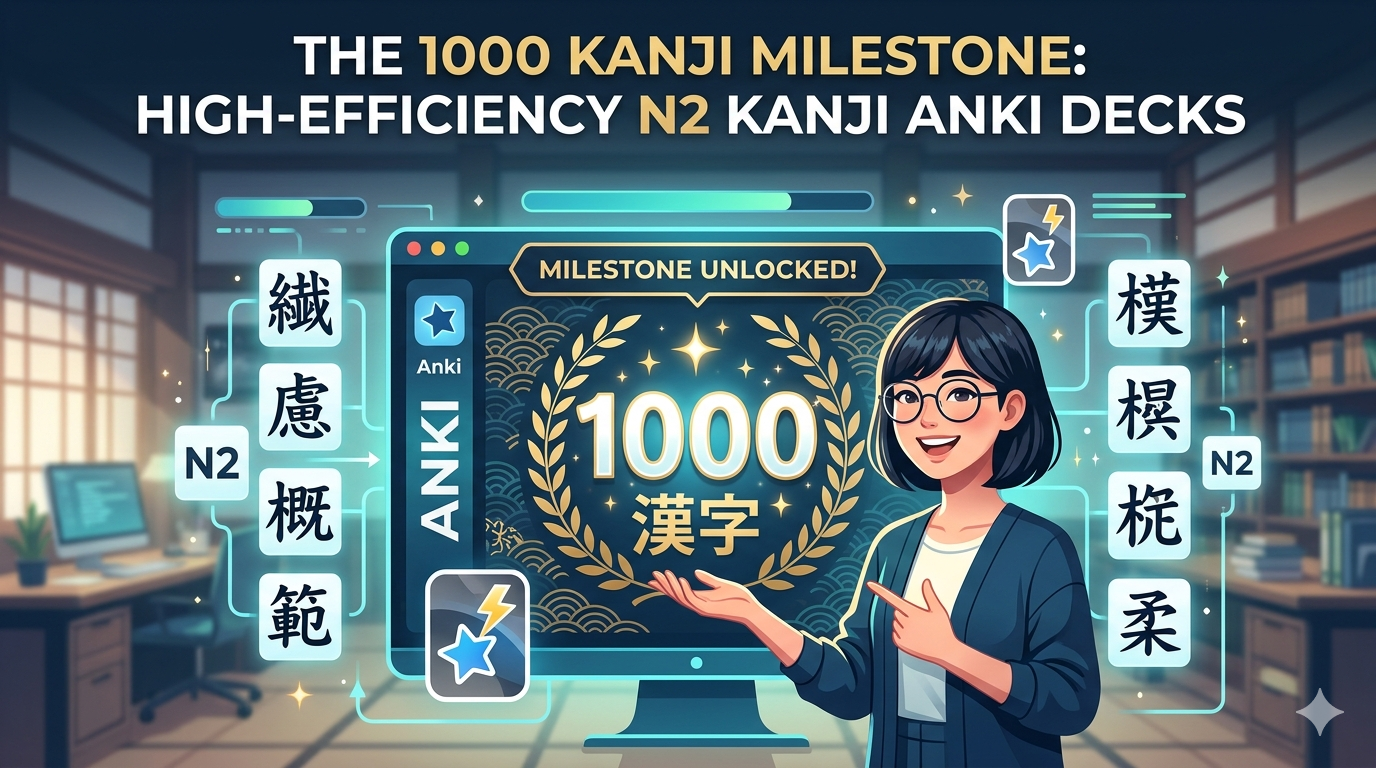
But here is the truth: reaching the 1,000 Kanji milestone isn’t about working harder; it’s about working smarter. By utilizing a high-efficiency Anki (Spaced Repetition System) strategy, you can internalize these characters so deeply that they become second nature.
In this guide, we are going to dive into how to build the ultimate N2 Kanji deck and how this fits into our broader strategy of Professional Japanese: Mastering the JLPT N2 with Advanced SRS.
Why 1,000 Kanji is the Magic Number
The JLPT N2 is the gateway to working in Japan. It covers approximately 1,000 Kanji (including the 600 from N3/N4/N5). These 1,000 characters account for over 90% of the text you will see in a standard Japanese newspaper.
Once you hit this milestone, you stop “studying” Japanese and start “using” it. However, the N2 Kanji are tricky. They often involve:
- Abstract Concepts: Moving from concrete nouns (like “Tree” or “Car”) to abstract ideas (like “Infrastructure” or “Logistics”).
- Complex Components: Kanji with 12+ strokes that look like a mess of ink if you don’t know the radicals.
- Nuanced Readings: Knowing when to use the On-yomi vs. the Kun-yomi in formal compounds.
Building the “High-Efficiency” Anki Deck
Not all Anki decks are created equal. If your cards only have a Kanji on the front and a meaning on the back, you are setting yourself up for failure. To reach the N2 milestone, your cards need depth.
1. The Anatomy of a Perfect N2 Kanji Card
A high-efficiency card should include:
- Front: The Kanji in a target word (e.g., 把握 – haaku).
- Back: The reading (はあく), the meaning (Grasp/Understand), and a Sentence Example.
- The Component Breakdown: List the radicals (e.g., 手/扌 for “hand”).
2. Focus on “Vocabulary-First” Kanji Learning
One of the biggest mistakes is learning Kanji in isolation. In the N2 exam, you aren’t tested on how many meanings a single character has; you are tested on how it functions within a word.
Instead of learning 議 (Consultation) alone, learn 会議 (Meeting), 議長 (Chairman), and 不思議 (Mysterious). This creates a semantic web in your brain that makes recall significantly faster.
Advanced Strategies for N2 Retention
Radical Decomposition
At the N2 level, you must stop seeing Kanji as a collection of strokes and start seeing them as a collection of Radicals.
For example, the Kanji 範 (Example/Model) looks complex. But if you see it as Bamboo (竹) + Car (車) + Rule (卩), it becomes a story.
“A Car following the Rules on a Bamboo road is the perfect Model of safety.”
For a deep dive into how radicals function, the WaniKani Radical Guide is an excellent resource for creating these “stories” or mnemonics.
The “Context Mining” Method
To make your Anki deck truly human and relevant to your goals, you should add cards from things you actually read. If you see a Kanji in a news report about the economy, add it! This is where you bridge the gap between Kanji and Formal Nuance: How to Memorize N2 Grammar Patterns using Anki.
Practical Application: The 80/20 Rule
You don’t need to know every single rare reading for every Kanji. Focus on the Joyo Kanji—the characters used in daily life.
| Kanji | N2 Word | Meaning | Formal Nuance |
| 籍 | 戸籍 (Koseki) | Family Registry | Administrative/Legal |
| 概 | 概要 (Gaiyou) | Outline/Summary | Business/Academic |
| 拠 | 根拠 (Konkyo) | Basis/Evidence | Logical/Argumentative |
By focusing on these high-frequency words, you prepare yourself for both the exam and the Japanese workplace. For those looking for a pre-made list of these essential characters, the Official JLPT Kanji List provides the necessary benchmarks for each level.
Overcoming the “Anki Slump”
We’ve all been there: you open Anki, see 300 reviews, and close the app. To reach the 1,000 Kanji milestone, you have to manage your “Leaches” (cards you consistently get wrong).
The 3-Strike Rule:
If you miss a Kanji card three times in one session, suspend it. Don’t let it drain your energy. Go back to a resource like the Jisho Dictionary, look up more example sentences for that Kanji, and recreate the card with a better mnemonic. Sometimes a fresh perspective is all your brain needs to make the connection.
Summary: Your Path to N2 Mastery
Reaching the 1,000 Kanji milestone is a monumental achievement in any language learner’s journey. It signifies that you are no longer a beginner; you are an intermediate learner standing on the doorstep of fluency.
By using high-efficiency Anki decks that prioritize vocabulary, radicals, and context, you ensure that your study time is effective. Remember, the goal isn’t just to pass a test—it’s to gain the ability to navigate Japanese society with confidence.
Once you have your Kanji foundation solid, you’ll find that complex structures become much easier to digest. Your next step should be mastering the subtle “feeling” of the language in our guide on Formal Nuance: How to Memorize N2 Grammar Patterns using Anki.