If the JLPT were a video game, N1 would be that hidden, overpowered final boss that requires not just high stats, but a completely different strategy to defeat. Many learners sail through N5 to N2 using standard textbooks, only to find themselves completely blindsided by the sheer volume and obscurity of N1 content.
At the N1 level, you aren’t just learning “more” Japanese; you are learning Academic, Literary, and Professional Japanese. You are moving away from daily conversations and into the realm of philosophy, technical manuals, and high-level editorials. To survive this transition, your study methods must evolve. This is where specialized Anki decks become your most powerful weapon.
In this pillar guide, we will explore the architecture of a successful N1 study plan, how to optimize your SRS workflow, and why generic decks often fail at this elite level.
Why N1 is the “Final Boss” of Language Proficiency
The jump from N2 to N1 is often described as a chasm. While N2 proves you can function in a Japanese workplace, N1 proves you can think, debate, and analyze in Japanese at a native-like level.
The Volume Challenge
- Vocabulary: You need roughly 10,000 words. Many of these are abstract “Sino-Japanese” words (Kango) that rarely appear in casual anime or drama.
- Kanji: You must master the full set of 2,136 Jōyō Kanji, including obscure readings used only in formal contexts.
- Grammar: N1 grammar isn’t just “harder”—it’s archaic. You will encounter structures that many younger Japanese natives rarely use but are essential for reading a newspaper like the Asahi Shimbun.
To manage this mountain of data, you cannot rely on memory alone. You need a system that tracks your forgetting curve with mathematical precision.
Building Your N1 Arsenal: Specialized Anki Decks
A standard “N1 Vocab List” deck is a good start, but it won’t get you over the finish line. To pass the JLPT N1, you need a multi-pronged approach. Here are the three specialized pillars of N1 Anki mastery:
1. Abstract & Academic Vocabulary
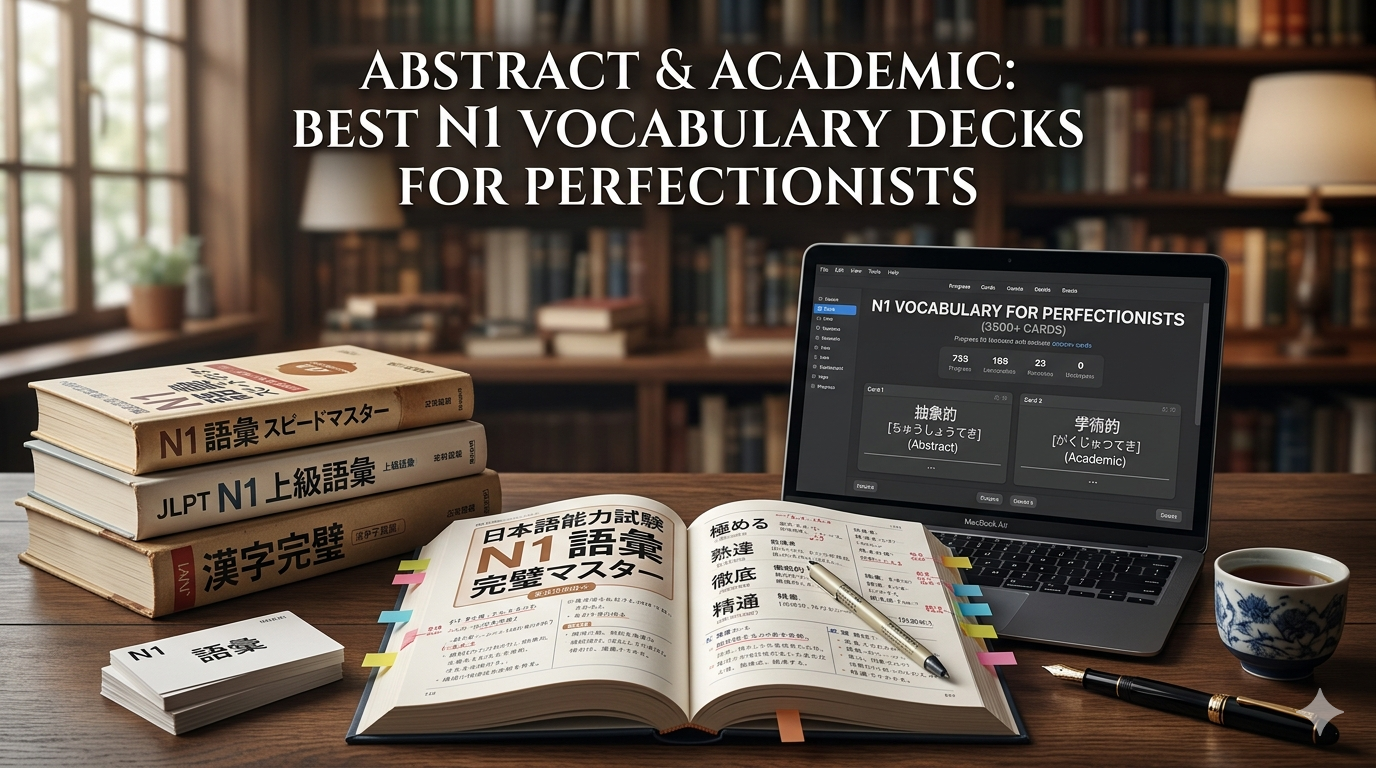
N1 vocabulary is heavily weighted toward concepts like “stagnation,” “proliferation,” and “reconciliation.” If your Anki cards only provide a one-word English translation, you’ll lose the nuance. Your decks should focus on Abstract & Academic: Best N1 Vocabulary Decks for Perfectionists to ensure you understand how these words interact with formal Japanese particles.
2. The Literary & Archaic Grammar Deck
N1 grammar often feels more like “Classical Japanese Lite.” Patterns like ~だに (even just…) or ~まじき (should not…) require high-quality example sentences. We recommend focusing on Literary Excellence: Mastering N1 Grammar & Formal Structures to separate the “written-only” patterns from the “spoken” ones.
3. Comprehensive Jōyō Kanji Mastery
By the time you reach N1, you should stop learning Kanji as individual symbols and start learning them as parts of complex systems. Using Jōyō Kanji Mastery: The Best Anki Decks for the Full N1 Kanji List allows you to focus on components and radicals, which is essential for guessing the meaning of words you’ve never seen before during the exam.
The “Sentence Mining” Revolution
One of the most human ways to study for N1—and prevent “Anki Burnout”—is through Sentence Mining. Instead of downloading a pre-made deck of 3,000 words you don’t care about, you create cards from content that interests you.
If you are reading an editorial on the Nikkei and see a word like 寡占 (kasen – Oligopoly), you “mine” that sentence.
- Front: The sentence containing the word.
- Back: The reading, definition (in Japanese, if possible), and a personal note on where you found it.
This makes the card “sticky.” Your brain remembers the context of the Nikkei article, which makes the word much easier to recall than a dry list in a textbook.
Practical Application: The 15-Minute Rule
The secret to defeating the “Final Boss” isn’t pulling all-nighters; it’s consistency. For N1, the sheer number of reviews in Anki can be terrifying.
The Strategy:
- Morning Burst (15 mins): Do your “Old Reviews” first thing in the morning. Your brain is fresh, and getting them out of the way prevents the “Review Mountain” from growing.
- Evening New Cards (10 mins): Add only 5-10 new cards a day. At the N1 level, quality beats quantity.
- Active Immersion: Spend at least 30 minutes reading real Japanese (not textbooks). If you see a card you just studied in a real article, it moves from “short-term” to “permanent” memory instantly.
Unique Insights: The “Monolingual Transition”
The single biggest tip for passing N1 is to ditch the English translations. If you are still using English on the back of your Anki cards, you are slowing down your processing speed.
At the N1 level, use Japanese-to-Japanese (J-J) definitions. This forces you to stay in the “Japanese mindset.” If you look up a word and the definition contains another word you don’t know, that’s a signal that you have a gap to fill. This “nesting” of knowledge is how you truly master The Final Boss: Passing JLPT N1 Using Specialized Anki Decks.
Conclusion: Beyond the Certificate
Passing the N1 is a massive achievement, but remember that Anki is just a tool to get you there. The real prize isn’t the piece of paper; it’s the ability to pick up any Japanese book, watch any news broadcast, or engage in any high-level discussion without feeling lost.
By using specialized decks for vocabulary, grammar, and Kanji, and by humanizing your study through sentence mining and J-J definitions, you turn a daunting task into a manageable daily routine.