JLPT Level Needed to Study in Japan (N5–N1 Explained)
When prospective international students ask me, “What Japanese proficiency level do I need to study in Japan?”, they often expect a simple answer like “N2” or “N3.” In reality, the required JLPT level for studying in Japan depends entirely on the type of institution you plan to attend, the language of instruction, and whether you are meeting immigration entry requirements or academic classroom survival needs.
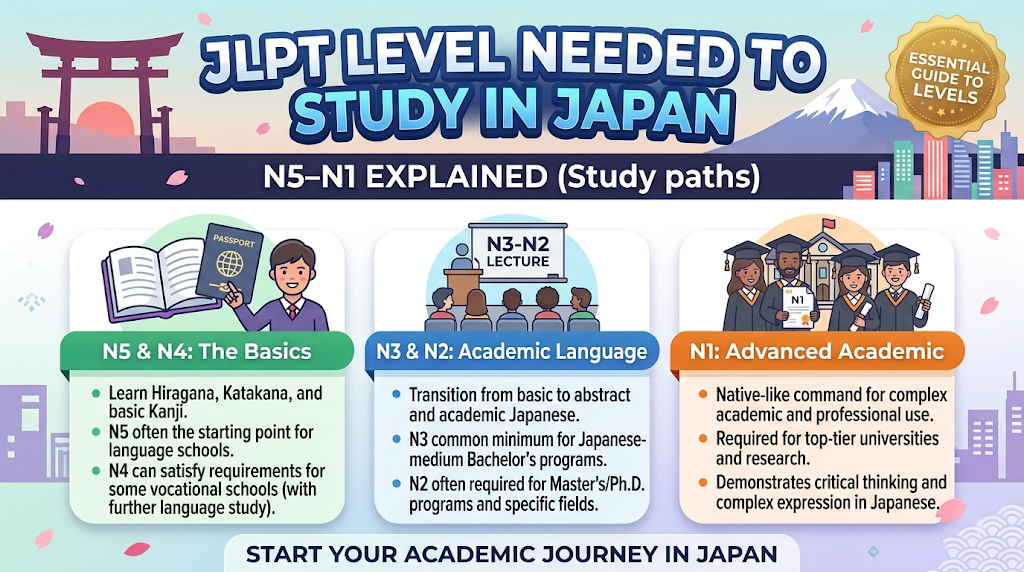
The Japanese Language Proficiency Test (JLPT) is divided into five levels, ranging from N5 (beginner) to N1 (advanced). Understanding how these levels map to Japanese language schools, vocational colleges (Senmon Gakko), undergraduate programs, and graduate schools is critical for planning your academic journey without running into visa rejections or academic burnout.
Here is a comprehensive breakdown from a Japanese language and higher education perspective on what each JLPT level actually equips you for, what admissions committees look for, and how to bridge the gap between passing a multiple-choice exam and succeeding in a Japanese classroom.
At a Glance: JLPT Levels vs. Study Pathways in Japan
| JLPT Level | Target Academic Pathway | Estimated Study Hours | Key Functional Capability |
| N5 | Language Schools (Immigration Baseline) | 150–200 hours | Basic greetings, hiragana, katakana, elementary kanji (~100). |
| N4 | Advanced Language School Placement | 300–400 hours | Elementary conversation, everyday basic reading, standard daily life tasks. |
| N3 | Vocational Schools (Senmon Gakko), Select Colleges | 450–650 hours | Everyday intermediate fluency, basic technical lectures, trade school prep. |
| N2 | Universities (Undergraduate), Specialized Colleges | 1,150–1,600 hours | Business & academic Japanese, full university lectures, news articles. |
| N1 | Top-Tier Universities, Graduate Schools, Law & Humanities | 1,800–2,500+ hours | High-level academic literature, research defenses, nuanced formal debate. |
JLPT N5: The Student Visa & Language School Baseline
JLPT N5 represents the foundation of the Japanese language. You understand basic expressions, master Hiragana and Katakana, and recognize approximately 100 simple Kanji alongside 800 vocabulary words.
Is N5 Enough to Study Degree Programs?
No. JLPT N5 is far below the threshold for academic coursework in Japanese. You cannot enroll directly into a Japanese university, junior college, or vocational school with an N5 certificate.
Where N5 Actually Works
N5 is primarily used to satisfy immigration entry requirements for students entering Japanese language institutes (Nihongo Gakko).
When applying for a student visa to attend a language school in Japan, the Immigration Services Agency requires proof that you have either passed the JLPT N5 (or an equivalent exam like NAT-TEST Level 5) or completed at least 150 hours of formal Japanese language instruction at a recognized institution.
Understanding the Student Visa Language Requirements for Japan is essential before applying, as failing to provide proof of basic proficiency (N5 or 150 hours) is one of the most common reasons for certificate of eligibility (COE) delays or rejections. Official guidance on visa documentation and living guidelines can also be reviewed directly through the JASSO Study in Japan Portal.
Expert Practical Advice: Do not view N5 as an academic milestone—view it as your entry ticket to step foot in Japan. Once you arrive at a language school with N5, you will typically be placed in beginner tracks where you study 4 to 5 hours daily to reach N2 within 1.5 to 2 years.
JLPT N4: Elementary Fluency & Daily Life Navigation
JLPT N4 builds upon basic grammar structures and expands your vocabulary to around 1,500 words and 300 Kanji. At this level, you can comprehend slow, clear conversations about daily routines and read basic passages on familiar topics.
Is N4 Enough for Academic Study?
Similar to N5, N4 is insufficient for academic programs taught in Japanese. However, holding an N4 certificate gives you a significant head start when entering a Japanese language school.
Why N4 Matters for Your Study Plan
- Higher Language School Placement: Arriving in Japan with N4 allows you to skip absolute beginner classes, saving you 3 to 6 months of tuition and living expenses.
- Part-Time Work (Arubaito): Students holding an N4 level can often secure entry-level part-time jobs in kitchen staff positions, cleaning services, or sorting facilities that require minimal customer interaction.
- Faster Track to University: Starting at N4 puts you on a realistic path to reach N2 within 12 to 18 months of intensive study in Japan.
JLPT N3: The Vocational School & Technical Pathway
JLPT N3 acts as the bridge between elementary Japanese and advanced academic Japanese. It covers roughly 650 Kanji and 3,700 vocabulary words. At N3, you can read articles about everyday topics with assistance and grasp the main points of spoken Japanese at near-normal speeds.
Can You Study at Japanese Institutions with N3?
Yes, but with specific limitations.
- Vocational Schools (Senmon Gakko): While most vocational schools officially prefer JLPT N2, a growing number accept N3 applicants—provided the student passes an internal Japanese language entrance exam and interview. Trades like culinary arts, hospitality, automotive repair, caregiving (Kaigo), and graphic design frequently consider strong N3 candidates.
- English-Medium University Programs: If you are enrolling in an English-taught degree program (such as those under the Super Global University initiative), your academic coursework is conducted in English. However, having N3 is the sweet spot for comfortably managing student life, communicating with campus staff, and securing internships in Japan.
If you are exploring financial assistance, keep in mind that several private funding organizations offer Scholarships in Japan That Accept JLPT Scores at the N3 or N2 level, particularly for vocational training and exchange programs.
JLPT N2: The Standard Benchmark for Japanese Universities
JLPT N2 is the single most important milestone for international students aiming to pursue higher education in Japan. It requires knowledge of around 1,000 Kanji and 6,000 vocabulary items. Passing N2 indicates that you can understand Japanese used in everyday situations and in a variety of deeper, more complex contexts.
       [ N5 / N4 ] ---------> Student Visa & Language School Entry
            |
            v
         [ N3 ] ------------> Vocational Schools & English-Medium Degrees
            |
            v
         [ N2 ] ------------> Undergraduate Degrees & Specialized Colleges
            |
            v
         [ N1 ] ------------> Elite Universities, Post-Grad & Humanities
Why N2 is the Golden Standard
For the vast majority of Japanese-medium undergraduate degree programs, private universities, and technical colleges, JLPT N2 is the minimum official requirement for admission.
When reviewing the broader landscape of Study in Japan with JLPT: Universities, Admission & Requirements, you will find that N2 proves to admissions officers that you can:
- Follow lectures delivered in natural-speed Japanese.
- Read academic textbooks and reference materials.
- Write basic essays (Sakubun) and exam responses.
- Participate in seminar discussions (Zemi).
The Distinction Between JLPT N2 and the EJU
While N2 is widely recognized, many prestigious national and public universities do not rely solely on the JLPT. Instead, they require the Examination for Japanese University Admission for International Students (EJU).
To learn more about specific institutional expectations and how testing requirements vary across colleges, consult our dedicated guide on JLPT Required for Japanese University Admission.
Key Difference:
- JLPT N2 tests passive comprehension (reading and listening multiple-choice).
- EJU Japanese tests active academic skills, including a timed 30-minute essay section (記述 – Kijutsu), complex reading comprehension under tight time constraints, and academic listening.
Expert Insight: If your target university accepts either JLPT N2 or EJU, the JLPT is generally easier to pass because it lacks a written writing component. However, preparing for the EJU will make you far better equipped for actual university lectures.
JLPT N1: Advanced Academic Mastery & Graduate Research
JLPT N1 is the highest level of Japanese language proficiency, encompassing over 2,000 Kanji and 10,000+ vocabulary items. It requires an understanding of abstract, highly nuanced, and formal language used in academic papers, editorials, and specialized literature.
Who Needs JLPT N1?
While N2 gets your foot in the door at most universities, N1 is strongly recommended or strictly required for the following pathways:
- Top-Tier National Universities: Institutions such as the University of Tokyo, Kyoto University, Osaka University, and Waseda University frequently require N1 (or top-tier EJU scores) for humanities, law, economics, and literature faculties.
- Graduate Schools (Master’s and PhD Programs): Conducting original research, writing a thesis in Japanese (Ronbun), and defending it before a faculty committee demands the linguistic precision of N1.
- Medical, Legal, and Pharmaceutical Studies: Professional degree tracks require comprehensive command of specialized jargon and high-level formal Japanese (Keigo).
Additionally, applicants targeting government-backed funding like MEXT should review the JLPT for MEXT Scholarship: Eligibility Guide. While MEXT provides intensive language training for undergraduate scholars upon arrival, having an N1 or N2 prior to applying drastically strengthens your candidacy during embassy recommendations and university placements. Official test guidelines and sample questions can be evaluated on the Official JLPT Website.
The Hidden Classroom Gap: JLPT Score vs. Real-World Ability
One critical reality that many international students overlook is that passing the JLPT does not automatically mean you are ready for a Japanese classroom.
The JLPT is a 100% multiple-choice test. It does not evaluate:
- Speaking ability (oral presentations, seminar debates).
- Writing ability (handwritten Kanji essays, research papers).
- Interactive listening (asking clarifying questions during a fast-paced lecture).
   JLPT Evaluation Domain              Actual Classroom Demands
+--------------------------+        +--------------------------+
|  Multiple-Choice Reading |        |  Handwritten Essays      |
|  Multiple-Choice Listening|  VS    |  Oral Presentations      |
|  Grammar Recognition     |        |  Seminar Discussions     |
|  Vocabulary Matching     |        |  Academic Thesis Defense |
+--------------------------+        +--------------------------+
Common Student Traps and How to Avoid Them
- The “Kanji-Heavy” Fallacy:Students from Kanji-using backgrounds (such as China or Taiwan) often pass JLPT N2 or N1 quickly due to superior reading comprehension. However, they may struggle with speaking and listening comprehension during university group work.
- The Listening Trap:Phonetically comfortable speakers may pass N3 or N2 listening easily, but struggle with reading dense academic texts under tight deadlines.
- The Essay Shock:In your first semester at a Japanese university, you will be asked to write 2,000-word term papers (Reporto). The JLPT never prepares you to structure arguments using academic formatting (Dewa arimasu / Da style) or cite Japanese sources properly.
How to Prepare Beyond the Exam:
- Practice writing short essays (Sakubun) by hand on manuscript paper (Genko Yoshi).
- Read Japanese newspapers like Asahi Shimbun or Nihon Keizai Shimbun daily to get used to formal prose.
- Practice speaking Japanese aloud using shadowing techniques to build natural conversational speed and confidence.
Recommended Timeline: From Zero to University-Ready
If you are starting from scratch and aiming to enroll in a Japanese-taught university program, here is a realistic, step-by-step preparation schedule:
Step 1: Home Country Preparation (Months 1–12)
- Goal: Reach JLPT N4 or N3 before leaving for Japan.
- Focus: Master Hiragana, Katakana, basic grammar (Minna no Nihongo or Genki I & II), and 300–600 Kanji.
- Outcome: Secure your student visa easily and place into intermediate language classes upon arrival.
Step 2: Language School in Japan (Months 13–24)
- Goal: Advance from N3 to JLPT N2/N1.
- Focus: Daily 4-hour intensive classes, exam prep for JLPT/EJU, essay writing practice, and university interview prep.
- Outcome: Pass JLPT N2 in your July or December exam session during your first year in Japan.
Step 3: University Application & Entrance Exams (Months 20–24)
- Goal: Submit university applications, sit for internal exams, and complete admissions interviews.
- Focus: Tailoring your Statement of Purpose (Shiyuushoshyo), practicing past university entrance papers, and completing mock interviews in Japanese.
Final Checklist: What JLPT Level Do You Need?
Before submitting your applications or booking your test date on the official MEXT Official Website or local test center portals, use this checklist to confirm your target level:
- Attending a Language School? Target N5 (or 150 study hours) for visa approval.
- Entering a Vocational School (Senmon Gakko)? Target N3 to N2.
- Applying to Undergraduate University Programs? Target N2 (or EJU equivalent).
- Applying to Graduate School or Elite Universities? Target N1.
- Enrolling in an English-Medium Degree Program? Target N3 for daily life, part-time jobs, and networking.
Determining the right JLPT level for studying in Japan comes down to matching your personal academic timeline with the realistic demands of Japanese higher education. Start early, build balanced skills across reading, writing, listening, and speaking, and use the JLPT as a stepping stone toward true academic fluency.