Every year, thousands of Japanese language learners register for the Official JLPT Website. They buy heavy stacks of Shin Kanzen Master books, print hundreds of Anki decks, and brace themselves for months of grueling drill sessions. But over the last two years, a major shift occurred across study groups and forums: students are relying on Large Language Models (LLMs) like ChatGPT, Claude, and specialized language apps as their primary study companions.
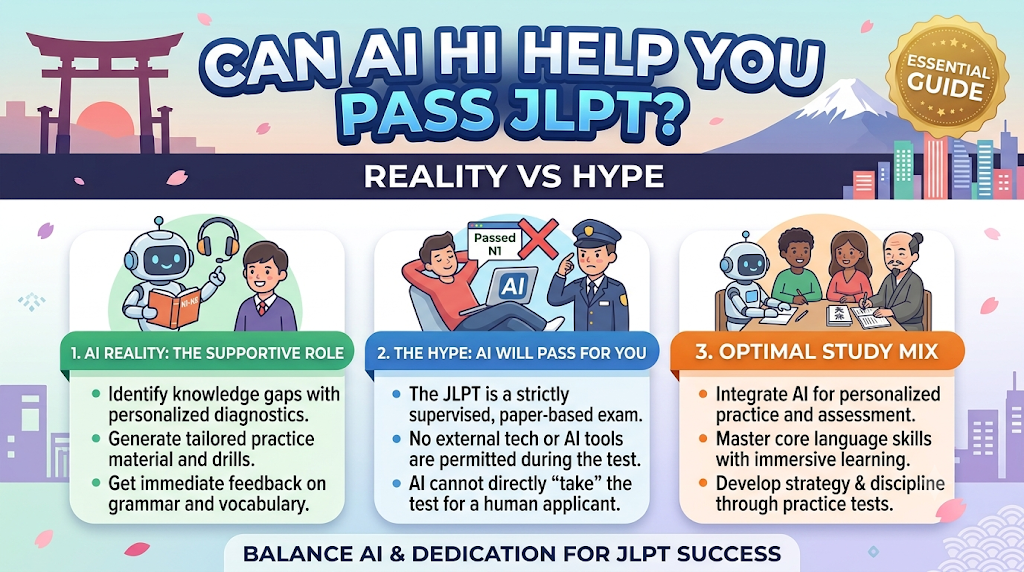
Prompts promise that AI will serve as a 24/7 native Japanese tutor, grading essays, dissecting trick grammar points, and generating endless reading comprehension passages tailored to your exact weaknesses.
Is AI the ultimate shortcut to clearing N3, N2, or N1, or is it an overhyped hallucination machine that risks messing up your grammar right before exam day?
Having worked with hundreds of Japanese learners—and tested modern AI models on actual JLPT test sets—here is an honest, hype-free breakdown of where AI excels, where it fails spectacularly, and how to build a study workflow that delivers a passing score.
The Big Promise vs. Hard Reality: What the Data Shows
To understand AI’s real utility, look at how modern LLMs perform on standardized Japanese language tests compared to human examinees.
Modern AI models routinely score above 85%–90% on reading and grammar sections for N5 through N3 levels. However, as test items move into N2 and N1 nuance-heavy questions, performance drops significantly.
AI Model Accuracy across JLPT Levels (Controlled Test Samples)

N5 | ████████████████████ 98%
N4 | ███████████████████  95%
N3 | █████████████████    88%
N2 | ███████████████      76%
N1 | █████████████        64%
Why Does AI Struggle at Higher JLPT Levels?
- Contextual Subtlety (Kūki wo Yomu): N2 and N1 reading passages rely heavily on understated logic, author intent, and business context that requires reading between the lines. AI often interprets figurative phrasing literally.
- Distractor Items in Grammar: The JLPT test creators specifically design multiple-choice distractors to trap students who rely solely on mechanical pattern matching. AI models often fall into these same traps because the false choices look grammatically plausible on paper.
- Audio Processing Lag in Listening: While text processing is fast, generating or transcribing natural-speed Japanese audio with proper pitch accent (heiban, atamadaka) remains a weak spot for standard conversational AI models.
Where AI Excels: 4 High-Impact Use Cases for JLPT Prep
When used correctly, AI is an effective study assistant. Here are four practical applications where AI saves dozens of hours of manual study time:
1. Instant Sentence Deconstruction & Parser
Instead of manually looking up each kanji and particle in a long N3 compound sentence, you can feed the raw text to an LLM and receive a fully parsed breakdown:
- Sentence: 予算の都合上、計画を変更せざるを得なくなった。
- AI Analysis Output:
- 予算 (よさん – yosan): Budget
- の (no): Possessive particle
- 都合上 (つごうじょう – tsugōjō): “Due to reasons of / for the sake of” (N2 grammar pattern)
- 計画 (けいかく – keikaku): Plan
- を (o): Object marker
- 変更せざるを得なくなった (henkō sezaru wo enaku natta): “Forced to change” $\rightarrow$ Combines 変更する + ~ざるを得ない (have no choice but to) + なる (to become, past tense).
Using a dedicated tool like the Best AI Grammar Checker for Japanese Learners allows you to verify complex sentence structures instantly without waiting for a private tutor to reply.
2. Generating Target-Level Reading Passages
One of the biggest struggles for N3 and N2 test-takers is finding fresh, level-appropriate reading material. Standard textbooks offer only 10–15 short passages per module.
With structured prompts, you can instruct an AI to write short news articles, opinion pieces, or personal essays restricted strictly to N3 vocabulary and grammar patterns.
3. Explaining Micro-Differences in Synonym Usage
Dictionaries give you definitions; AI gives you context. Consider the difference between 〜に際して (ni saishite) and 〜にあたって (ni atatte). Both mean “on the occasion of,” but an AI can break down register, formality, and subtle usage conditions in plain conversational English.
If you want to optimize your daily workflow with structured prompts for sentence parsing, reading generation, and vocabulary nuance, check out our guide on Using ChatGPT to Learn Japanese (Best Prompts).
4. Interactive JLPT Drills
You can turn any LLM into a real-time drill master that generates endless practice questions, hides the answer until you attempt it, and explains why your specific wrong answer was incorrect.
The Dark Side: 3 Ways AI Can Ruin Your Prep
Using AI uncritically during test prep can lead to false confidence and bad habits. Watch out for these three major pitfalls:
1. Grammatical Hallucinations and “Gaijin Japanese”
AI models are trained on massive web datasets, which include millions of non-native Japanese posts from forums and learning blogs. As a result, AI models occasionally generate or validate grammatically unnatural sentences (“Gaijin Japanese”) that sound correct to a learner but are completely wrong according to standard JLPT specifications.
2. The Pitch Accent & Audio Blind Spot
JLPT Listening sections require acute auditory awareness—distinguishing long vowels (chōon), double consonants (sokuon), and pitch variations in high-speed dialogue. Most text-based LLMs do not account for pitch accent variations. Relying solely on synthetic text-to-speech engine audio can warp your listening comprehension ahead of exam day.
3. Lack of Official JLPT Question Formatting
The JLPT uses strict, standardized question templates (e.g., Mondai 1: Reading Kanji, Mondai 2: Orthography, Mondai 3: Contextual Expressions, Mondai 4: Paraphrases, Mondai 5: Usage). Generic AI prompts often fail to replicate these exact question styles, offering vague multiple-choice questions that do not reflect actual test conditions.
The AI vs. Human Tutor vs. Textbook Comparison
To make an informed decision for your prep strategy, examine how AI compares directly against traditional study methods:
| Dimension | AI Models (ChatGPT, Claude) | Traditional Textbooks (Shin Kanzen, Sou Matome) | Native Human Tutors (iTalki, Classrooms) |
| Cost | Free to ~$20/month | $50 – $150 (One-time purchase) | $15 – $40 / hour |
| Availability | 24/7 Instant response | 24/7 Self-paced | Requires scheduling |
| JLPT Alignment | Moderate (Requires custom prompting) | High (100% targeted to test spec) | High (If exam-certified) |
| Nuance Explanation | Good (Slight risk of error) | Static (Brief print explanations) | Excellent (Real-world intuition) |
| Listening Practice | Synthetic / Weak | Standard native audio tracks | Authentic conversational practice |
| Personalization | High (Adapts to your inputs) | Low (Fixed curriculum) | High (Tailored feedback) |
The Golden Formula: How to Safely Use AI to Pass the JLPT
To pass the exam reliably, use AI as a supplementary drill partner and parser, not as your primary source of truth.
┌─────────────────────────────────────────────────────────────┐
│                 YOUR JLPT PREPARATION STACK                 │
├──────────────────────────────┬──────────────────────────────┤
│ Core Truth (70%)             │ AI Acceleration (30%)        │
│ ──────────────────────────── │ ──────────────────────────── │
│ • Official Mock Exams        │ • Custom Reading Generation  │
│ • Standard Textbooks         │ • Sentence Structure Parsing │
│ • Native Audio Recordings    │ • Nuance Explanations        │
└──────────────────────────────┴──────────────────────────────┘
- Use Official Materials for Core Truth: Always ground your main vocabulary lists, native audio practice, and full mock exams in official practice workbooks or well-tested series like Kanzen Master. You can verify upcoming exam dates, registration procedures, and official test guidelines directly on the JEES JLPT Application Portal.
- Use AI for Rapid Deconstruction: When you encounter a complex reading passage or standard error in your practice test that the answer key doesn’t explain well, paste it into an AI tool for immediate parsing.
- Cross-Check Grammar: Never take an AI’s word on a nuanced grammar rule at the N2 or N1 level without cross-referencing a trusted native reference site or dedicated grammar database.
For a full breakdown of mobile apps, web interfaces, and AI engines designed specifically for language students, read our comprehensive review on the Best AI Apps to Learn Japanese (2026 Review).
To see how these tools fit into a broader ecosystem of flashcard tools, automated pitch accent detectors, and smart reading extensions, check out our core pillar resource on AI Tools to Learn Japanese Faster in 2026.
Level-by-Level Action Plan: How to Integrate AI Today
For JLPT N5 & N4 Learners (Beginners)
- Primary Need: Building basic sentence mechanics, mastering Kana/Kanji readings, and overcoming vocabulary hesitation.
- AI Strategy: Use AI to generate simple example sentences for fundamental vocabulary items (Teburukuro, Rensshū, Asobu). Ask the model to create short story dialogues using only polite form (Desu/Masu).
- Prompt Idea: “Write a 100-word daily life conversation between two friends planning a weekend trip to Kyoto. Use only JLPT N5 vocabulary and grammar. Include furigana in brackets and provide an English translation below.”
For JLPT N3 Learners (Intermediate Transition)
- Primary Need: Bridging the gap from literal sentences to natural Japanese, mastering compound grammar structures, and handling longer reading passages.
- AI Strategy: Use AI to rewrite simple news passages into N3-level Japanese and drill grammar pairs like 〜に関して (ni kanshite) vs 〜について (ni tsuite).
- Prompt Idea: “Take this Japanese paragraph and rewrite it using JLPT N3 level grammar. Highlight the N3 grammar points used and explain why each was chosen over simpler alternatives.”
For JLPT N2 & N1 Learners (Advanced)
- Primary Need: Navigating abstract prose, corporate registers, nuanced opinion pieces, and rapid-fire audio distractors.
- AI Strategy: Use AI strictly as an analytical tool for complex reading comprehension passages. Feed the model dense editorial text and ask it to write comprehension questions that test logical deduction (What is the author’s primary thesis?).
- Prompt Idea: “Analyze the following Japanese editorial passage. Identify the main argument, summarize the counterargument mentioned in paragraph 3, and list any advanced formal transitions (Sore ni mo kakawarazu, Sore yue ni).”
The Verdict: Reality Wins Over Hype
Can AI help you pass the JLPT? Yes, absolutely.
Can AI pass the JLPT for you, or replace genuine practice with authentic materials? No.
AI is neither a magic cheat code nor an overhyped novelty. It is a high-speed accelerator. If you combine verified reference materials with intelligent AI prompts, you can cut hundreds of hours of dictionary searches and sentence decoding off your study timeline.
Stay grounded in official study sets, run your daily drills, and use AI strategically to clarify confusing concepts along the way.