
If you’ve been studying Japanese for a while, you know the feeling. You reach the intermediate level (around JLPT N3), and suddenly, the language becomes less about “how to say basic things” and more about nuance. You want to express subtle tendencies, habits, and patterns of behavior without sounding like a textbook robot.
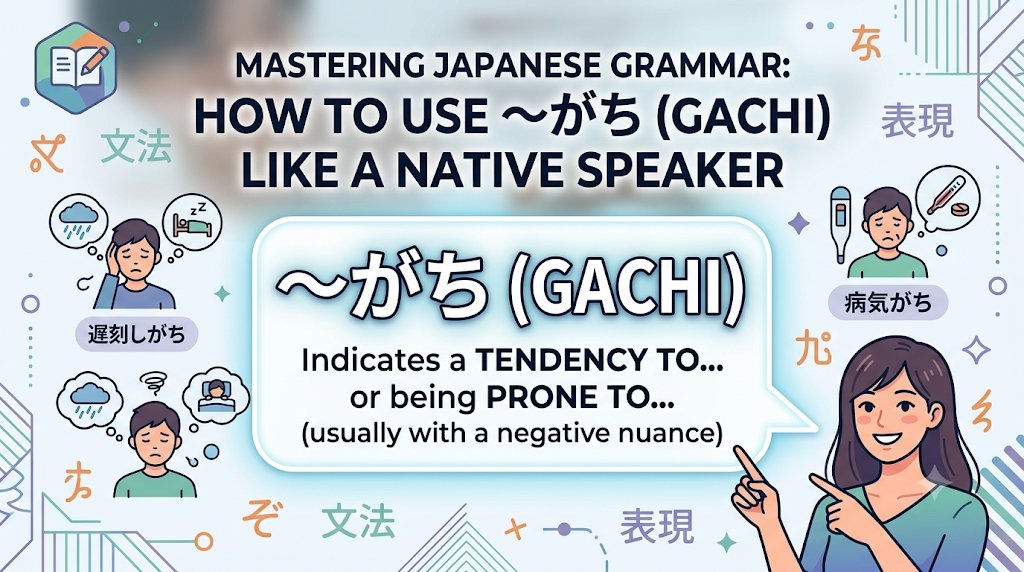
One grammar pattern that crops up constantly in everyday conversation, news, and JLPT exams is ~がち (gachi).
While most textbooks translate ~gachi simply as “tend to” or “apt to,” relying solely on that definition will cause you to misuse it. There is a specific emotional color and social context attached to ~がち that native speakers pick up on instantly.
In this guide, we’ll break down everything you need to know about ~がち: its structural rules, its hidden negative nuance, how it compares to similar grammar points, and practical ways to use it in daily life.
1. What Does ~がち (gachi) Mean?
At its core, ~がち (gachi) indicates a strong tendency or a frequent occurrence. It means that something happens often, or that a particular state easily occurs.
However, here is the crucial element that standard word lists often leave out: ~がち almost always carries a negative nuance.
When you use ~がち, you aren’t just stating an objective statistical fact. You are usually pointing out:
- An undesirable habit
- A flaw or weakness
- A mistake people frequently make
- An unfortunate state of affairs
Why standard translations can deceive you
Consider the English sentence: “He tends to wake up early.”
If waking up early is viewed as a healthy, positive habit, using ~がち in Japanese would sound unnatural to a native speaker. But if waking up early causes him to be exhausted by noon, then ~がち fits perfectly.
2. Structural Rules: How to Form ~がち
Using ~がち grammatically is straightforward. It attaches directly to the verb stem (Masu-form without masu) or directly to Nouns.
A. Conjugation Rules
| Part of Speech | Rule | Example Base | Final Conjugated Form |
| Verb (Stem) | Verb (Masu-form) + がち | 忘れる (wasure-ru) $\rightarrow$ 忘れ | 忘れがち (wasuregachi) |
| Verb (Stem) | Verb (Masu-form) + がち | 遅れる (okure-ru) $\rightarrow$ 遅れ | 遅れがち (okuregachi) |
| Noun | Noun + がち | 遠慮 (enryo) | 遠慮がち (enryogachi) |
| Noun | Noun + がち | 病気 (byouki) | 病気がち (byoukigachi) |
B. Treating ~がち in Sentences
Once formed, ~がち functions syntactically as a Na-adjective or a Noun suffix:
- As a sentence modifier: Add な (na) before a noun.
- 休みがちな学生 (yasumi-gachi na gakusei) = A student who tends to take days off.
- As an adverbial phrase: Add に (ni) before a verb.
- 留守がちになる (rusu-gachi ni naru) = To tend to be away from home more often.
- At the end of a sentence: Follow with だ (da), です (desu), or である (de aru).
- ひとりで悩みを抱え込みがちです。 (Hitori de nayami wo kakaekomi-gachi desu.) = One tends to bottle up worries alone.
3. High-Frequency Expressions You Should Memorize
While you can technically attach ~がち to many verbs and nouns, native speakers regularly use a core set of set expressions. Learning these collocations will immediately raise the naturalness of your spoken and written Japanese.
Common Verb Combinations
- 忘れがち (Wasuregachi) — Tend to forget
- 初心を忘れがちになる。
- Shojin wo wasuregachi ni naru.
- One tends to forget their original motivation.
- 遅れがち (Okuregachi) — Tend to be late / fall behind
- 最近、電車の運行が遅れがちだ。
- Saikin, densha no unkou ga okuregachi da.
- Lately, train services tend to be delayed.
- 偏りがち (Katayorigachi) — Tend to be biased / unbalanced
- 一人暮らしの食事は栄養が偏りがちだ。
- Hitorigurashi no shokuji wa eiyou ga katayorigachi da.
- Meals for people living alone tend to lack nutritional balance.
- 思い込みがち (Omoikomigachi) — Tend to assume / jump to conclusions
- 自分の考えが正しいと思い込みがちだ。
- Jibun no kangae ga tarashii to omoikomigachi da.
- People tend to assume their own way of thinking is correct.
- 抱え込みがち (Kakaekomigachi) — Tend to take on too much / bottle things up
- 真面目な人ほど、一人で仕事を抱え込みがちです。
- Majime na hito hodo, hitori de shigoto wo kakaekomigachi desu.
- The more conscientious a person is, the more they tend to bottle up their workload alone.
Common Noun Combinations
- 病気がち (Byoukigachi) — Prone to illness / sickly
- 幼い頃は病気がちで、よく学校を休んでいた。
- Osanai koro wa byoukigachi de, yoku gakkou wo yasunde ita.
- When I was young, I was prone to illness and often missed school.
- 留守がち (Rusugachi) — Often away from home
- 仕事が忙しく、最近は家を留守がちにしている。
- Shigoto ga isogashiku, saikin wa ie wo rusugachi ni shite iru.
- Work is busy, so I’ve tended to be away from home a lot lately.
- 遠慮がち (Enryogachi) — Hesitant / reserved / diffident
- 彼女は遠慮がちに発言した。
- Kanojo wa enryogachi ni hatsugen shita.
- She spoke hesitantly/reservedly.
4. Nuance Breakdown: Comparing ~がち with Similar Grammar
One of the biggest hurdles on the JLPT N3 and N2 exams is distinguishing between grammar points that carry similar dictionary translations. Let’s compare ~がち with ~やすい, ~気味, and ~っぽい.
                   Grammar Comparison Overview
┌─────────────┬─────────────────────────────┬───────────────────────────┐
│ Pattern     │ Core Meaning                │ Nuance / Tone             │
├─────────────┼─────────────────────────────┼───────────────────────────┤
│ ~がち      │ Tendency to end up in state │ Mostly negative / Habitual│
│ ~やすい    │ Easy to do / Susceptible    │ Neutral or Natural        │
│ ~気味      │ Slight feeling / Touch of   │ Physical/Mental state     │
│ ~っぽい    │ -ish / Childish / Easily    │ Characteristic / Quality  │
└─────────────┴─────────────────────────────┴───────────────────────────┘
1. ~がち vs. ~やすい (Yasui)
Both can translate to “tends to” or “easy to,” but their focus differs:
- ~やすい (Easy to / Prone to): Focuses on physical properties, natural ease, or objective susceptibility. It can be neutral, positive, or negative.
- このペンは書きやすい。 (This pen is easy to write with — Positive)
- 湿気が多いと、食べ物が傷みやすい。 (When humidity is high, food spoils easily — Objective physical trait)
- ~がち (Tend to): Focuses on human tendencies, habits, or recurring negative states over time.
- 雨の日は遅刻しがちだ。 (On rainy days, people tend to be late — Undesirable tendency)
2. ~がち vs. ~気味 (Gimi)
- ~気味 (Gimi): Means “a touch of,” “a bit of,” or “slightly feeling like.” It refers to a current physical or psychological state that is beginning to manifest.
- 風邪気味です。 (Kaze-gimi desu) = I have a slight touch of a cold right now.
- 焦り気味だ。 (Aseri-gimi da) = I’m feeling a bit rushed right now.
- ~がち (Gachi): Refers to a frequency or pattern over time, not just a current temporary state.
- 風邪を引きがちだ。 (Kaze wo hikigachi da) = I tend to catch colds often (habitual/prone over a period).
3. Quick Reference Example
- 風邪気味 (Kaze-gimi): “I feel a cold coming on today.”
- 風邪を引きがち (Kaze wo hikigachi): “I am the type of person who frequently catches colds.”
To practice these structures interactively or test your understanding across different contexts, you can utilize structured practice portals such as Tofugu’s Japanese Grammar Guides to see how various suffixes function in everyday speech.
5. Sample Sentences for Contextual Learning
To master grammar, seeing isolated rules isn’t enough; you need to see how sentences build naturally around the pattern.
Context: Workplace & Professional Life
- 忙しいプロジェクトの最中は、コミュニケーションが不足しがちになります。
- Isogashii purojekuto no saichuu wa, komyunikeeshon ga fusoku shigachi ni narimasu.
- During busy projects, communication tends to become insufficient.
- 自分のやり方に固執するあまり、他人の意見を軽視しがちな傾向がある。
- Jibun no yarikata ni koshitsu suru amari, tanin no iken wo keishi shigachi na keikou ga aru.
- Due to sticking too stubbornly to one’s own methods, there is a tendency to disregard others’ opinions.
Context: Lifestyle & Daily Habits
- スマートフォンばかり見ていると、夜更かしをしがちで睡眠不足に陥る。
- Sumaatofon bakari mite iru to, yofukashi wo shigachi de suimin busoku ni ochiiru.
- When you do nothing but look at your smartphone, you tend to stay up late and fall into sleep deprivation.
- 一人暮らしを始めたばかりの頃は、外食に頼りがちでした。
- Hitorigurashi wo hajimeta bakari no koro wa, gaishoku ni tayorigachi deshita.
- When I first started living alone, I tended to rely heavily on eating out.
Context: Learning & Personal Development
- 外国語を学習する際、間違いを恐れて発言を控えがちになる人が多い。
- Gaikokugo wo gakushuu suru sai, machigai wo osorete hatsugen wo hikaegachi ni naru hito ga ooi.
- When learning a foreign language, many people tend to refrain from speaking out of fear of making mistakes.
6. Common Mistakes Learners Make (and How to Avoid Them)
Mistake 1: Using ~がち for Purely Positive Achievements
- Incorrect: 彼は毎日早起きして、勉強を続けがちだ。
- Correct: 彼は毎日早起きして、勉強を続けている。
Why? Continuing to study diligently is a positive effort. Using ~がち implies that continuing to study is a problematic or undesirable outcome.
Mistake 2: Confusing Verb Base Attachments
- Incorrect: 忘れるがち (Attaching to the dictionary form)
- Correct: 忘れがち (Attaching to the Masu-stem)
Why? Always drop the ~ます (masu) ending before adding がち. For group 2 verbs like 忘れる (wasureru), removing ru leaves you with wasure.
Mistake 3: Overusing it for One-time Events
- Incorrect: 昨日、鍵を忘れがちだった。
- Correct: 昨日、鍵を忘れてしまった。
Why? ~がち describes a broad pattern, repeated occurrence, or general disposition. It cannot be used for a single isolated incident that happened yesterday.
7. How to Study ~がち for the JLPT
If you are preparing for the JLPT N3 or N2, test designers love to test grammar patterns that look similar on the surface. Here is how you can effectively retain and review this grammar point:
- Focus on Pairings: Don’t memorize ~がち in isolation. Memorize fixed chunks like 遠慮がち (enryogachi), 忘れがち (wasuregachi), and 偏りがち (katayorigachi).
- Identify the Tone: When reading a passage in the reading section (読解), if you see ~がち, identify the problem the author is pointing out. It often marks the “issue” that the rest of the paragraph will offer a solution for.
- Check Official Syllabus Resources: Ensure your study plan aligns with standard exam expectations. You can review guidelines and official exam specifications through the Official JLPT Website to see how grammar competencies are assessed across levels.
Conclusion
Understanding ~がち (gachi) bridges the gap between knowing raw vocabulary and speaking natural, nuanced Japanese. By remembering its three core characteristics—attaching to verb stems/nouns, indicating a repeated pattern, and carrying a negative or critical undertone—you can avoid common pitfalls and express yourself with precision.


