
If you’ve been studying Japanese for a while, you’ve likely noticed that native speakers rarely state facts with 100% directness unless they witnessed something with their own eyes. Japanese communication relies heavily on subtle qualifiers, evidentiary markers, and softeners that allow speakers to share information without overcommitting to its absolute certainty.
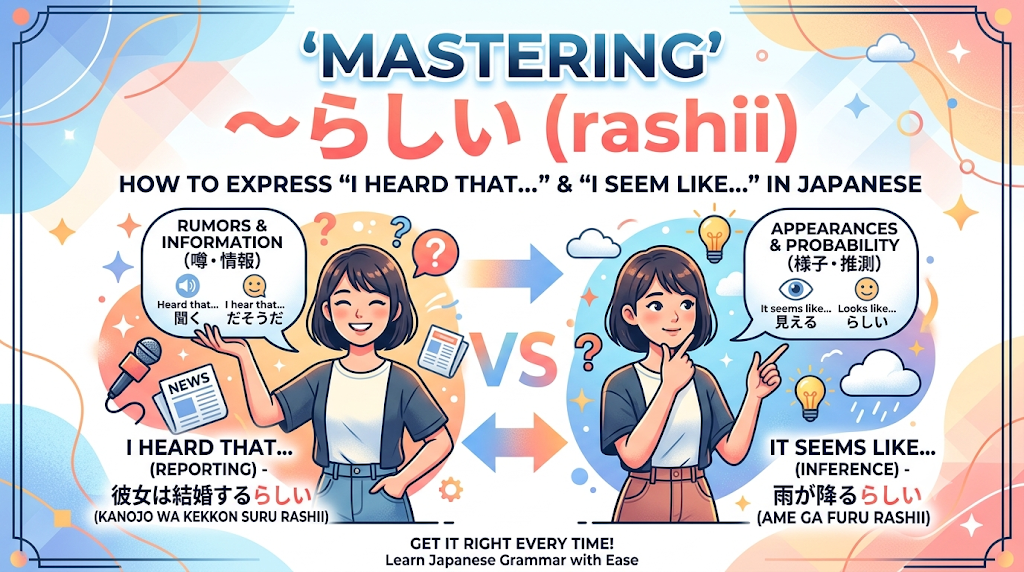
One of the most natural and versatile grammar patterns for doing this is 〜らしい (rashii).
Whether you are prepping for the JLPT N4/N3 exams, watching your favorite anime, or trying to catch up on office gossip in Tokyo, mastering 〜らしい is essential. It lets you say everything from “I heard it’s going to rain later” to “He acts like a real professional.”
In this deep-dive guide, we will break down the two main functions of 〜らしい, look at exact sentence structures, compare it to tricky similar patterns like 〜そうだ (sou da) and 〜ようだ (you da), and explore native nuances that textbook explanations often leave out.
What Does 〜らしい (rashii) Actually Mean?
At its core, 〜らしい is an auxiliary adjective that translates roughly to “it seems like,” “I heard that,” “apparently,” or “typical of.”
To use it accurately, you need to understand that it has two primary, distinct functions:
- Hearsay & External Conjecture (Conjecture based on information): Expressing that something seems to be true based on information you read, heard, or deduced from outside sources.
- Archetypal Characteristics (Typical behavior/nature): Expressing that someone or something embodies the quintessential qualities of a specific noun (e.g., “a real man,” “typical spring weather”).
Let’s break down each function in detail so you can use them naturally in conversation.
Function 1: Hearsay and Evidence-Based Conjecture
When you use 〜らしい for hearsay or conjecture, you are signaling to your listener: “I didn’t witness this directly, but based on what I heard, read, or saw secondhand, this appears to be the case.”
Key Nuance
Unlike casual gossip where you might pass off rumors as absolute fact, 〜らしい maintains a polite distance from the information. You are sharing what you know while leaving room for the possibility that the information might not be entirely accurate.
Conjugation & Sentence Structure
Attaching 〜らしい to convey hearsay is straightforward because it almost always takes the Plain Form (Informal Form) directly before it.
| Part of Speech | Structure | Example Conjugation | English Meaning |
| Verbs | Plain Form + らしい | 行く + らしい $\rightarrow$ 行くらしい | It seems (they) will go / I heard (they) are going. |
| i-Adjectives | Plain Form + らしい | 忙しい + らしい $\rightarrow$ 忙しいらしい | Apparently (they) are busy. |
| na-Adjectives | Drop な + らしい | 元気(な) + らしい $\rightarrow$ 元気らしい | I heard (they) are doing well. |
| Nouns | Plain Noun + らしい | 雨 + らしい $\rightarrow$ 雨らしい | It looks like rain / I heard it’s rain. |
Pro Tip for JLPT Test Takers: Notice how na-adjectives do not take だ or な before らしい when expressing hearsay/conjecture. You attach らしい directly to the stem.
Real-World Example Sentences (Hearsay & Conjecture)
Let’s look at how this functions in everyday scenarios:
Example 1: Passing along news or weather updates
- 日本語: 田中さんは来月、結婚するらしいですよ。
- Romaji: Tanaka-san wa raigetsu, kekkon suru rashii desu yo.
- English: I heard that Mr. Tanaka is getting married next month.
- Context: You read an announcement or heard a mutual colleague mention it. You aren’t making it up, but you weren’t personally invited yet either.
Example 2: Deducing from environmental clues or reports
- 日本語: 外は風が強くて、かなり寒いらしい。
- Romaji: Soto wa kaze ga tsuyokute, kanari samui rashii.
- English: It seems really cold outside with strong winds.
- Context: You are inside a temperature-controlled office, but you saw trees swaying wildly outside or looked at a weather app on your phone.
Example 3: Workplace gossip and hearsay
- 日本語: 新しい部長は厳しいらしいから、気をつけたほうがいいよ。
- Romaji: Atarashii buchou wa kubishii rashii kara, ki o tsuketa hou ga ii yo.
- English: I heard the new department manager is strict, so we’d better be careful.
- Context: A warning based on rumors from other departments.
Function 2: Typicality and Essential Characteristics
The second major way native speakers use 〜らしい is to express that someone or something behaves exactly as expected for their category or role.
In English, we express this using phrases like:
- “That’s so like him!”
- “He’s a true professional.”
- “It’s quintessential spring weather.”
Structure for Typicality
This structure only connects with Nouns:
$$\text{Noun} + \text{らしい}$$
When used this way, the resulting word behaves grammatically like an i-adjective. You can conjugate it just as you would any i-adjective:
- Affirmative: 男らしい (otokorashii – manly / characteristic of a man)
- Negative: 男らしくない (otokorashikunai – unmanly / not typical of a man)
- Adverbial: 男らしく (otokorashiku – manfully / behaving in a manly way)
- Past tense: 男らしかった (otokorashikatta – was manly)
Real-World Example Sentences (Typicality)
Example 1: Describing seasonal weather
- 日本語: 今日はぽかぽかして、春らしい天気ですね。
- Romaji: Kyou wa pokapoka shite, harurashii tenki desu ne.
- English: Today is nice and warm; it’s truly spring-like weather.
- Nuance: It is actually spring, and the weather feels exactly how spring should feel.
Example 2: Complimenting professional behavior
- 日本語: どんな時でも冷静に対応するのは、プロらしい態度だ。
- Romaji: Donna toki demo reisei ni taiou suru no wa, puro-rashii taido da.
- English: Remaining calm under any situation is a truly professional attitude.
- Nuance: The person is a professional, and their actions reflect that identity perfectly.
Example 3: Expressing typical personality traits
- 日本語: 失敗してもすぐに笑顔を見せるなんて、彼らしいね。
- Romaji: Shippai shitemo sugu ni egao o miseseru nante, kare-rashii ne.
- English: Showing a smile right after making a mistake—that is so typical of him.
Nuance Spotlight: 〜らしい vs. 〜そうだ vs. 〜ようだ
One of the biggest hurdles Japanese language learners face when studying for the JLPT is distinguishing between the different ways to say “seems like” or “looks like.”
Let’s clear up the confusion between 〜らしい (rashii), 〜そうだ (sou da), and 〜ようだ (you da) once and for all.
       [Source of Information & Direct Perception Spectrum]

Direct Visual Intuition          External Reports / Reports & Logic
(Looking at it right now)        (Hearing rumors / Objective clues)
       |                                      |
   〜そうだ (Sou da)                      〜らしい (Rashii)
   "It looks like..."                     "I heard that / Apparently..."
       |                                      |
       +-------------------〜ようだ-------------------+
                          (You da)
                   "It appears to be..."
              (Based on subjective sensory evidence)
1. 〜そうだ (Visual Impression / Immediate Conjecture)
- Meaning: “It looks like [about to happen]” or “It gives the impression of…”
- Source: Direct physical observation right in front of your eyes.
- Example: 雨が降りそうだ (Ame ga furisou da) — “It looks like it’s about to rain.” (You are looking at dark pitch-black clouds right above your head).
2. 〜そうだ (Direct Hearsay)
- Meaning: “I heard that…”
- Source: You are directly quoting a specific statement or report you heard or read.
- Example: 天気予報によると、雨が降るそうだ (Tenki yohou ni yoruto, ame ga furu sou da) — “According to the weather forecast, I heard it will rain.”
3. 〜ようだ (Subjective Impression / Analogy)
- Meaning: “It seems like…” or “It looks as if…”
- Source: Based on your own sensory perception (smell, sound, feeling) or making a metaphorical comparison.
- Example: まだ春なのに、夏休みのようだ (Mada haru nanoni, natsuyasumi no you da) — “Even though it’s still spring, it feels like summer vacation.”
4. 〜らしい (Objective Evidence / Typicality)
- Meaning: “Apparently…” or “Typical of…”
- Source: Based on indirect objective information, third-party reports, or general consensus.
- Example: 明日は雨らしい (Ashita wa ame rashii) — “Apparently, it’s going to rain tomorrow.” (Based on what people are saying or a quick glance at a news feed).
For comprehensive breakdowns on exam-specific grammar lists and official test guidelines, you can review the latest updates on the official JLPT (Japanese-Language Proficiency Test) Website.
Practical Application: Natural Conversational Patterns
To make your Japanese sound authentic, avoid over-using robotic, textbook-style sentences. Here are three high-frequency conversational patterns that native speakers use every day with 〜らしい:
1. Adding Softened Uncertainty with 〜みたい (Mitai)
In casual Japanese, 〜みたい (mitai) and 〜らしい (rashii) are frequently combined or interchanged in speech.
- カジュアル (Casual): あの店、今日やすみらしいよ。 (Ano mise, kyou yasumi rashii yo.)
- Translation: “Looks like that shop is closed today.”
2. Expressing Disappointment in Untypical Behavior
By negating the typicality form (〜らしくない), you can express surprise or concern when someone acts out of character:
- 日本語: ええ?テストで点数が低かったの?君らしくないね。
- Romaji: Ee? Tesuto de tensuu ga hikukatta no? Kimi-rashikunai ne.
- English: What? You got a low score on the test? That’s really not like you.
3. Softening Direct Gossip
When discussing workplace news or rumor-heavy topics, appending 〜らしい prevents you from sounding like a busybody or declaring unverified information as factual truth.
- 日本語: 鈴木さん、転職するらしいよ。
- Romaji: Suzuki-san, tenshoku suru rashii yo.
- English: Word on the street is that Suzuki-san is changing jobs.
Common Mistakes to Avoid
Even advanced Japanese students occasionally make structural or contextual errors with this grammar point. Here are three common traps to watch out for:
Trap #1: Using 〜らしい for direct visual observations
- ❌ Incorrect: (Looking directly at a sliced cake) このケーキ、おいしいらしい!
- ⭕ Correct: このケーキ、おいしそう! (Kono keeki, oishisou! – This cake looks delicious!)
- Why: If you are physically looking right at something in front of you, use 〜そうだ (oishisou). Reserve 〜らしい for when you are going off a recommendation, a review, or second-hand information.
Trap #2: Adding な or だ between a na-adjective and らしい (Hearsay form)
- ❌ Incorrect: 彼女は静かならしい。
- ⭕ Correct: 彼女は静からしい。 (Kanojo wa shizuka rashii. – I heard she is quiet.)
- Why: When using hearsay/conjecture らしい with na-adjectives, drop the な particle entirely.
Trap #3: Confusing “Typical Of” with “Resembling”
- ❌ Incorrect: 彼は男なのに、女らしい。(When trying to say “He dresses like a woman”)
- ⭕ Correct: 彼は女性のようだ / 女性みたいだ。 (Kare wa josei no you da / josei mitai da.)
- Why: N + らしい means the subject is part of that category and possesses its true qualities (e.g., a woman acting like a woman). If you are drawing a metaphorical comparison (someone acting like something they are not), use 〜ようだ (you da) or 〜みたい (mitai).
JLPT Practice Questions
Test your mastery of 〜らしい with these quick practice questions!
Question 1 (Grammar – Conjugation)
Choose the correct option to fill in the blank:
田中先生は明日、出張で不在________。
(Tanaka-sensei wa ashita, shucchou de fuzai ________.)
“I heard Tanaka-sensei will be away on a business trip tomorrow.”
- らしいだ
- ならしい
- らしい
- らしかった
- Correct Answer: 3. らしい
- Explanation: 不在 (fuzai – absent) functions as a noun/na-adjective state. For hearsay, we attach らしい directly without adding だ or な.
Question 2 (Nuance Check)
Which sentence best expresses: “It feels like true autumn today!” (Assuming it is currently autumn)?
- 今日は秋のようだ。
- 今日は秋らしい。
- 今日は秋そうだ。
- 今日は秋らしいだ。
- Correct Answer: 2. 今日は秋らしい。
- Explanation: Option 2 correctly uses Noun + らしい to indicate that today possesses the quintessential, typical qualities of autumn. Option 1 implies a metaphorical likeness (as if it were autumn, even if it might not be). Option 3 is grammatically incorrect.
Recommended Learning Resources
To strengthen your overall understanding of Japanese grammar structures, JLPT prep strategies, and contextual language usage, explore these essential online resources:
- Check out comprehensive grammar guides and exercise sets on Maggie Sensei, one of the most practical user-friendly blogs for learning authentic Japanese nuances.
- Review detailed JLPT structure breakdowns, test dates, and official study materials at the Tofugu Japanese Learning Guide.
Summary Checklist
Before you head off to practice in your conversation notebooks or speaking exchanges, run through this quick memory checklist:
- Hearsay / Evidence: Verb (Plain) / i-Adj / Na-Adj (Stem) / Noun + らしい (“I heard that…” / “Apparently…”)
- Typicality: Noun + らしい (“Typical of…” / “Quintessential…”)
- Negation: 〜らしくない (“Uncharacteristic of…”)
- Adverbial: 〜らしく (“In a typical manner…”)


