
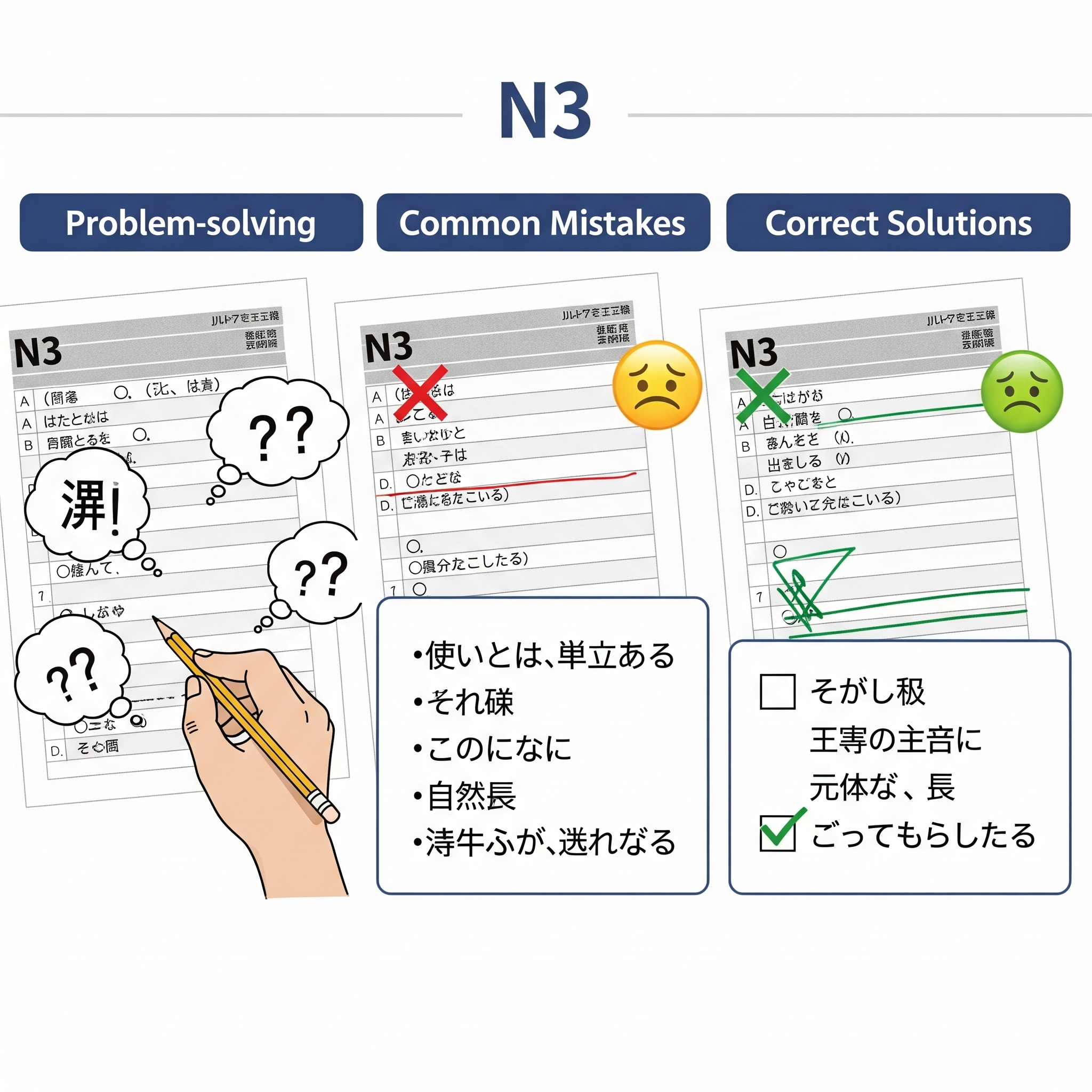
Konnichiwa, future N3 achievers!
The JLPT N3 is a crucial milestone for Japanese learners—it bridges the gap between basic and intermediate proficiency. However, many test-takers struggle with certain patterns, grammar points, and tricky questions that lead to avoidable mistakes.
In this guide, we’ll break down: ✔ Common mistakes in JLPT N3 ✔ Correct answers explained in detail ✔ Practical strategies to avoid errors ✔ Key grammar & vocabulary that trip up learners
Whether you’re preparing for the next exam or just brushing up, this post will help you spot errors before they cost you points.
For a complete roadmap, including the test’s total time and structure, be sure to start with our main guide: [Your Ultimate JLPT N3 Full Test Guide: Structure, Scoring, and Success Strategies]
Why Do Students Fail JLPT N3?
Before diving into answers, let’s understand why many test-takers struggle with N3:
- Misunderstanding Grammar Nuances – Some structures look similar but have different uses (e.g., ~そう vs. ~よう).
- Kanji & Vocabulary Confusion – Homonyms (同音異義語) like 大事 (important) vs. 退治 (subdue) can be tricky.
- Listening Pitfalls – Fast speech, contractions (~ちゃう for ~てしまう), and indirect answers trip many.
- Time Management – Running out of time in reading comprehension is a common issue.
Now, let’s analyze real JLPT N3 questions and their correct solutions.
1. Grammar Mistakes & Fixes
Mistake: Confusing ~そうだ (Appearance) vs. ~ようだ (Inference)
Example Question: 「空が暗いから、雨が______。」 A) 降りそうだ B) 降るようだ
✅ Correct Answer: A) 降りそうだ
Why?
- ~そうだ = “Looks like it will rain” (based on visual cues).
- ~ようだ = “It seems like it’s raining” (inference, not direct observation).
Common Error: Many pick B thinking it’s a logical guess, but A matches the “dark sky” (visible clue).
📌 Pro Tip: If the sentence gives a direct observation (dark sky, someone’s tired face), use ~そうだ.
Mistake: Misusing ~てしまう (Accidental Actions)
Example Question: 「電車の中で寝て______、降りる駅を過ぎてしまった。」 A) しまって B) いて
✅ Correct Answer: A) しまって
Why?
- ~てしまう implies unintended results (oversleeping → missing the station).
- ~ていて just describes a continuous state (not the consequence).
Common Error: Learners pick B because it “sounds natural,” but A conveys regret.
📌 Pro Tip: If the sentence has a mistake/accident, ~てしまう is likely correct.
2. Vocabulary & Kanji Errors
Mistake: Mixing Up Similar-Sounding Words
Example Question: 「彼の話は______で、全然面白くなかった。」 A) 退屈 B) 大工
✅ Correct Answer: A) 退屈 (boring)
Why?
- 退屈 (たいくつ) = boring
- 大工 (だいく) = carpenter (completely different meaning!)
Common Error: Fast readers might misread the kanji and pick B.
📌 Pro Tip: Slow down on kanji compounds—check meanings, not just pronunciation.
3. Listening Section Traps
Mistake: Missing Contractions & Casual Speech
In the listening section, spoken Japanese often shortens phrases:
- ~てしまう → ~ちゃう
- ~なければならない → ~なきゃ
Example Dialogue: Woman: 「宿題、もう終わった?」 Man: 「ううん、まだやってない。今からやる______。」
✅ Correct Answer: ~なきゃ (short for ~なければならない)
Common Error: Some learners miss the contraction and pick a formal option.
4. Reading Comprehension Tricks
Mistake: Overlooking Negative Forms
Example Passage: 「この薬は飲むと眠くなります。運転前には飲まないでください。」
Question: 「この薬について、正しいのはどれ?」 A) 運転前に飲むと危ない B) 運転前に飲むと元気になる
✅ Correct Answer: A)
Why? The text says “Do not drink before driving”, implying danger.
Common Error: Some skim and miss the ないでください (negative command).
📌 Pro Tip: Underline negations (ない, ず, 禁止) in reading passages.
How to Avoid These Mistakes & Secure Your Pass
1. Drill Grammar Patterns
- Use JLPT N3 grammar books
- Make flashcards for similar-looking structures
2. Practice Real Listening Materials
- Watch Japanese YouTubers without subtitles.
Final Thoughts on Scoring Success
The JLPT N3 is challenging but beatable if you know where mistakes happen. Focus on: ✔ Grammar nuances (~そう vs. ~よう) ✔ Kanji/vocabulary distinctions ✔ Listening contractions (~ちゃう, ~なきゃ) ✔ Reading comprehension tricks
After the exam, the biggest question is how you performed. Understanding the mechanism behind the results is crucial:
- Understanding the System: Learn exactly how your raw score is converted to the final sectional scores: [JLPT N3 Full Marks & How Scoring Works in Each Section] and [JLPT N3 Exam Pass Mark & Scoring System Explained]
- Checking Your Results: When the day comes, you’ll need the official solutions to check your answers against your memory or practice sheet. Find the resources here: [JLPT N3 Answer Key 2025: Official Solutions & How to Check Your Score]
- Answer Sheet Strategy: To avoid losing points on easily avoidable errors, ensure you know the proper filling method: [JLPT N3 Answer Sheet: How to Fill It Correctly and Avoid Mistakes]. You can practice with the official layout by downloading the template: [JLPT N3 Answer Sheet Sample: Format, Tips, and Practice PDF]


