Konnichiwa, fellow Japanese language learners!
So, you’ve set your sights on the JLPT N3. That’s fantastic! It’s a huge milestone, often seen as the crucial bridge between casual conversation and genuine, practical fluency. You’re probably knee-deep in textbooks, drowning in kanji flashcards, and your ears are constantly tuned to Japanese podcasts.
To succeed on this exam, you first need to master the administrative and strategic details. For a complete guide to everything from the structure to success strategies, be sure to start with our main resource: [Your Ultimate JLPT N3 Full Test Guide: Structure, Scoring, and Success Strategies]
But amidst all this study, have you ever found yourself wondering:
“Exactly what score do I need to pass?” “Why is the scoring so mysterious? What’s a ‘scaled score’ anyway?” “Is one section more important than the others?”
If you nodded yes, you’re not alone. The JLPT scoring system can feel like a secret ritual, shrouded in mystery. But don’t worry! As your guide on this language journey, I’m here to demystify it all for you.
Today, we’re pulling back the curtain on the JLPT N3 exam’s pass marks and scoring system. This isn’t just about the numbers; it’s about understanding the strategy behind your study plan. Let’s dive in!
First Things First: The Golden Rule of Passing the JLPT N3
Forget everything you know about standard exam grading. The JLPT doesn’t work on a simple percentage. Passing the N3 isn’t about getting 60% of the questions right. Instead, you need to achieve two separate goals simultaneously:
- An Overall Pass Mark: Your total score must meet a minimum threshold.
- Sectional Pass Marks: You must also achieve a minimum score in each individual test section.
Fail just one section, even if your overall score is perfect, and you won’t pass. This system ensures you have a balanced ability across all core skills.
The N3 Exam Structure: A Quick Refresher
Before we talk numbers, let’s recall what we’re being tested on. The N3 is divided into two time blocks but graded across three distinct scoring sections:
| Scored Section | Tested Components | Maximum Score |
| 言語知識 (Characters, Vocabulary, Grammar) | 語彙 (Vocabulary) + 文法 (Grammar) | 60 points |
| 読解 (Reading) | 読解 (Reading Comprehension) | 60 points |
| 聴解 (Listening) | 聴解 (Listening Comprehension) | 60 points |
Export to Sheets
Wait, that seems like two sections, right? But for scoring, the Language Knowledge block is split into two separate scores: one for the Vocabulary/Grammar part and one for the Reading part. So, effectively, you’re graded on three scored sections.
The Magic Numbers: JLPT N3 Pass Marks Explained
Alright, here are the numbers you’ve been searching for.
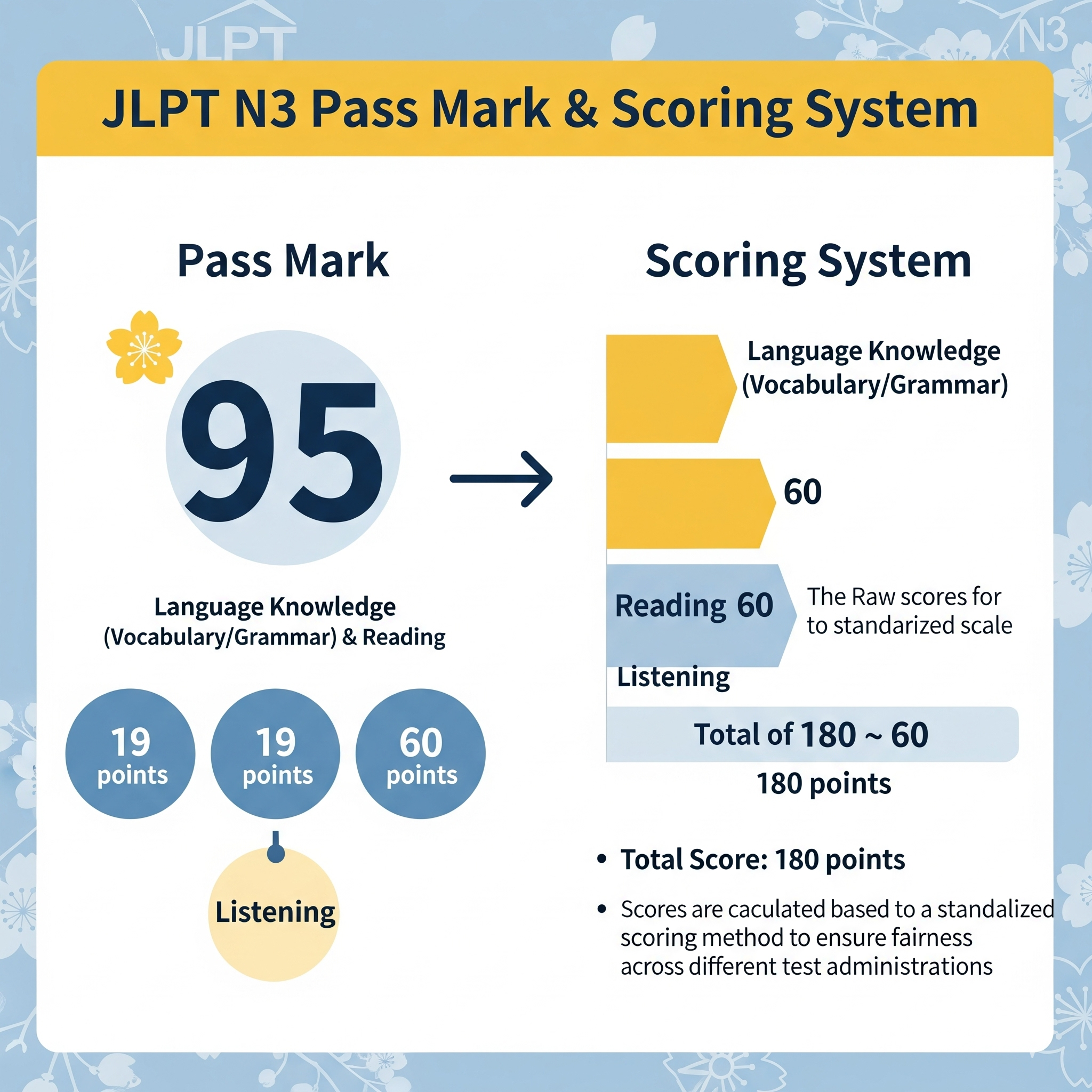
- Overall Pass Mark: You need a total score of 95 out of 180.
- Sectional Pass Marks: You must get at least 19 points in each of the three sections. Each section has a maximum of 60 points.
Let’s put that into a simple table:
| Section | Maximum Score | Minimum “Passing” Score (per section) |
| Language Knowledge (Vocab/Grammar) | 60 points | 19 points |
| Reading | 60 points | 19 points |
| Listening | 60 points | 19 points |
| TOTAL | 180 points | 95 points |
Export to Sheets
For an even more in-depth analysis of the maximum score and how points are awarded, see our full scoring article: [JLPT N3 Full Marks & How Scoring Works in Each Section](Cluster Link: JLPT N3 Full Marks & How Scoring Works in Each Section).
The “Scaled Score” Mystery: Why Your Raw Score Doesn’t Matter
This is the part that confuses everyone. The score on your results sheet is NOT a raw score. It’s a scaled score.
What does that mean?
The Japan Foundation uses a statistical method to convert your raw score (the number of questions you got right) into a scaled score. This process adjusts for minor variations in difficulty between different test versions.
Why do they do this?
It ensures fairness. Let’s say the July exam’s listening section was notoriously difficult, and the December one was slightly easier. The scaled score adjusts for this so that a candidate’s ability is measured consistently, regardless of which test date they took. You’re not penalized for taking a “harder” exam.
In human terms: Don’t waste time after the exam trying to calculate your score based on how many answers you think you got right. It’s nearly impossible. Focus on your performance during your practice tests instead.
If you’re interested in the official calculations and final results, our dedicated resources cover everything from the post-test stage to certification: [JLPT N3 Answer Key 2025: Official Solutions & How to Check Your Score]and [JLPT N3 Answer Key 2025: Results, Analysis, and Expert Insights]
The Hidden Insight: What the Scoring System Tells You About How to Study
This isn’t just boring data. The structure of the pass marks gives us a huge clue about how to approach the exam. The requirement to pass each section means you cannot afford to be weak in any one area.
I’ve seen too many students make this mistake. They pour all their time into memorizing kanji and grammar points, completely neglecting their listening skills until the last minute. They walk out of the exam thinking, “I nailed the reading!” only to get their results and see a big, red 不合格 (fugoukaku – not passed) because their listening score was 18—just one point below the sectional threshold.
The moral of the story: Your study plan must be balanced. You need a strategy that gives equal weight to Vocabulary, Grammar, Reading, and Listening.
If you’re unsure where to start with a balanced plan, check out our guide on creating a winning JLPT N3 study schedule.
Practical Application: How to Use This Knowledge to Pass
Okay, so we know the rules. How do we turn this into a passing ticket?
- Practice Tests Are Your Best Friend: The single most important thing you can do is take full, timed practice tests. Don’t just focus on the questions; practice filling in the answer sheet and managing your time. Treat it like the real deal. To avoid simple administration errors on test day, consult our detailed guides on the paper-based aspects of the exam: [JLPT N3 Answer Sheet: How to Fill It Correctly and Avoid Mistakes] and [JLPT N3 Answer Sheet Sample: Format, Tips, and Practice PDF]
- Analyze Your Practice Results: After grading your practice test, don’t just look at the overall score. Break it down! Did you barely scrape 19 in Reading? That’s a huge red flag. It means you need to dedicate more time to reading practice, perhaps by using these effective techniques for improving Japanese reading speed.
- Target Your Weaknesses: The scoring system forces you to be well-rounded. If listening is your Achilles’ heel, you need to make it a daily habit. Immerse yourself with Japanese podcasts, TV shows, and NHK News Web Easy (outbound link to a fantastic free resource). Listen actively, not just as background noise.
- Don’t Neglect Your Strengths: While shoring up weaknesses, you must maintain your strengths. If you’re great at vocabulary, keep those flashcards rotating to ensure you don’t backslide.
Beyond the Pass: What Your Score Can Tell You
Passing is the goal, but your score can also be a useful diagnostic tool.
- A high score in Language Knowledge but low in Reading? You might know your grammar rules well but struggle to apply them quickly in long texts. You need more extensive reading practice.
- Aced Listening but failed Vocabulary? Maybe you’re great at picking up words from context in conversations but haven’t done the hard work of memorizing the core N3 vocab list. It’s time to hit the books like Try! N3 (affiliate link to a recommended grammar book) or use a dedicated SRS app.
For a detailed analysis of common errors and specific question types, review our expert-led breakdown: [JLPT N3 Answers Explained: Common Mistakes & Correct Solutions]
Final Thoughts: You’ve Got This!
Understanding the [JLPT N3 Exam Pass Mark & Scoring System Explained](Cluster Link: JLPT N3 Exam Pass Mark & Scoring System Explained) takes away a lot of the anxiety and allows you to study smarter. Remember the golden rule: balance is key. Aim not just for a 95/180 overall, but for a strong, confident score above 19 in each and every section.
The N3 is a challenge, but it’s an incredibly rewarding one. Passing it proves you have the language foundation to handle real-life situations in Japan, both in writing and conversation.
For more tips on conquering the trickiest part of the exam for many, have a look at our article on mastering JLPT N3 listening in 30 days.
Ganbatte kudasai! (Do your best!)