Introduction
So, you’ve decided to take the Japanese Language Proficiency Test (JLPT) N4—great choice! This level bridges the gap between basic (N5) and intermediate (N3) Japanese, making it a crucial step in your language journey.
But what exactly does the JLPT N4 cover? How much grammar, vocabulary, and kanji do you need to know? And most importantly—how can you study effectively?
In this comprehensive guide, we’ll break down the full JLPT N4 syllabus, offer unique insights, and provide practical study tips to help you pass with confidence.
JLPT N4 Overview
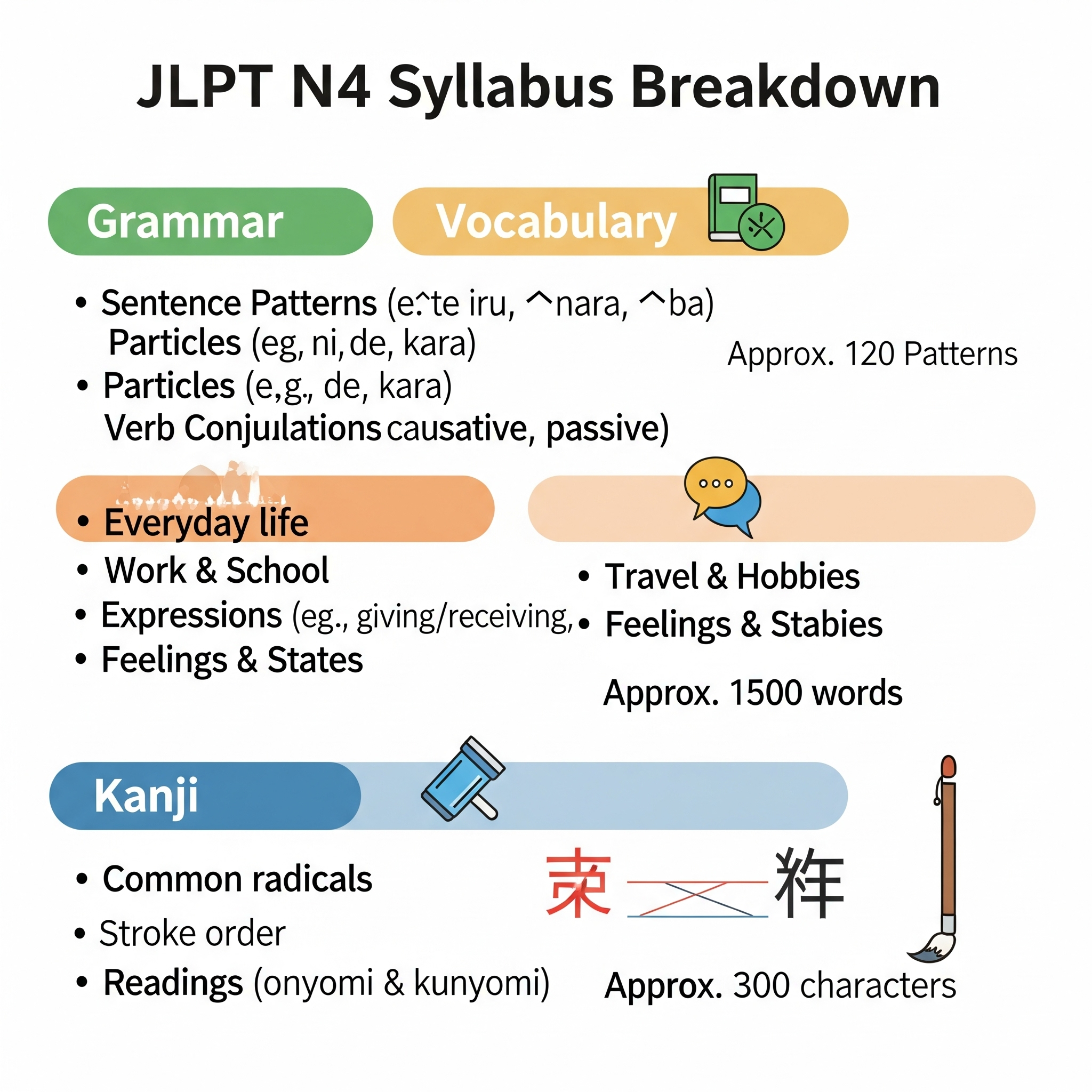
The JLPT N4 tests your ability to understand basic Japanese in everyday situations. You’ll need:
- ~300 kanji (up from N5’s ~100)
- ~1,500 vocabulary words
- Essential grammar structures for daily conversations
The exam has three sections:
- Language Knowledge (Vocabulary & Kanji) – 30 mins
- Language Knowledge (Grammar) & Reading – 60 mins
- Listening – 35 mins
Now, let’s dive into each section in detail.
1. JLPT N4 Kanji: What You Need to Know
Unlike N5, where kanji is minimal, N4 introduces ~200 new kanji, bringing your total to around 300.
Key Kanji Categories for N4
- Time & Dates (e.g., 週-shuu (week), 昨-saku (previous))
- Common Verbs (e.g., 食-tabe (eat), 飲-no (drink))
- Adjectives & Directions (e.g., 新-shin (new), 北-kita (north))
Pro Tip: Use spaced repetition (Anki, WaniKani) to memorize kanji efficiently. Focus on readings (onyomi & kunyomi) and common compound words.
Need kanji practice? Check out our JLPT N4 Kanji List for a downloadable PDF.
2. JLPT N4 Vocabulary: Essential Words
The N4 vocabulary list includes ~1,500 words, expanding on N5 basics with more:
- Daily life terms (e.g., 準備-junbi (preparation), お釣り-otsuri (change))
- Work & School-related words (e.g., 会議-kaigi (meeting), 宿題-shukudai (homework))
- Expressions for politeness (e.g., お願いします-onegaishimasu (please))
How to Study N4 Vocab Effectively:
✅ Flashcards (Anki, Memrise)
✅ Context-based learning (watch Japanese dramas, read NHK Easy News)
✅ Practice with mock tests
Struggling with vocabulary? Try our JLPT N4 Vocabulary Quiz to test your knowledge.
3. JLPT N4 Grammar: Key Structures
N4 grammar introduces more complex sentence patterns than N5. Here are must-know grammar points:
Essential N4 Grammar Patterns
- 〜たら (If/When) – 食べたら… (If you eat…)
- 〜ながら (While doing…) – 歩きながら話す (Talk while walking)
- 〜かもしれない (Might be…) – 雨が降るかもしれない (It might rain)
- 〜てみる (Try doing…) – 食べてみる (Try eating)
- 〜のに (Although/Despite) – 勉強したのに… (Even though I studied…)
Common Mistakes to Avoid:
❌ Confusing 〜たら (tara) with 〜ば (ba) (both mean “if,” but usage differs)
❌ Misusing 〜てしまう (regretful completion) – e.g., 忘れてしまった (I accidentally forgot)
Want a deeper dive? Read our JLPT N4 Grammar Guide.
4. JLPT N4 Reading & Listening Tips
Reading Comprehension
- Focus on short passages (emails, notices, simple articles)
- Look for key phrases like 〜なければならない (must do)
Listening Section
- Practice with JLPT-style dialogues (e.g., daily conversations, announcements)
- Pay attention to question words (誰-dare (who), 何時-nanji (what time))
Recommended Resources:
- NHK Easy Japanese (for reading)
- JLPT N4 Listening Practice (free exercises)
5. Study Plan & Exam Strategy
8-Week JLPT N4 Study Plan
| Week | Focus Area |
|---|---|
| 1-2 | Kanji & Vocabulary |
| 3-4 | Grammar Patterns |
| 5-6 | Reading Practice |
| 7-8 | Mock Tests & Listening |
Exam Day Tips:
✔ Skip hard questions and return later
✔ Guess logically (eliminate wrong options)
✔ Manage time (don’t spend too long on one section)
Final Thoughts
The JLPT N4 is a stepping stone to fluency, testing practical Japanese skills. By mastering kanji, vocabulary, and grammar, you’ll not only pass the exam but also communicate more confidently in real-life situations.
Need more help? Check out our JLPT N4 Full Guide for extra resources!
FAQs
Q: How hard is JLPT N4 compared to N5?
A: N4 requires more vocabulary & grammar, but with consistent study, it’s manageable.
Q: Can I pass N4 in 3 months?
A: Yes, if you study 1-2 hours daily using structured materials.
Q: Is N4 enough for daily conversation?
A: It covers basic interactions, but for deeper conversations, aim for N3+.