
Konnichiwa, future JLPT test-taker!
So, you’ve decided to take the plunge and challenge the Japanese-Language Proficiency Test, starting at the N5 level. First off, congratulations! Committing to this goal is the first and most important step on your Japanese language journey. I remember my first JLPT experience—a mix of excitement, nerves, and a whole lot of questions. The biggest one? “Just what score do I need to actually pass?”
It’s a common point of confusion. You might have heard things like “you need about 50%,” but the reality is a bit more nuanced. As someone who has both taken and tutored students for the JLPT for years, I’m here to demystify it all for you.
This isn’t just about the numbers. This is your friendly sensei’s guide to not just passing the JLPT N5, but acing it with confidence. We’ll crack the code on the scoring system, explore what’s actually on the test, and I’ll share some insider tips that go far beyond just “study more.”
Let’s get started!
What Exactly is the JLPT N5 Pass Mark?
Let’s cut straight to the chase. To pass the JLPT N5, you need to achieve two things:
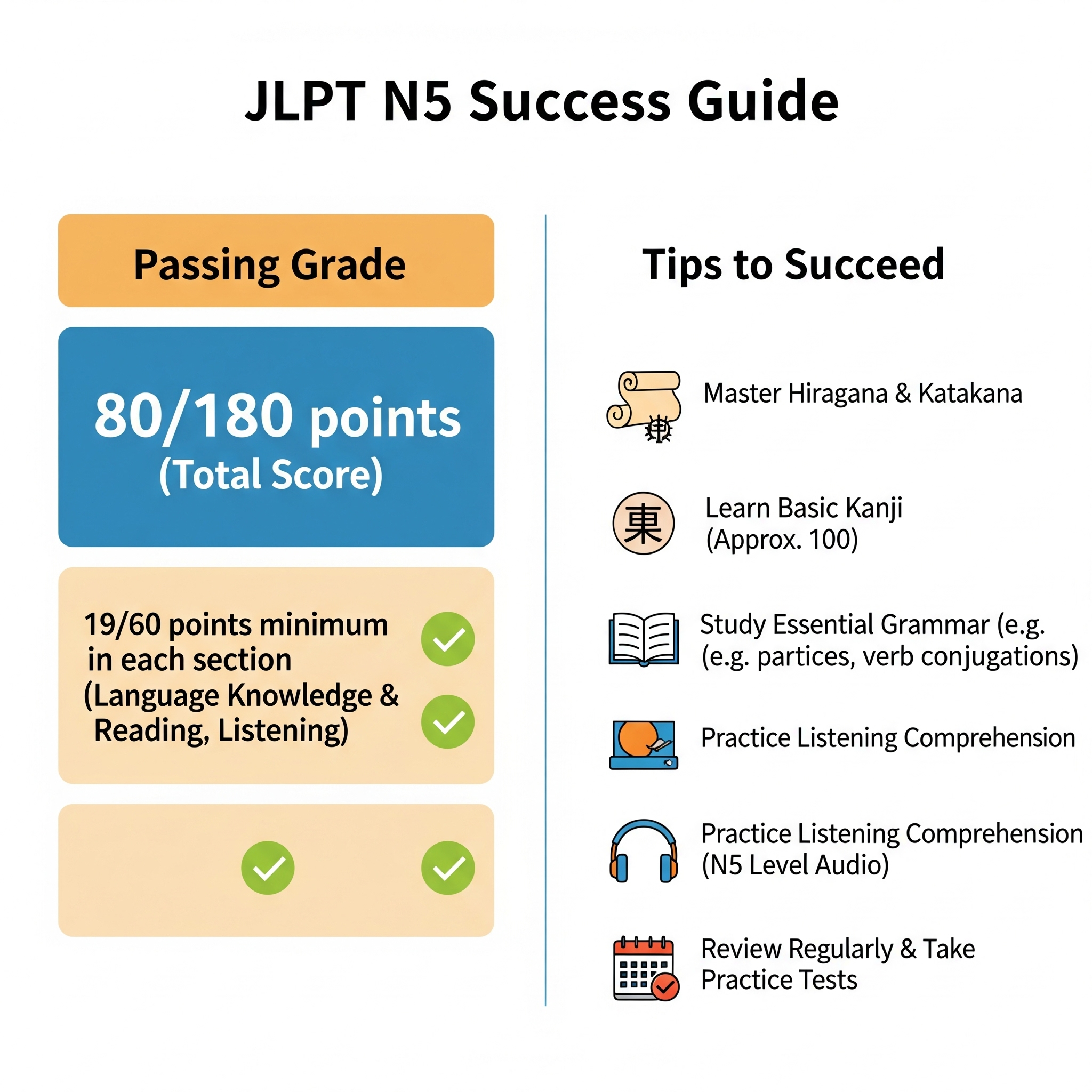
- An Overall Pass Mark: A total score of 80 points out of 180.
- Sectional Pass Marks: You must also achieve a minimum score in each section. This is called the “sectional pass mark” and it’s designed to ensure you have a balanced ability.
Here’s the breakdown for N5:
- Language Knowledge (Vocabulary & Grammar): 38/120 points
- Reading: 19/60 points
- Listening: 19/60 points
Think of it like this: You can’t fail the listening section completely but ace the reading and still pass. The test wants to confirm you have a basic, well-rounded foundation in all key areas.
But wait, 80 out of 180 is roughly 44%? That seems low! This is where most people get confused. The JLPT doesn’t use a simple percentage-based system. It uses a scaled scoring method called “Item Response Theory” (IRT).
What is Scaled Scoring? It’s Not About Raw Scores!
This is the most important concept to understand. Your final score is not just a tally of your correct answers (your “raw” score).
- Raw Score: The number of questions you answer correctly. (e.g., 45/60 correct in Vocabulary).
- Scaled Score: A converted score that the testing body calculates based on the difficulty of each question. This allows for a fair comparison across different test versions.
Why does this matter? Let’s say one test version has a brutally difficult reading passage. The scoring system will account for that. Getting a question wrong that almost everyone else got wrong will hurt your score less than getting a supposedly “easy” question wrong.
So, while you might walk out of the exam hall and calculate a raw score of 50%, the scaled score could come out to a passing 85! My advice? Don’t try to calculate your exact score based on correct answers. Focus on understanding the material thoroughly, and the scores will follow.
A Deep Dive into the N5 Test Sections
To conquer the enemy, you must know the enemy. The JLPT N5 isn’t a monster; it’s a very specific checklist of skills. Here’s what you’ll face:
1. Language Knowledge (Vocabulary) – ~15 minutes
This section tests your basic word power.
- What to expect: Kanji reading (how to read a kanji word), orthography (choosing the correct kanji for a hiragana word), contextually-defined expressions (choosing the right word for a sentence), and paraphrases (finding a word with a similar meaning).
- Expert Tip: Flashcards are your best friend here. But don’t just memorize in isolation. Use new words in a simple sentence. Apps like Anki (outbound link) are phenomenal for spaced repetition, a technique that helps cement vocabulary into your long-term memory.
2. Language Knowledge (Grammar) & Reading – ~40 minutes
This is a combined section that tests your understanding of basic sentence structure and your ability to comprehend short writings.
- Grammar: You’ll be tested on particle usage (は, が, を, に, で, etc.), basic verb conjugations (ます-form, て-form, dictionary form, past tense), and simple sentence patterns.
- Reading: You’ll read short passages like notices, messages, and short paragraphs (around 80-200 characters) and answer questions about them.
- Expert Tip: Grammar is about patterns. Instead of just reading grammar points, get a dedicated JLPT N5 grammar book like the “Shin Kanzen Master” or “Try!” series (outbound link to a store like White Rabbit Japan). These books drill the patterns through examples and exercises. For reading, practice is key. Start with children’s stories or dedicated N5 reading practice books.
3. Listening – ~30 minutes
This section often causes the most anxiety, but it’s very passable with practice.
- What to expect: It’s divided into task-based comprehension (responding to a short phrase), point comprehension (listening for a specific piece of info), and utterance expressions (choosing the most appropriate thing to say in a situation).
- Expert Tip: The listening is played only once. There are no repeats. The best way to prepare is to immerse yourself in slow, clear Japanese daily. My top recommendations are the Nihongo Con Teppei podcast for beginners and the YouTube channel Japanese Ammo with Misa (outbound links). Even 10-15 minutes a day will dramatically improve your ear.
Beyond the Books: Unique Tips to Guarantee Your N5 Success
Anyone can tell you to “study more.” Here are practical, human strategies that actually work.
1. Embrace the “Everyday Japanese” Mindset
The JLPT N5 is built on practical, daily life Japanese. Don’t just see it as an exam. See it as a toolkit for real life.
- Practical Application: Label items in your house with their Japanese names (冷蔵庫 – refrigerator, 机 – desk). When you make a shopping list, try to write one or two items in Japanese. Watch an anime or drama and try to pick out the N5 grammar points you’ve learned (“Ah, they used ~たい form!”).
2. Master Time Management Before Test Day
The time limits are strict, especially for the reading section.
- Strategy: When practicing, always use a timer. For the Reading section, a good tactic is to glance at the questions first so you know what information to look for when you read the passage. This saves you from reading the entire text multiple times.
3. Turn Your Weakness into Your Strength
We all have a section we dread. For most, it’s listening.
- Action Plan: If listening is your weak point, don’t avoid it. Attack it. For one week, make it your primary focus. Do 20 minutes of listening practice every single day. You’ll be shocked at how much you improve in just seven days. The brain adapts quickly.
4. The Power of the Practice Test
About a month before your exam, take a full, timed practice test under exam conditions. No phone, no breaks, no distractions.
- Why? This isn’t just to test your knowledge. It’s to practice your stamina, your focus, and your time management. It will expose your true weaknesses and make the actual test day feel familiar, not frightening. You can find official practice workbooks on the Official JLPT Website .
You’ve Got This!
Passing the JLPT N5 is an absolutely achievable goal. It requires consistent effort, but it doesn’t require genius. Understand the scoring system, familiarize yourself with the test format, and most importantly, connect your studying to the living, breathing language that is Japanese.
Remember, this test is a milestone, not the final destination. It’s a fantastic way to validate your hard work and give you the confidence to keep going to JLPT N4 and beyond.
Your journey is just beginning, and it’s going to be an amazing ride. がんばってください (Ganbatte kudasai) – Do your best!
P.S. Still feeling unsure about your preparation? Check out our other guides to build a solid foundation:
- Your First 100 Japanese Kanji: A Guide for JLPT N5
- How to Effectively Use Flashcards for Language Learning
- The Best Free Resources for Beginner Japanese Learners
- From N5 to N4: What to Expect on the Next Step of Your JLPT Journey


