Kon’nichiwa, future Japanese speakers! So, you’ve decided to take the plunge and sign up for the JLPT N5. First off, congratulations! Committing to this goal is a huge first step, and it’s completely normal to feel a mix of excitement and nerves. What exactly will be on the test? Is it as hard as it seems?
I remember my first JLPT exam. I was clutching my pencils, nervously double-checking the test venue, and wondering if I’d spent enough time with my textbook. Let me tell you a secret: the N5 is not a monster. It’s a friendly, structured check-in designed to confirm you’ve got the absolute basics down.
As someone who has both taken and prepared students for all levels of the JLPT, I’m here to demystify it for you. This isn’t just a list of topics; it’s a deep dive into the JLPT N5 questions themselves. We’ll break down each section, so you know exactly what to expect on test day. Let’s turn those nerves into confident energy!
What is the JLPT N5, Really?
Think of the N5 not as a final exam, but as a milestone. It’s the foundation. It proves you can understand and use basic Japanese you might encounter in everyday, familiar situations. The key is recognition and comprehension, not necessarily complex conversation.
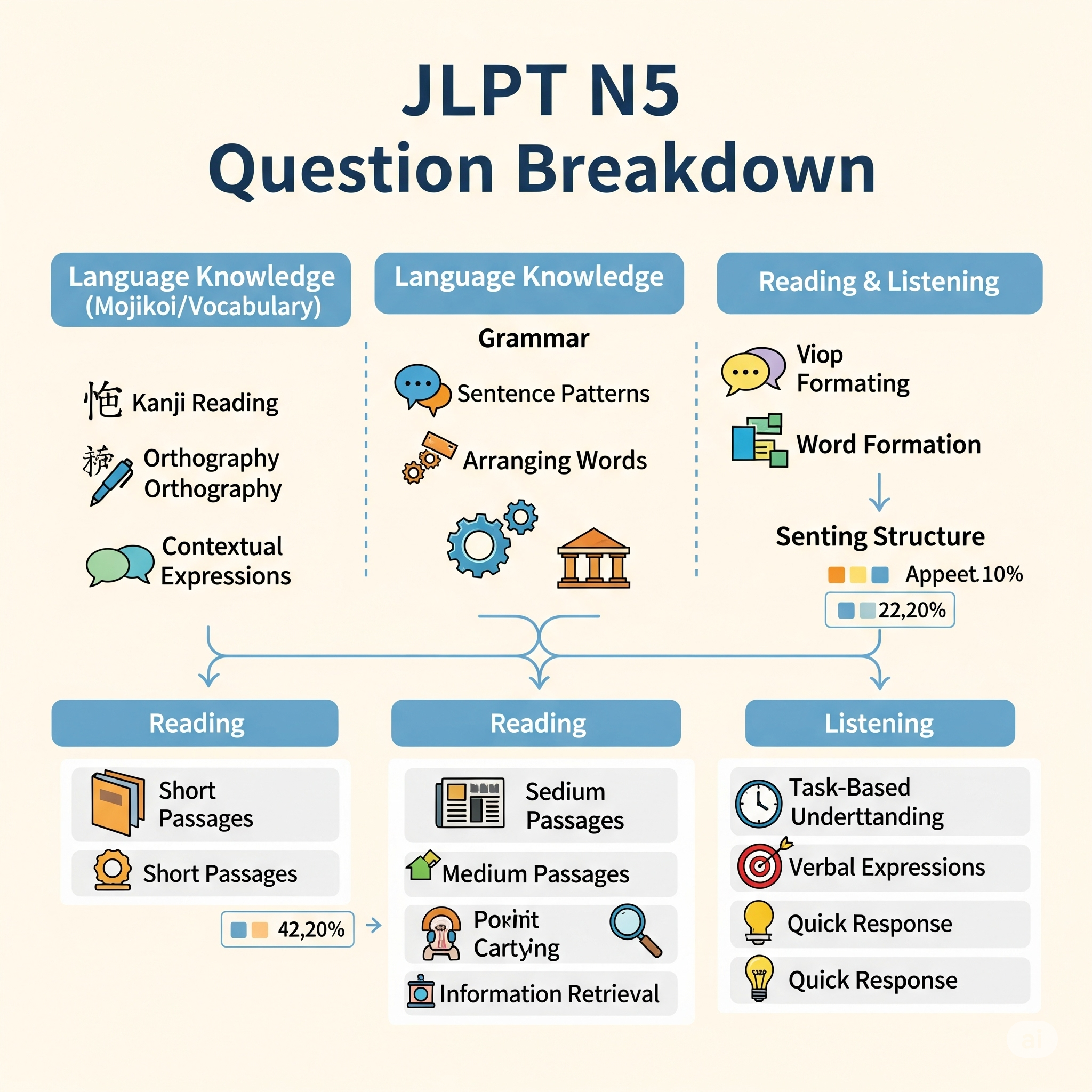
The test is divided into three main sections:
- Language Knowledge (Vocabulary) – 20 minutes
- Language Knowledge (Grammar) & Reading – 40 minutes
- Listening – 30 minutes
Total test time: about 1 hour and 30 minutes.
Now, let’s get into the nitty-gritty of each section.
Section 1: Language Knowledge (Vocabulary) – 文字・語彙 (Moji・Goi)
This section tests your basic word power. You’ll have 20 minutes to answer around 15-20 questions. The pace here is quick, so you can’t afford to dawdle.
What to Expect:
- Question Type 1: Kanji Reading (漢字読み). You’ll see a word written in kanji (like
学生) and have to choose the correct hiragana reading (がくせい) from four options.- Pro Tip: The kanji tested are the ~100 most fundamental ones (e.g., 人、日、月、山、水). Focus on learning these kanji with their core meanings and readings. Flashcards are your best friend here.
- Question Type 2: Orthography (表記). This is the reverse. You’ll see a word written in hiragana (like はは) and have to choose the correct kanji (母) from the options.
- Insight: This tests if you can link a sound to its written form. It’s common for beginners to mix up similar-looking kanji like 木 (tree) and 本 (book), so pay close attention to stroke differences.
- Question Type 3: Contextually Appropriate Expressions (文脈規定). You’ll get a short sentence with a blank and need to choose the most natural word to fill it.
- Example: “きのうはとても( )から、かさをもってでかけました。” (Yesterday was very ____, so I took an umbrella when I went out.) The correct choice would be あめ (rain).
- Practical Application: This is less about memorization and more about understanding basic word meaning in context. Read the whole sentence!
- Question Type 4: Paraphrases (言い換え類義). Find the word or phrase that means the same thing as the underlined part.
- Example: “わたしはまいあさコーヒーをのみます。” (I drink coffee every morning.) The answer might be いつも (always) or another time-related word.
- Pro Tip: This tests your vocabulary depth. You’ll need to know synonyms like びょういん (hospital) and 病院 (also hospital, in kanji).
Section 2: Grammar & Reading – 文法・読解 (Bunpou・Dokkai)
This 40-minute section is where you need to manage your time wisely. It has a grammar part and a (very) short reading part.
Part A: Grammar
The grammar questions test your understanding of basic sentence structure.
- Question Type 1: Sentence Structure (文法形式の判断). You’ll get a sentence with a blank and need to choose the correct grammar point to complete it.
- What to Study: This is where your textbook knowledge comes in. Expect to see particles like は、が、を、に、で, verb conjugations (ます-form, て-form, ない-form), and basic patterns like
~たいです(want to),~ことがあります(have done before), and~たり~たりします(do things like A and B).
- What to Study: This is where your textbook knowledge comes in. Expect to see particles like は、が、を、に、で, verb conjugations (ます-form, て-form, ない-form), and basic patterns like
- Question Type 2: Text Grammar (文の組み立て). You’ll be given a few words/phrases in jumbled order and must assemble them into a logical, grammatically correct sentence.
- Example: The words [でんしゃ・で・かいしゃ・いきます・へ] need to be ordered as: かいしゃへでんしゃでいきます。 (I go to company by train.)
- Insight: This tests your innate feel for Japanese sentence structure (Subject-Object-Verb). The best practice? Write sentences yourself! The more you write, the more natural the word order becomes.
Part B: Reading Comprehension
Don’t let the word “reading” scare you. At the N5 level, the passages are incredibly short and simple.
- Question Type 1: Short Passages. You’ll read a brief notice, message, or paragraph (about 100-200 characters) and answer questions about its main point or specific details.
- Example: A short note from a friend: “たなかさん、あしたのパーティーは 7じはんからです。にほんの りょうりを つくります。どうぞ 来てください。” The question might be “What time is the party?”
- Pro Tip: The answer is always in the text. Don’t overthink it! Practice skimming for keywords like time (何時), people (誰), and place (どこ).
- Question Type 2: Information Retrieval. This is like a real-life skill. You’ll be given a simple advertisement, schedule, or flyer and need to find a specific piece of information.
- Example: A bus schedule. The question might be, “If you want to arrive at the station by 9:00 AM, which bus should you take?”
- Practical Application: This is the most practical part of the test. It mimics exactly the kind of thing you’d need to do while traveling in Japan. Scan the document; you don’t need to read every word.
For a deeper dive into building this foundational knowledge, check out our guide on How to Start Learning Japanese: A Roadmap for Absolute Beginners.
Section 3: Listening – 聴解 (Choukai)
The 30-minute listening section can be intimidating because you only hear each clip once. But the content is slow, clear, and basic.
- Question Type 1: Task-Based Comprehension (課題理解). You’ll hear a short conversation followed by a question (played first on the recording!). You have to listen for what the speaker will do next.
- Example: A conversation might be about what to eat for lunch. The question is “What will the man eat?” You’ll need to listen for the final decision.
- Pro Tip: The first thing you hear is the question. WRITE IT DOWN. Knowing what information to listen for is half the battle.
- Question Type 2: Point Comprehension (ポイント理解). Similar to the first, but the question is often about a key point within the conversation (e.g., “Why is the woman tired?”). The question is also played first.
- Question Type 3: Verbal Expressions (発話表現). You’ll see a picture of a situation and listen to a short phrase. You have to choose the most appropriate response.
- Example: A picture of someone handing you a gift. You hear “どうも。” The best response is “どうぞ。” or “ありがとうございます。”
- Insight: This tests your knowledge of basic, everyday exchanges. It’s pure memorization of common social phrases.
- Question Type 4: Quick Response (即時応答). You hear a short statement or question and must choose the most natural response from three options.
- Example: You hear: “いっしょに ばんごはんを たべませんか。” (Won’t you eat dinner with me?)
- Correct responses would be things like “はい、たべましょう。” (Yes, let’s eat) or “すみません、ちょっと…” (Sorry, I’m a bit busy…).
- Pro Tip: This tests your conversational reflexes. The best practice is to shadow audio from your textbook or use apps like Japanesepod101 to get used to the rhythm of quick back-and-forths.
How to Conquer the N5: Your Study Battle Plan
- Master Your Textbooks: Complete books like Genki I or Minna no Nihongo I. They are perfectly aligned with the N5 curriculum.
- Kanji is Non-Negotiable: Aim for the first 100 kanji. Use spaced repetition systems (SRS) like Anki (outbound link) or WaniKani to make it stick.
- Listen Every Single Day: Even 15 minutes of Japanese audio daily—podcasts, anime (with Japanese subtitles!), textbook dialogues—will dramatically improve your listening skills.
- Take Practice Tests: This is the most important step. The Official JLPT Website offers sample questions. Familiarity with the format will reduce your anxiety immensely. For a more detailed plan, see our post on Creating a 3-Month JLPT N5 Study Schedule.
The Day of the Test: A Final Word of Encouragement
You’ve studied. You’ve practiced. You are ready. On test day, remember to breathe. If you get stuck on a question, mark it and move on. You can always come back. The N5 is a marathon of focus, not a sprint of genius.
Passing the N5 is an incredible feeling. It’s tangible proof that you’ve started this journey on the right foot. It’s the key that unlocks the door to N4 and beyond.
So, go in there with confidence. You’ve got this! がんばってください!(Good luck!)
Ready for the next challenge? Once you’ve mastered the N5, it’s time to look ahead to our overview of What to Expect on the JLPT N4 Exam.
JLPT N5 Kanji: How Many You Need to Learn