Kon’nichiwa, fellow language learners!
If you’re like me, you probably started learning Japanese with a textbook, a list of grammar rules, and… a sense of overwhelming dread. Don’t get me wrong, structured study is the backbone of language acquisition, especially for tackling the JLPT. But what if I told you that one of the most effective tools for achieving fluency is also one of the most enjoyable?
It’s true. For years, I’ve advocated for using authentic content, and nothing beats Japanese television and dramas. They are a living, breathing library of the language—far removed from the slow, overly-precise dialogues of old classroom CDs.
But here’s the catch: simply turning on Netflix and hoping to absorb Japanese through osmosis is like hoping to become a chef by watching the Food Network. You need a strategy.
In this guide, I’ll share my expert insights and practical steps on how to learn Japanese by watching TV and dramas effectively. This isn’t just about passive watching; it’s about active learning. Let’s dive in.
Why Your Favorite Dorama is a Secret Language Weapon
Before we get to the “how,” let’s talk about the “why.” Textbooks teach you about the language. TV shows teach you how the language lives.
- Real-World Japanese: You hear the language as it’s actually spoken—with contractions, slang, filler words (like えっと, etto), and all the beautiful imperfections of natural conversation. This is the opposite of the robotic, textbook-perfect Japanese.
- Cultural Context: Language is culture. You see how people bow on the phone, how they interact in a izakaya (Japanese pub), and the subtle nuances of honorifics (-san, -sama, -kun) in action. This cultural fluency is something you simply can’t get from a book.
- Listening Comprehension Bootcamp: Your ears will adapt to the speed, rhythm, and pitch accent of native speakers. This is invaluable preparation for the listening section of any JLPT level.
- Vocabulary in Context: Words and phrases stick in your memory better when they’re tied to a character’s emotion, a funny scene, or a dramatic plot twist.
The Golden Rule: Active Watching vs. Passive Watching
This is the most important concept in this entire guide. Passive watching is putting on a show with English subtitles and zoning out. You might pick up a word or two, but the progress is glacial.
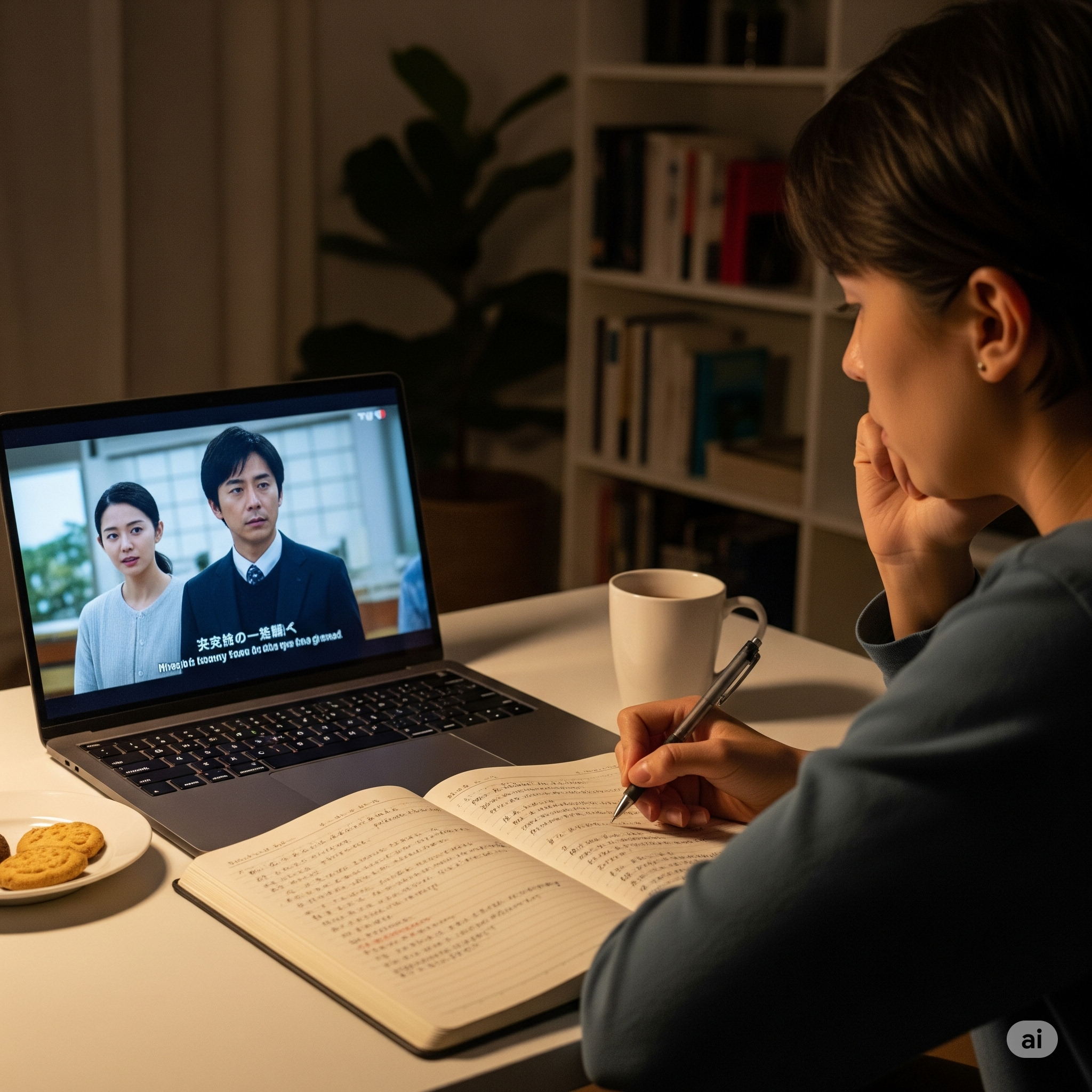
Active watching is treating your screen like a classroom. It requires effort, but the payoff is immense. Your goal is to shift from mostly passive to mostly active over time.
Your Step-by-Step Blueprint for Active Learning
Ready to transform your viewing habits? Follow this actionable plan.
Step 1: Choose the Right Content for Your Level
This is crucial. Starting with a complex historical drama (taiga dorama) or a fast-paced political thriller when you’re a beginner is a recipe for frustration.
- Beginner (N5-N4): Focus on kids’ shows, especially anime like
Chibi Maruko-chanorSazae-san. The language is simpler, the dialogue is slower, and the stories are often grounded in everyday life. You can explore more options in our guide on The Best Anime for Japanese Language Beginners. - Intermediate (N3-N2): This is the sweet spot for dramas. Slice-of-life shows like
Terrace House(unscripted!) orMidnight Dinerare fantastic. The conversations are natural and relatable. Anime likeShirokuma Cafeis also famous for its clear and relatively easy dialogue. - Advanced (N2-N1): You’re ready for anything! Dive into legal dramas, historical pieces, and rapid-fire comedies. Challenge yourself with variety shows like
Wednesday Downtownwhere natural, unscripted conversation reigns supreme.
Step 2: Strategic Viewing with Subtitles
Subtitles are a tool, not a crutch. Use them strategically:
- First Watch (With Japanese Subtitles): If available, always start with Japanese subtitles (字幕, jimaku). Watch the scene and try to follow along. Your goal is to connect the sounds you’re hearing to the words you’re reading. This reinforces reading and listening simultaneously.
- Identify and Note: Pause when you hear a word or grammar point you don’t know. Write it down! Look it up. I recommend a great digital tool for this like Jisho.org (outbound link to a fantastic online dictionary).
- Second Watch (Without Subtitles): Now, rewatch the same scene without any subtitles. See how much more you can understand now that you’ve dissected it. This is where the magic happens—your brain starts to parse the language on its own.
- Use English Subtitles Sparingly: Only use English subtitles after you’ve done the above steps, to check your comprehension. Relying on them first will train your brain to ignore the Japanese.
Step 3: The Power of the Pause Button and Shadowing
Your remote is your best friend.
- Pause and Repeat: Heard a cool phrase? Pause. Repeat it out loud. Mimic the intonation, the emotion, even the mouth movements. This builds muscle memory for your speech organs.
- Shadowing: As you get more comfortable, try “shadowing.” Play a short line of dialogue and try to speak it simultaneously with the character, like an echo. This dramatically improves your pacing and pronunciation.
Step 4: Note-Taking and Creating a Personal Phrasebook
Don’t just watch and forget. Be a linguist!
Keep a dedicated notebook or a digital app like Notion for your “TV Learnings.” For each episode, note down:
- New Vocabulary: Especially slang (e.g., めっちゃ, meccha – super) or onomatopoeia (e.g., ワクワク, waku waku – feeling excited).
- Grammar Patterns: “Ah, so that’s how you use 〜させられる (causative-passive) in a real sentence!”
- Cultural Notes: “So that’s how you properly accept a business card with two hands!”
Step 5: Review and Integrate
At the end of the week, review your notes. Add your new vocabulary to your SRS flashcard deck (like Anki or Memrise). Try to write a few sentences using the new grammar you learned. The key is to move the language from the TV screen into your own active repertoire.
Unique Insights from a JLPT Expert
As someone who’s deeply familiar with the JLPT, I can tell you that dramas are a secret weapon for the listening section. The exam often features conversations in everyday settings: a couple chatting in a kitchen, friends making plans, a customer in a store. These are exactly the scenarios you immerse yourself in through dramas.
Watching shows will train you to pick up on:
- Male vs. Female Speech Patterns: The differences between 俺 (ore), 僕 (boku), and 私 (watashi) for “I”.
- Humble and Honorific Speech (Keigo): Hearing 尊敬語 (sonkeigo) and 謙譲語 (kenjōgo) used correctly in a business context is priceless for N2/N1 students.
- Elliptical Speech: Japanese people often drop the subject of a sentence. TV trains your brain to infer meaning from context, a critical skill for the JLPT listening comp.
For a deeper dive into mastering this crucial aspect of the exam, check out our post on How to Conquer the JLPT Listening Section.
Recommended Shows to Get You Started
- For Absolute Beginners:
Yotsuba&!(anime) – Simple, everyday language. - For Intermediates:
Switched(Netflix) – Short, emotional, and relatively clear dialogue.Terrace House– The unscripted interactions are gold for learning natural speech. - For Advanced Learners:
Naoki Hanzawa– Great for business Japanese and keigo. ****
Tools to Supercharge Your Learning
- Language Reactor (Browser Extension): A game-changer for Netflix and YouTube. It allows you to display Japanese and English subtitles simultaneously, pause after every line, and easily click words to get definitions. This is one of the best tools out there, and you can learn more about it on their official website (outbound link).
- Netflix & Viki: Both have huge libraries of Japanese content. Viki often has a “Learn Mode” with crowd-sourced subtitles and notes.
- Anki: The king of SRS. Create flashcards from the sentences you mine from your shows.
If you’re looking to build a full study plan that incorporates these methods, our Ultimate JLPT Study Plan Guide is a great next step.
Embrace the Journey
Learning Japanese by watching TV is not a shortcut; it’s a highly effective supplement. There will be times when you understand nothing and it feels exhausting. That’s normal. Celebrate the small victories—the first time you understand a full sentence without subtitles, the first time you use a phrase you heard in a drama.
So, grab your notebook, choose a show, and push play. Your next great Japanese lesson is about to begin.
Happy watching (and learning)!
またね! (See you later!)
Does Watching Anime Help You Learn Japanese? What Science Says
Best Manga to Learn Japanese (Fun Reading for Learners)
Can You Really Learn Japanese from Anime? My Honest Take