Let’s cut to the chase. You’re here because you’ve set your sights on the summit of Japanese language proficiency: the JLPT N1. It’s a formidable goal, and the most common question I get from dedicated learners like you is, “Sensei, just how many hours of study am I looking at?”
The short, textbook answer is approximately 3000-4800 hours of total study from absolute beginner to N1 mastery, as suggested by the Japan Foundation. But if you’re already at, say, N3 or N2, that number is useless without context. Throwing around a number like 3000 hours can be paralyzing. It sounds less like a study plan and more like a life sentence!
As someone who has both passed the N1 and guided dozens of students to success, I’m here to tell you that the raw number of hours is the least important part of the equation. How you use those hours is everything.
Today, we’re going to move beyond the scary numbers and break down what the N1 truly demands, how to audit your current skills, and how to build a realistic, human-friendly study plan that won’t lead to burnout.
What Does the JLPT N1 Actually Test? It’s More Than Just Vocabulary
Before we can count the hours, we need to understand the beast. The N1 isn’t just an advanced version of the N2. There’s a fundamental shift in what it tests.
- Reading (読解 – Dokkai): This is where many candidates falter. We’re no longer talking about blog posts or simple news articles. N1 reading consists of complex, abstract essays on topics like sociology, psychology, and culture, dense academic abstracts, and lengthy critiques. It requires you to follow nuanced arguments and understand the author’s intent, not just the literal meaning of the words. You’ll need to read between the lines.
- Listening (聴解 – Choukai): Forget clear, slow dialogues. N1 listening features natural-speed conversations between multiple native speakers, often with dropped particles, slang, and implied meanings. You’ll hear news reports, university lectures, and workplace discussions where you have to quickly synthesize information and identify a speaker’s point of view.
- Grammar (文法 – Bunpou) & Vocabulary (語彙 – Goi): Yes, you need to know around 10,000 vocabulary words and hundreds of advanced grammar patterns. But the test doesn’t ask you to recite them. It demands you can differentiate between subtly different expressions and choose the one that is most natural and contextually appropriate. It’s about precision.
The unique insight here is that N1 is a test of applied reasoning in Japanese, not just rote memorization. This is why the quality of your study hours is so critical.
The 3000-Hour Myth: auditing Your Starting Point
The 3000-4800 hour figure is a benchmark for a complete beginner with no prior kanji knowledge (e.g., an English native speaker). It’s a vast oversimplification.
A much more honest approach is to audit your current abilities. Ask yourself:
- What is my strongest skill? Are you a reading wizard but freeze during listening? Or maybe your vocabulary is vast, but grammar patterns trip you up?
- How is my “passive” knowledge vs. “active” knowledge? You might be able to recognize a kanji when reading (passive), but can you recall it and write it from memory (active)? The JLPT is primarily a test of passive recognition, which is slightly less demanding.
- What’s my previous JLPT experience? The jump from N2 to N1 is famously steep. Here’s a more granular breakdown:
- From N2 to N1: You’re looking at a dedicated 900 – 1500 hours of targeted study. N2 is functional fluency; N1 is comprehensive mastery.
- From N3 to N1: This is a significant leap. You’ll likely need 1500 – 2500 hours.
- Self-Studied (No Formal Test Taken): Be brutally honest with yourself. Take a official JLPT practice test (outbound link) under timed conditions. Your score will tell you more than any guesswork can.
Building Your Personalized N1 Study Plan: Quality Over Quantity
Okay, let’s get practical. Let’s say you’ve determined you need about 1200 hours of study. How do you structure that?
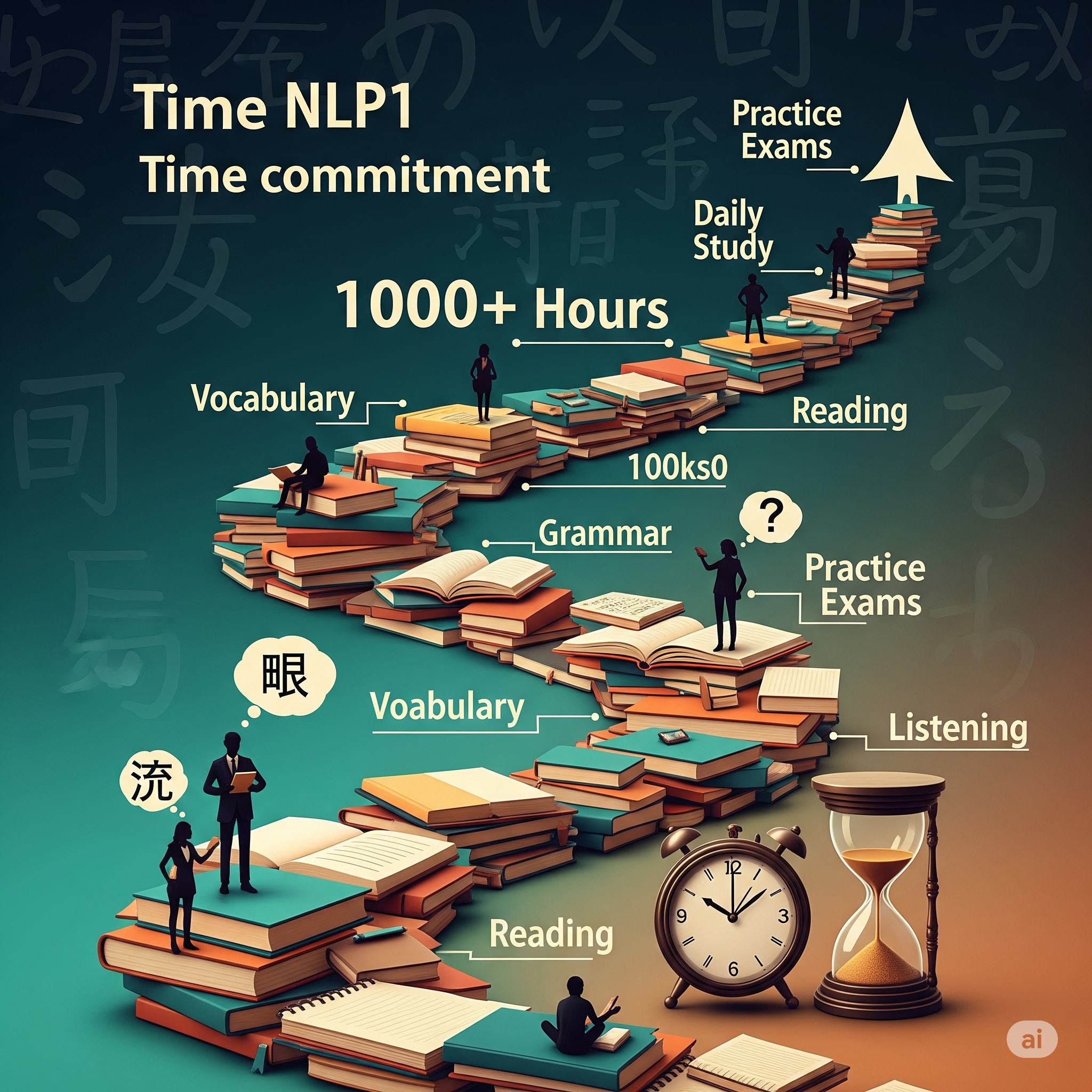
A 12-Month, Human-Friendly Plan (Example: ~1200 hours)
This breaks down to about 100 hours per month, or 3-4 hours of focused study per day. Before you panic, remember: this includes listening to podcasts during your commute or reviewing flashcards on your phone.
- Months 1-3: The Foundation Phase (~300 hours)
- Focus: Rote memorization and input. This is the grind.
- Action: Systematically work through an N1 grammar book ( like So-Matome N1 or Shin Kanzen Master N1) (affiliate links) and a kanji/vocab book. Aim to learn 20-25 new words and 2-3 grammar points every single day.
- Pro Tip: Don’t just memorize the meaning. For each new word or grammar point, find and write down one real-world example sentence. This builds context, which is key for N1. Our guide on Building a Killer Japanese Vocabulary Notebook can help you here.
- Months 4-9: The Application Phase (~600 hours)
- Focus: Shifting from input to output. This is where you make those hours count.
- Reading: Read, read, read. Not just textbooks. Read Japanese news articles on Asahi Shimbun (outbound link), opinion pieces on NewsWeb Easy (outbound link) (then graduate to full NHK news), and short stories. Don’t look up every word. Try to infer meaning from context.
- Listening: Immerse yourself. Switch your podcast app to Japanese content. Listen to NHK Radio News (outbound link) daily. Watch Japanese dramas and anime without subtitles, then re-watch with Japanese subtitles to confirm your understanding.
- Grammar/Vocab: Start doing tons of practice questions. You’ll see how the patterns you memorized are actually tested.
- Months 10-12: The Exam Mastery Phase (~300 hours)
- Focus: Test-taking strategy and endurance.
- Action: Take full, timed practice tests once every two weeks. This is non-negotiable. The N1 is a marathon of focus. You need to build the mental stamina to concentrate for nearly three hours.
- Review: After each test, don’t just check your score. Analyze every mistake. Why did you get it wrong? Was it a vocabulary gap? A misreading of the question? A failure in listening comprehension? This analysis is where the most significant learning happens. For a deep dive on this, check out My JLPT Test-Day Strategy: A Step-by-Step Guide.
Unique Insights from a JLPT Veteran
- The “One-Minute Rule”: If you can’t figure out a reading question in one minute, circle your best guess, mark it, and move on. The biggest mistake is wasting precious time on one problem and then having to rush through the last 10. Time management is a skill you must practice.
- Master the Answer Sheet: The listening section gives you almost no time between questions. Practice shading those bubbles quickly and accurately during your practice tests. It sounds silly, but under pressure, every second counts.
- Your Phone is Your Best Friend and Worst Enemy: Use it for Anki flashcards, listening to podcasts, and reading news. But during your dedicated study hours, put it on Do Not Disturb. A distracted hour does not count as a study hour.
Keyphrase Integration and Final Motivation
The journey to prepare for JLPT N1 is long, but it is also incredibly rewarding. The number of hours needed for JLPT N1 is less important than your consistency. The JLPT N1 preparation time is a investment in not just a certificate, but in a deeper understanding of the Japanese language and culture.
You will have days where you feel like you’ve forgotten everything. You will stare at a page of kanji and see squiggles. This is normal. This is part of the process.
Remember, how many hours to study for JLPT N1 is your personal equation. Don’t compare your chapter 1 to someone else’s chapter 20. Trust your plan, focus on high-quality, engaged study time, and consistently apply yourself.
You can conquer this mountain. 頑張ってください (Ganbatte kudasai)!
Ready to start your journey but not sure where to begin? Download our free JLPT N1 Study Plan Checklist to track your progress and stay organized!