Konnichiwa, fellow Japanese language learner!
So, you’ve set your sights on the JLPT N4. That’s awesome! It’s a huge and rewarding step up from N5, moving you from simple phrases to actually having real conversations and understanding more of the Japanese you encounter in anime, manga, and daily life.
But let me guess: life is busy. Between work, family, and other responsibilities, finding time to study feels like a mission impossible. You might be thinking, “Can I really go from N5 to confidently passing N4 in just six months?”
The answer is a resounding yes—if you have a smart, structured, and realistic plan. As someone who has both taken and tutored students for the JLPT, I’m here to tell you that it’s not about having endless free time; it’s about using the time you do have effectively.
This isn’t another generic list of textbooks. This is a practical, human-friendly roadmap designed for busy learners like you. We’ll break down the journey into manageable chunks, focus on what truly matters, and integrate learning seamlessly into your life.
What Does the JLPT N4 Actually Test?
Before we dive into the schedule, let’s understand the battlefield. The N4 is a significant leap from N5. The Japan Foundation estimates you need to know about:
- Kanji: ~300 characters (up from ~100 at N5)
- Vocabulary: ~1,500 words (up from ~800 at N5)
- Grammar: All the N5 grammar points, plus approximately 100 new N4-level structures.
The exam is divided into three sections:
- Language Knowledge (Vocabulary): 30 mins
- Language Knowledge (Grammar) & Reading: 60 mins
- Listening: 35 mins
The key insight many miss? The sections are timed tightly. You not only need to know the material but also need to be able to access it quickly under pressure. Our plan will build both knowledge and speed.
The Core Philosophy: Consistency Over Cramming
Forget all-night study sessions. For a busy learner, consistency is your most powerful weapon. Studying for 30-45 minutes every day is infinitely more effective than studying for 5 hours on a Saturday and then doing nothing for the rest of the week. Language learning is about building neural pathways, and that requires daily repetition.
Your mantra for the next six months: “A little every day.”
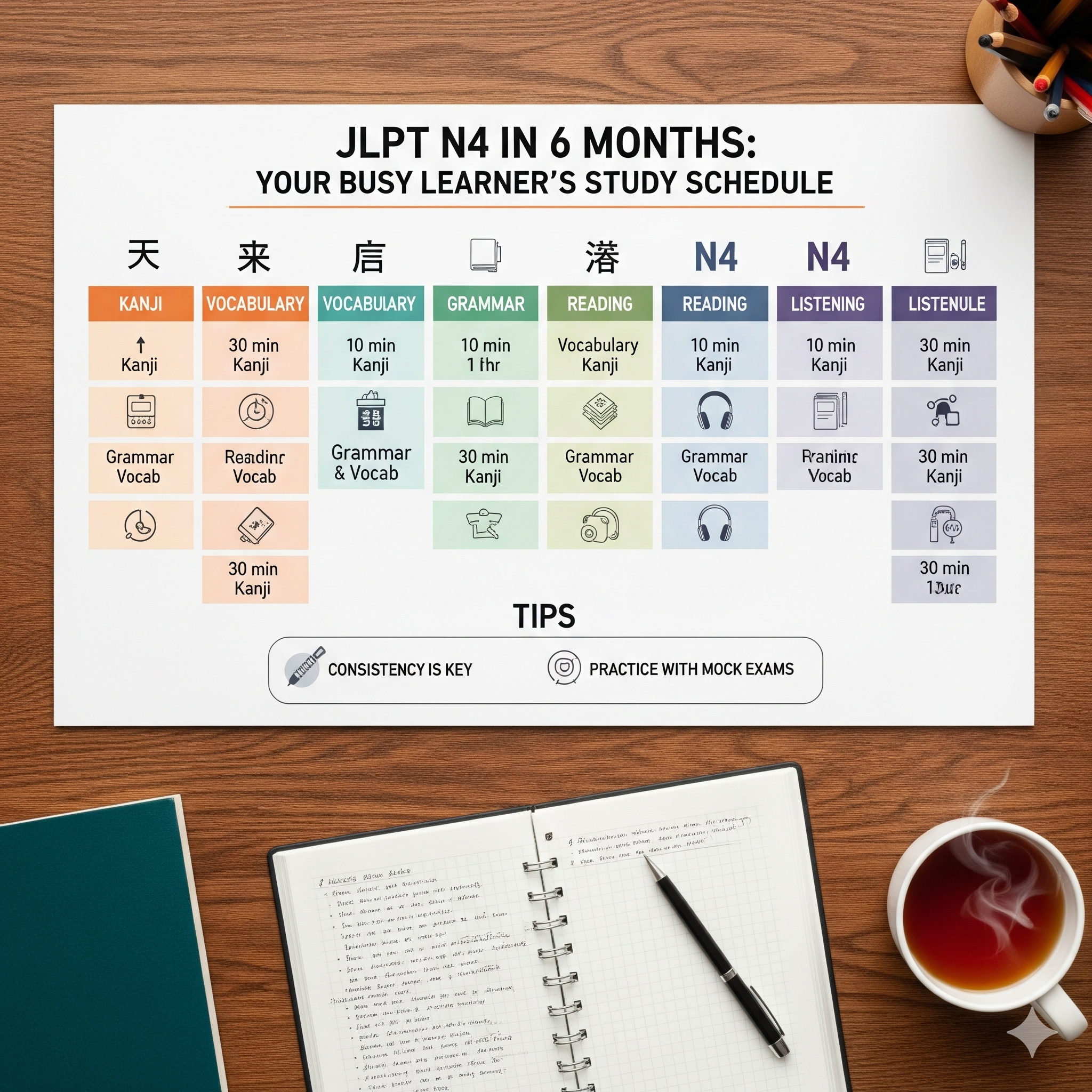
Your 6-Month JLPT N4 Study Schedule
This schedule is divided into phases, each building on the last. Feel free to adjust the timelines by a week or two based on your personal pace.
Months 1-2: Laying the Foundation (Vocabulary & Kanji Boost)
Goal: Reactivate your N5 knowledge and build a strong base of N4 vocab and kanji.
- Weekly Time Commitment: 5-6 hours (e.g., 45 mins/day + a slightly longer session on the weekend).
- Focus: 70% Vocabulary/Kanji, 30% Grammar.
How to Do It:
- Kanji: Don’t just memorize characters in isolation. Learn them with vocabulary. Use a dedicated resource like the “Basic Kanji Book” or an app like Kanji Study. Aim for 3-5 new kanji per day. For each one, learn 2-3 common words that use it. (e.g., 勉 ben (exertion) → 勉強 benkyou (study)).
- Vocabulary: This is your priority. Use a digital SRS (Spaced Repetition System) flashcard app like Anki or Memrise. Find a pre-made “JLPT N4 Vocabulary” deck and commit to reviewing it every single day. Even on your busiest day, do your reviews—it only takes 10-15 minutes.
- Grammar: Start working through a core textbook. I highly recommend the “Try! series” or “Shin Kanzen Master N4 Grammar”. Don’t just read the points. Copy the example sentences. This builds muscle memory for sentence structure.
- Practical Application: Label items in your house with sticky notes (Japanese + kanji). Change your phone’s language to Japanese for 15 minutes a day. Listen to Japanese music during your commute and try to pick out words you know.
Months 3-4: Diving Deep into Grammar & Reading
Goal: Master N4 grammar patterns and apply your vocab knowledge to reading comprehension.
- Weekly Time Commitment: 6-7 hours.
- Focus: 50% Grammar, 30% Reading, 20% Vocab/Kanji Review.
How to Do It:
- Grammar: By now, you should be halfway through your grammar book. Your focus shifts from “what does this mean?” to “how is it different from…?“. A lot of N4 grammar points are frustratingly similar (e.g., そうだ, ようだ, らしい). Create a comparison chart for yourself. Write short paragraphs using 2-3 new grammar points together.
- Reading: This is where it gets real! Start reading simple, short-form content. NHK Web Easy is a fantastic resource for beginner-friendly news articles. Satori Reader is another incredible tool with built-in dictionaries and grammar explanations. Don’t try to understand every word. Focus on grasping the main idea using the grammar and kanji you know.
- Listening: Start incorporating practice. Listen to a podcast like Nihongo Con Teppei for beginners. Don’t worry about understanding everything. The goal is to get your ears accustomed to the speed and rhythm of natural speech.
Month 5: The Listening Push & Integrated Practice
Goal: Sharpen your listening skills and start combining all elements with practice tests.
- Weekly Time Commitment: 6-7 hours.
- Focus: 40% Listening, 30% Full-Length Practice, 30% Weakness Review.
How to Do It:
- Listening: This is often the hardest section for non-native speakers. Move from passive to active listening. Use past paper listening sections or dedicated JLPT prep apps. Listen to the same clip three times: first for gist, second for details, and third while reading the transcript to identify what you missed.
- Mock Exams: This is crucial. Take your first full-length practice test under timed conditions at the start of the month. This isn’t to pass; it’s to diagnose your weaknesses. Do you run out of time in reading? Does the listening section feel too fast? This test tells you exactly what to work on for the next month.
- Review: Based on your mock test, dedicate time to your weak areas. Was grammar your downfall? Drill those confusing points. Was kanji recognition slow? Ramp up your flashcard reviews.
Month 6: Final Review & Test Strategy
Goal: Solidify knowledge, build test-taking endurance, and boost confidence.
- Weekly Time Commitment: 5-6 hours (taper off slightly the week before the test to avoid burnout).
- Focus: 60% Practice Tests & Timed Drills, 40% Targeted Review.
How to Do It:
- Practice Tests: Take 2-3 more full-length practice tests throughout the month. The goal here is to build stamina and familiarity with the test format. The JLPT is a marathon, and you need to condition yourself for it.
- Error Log: Keep a notebook of every question you get wrong. Write down why you got it wrong. Was it a vocabulary gap? A misheard sound? A misread grammar pattern? Review this error log daily.
- Strategy: Develop a test-day strategy. For the reading section, will you skim the questions first? For listening, will you jot down quick notes? Having a plan reduces anxiety.
- The Final Week: Do not try to learn anything new! This week is for light review, flipping through your error log, and listening to Japanese daily to keep your ears sharp. Trust in the work you’ve done.
Essential Resources for Your Journey
- Primary Textbooks:
- Try! JLPT N4: Excellent for grammar with clear explanations and practice questions.
- Shin Kanzen Master N4 Series: More rigorous and detailed, fantastic for drilling.
- Basic Kanji Book Vol. 1 & 2: The best step-by-step kanji learning system I’ve found.
- Online Tools & Apps:
- Anki (App/Website): Non-negotiable for SRS flashcard review.
- Jisho.org (Website): The best online Japanese dictionary.
- Satori Reader (Website/App): The best tool for guided reading practice (subscription worth it).
- NHK Web Easy (Website): Free, simplified news articles.
- Practice Tests: The official JLPT Official Practice Workbook (free download) is the gold standard. Also, look for past papers online.
For a deeper dive into building your core vocabulary, check out our post on <a href=”/blog/effective-japanese-vocabulary-building” target=”_blank”>Effective Techniques for Building Japanese Vocabulary</a>.
Unique Insights from a JLPT Veteran
- The Power of “Voice”: When you learn a new grammar point, don’t just read the example sentence. Say it out loud. Give it a context and an emotion. This creates a stronger memory hook than silent reading.
- Embrace the “I Don’t Know” Strategy: On the test, you will encounter unknown words. Don’t panic. Use the kanji knowledge you have to make an educated guess, or skip it and move on. Getting stuck on one question can cost you time for five others.
- Listening is a Muscle: Your listening ability will likely feel like it’s not improving until suddenly, it does. It’s a plateau that leads to a spike. Trust the process and keep listening daily, even if it’s just for 10 minutes.
If listening is your biggest worry, I break down the techniques further in my article <a href=”/blog/mastering-jlpt-listening” target=”_blank”>How to Master the JLPT Listening Section</a>.
You Can Do This!
Passing the JLPT N4 in six months while busy is a challenge, but it’s an incredibly achievable one. It requires a plan, dedication, and self-compassion. Some days you’ll miss your study goal, and that’s okay. Just get back on track the next day.
This journey is about more than a certificate; it’s about unlocking a deeper level of connection with the Japanese language and culture. Every kanji you learn, every sentence you understand, is a victory.
Share your goal with friends or find an online study group for accountability. And when you pass—because you will with this plan—come back and tell us your story!
頑張ってください!(Ganbatte kudasai!) Do your best!
How to Pass JLPT N4 in 2 Months: Your Expert Fast-Track Study Plan
How to Prepare for JLPT N4: Proven Study Strategies
JLPT N4 Grammar Test: Practice Questions & Answer Keys