
Konnichiwa, future Japanese speakers! So, you’ve started your journey to learn Japanese and are tackling the JLPT N5. It’s an exciting first step, and you’ve probably already met some of the most colorful characters in the language: adjectives.
If you’ve read our pillar post, [IJLPT N5 Vocabulary Complete List: Nouns, Verbs, Adjectives & Flashcards, you’ll know that adjectives are a core part of the foundation. But let’s be honest, when you first hear “i-adjectives” and “na-adjectives,” it can sound a bit… technical. Maybe even a little daunting.
Don’t worry! I’m here to demystify it all. Think of me as your friendly senpai (先輩 – senior) guiding you through the woods. By the end of this guide, you won’t just memorize the rules; you’ll understand them. We’ll cover everything from the essential JLPT N5 adjectives list to how to use them in real conversations, complete with conjugation charts, common mistakes, and unique insights I’ve gathered from years of teaching.
Let’s turn this topic from a challenge into your strength!
First Things First: What Are Japanese Adjectives Like?
In English, adjectives are pretty straightforward. They don’t change much. “A big cat” becomes “the cat is big.” The word “big” stays… well, big.
Japanese adjectives are more dynamic. They conjugate. This means their endings change to express tense (past vs. non-past) and positivity ( affirmative vs. negative). It’s similar to how verbs change in many languages. This is the single most important concept to grasp early on!
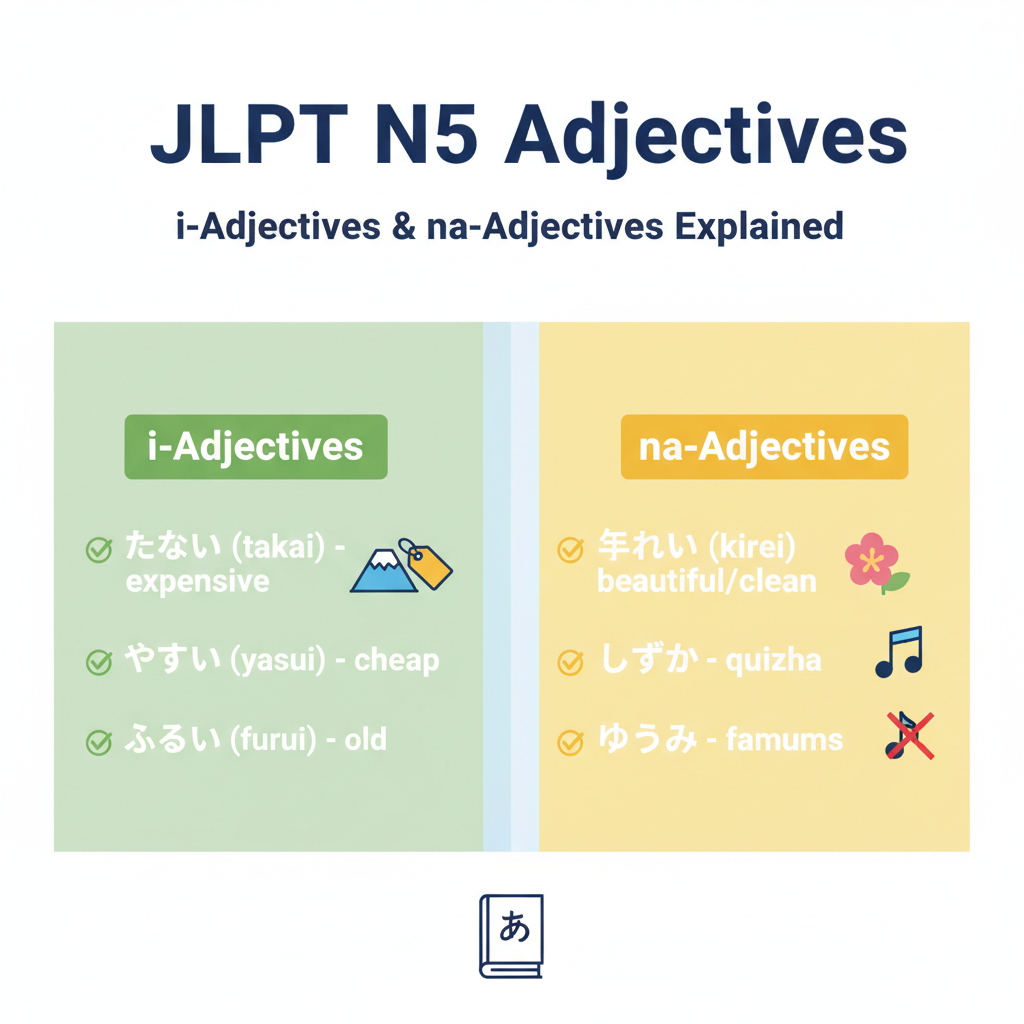
For the JLPT N5, you need to know the two main families:
- い-Adjectives (i-adjectives)
- な-Adjectives (na-adjectives)
Their names come from how they connect to nouns. Let’s meet the families.
The い-Adjectives: The Straightforward Siblings
い-adjectives are, in many ways, the easier of the two to spot. They are loyal and always end with the Hiragana character い (i) when in their plain, dictionary form.
Examples:
- あつい (atsui) – hot
- さむい (samui) – cold
- たかい (takai) – expensive; high
- おいしい (oishii) – delicious
- やすい (yasui) – cheap
The key insight here is that the い is part of the adjective itself. It’s not just a suffix; it’s integral to the word. This becomes crucial when we start conjugating.
How to Conjugate い-Adjectives
This is where the magic happens. We change the final い to express different meanings. Let’s use たかい (takai – expensive/high) as our example.
| Form | How to Conjugate | Example (たかい) | Meaning |
|---|---|---|---|
| Non-Past (Present/Future) | Dictionary form | たかい | is expensive |
| Non-Past Negative | Replace い with くない | たかくない | is not expensive |
| Past Affirmative | Replace い with かった | たかかった | was expensive |
| Past Negative | Replace い with くなかった | たかくなかった | was not expensive |
Practical Application:
- 今日はあついです。 (Kyō wa atsui desu.) – It is hot today.
- 昨日はあつくなかったです。 (Kinō wa atsukunakatta desu.) – It was not hot yesterday.
- このりんごはおいしくない。 (Kono ringo wa oishikunai.) – This apple is not delicious. (Note: Omitting
desumakes it plain form, which is also needed for N5!).
See how the い in あつい changes to くない or くなかった? It’s a predictable pattern. Once you learn it for one, you know it for all い-adjectives!
For more details, please visit Complete JLPT N5 Vocabulary List with Meanings
The な-Adjectives: The Chill Cousins
な-adjectives are a bit more relaxed. In their dictionary form, they do not end with い. However, some can end with い (like きれい), which is the primary source of confusion for beginners!
Examples:
- しずか (shizuka) – quiet
- きれい (kirei) – pretty; clean
- げんき (genki) – healthy; energetic
- すき (suki) – liked (a favourite!)
- べんり (benri) – convenient
The Golden Rule: If a word that means an adjective and looks like it ends in い isn’t on your い-adjective list… it’s probably a な-adjective. きれい is the classic example. It ends with い but is a な-adjective! We say きれいな花 (kirei na hana – a pretty flower).
They are called “な-adjectives” because they need な (na) to connect directly to a noun.
How to Conjugate な-Adjectives
Here’s the good news: な-adjectives themselves don’t change. They are static. Instead, we conjugate the copula (the “is” part of the sentence), which is です (desu).
Let’s use しずか (shizuka – quiet) as our example.
| Form | How to Conjugate | Example (しずか) | Meaning |
|---|---|---|---|
| Non-Past (Present/Future) | + です | しずかです | is quiet |
| Non-Past Negative | + では ありません / じゃ ありません | しずかでは ありません | is not quiet |
| Past Affirmative | + でした | しずかでした | was quiet |
| Past Negative | + では ありませんでした / じゃ ありませんでした | しずかでは ありませんでした | was not quiet |
Practical Application:
- このとしょかんはしずかです。 (Kono toshokan wa shizuka desu.) – This library is quiet.
- そのへやはしずかではありませんでした。 (Sono heya wa shizuka de wa arimasen deshita.) – That room was not quiet.
- わたしはコーヒーがすきです。 (Watashi wa kōhī ga suki desu.) – I like coffee. (Lit: As for me, coffee is liked.)
Notice how しずか never changes? We only play with the desu that follows it. This makes conjugating な-adjectives very simple once you memorize the forms of desu.
Side-by-Side Comparison: i-Adjective vs. na-Adjective
Let’s put it all together in a direct comparison. This is the kind of clear view students find incredibly helpful.
| Feature | い-Adjective (e.g., たかい) | な-Adjective (e.g., しずか) |
|---|---|---|
| Dictionary Form | Ends with い | Does not usually end with い |
| Modifying a Noun | 直接 (Directly) たかい + ほん = たかいほん (an expensive book) | 需要 な (Needs な) しずか + な + まち = しずかなまち (a quiet town) |
| Present Tense | たかいです (is expensive) | しずかです (is quiet) |
| Present Negative | たかくないです / たかくありません (is not expensive) | しずかでは ありません (is not quiet) |
| Past Tense | たかかったです (was expensive) | しずかでした (was quiet) |
| Past Negative | たかくなかったです (was not expensive) | しずかでは ありませんでした (was not quiet) |
Must-Know JLPT N5 Adjectives List
Now for the gold you came for! Here is a curated list of the most common adjectives you will encounter on the JLPT N5, sorted by type. Pro Tip: Don’t just read this list. Say them out loud! Create flashcards. Try to use each one in a simple sentence.
Common い-Adjectives for JLPT N5
| Adjective | Hiragana | Romaji | Meaning |
|---|---|---|---|
| 赤い | あかい | akai | red |
| 青い | あおい | aoi | blue |
| 白い | しろい | shiroi | white |
| 黒い | くろい | kuroi | black |
| 新しい | あたらしい | atarashii | new |
| 古い | ふるい | furui | old (thing) |
| いい / 良い | いい / よい | ii / yoi | good |
| 悪い | わるい | warui | bad |
| 大きい | おおきい | ōkii | big |
| 小さい | ちいさい | chīsai | small |
| 高い | たかい | takai | expensive; high |
| 安い | やすい | yasui | cheap |
| 熱い | あつい | atsui | hot (object) |
| 冷たい | つめたい | tsumetai | cold (object) |
| 暑い | あつい | atsui | hot (weather) |
| 寒い | さむい | samui | cold (weather) |
| 難しい | むずかしい | muzukashii | difficult |
| 易しい | やさしい | yasashii | easy |
| 面白い | おもしろい | omoshiroi | interesting |
| つまらない | つまらない | tsumaranai | boring |
Unique Insight: Notice いい (good)? It’s an irregular い-adjective. Its conjugations don’t come from いい but from its older form, よい.
- いいです -> is good
- よくないです -> is not good (not いくない)
- よかったです -> was good (not いかった)
- よくなかったです -> was not good
It’s the most common exception, so just memorize these four forms.
Common な-Adjectives for JLPT N5
| Adjective | Hiragana | Romaji | Meaning |
|---|---|---|---|
| 静か | しずか | shizuka | quiet |
| きれい | きれい | kirei | pretty; clean |
| 元気 | げんき | genki | healthy; energetic |
| 好き | すき | suki | liked |
| 嫌い | きらい | kirai | disliked |
| 便利 | べんり | benri | convenient |
| 不便 | ふべん | fuben | inconvenient |
| 大事 | だいじ | daiji | important |
| 大丈夫 | だいじょうぶ | daijōbu | okay; safe |
| 有名 | ゆうめい | yūmei | famous |
| 親切 | しんせつ | shinsetsu | kind |
For more vocabulary, please check out JLPT N5 Vocabulary with Example Sentences for Daily Use
Beyond the Basics: Practical Application and Common Mistakes
Knowing the list is one thing. Using them correctly is another. Here’s how to sound more natural and avoid classic beginner errors.
1. The は vs. が Particle with Adjectives
This is a huge source of confusion. When do you use は (wa) and when do you use が (ga) with adjectives?
- Use は (wa) to state a general fact or topic.
- このカレーはおいしいです。 (Kono karē wa oishii desu.) – As for this curry, it is delicious. (This is a general statement about the curry.)
- Use が (ga) to identify or specify something, often for the first time.
- あ、おいしいカレーがありますね! (A, oishii karē ga arimasu ne!) – “Oh, there’s delicious curry!” (You’re pointing out its existence or identifying it.)
2. Using Adjectives as Nouns
You can add の (no) or なの (na no) to an adjective to turn it into a noun phrase. This is like saying “the red one” or “the quiet one.”
- い-Adjective: 赤い + の = 赤いの (akai no) – the red one
- その赤いのはいくらですか。 (Sono akai no wa ikura desu ka?) – How much is that red one?
- な-Adjective: 静か + な + の = 静かなの (shizuka na no) – the quiet one
- しずかなのがいいです。 (Shizuka na no ga ii desu.) – I want the quiet one. (Lit: The quiet one is good.)
3. Connecting Adjectives
Want to say “that restaurant is cheap and delicious”? You can connect adjectives with the te-form.
- い-Adjectives: Replace the final い with くて
- 安い (yasui) -> 安くて (yakute)
- おいしい (oishii) -> おいしくて (oishikute)
- あのレストランは安くておいしいです。 (Ano resutoran wa yasukute oishii desu.)
- な-Adjectives: Use で (the te-form of です)
- しずか (shizuka) -> しずかで
- きれい (kirei) -> きれいで
- この公園はしずかできれいです。 (Kono kōen wa shizuka de kirei desu.) – This park is quiet and beautiful.
Study Tips from a Sensei
- Learn in Pairs: Study opposites together. 大きい (big) and 小さい (small). 熱い (hot) and 冷たい (cold). It builds a stronger neural network in your brain.
- Color Your World: Literally! Stick a sticky note on everything in your house with its Japanese adjective. 白い壁 (shiroi kabe – white wall), 大きいベッド (ōkii beddo – big bed). Immersion is key.
- Conjugate Out Loud: When you learn a new adjective, don’t just say its dictionary form. Immediately practice all four forms: “おいしい、おいしくない、おいしかった、おいしくなかった”. Make it a rhythm.
- Consume Real Material: Watch kids’ shows or beginner-friendly Japanese YouTube channels. Pause and repeat sentences you hear that contain adjectives. For a deeper dive into building this kind of comprehension, check out our guide on [Internal Link: How to Use Japanese Anime to Learn the Language (The Right Way)].
Practice Makes Perfect!
Let’s test your knowledge. Try to translate these sentences. (Answers at the bottom!).
- That movie was interesting.
- My teacher is not famous.
- This bag was not expensive.
- I like quiet music.
For more practice, please visit JLPT N5 Nouns: Essential Words You Must Know
Conclusion: You’ve Got This!
Mastering i-adjectives and na-adjectives is a massive leap forward in your JLPT N5 journey. It unlocks your ability to describe the world around you, moving beyond simple nouns and verbs. Remember, the goal isn’t perfection from day one; it’s consistent practice.
Download this list, practice the conjugations, and try to form a few simple sentences every day. Before you know it, it will become second nature.
If you’re wondering how these adjectives fit into the bigger picture of the exam, our pillar post, [Internal Link: The Ultimate Guide to JLPT N5 Grammar: Everything You Need to Know], breaks down the entire grammar section for you.
And remember, every expert was once a beginner. がんばってください!(Ganbatte kudasai! – Do your best!)
Answers to Practice:
- あのえいがはおもしろかったです。(Ano eiga wa omoshirokatta desu.)
- わたしのせんせいはゆうめいではありません。(Watashi no sensei wa yūmei de wa arimasen.)
- このかばんはたかくなかったです。(Kono kaban wa takakunakatta desu.)
- わたしはしずかなおんがくがすきです。(Watashi wa shizuka na ongaku ga suki desu.)
Outbound Links (Authoritative Sources):
- Link to the official JLPT website (for test information).
- Link to a reputable online Japanese dictionary like Jisho.org (for students to look up words).
- Link to a resource like Tae Kim’s Grammar Guide (for further grammar explanation).


