Konnichiwa, future Japanese master!
So, you’ve decided to take the plunge and learn Japanese. First of all, おめでとうございます (omedetō gozaimasu) – congratulations! This is an exciting first step on a incredibly rewarding journey. And if you’re aiming for the JLPT N5, you’re already on the right track.
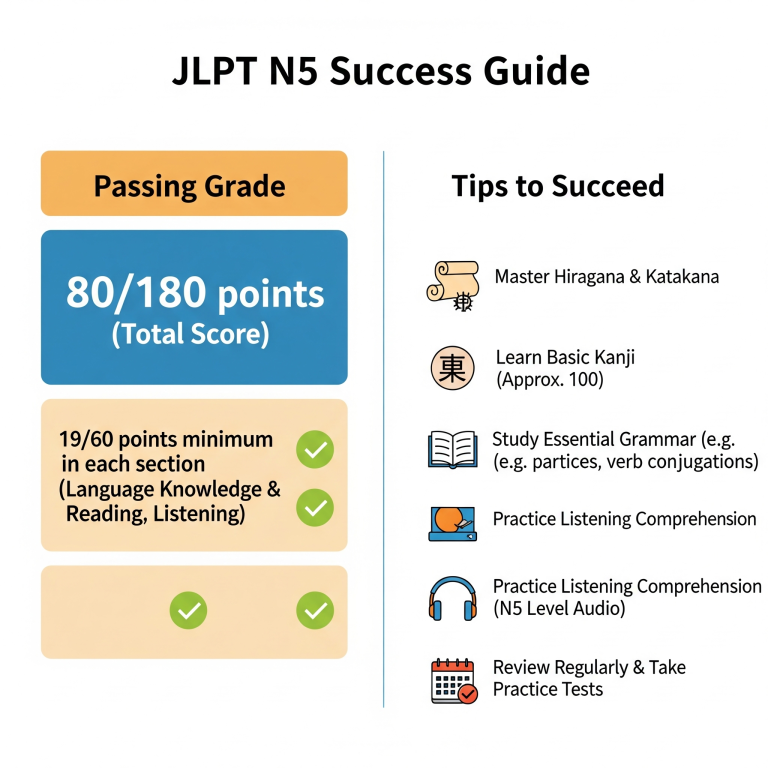
You’ve probably read our pillar post, JLPT N5 Vocabulary Complete List: Nouns, Verbs, Adjectives & Flashcards, which gives you the big-picture strategy. You know the structure, the sections, and the study plan. But now, you’re thinking, “Okay, but where do I actually start?”
The answer, almost always, is vocabulary.
Think of vocabulary as the individual bricks you’ll use to build the house of your Japanese language skills. Without enough bricks, you can’t build anything solid. The JLPT N5 tests your ability to understand basic Japanese, and that all begins with recognizing and understanding these fundamental words.
This list isn’t just a random collection. These are the 100 most common JLPT N5 vocabulary words you’re virtually guaranteed to encounter on the exam and in everyday beginner conversations. I’ve compiled them not just as a list, but as a learning tool, complete with insights, memory tricks, and context that you won’t find in a standard textbook.
Let’s turn memorization from a chore into an adventure!
Before We Begin: How to Use This List for Maximum Effect
Don’t just read this list once and forget it. Here’s how to make these words stick:
- Learn in Context: We’ve grouped words loosely by theme (like time, people, verbs) to help your brain create connections.
- Sound is King: Japanese is all about pronunciation. Always listen to the audio for each word. Use a resource like Jisho.org (outbound link to a fantastic online dictionary) where you can click the speaker icon to hear a native pronunciation. Mimic it. Record yourself.
- Make it Personal: Write sentences about your life. Instead of just “I eat bread,” try “I often eat bread with my friend on Sunday.” (これから、私はよく日曜日に友達とパンを食べます).
- Use Spaced Repetition: Apps like Anki (outbound link) are brilliant for this. They show you words right before you’re about to forget them, cementing them into your long-term memory.
- Don’t Overwhelm Yourself: Aim for 10-15 new words a day. Consistency is far more important than cramming.
Alright, 始めましょう (hajimemashō) – let’s begin!
The Absolute Essentials: Pronouns and People
These words are your anchors in a conversation. They help you point to who and what you’re talking about.
- 私 (watashi) – I, me
- Insight: The standard, polite way to say “I” for both genders. In casual contexts, men might use 僕 (boku) and women might use あたし (atashi), but stick with 私 for the JLPT N5.
- あなた (anata) – You
- Insight: Use this sparingly! Japanese often omits pronouns when it’s clear from context. Overusing あなた can sound strangely direct or even rude (like you’re pointing a finger). It’s often better to use the person’s name + さん (-san).
- 彼 (kare) – He, boyfriend
- 彼女 (kanojo) – She, girlfriend
- 人 (hito) – Person
- 先生 (sensei) – Teacher, master, doctor
- Insight: Not just for school teachers! Use it for doctors, professors, and experts in a field. It’s a title of respect.
- 学生 (gakusei) – Student
- 友達 (tomodachi) – Friend
- 名前 (namae) – Name
Getting Around: Places and Directions
The world is waiting to be explored! These words will help you navigate it.
- ここ (koko) – Here
- そこ (soko) – There (near the listener)
- あそこ (asoko) – Over there
- どこ (doko) – Where?
- 国 (kuni) – Country
- 家 (ie / uchi) – House, home
- 学校 (gakkō) – School
- 会社 (kaisha) – Company, office
- 駅 (eki) – Station
- 店 (mise) – Shop, store
- 入口 (iriguchi) – Entrance
- 出口 (deguchi) – Exit
- Memory Trick: 出 (de) means “exit” or “to leave.” Think of it as your ticket out.
- 右 (migi) – Right
- 左 (hidari) – Left
- 前 (mae) – Front, before
- 後ろ (ushiro) – Back, behind
- 上 (ue) – Up, on, above
- 下 (shita) – Down, under, below
- 中 (naka) – Inside
- 外 (soto) – Outside
Talking About Time: Days, Months, and Moments
Time is a crucial framework for making plans and telling stories.
- 時間 (jikan) – Time
- 今 (ima) – Now
- 今日 (kyō) – Today
- 明日 (ashita) – Tomorrow
- 昨日 (kinō) – Yesterday
- 毎日 (mainichi) – Every day
- 朝 (asa) – Morning
- 昼 (hiru) – Daytime, noon
- 夜 (yoru) – Night
- 時 (ji) – O’clock
- Usage: Add it after the number. 三時 (san-ji) = 3 o’clock.
- 分 (fun/pun) – Minute
- 週 (shū) – Week
- 月曜日 (getsuyōbi) – Monday
- 火曜日 (kayōbi) – Tuesday
- 水曜日 (suiyōbi) – Wednesday
- 木曜日 (mokuyōbi) – Thursday
- 金曜日 (kin’yōbi) – Friday
- 土曜日 (doyōbi) – Saturday
- 日曜日 (nichiyōbi) – Sunday
- Memory Trick: The days are named after elements: Moon, Fire, Water, Wood, Gold, Earth, Sun.
- 年 (toshi/nen) – Year
- 来年 (rainen) – Next year
- 去年 (kyonen) – Last year
The Building Blocks: Numbers and Counters
Numbers are universal, but how you count objects in Japanese is unique. For a deep dive into this crucial topic, check out our guide on Complete JLPT N5 Vocabulary List with Meanings.
- 一 (ichi) – One
- 二 (ni) – Two
- 三 (san) – Three
- 四 (shi / yon) – Four
- Insight: Four has two readings. し (shi) is often avoided because it’s a homophone for “death.” You’ll hear よん (yon) more frequently.
- 五 (go) – Five
- 六 (roku) – Six
- 七 (shichi / nana) – Seven
- Insight: Similar to four, しち (shichi) can sound like another unpleasant word, so なな (nana) is very common.
- 八 (hachi) – Eight
- 九 (kyū / ku) – Nine
- 十 (jū) – Ten
- 百 (hyaku) – Hundred
- 千 (sen) – Thousand
- 万 (man) – Ten thousand
- Insight: This is a big conceptual difference! In Japanese, 10,000 (一万 – ichi-man) is a single unit. It takes some getting used to.
- 円 (en) – Yen (Japanese currency)
- いくら (ikura) – How much?
- ~人 (~nin) – Counter for people
- Usage: 一人 (hitori) – 1 person, 二人 (futari) – 2 people, 三人 (sannin) – 3 people. Note the exceptions for 1 and 2!
The Action Heroes: Essential Verbs
Verbs bring your sentences to life. These are some of the most common and useful ones. Remember, for the JLPT N5, you need to know both the dictionary (masu-stem) form and the polite ~ます (~masu) form.
- です (desu) – Is, am, are (copula)
- Insight: This isn’t technically a verb, but it acts like one. It’s the polite, declarative “is.” The plain form is だ (da).
- あります (arimasu) – There is (for inanimate objects/plants)
- います (imasu) – There is (for living things, people, animals)
- This distinction is critical for the JLPT N5! You must know the difference. Book vs. Cat. Pen vs. Person.
- します (shimasu) – To do
- 行きます (ikimasu) – To go
- 来ます (kimasu) – To come
- 帰ります (kaerimasu) – To return home
- 食べます (tabemasu) – To eat
- 飲みます (nomimasu) – To drink
- 見ます (mimasu) – To see, to look, to watch
- 聞きます (kikimasu) – To hear, to listen; to ask
- 読みます (yomimasu) – To read
- 書きます (kakimasu) – To write
- 買います (kaimasu) – To buy
- 売ります (urimasu) – To sell
- 会います (aimasu) – To meet
- わかります (wakarimasu) – To understand
- 知ります (shirimasu) – To know
- あります (arimasu) – To have (for inanimate objects)
- Insight: To say “I have a book,” you say 本があります (Hon ga arimasu), which literally means “As for me, a book exists.” The possessive is implied by the context.
- 休みます (yasumimasu) – To rest, to take a day off
Describing Your World: い-adjectives and な-adjectives
Adjectives add color and detail. Japanese has two main types, and telling them apart is a key N5 skill.
い-adjectives (end in い before the noun)
- 大きい (ōkii) – Big
- 小さい (chiisai) – Small
- 新しい (atarashii) – New
- 古い (furui) – Old (not age, but objects)
- いい / 良い (ii / yoi) – Good
- 悪い (warui) – Bad
- 熱い (atsui) – Hot (objects, weather)
- 冷たい (tsumetai) – Cold (objects, touch)
- 高い (takai) – High, expensive
- 安い (yasui) – Cheap
- 難しい (muzukashii) – Difficult
- 易しい (yasashii) – Easy, gentle
- Note: For “easy,” 簡単 (kantan – a な-adjective) is also extremely common.
- 白い (shiroi) – White
- 黒い (kuroi) – Black
な-adjectives (need な before a noun)
- 元気な (genki na) – Healthy, lively, energetic
* How are you? お元気ですか? (O-genki desu ka?) is the standard greeting. - きれいな (kirei na) – Beautiful, clean
- 静かな (shizuka na) – Quiet
- 好きな (suki na) – Liked, beloved
* Usage: 私は猫が好きです (Watashi wa neko ga suki desu) – I like cats. Note the particle が (ga) is used, not を (o). - 嫌いな (kirai na) – Disliked
- 大好きな (daisuki na) – Really liked, to love
- 簡単な (kantan na) – Simple, easy
Beyond the List: Making These Words Stick for the JLPT and Life
Memorizing this list is a huge accomplishment, but the real goal is to use them. Here’s how to integrate them:
- Create Flashcards: Physical or digital. Put the Japanese word on one side, the reading and meaning on the other.
- Think in Mini-Sentences: Don’t just learn “tabemasu = to eat.” Learn “ご飯を食べます (gohan o tabemasu) = I eat a meal.” This teaches you the correct particle (を – o) at the same time.
- Label Your Home: Put sticky notes on things in your house: つくえ (tsukue) on your desk, まど (mado) on the window. Constant passive exposure works wonders.
- Find a Language Partner: Use an app like HelloTalk or Tandem to try using these words in simple chats. Don’t be afraid to make mistakes!
For more practical study methods, our post on JLPT N5 Vocabulary with Example Sentences for Daily Use is a great next step.
Final Thoughts: You’ve Got This!
Learning these 100 most common JLPT N5 vocabulary words is your first major milestone. It’s a challenging but incredibly satisfying task. Remember, language learning is a marathon, not a sprint. Celebrate small victories—every word you remember is a step closer to fluency.
This list, combined with a solid understanding of basic grammar from our pillar post, will give you the confidence not just to pass the JLPT N5, but to actually start understanding and using Japanese in the real world.
がんばってください (Ganbatte kudasai)! – Do your best!
Ready for the next challenge? Once you’ve mastered these words, it’s time to tackle the flash cards. Head over to our guide on JLPT N5 Vocabulary Flashcards (Anki + PDF) to continue your studies!