Hello, future Japanese learner! Are you feeling that mix of excitement and maybe a little nervousness as you stand at the threshold of the Japanese Language Proficiency Test (JLPT) N5? I remember that feeling perfectly—it’s like strapping on a backpack for a huge hike. You know it’s going to be a challenge, but the view from the top (that pass certificate!) is going to be amazing.

I’m here to tell you that the single most effective tool you have for conquering this first big milestone is the JLPT N5 practice test.
I’m not just talking about casually looking at a few questions. I mean deeply engaging with a full-length, timed mock exam. As someone who has been on this journey and helped countless others navigate the world of JLPT, I can assure you: the practice test isn’t just a rehearsal; it’s a strategic weapon.
This post is designed to be your comprehensive guide—your study buddy—to understanding, utilizing, and ultimately mastering your preparation for the N5 exam, making the most of every jlpt n5 practice test you take.
Why the Practice Test is Your Sensei (Teacher)
When we start studying a new language, we often focus on textbooks, apps, and flashcards. Those are the bricks and mortar of your Japanese house. But the practice test? That’s the blueprint. It shows you exactly how the final structure needs to look.
1. The Blueprint of the Exam
The JLPT is a standardized test, which means it follows a predictable pattern. Without a practice test, you’re walking into a dark room. With it, the lights are on!
- Understanding the Format: The N5 is divided into two main sections:
- Language Knowledge (Vocabulary/Grammar) & Reading (Total 50 minutes)
- Listening (Total 30 minutes)
- Knowing the Question Types: The N5 section isn’t just one type of question. You’ll encounter:
- Kanji reading (choosing the correct hiragana for a kanji word).
- Contextual vocabulary (choosing the best word to fit a sentence).
- Grammar selection (choosing the right particle or structure).
- Sentence rearrangement (the dreaded ‘star’ question!).
- Reading comprehension (short passages).
- Listening comprehension (task-based and point-focused).
2. The Power of Time Management
I’ve seen it happen countless times: a student knows the material perfectly but runs out of time because they spent too long agonizing over a single grammar point. Time management is one of the toughest skills to master in the JLPT.
The Language Knowledge and Reading section has a very tight time limit. A well-designed jlpt n5 practice test forces you to work under pressure. By timing yourself, you learn to:
- Triage Questions: Quickly identify questions you know instantly and answer them first.
- Set Time Limits: Realize that you can’t spend more than, say, 45 seconds on a single vocabulary question.
- Build Stamina: Sitting for a full 80-minute test (plus the break!) is mentally exhausting. Practice tests build up your mental endurance.
3. Immediate, Unbiased Feedback
Textbook exercises are great for learning, but they don’t give you a true measure of exam readiness. A full practice test, especially one with detailed answers, gives you the cold, hard truth:
- Identify Your Blind Spots: You might be a kanji whiz but struggle with the listening section’s fast pace. Or maybe your particles (wa, ga, ni) are shaky. The sectional scores tell you exactly where to focus your study hours.
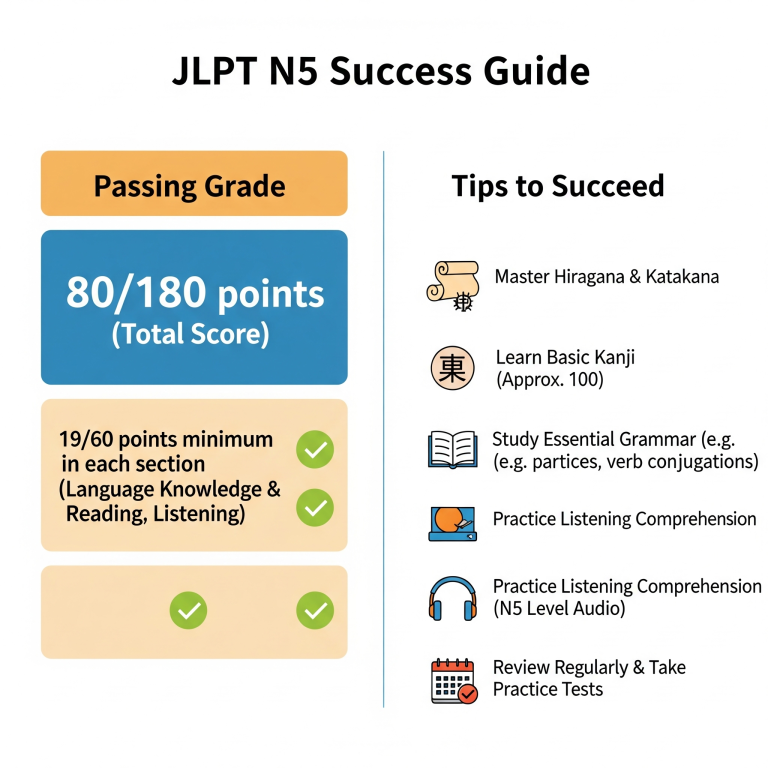
- Calculate Your Passing Score: The N5 requires an overall score of 80/180 points, and you must clear minimum sectional scores (38/120 for Language Knowledge/Reading and 19/60 for Listening). A practice test helps you ensure you’re meeting both thresholds.
The Strategic Way to Use Your JLPT N5 Practice Test
Taking a practice test is not a one-and-done activity. It’s a cyclical process of testing, reviewing, and targeted studying. Here is the expert methodology to follow for maximum score improvement.
Phase 1: The Diagnostic Test (Initial Assessment)
Take your first practice test as early as possible in your preparation.
How to Execute:
- Simulate the Real Day: Find a quiet, distraction-free space. Put your phone away. Use a pencil and a proper answer sheet (you can usually download these from test sites).
- Strict Timing: Use a timer for each section and do not exceed the allocated time. No dictionary. No looking up a kanji. This is about measuring your current knowledge.
- Endurance Test: Take the Listening section right after the Reading/Grammar section, mimicking the real exam experience.
Unique Insight: Your first score is just a starting point. Don’t be discouraged if it’s low! This test’s value is purely diagnostic—it’s showing you which areas are the most critical to work on right now. You wouldn’t fix a broken pipe without knowing where the leak is, right?
Phase 2: Deep Analysis and Review
This is the most critical phase, and most students skip it!
The Golden Rule: Spending time reviewing your mistakes is more valuable than taking ten new practice tests.
- Grade Objectively: Tally up your scores for each major sub-section (Kanji Reading, Vocabulary, Grammar, Reading, Listening).
- The Error Log: Create a simple spreadsheet or notebook section dedicated to your mistakes. For every single wrong answer, write down:
- Question Type: (e.g., Vocabulary: Contextual Use)
- The Wrong Answer: (e.g., “きょう” instead of “あした”)
- The Correct Answer:
- Why You Chose Wrong: (e.g., “Didn’t know the definition of the correct word,” or “Confused the particles ni and de“).
- Kanji and Vocabulary Deep Dive: For any word you missed, use a reliable dictionary to not only learn its meaning but also its part of speech (noun, verb, adjective) and a sample sentence.
Practical Application: If you missed a Listening question because you got distracted, your “Why I Chose Wrong” should be “Lack of focus/note-taking.” This leads to a practical fix: practice taking quick, shorthand notes in Japanese while listening.
Phase 3: Targeted Study
Based on your error log, focus your next few weeks of studying entirely on your weakest areas.
- If you failed the Grammar minimum: Spend an entire week drilling N5 particles and verb conjugations. Find a dedicated N5 grammar guide.
- If you failed the Kanji minimum: Dedicate time each day to learning your core 100 N5 kanji. Use flashcard apps with spaced repetition.
- If you failed the Listening minimum: Listen to slow, simple Japanese podcasts or beginner audio dramas, focusing on key words like who, what, where, when, and how many. Actively trying to extract this core information is the key to passing this section.
Phase 4: The Progress Test (Mid-Study Check)
After a few weeks of targeted study, take your second jlpt n5 practice test. This one is a progress check.
- Compare Scores: Did your scores improve in the areas you focused on? If your Grammar score went up but your Reading score dropped, you know where your next study focus needs to be.
- Rinse and Repeat: Go back to Phase 2 (Deep Analysis) and Phase 3 (Targeted Study) using the results of this second test.
Insider Tips for N5 Success: Unique Insights from a JLPT Expert
The N5 exam is simple, but it has little tricks that can trip up the unprepared. As your expert guide, here are a few things I’ve learned that can make a huge difference in your score.
1. The Particle Power-Up
In the Grammar section, the most common trap is particle confusion (wa, ga, o, ni, de, etc.). Many English speakers try to find a direct translation, which is a mistake.
Unique Insight: Think Function, Not Translation.
- は (wa) is for Topic: Think of it as, “As for X, the following is true.” It sets the stage.
- が (ga) is for Subject (often new information): It often points to the subject when it is the key piece of information you are trying to identify.
- に (ni) is for Destination/Time/Purpose: Think “to” or “at.”
- で (de) is for Means/Location of Action: Think “by means of” or “at the location of the action.”
When reviewing a practice test question you got wrong, don’t just memorize the correct particle; try to articulate why that particle is the only one that can function in that specific sentence.
2. The Contextual Clue in Vocabulary
The Vocabulary section is tricky because it’s not just about knowing the word; it’s about knowing which word is appropriate for the context.
Practical Application: When you encounter a vocabulary question in a jlpt n5 practice test, look at the sentence as a whole.
- If the sentence is about going somewhere, you probably need a verb of movement (e.g., 行く – iku or 来る – kuru).
- If the sentence is describing an object, you need an adjective (e.g., 大きい – ōkii or 小さい – chiisai).
Don’t just plug-and-play words. Understand the flow and context of the conversation or statement.
3. The Listening Section: The Art of Anticipation
The listening section is often the undoing of N5 test-takers. Here’s the pro-tip: Don’t wait for the audio to start!
- Read the Options FIRST: Before the dialogue begins, the narrator gives you a brief instruction, followed by a pause. Use this pause (and any images provided) to read all four multiple-choice answers.
- Anticipate the Question: By reading the options, you can often figure out what the question will be about—time, location, object, or action. This allows your brain to filter the incoming Japanese audio only for the critical information.
- Shorthand is Key: Don’t write full words. Use quick symbols and abbreviations. If a conversation is about deciding what to buy, use X for something they discard and a circle for something they choose.
Recommended Outbound Resources (External Links)
No single resource can do it all, and the Japanese community thrives on sharing. To truly supercharge your jlpt n5 practice test preparation, you should use these resources alongside your mock tests.
- The Japan Foundation’s Official JLPT Website: For the most authoritative information on the exam, including the structure, scoring, and free sample questions straight from the source. This is a must-bookmark.
- <a href=”https://www.jlpt.jp/e/samples/forlearners.html” target=”_blank” rel=”noopener noreferrer”>Visit the Official JLPT Sample Questions Page</a>
- Tango Ranks (For Vocabulary): Building a strong vocabulary foundation is non-negotiable for N5. Many find this an excellent, structured resource for learning vocabulary organized by JLPT level, often utilizing spaced repetition systems (SRS).
- <a href=”https://tango-ranks.com/jlpt-n5-vocabulary-list/” target=”_blank” rel=”noopener noreferrer”>Explore JLPT N5 Vocabulary Lists</a>
- Tae Kim’s Guide to Japanese Grammar: While not a dedicated JLPT site, this resource is a classic for beginners to understand the mechanics of Japanese grammar in a clear, logical way. Mastering the why of the grammar is essential for the N5’s toughest questions.
- <a href=”http://www.guidetojapanese.org/learn/grammar/” target=”_blank” rel=”noopener noreferrer”>Check Out a Comprehensive Japanese Grammar Guide</a>
Humanizing Your JLPT Journey: Beyond the Score
I want to pause the “expert” voice for a moment and talk to you student-to-student. Learning Japanese is an incredible adventure. Don’t let the stress of a single exam overshadow the joy of the language.
The N5 practice test isn’t a judge; it’s a mirror. It reflects your effort, not your worth.
- Celebrate the Small Wins: Did you finally nail the difference between 「〜たい」(~tai – want to) and 「〜がほしい」(~ga hoshii – want a thing)? That’s a huge victory! Acknowledge it.
- The Power of Consistency (The Japanese Mindset): The most successful N5 test-takers aren’t the geniuses; they are the people who study for 30 minutes every day. This concept of 継続は力なり (Keizoku wa chikara nari)—”Continuation is power”—is a core Japanese value. Daily consistency with a focused plan (informed by your practice test results) is your magic bullet.
- The “Why”: On days when you’re tired, and the kanji look like impossible scribbles, remember why you started. Was it for anime? Manga? Travel? To talk to a friend? Write it down. Put it on a sticky note. Let that motivation fuel your review of your latest jlpt n5 practice test mistakes.
Conclusion: You Are Ready. Ganbatte!
Passing the JLPT N5 is not about being smart; it’s about being prepared and strategic. Your jlpt n5 practice test is the key that unlocks that preparation. It tells you where to focus your finite time and energy, allowing you to study smarter, not just harder.
The road to Japanese fluency starts here. Take that first mock test, analyze your results, create a plan, and commit.
Ganbatte kudasai! (Please do your best!) I look forward to hearing about your success.
More JLPT N5 Listening Resources You Might Find Helpful
JLPT N5 Practice Tests & Mock Exams: Free PDFs, Online Quizzes & Workbooks –
JLPT N5 Mock Test: Simulate the Real Exam
JLPT N5 Quiz: Quick Test Your Knowledge
JLPT N5 Sample Questions with Solutions
Free JLPT N5 Practice Test (Vocabulary + Grammar)
JLPT N5 Past Year Papers PDF (Download Free)
JLPT N5 Exam Papers with Answer Keys
JLPT N5 Mock Test PDF with Solutions
JLPT N5 Practice Test Online: Interactive Exam Simulation