Hello, future Japanese language master!
Let me guess: you can read hiragana, you’ve memorized your first 100 kanji, and you can introduce yourself with confidence. But when you hear a native Japanese speaker, it all just sounds like a high-speed blur? You are not alone.

The JLPT N5 listening section is often the biggest hurdle for beginners. It’s not because the language is overly complex at this level, but because listening is a separate skill. It requires your brain to process sounds, vocabulary, and grammar in real-time, with no “rewind” button.
The good news? With the right kind of JLPT N5 listening practice online, you can absolutely train your ear and walk into that exam room feeling prepared and confident.
In this post, we’re not just giving you a quiz; we’re giving you a full-blown strategy. We’ll simulate the test environment, break down each question type you’ll encounter, and provide you with the resources to practice effectively from the comfort of your home.
Why the N5 Listening Section Feels So Tough (And How to Overcome It)
Before we dive into the practice, let’s humanize this. Why is it so hard?
- The Speed: Audio clips are spoken at a natural, albeit slow, pace for N5. For a beginner, even “slow” can feel lightning-fast.
- The “Sound Soup”: In Japanese, words often blend together. Particles like
は (wa)andを (o)can be barely audible, which can throw off your entire understanding of a sentence’s structure. - No Second Chances: The audio plays once. This creates pressure that isn’t present when you’re leisurely reading a textbook.
- The Accent and Intonation: You might be used to your teacher’s clear, textbook-perfect pronunciation. The voices on the JLPT will have different pitches and nuances.
The Solution? Consistent, targeted, and active listening. Passive listening, like having Japanese TV on in the background, won’t cut it for test prep. You need to engage with the material, just like you’re about to do here.
Let’s Test Your Skills: A Simulated N5 Listening Quiz
Alright, let’s get practical. Below, I’ve created a simulated quiz that mirrors the structure of the real JLPT N5.
How to take this quiz for maximum effect:
- Find a Quiet Space: No distractions.
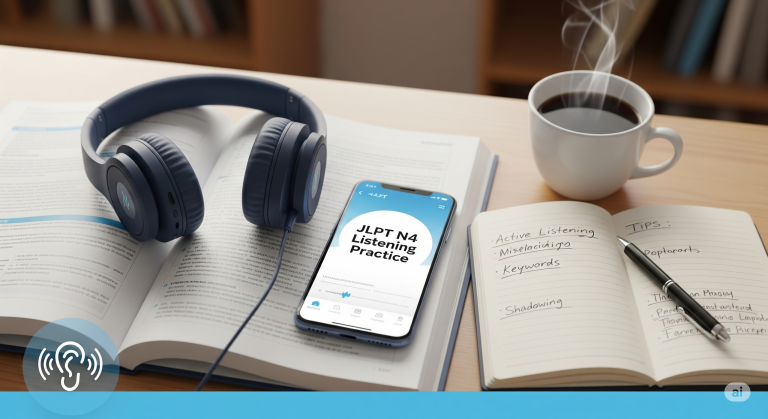
- Use Headphones: This helps you catch every sound.
- Have a Pen and Paper Ready: You will need to take notes, just like in the real exam.
- Listen Only Once: Resist the temptation to replay the audio immediately. The first try is what matters most.
I will provide the audio script and answers after the questions, so you can check your work and, most importantly, understand why you got an answer right or wrong.
Quiz: JLPT N5 Listening Practice Online (Task-Based Comprehension)
Instructions: You will hear several short conversations followed by a question. Each conversation will be played once. After listening, choose the best answer from the options provided below the audio player.
(For the purpose of this blog post, please read the scripts aloud at a steady pace, or use a text-to-speech tool. Imagine this is the audio you’re hearing.)
Question 1:
Audio Script:
- Man: すみません、きってを ください。
- Woman: はい、80えんです。
- Man: はい。
- Woman: 20えん おつりです。どうぞ。
Question: 男の人は いくら はらいましたか。
(What amount did the man pay?)
a) 80円
b) 100円
c) 20円<details> <summary><strong>Check Your Answer & Analysis for Question 1</strong></summary> <br> <b>Correct Answer: b) 100円</b> <br><br> <strong>Why?</strong> Let’s break it down, because this is a classic N5 pattern. <ul> <li>The man says, “Sumimasen, kitte o kudasai.” (Excuse me, stamps please.)</li> <li>The woman says, “Hai, 80-en desu.” (Yes, that’s 80 yen.)</li> <li>The man pays. We don’t hear the amount yet.</li> <li>The woman says, “<strong>20-en otsuri desu.</strong>” (Your change is 20 yen.)</li> </ul> The key phrase here is <strong>おつり (otsuri – change)</strong>. If the item costs 80 yen and the change is 20 yen, he must have paid 100 yen. This tests your ability to perform a simple calculation based on a daily life conversation. </details>
Question 2:
Audio Script:
- Woman: たなかさん、あしたの パーティーに 来ますか。
- Man: すみません、あしたは がっこうが ありますから…。
- Woman: あ、そうですか。
Question: たなかさんは あした パーティーに 来ますか。
(Will Tanaka-san come to the party tomorrow?)
a) はい、来ます。
b) いいえ、来ません。
c) わかりません。<details> <summary><strong>Check Your Answer & Analysis for Question 2</strong></summary> <br> <b>Correct Answer: b) いいえ、来ません。</b> <br><br> <strong>Why?</strong> This question tests your understanding of reasoning and rejection. <ul> <li>The woman asks if Tanaka-san will come.</li> <li>He starts with “Sumimasen,” which is a polite way to preface a negative response.</li> <li>He gives the reason: “<strong>Ashita wa gakkou ga arimasu kara…</strong>” (Because I have school tomorrow…).</li> </ul> The word “<strong>から (kara)</strong>” meaning “because” is crucial. He is giving a reason why he <em>cannot</em> come. The woman’s response, “A, sou desu ka,” is an acknowledgment, often with a hint of disappointment, confirming his absence. </details>
Question 3: (Quick Response)
This is another common question type. You hear a short statement or question, and you must choose the most natural and logical response.
Audio Script:
- Voice: いってきます。
Question: 何と 言いますか。
(What do you say?)
a) いってらっしゃい。
b) ただいま。
c) おかえりなさい。<details> <summary><strong>Check Your Answer & Analysis for Question 3</strong></summary> <br> <b>Correct Answer: a) いってらっしゃい。</b> <br><br> <strong>Why?</strong> This tests your knowledge of essential Japanese daily expressions (挨拶 – aisatsu). <ul> <li>”<strong>Ittekimasu</strong>” is said by a person leaving the house. It roughly means “I’ll go and come back.”</li> <li>The standard, set response to this is “<strong>Itterasshai</strong>,” which means “Please go and come back” or “See you later.”</li> </ul> This is pure memorization of cultural phrases. “Tadaima” (I’m home) and “Okaerinasai” (Welcome back) are a different pair of expressions used upon returning. </details>
How did you do? These three questions cover just a fraction of what you’ll see, but they highlight the core skills needed: careful listening for key details (numbers, reasons) and knowledge of set phrases.
Beyond the Quiz: A Strategic Framework for Your JLPT N5 Listening Practice Online
Now that you’ve had a taste, let’s build a sustainable practice routine. Randomly watching anime won’t help as much as a focused plan.
The Four Main Question Types on the JLPT N5 (And How to Tackle Them)
- Task-Based Comprehension (課題理解 – Kadai Rikai):
- What it is: You listen to a conversation and are asked a question like “What will the man do next?” or “What does the woman need to buy?”
- Pro Strategy: The question is often written in your test booklet before the audio plays. READ IT FIRST. This tells your brain exactly what information to listen for.
- Point Comprehension (ポイント理解 – Pointo Rikai):
- What it is: Similar to the first, but often involves understanding the reason or a specific point behind a decision.
- Pro Strategy: You will usually have time to look at the answer choices. Scan them for keywords. If the choices are “by train,” “by bus,” and “by bike,” you know you’re listening for a mode of transportation. Listen for keywords like
で (de) - by means ofor電車 (densha) - train.
- Verbal Expressions (発話表現 – Hatsuwa Hyougen):
- What it is: This is the “quick response” section, like our Question 3 above. You hear a situation and choose the most appropriate thing to say.
- Pro Strategy: This is 100% about mastering common daily expressions. Create flashcards for pairs like:
Ittekimasu->ItterasshaiTadaima->OkaerinasaiGochisousama deshita->DouzoOmedetou gozaimasu->Arigatou gozaimasu
- Quick Response (即時応答 – Sokuji Outou):
- What it is: A slightly more advanced version of the above. You hear a short question or statement and must choose the most logical and grammatically correct response from three options.
- Pro Strategy: Pay close attention to the grammar. If you hear
~masen ka?it’s often an invitation, and a positive response is expected. If you hear a question word likedoushite(why), your answer must provide a reason.
Where to Find the Best JLPT N5 Listening Practice Online (Free & Paid)
To truly excel, you need to diversify your listening sources. Here are some of my top recommendations, vetted for quality and relevance to the JLPT.
Free Resources:
- The Official JLPT Website (jlp.jp): This is your holy grail. They offer one full-length sample question paper for each level, including the audio and a transcript. This should be the cornerstone of your practice. [Outbound Link: https://www.jlpt.jp/e/samples/sample12.html]
- Japan Foundation’s “Marugoto Plus”: While not strictly JLPT-focused, the “Katsudoo” and “Rikai” sections have fantastic, simple listening exercises based on everyday situations. The clear audio and visual cues are perfect for N5 learners.
- NHK World Japan – “Easy Japanese”: This news site offers short, simple news stories in very easy Japanese, complete with audio and transcripts. It’s excellent for getting used to different voices and a slightly more formal tone.
Dedicated Practice Platforms:
- JLPT Sensei & JTest4U: These sites and their associated YouTube channels have dozens of specific listening drills for N5. They break down the questions by type, allowing for targeted practice.
- YouTube: Search for “JLPT N5 聴解” or “JLPT N5 Listening”. Channels like “Nihongo no Mori” (though they focus on higher levels too) and dedicated JLPT prep channels provide invaluable practice and analysis.
From Practice to Fluency: Humanizing Your Study Routine
As an expert, I’ll let you in on a secret: The students who pass with flying colors aren’t just the ones who do the most practice tests. They’re the ones who integrate Japanese into their lives in a way that feels human and enjoyable.
- Shadowing Technique: This is my #1 tip. After you’ve completed a listening exercise and checked the script, play the audio again and try to speak at the exact same time as the native speaker. Mimic their rhythm, their pitch, their pauses. This builds muscle memory for the language and dramatically improves your listening comprehension.
- The “Three-Listen” Method:
- First Listen: No notes. Just try to grasp the main idea. Who is talking? What is the general topic?
- Second Listen: Take notes. Write down keywords you catch: numbers, names, places, nouns.
- Third Listen: (After checking the script). Listen while reading the script. Identify the “gaps” between what you thought you heard and what was actually said. This is where the real learning happens.
- Embrace the “I Don’t Know”: It’s okay to not understand everything. Even advanced learners don’t catch 100% of every conversation. The skill is in learning to grab the essential information you can understand and using it to make an educated guess. This is a critical test-taking skill.
Final Words of Encouragement
The journey to passing the JLPT N5 listening section is a marathon, not a sprint. It’s about building a consistent habit. Even 15-20 minutes of active, focused JLPT N5 listening practice online every day will yield far better results than a two-hour cram session once a week.
You have the strategies. You have the resource list. You’ve even tested your skills with our interactive quiz. The path forward is clear.
Be patient with yourself. Celebrate the small victories—the first time you perfectly catch a number, the first time you understand a full conversation without the script. These are the moments that build confidence.
Now, go forth and train those ears! 頑張ってください!(Ganbatte kudasai! – Do your best!)
More JLPT N5 Listening Resources You Might Find Helpful
JLPT N5 Listening Guide: Practice, Tests, Tips & Audio Resources
JLPT N5 Listening Practice with Audio + Scripts
JLPT N5 Listening Practice PDF (Download + Audio Links)
Top JLPT N5 Listening Tips for Beginners
JLPT N5 Listening Audio Files (Free Download)
Best Apps for JLPT N5 Listening Practice