🐉 A Tsunami of Meaning: Why a Name is Never Just a Name
There are few characters in video game history whose name feels quite as deliberate and layered as Kanji Tatsumi from the iconic JRPG, Persona 4 Golden.
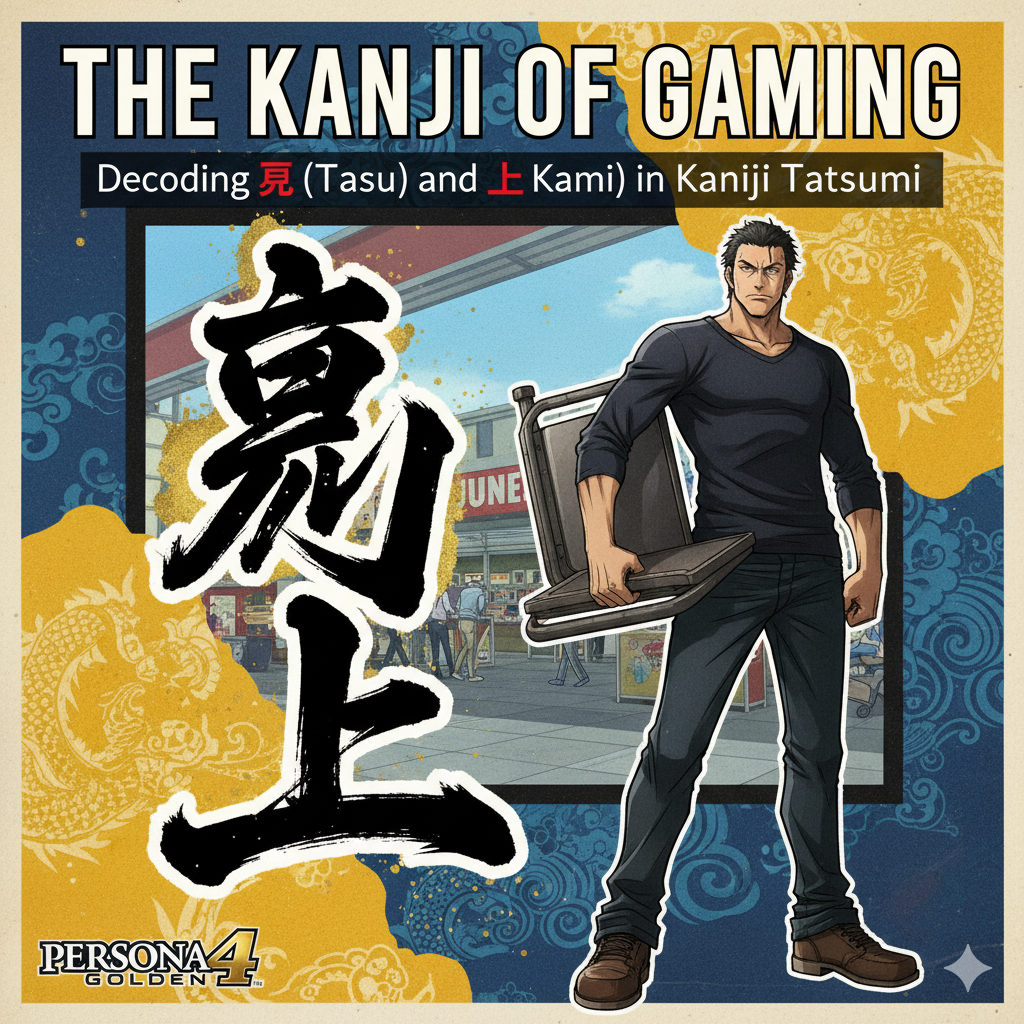
For the casual player, “Kanji” is simply the name of the tough-talking, punk-rock-aesthetic student who wields tables and chairs with surprising grace. But for those of us who appreciate the intricate tapestry of the Japanese language—the beautiful, complex world of Kanji characters—his name is a roadmap to his soul. It’s a linguistic easter egg, a secret message hidden in plain sight, and a testament to the masterful character design of the Persona series.
As a Japanese Language Proficiency Test (JLPT) expert, I’ve spent countless hours navigating the waves of kanji, and let me tell you, analyzing character names in Japanese media is one of the most rewarding aspects of this study. It’s like finding a hidden chest in a dungeon you thought you’d already cleared.
This deep dive is about two specific kanji that, while not explicitly in his given name (完二), echo a profound thematic presence related to him, his powerful Persona, and his transformative journey of self-acceptance. We are talking about the Kanji Tsunami of meaning that surrounds our beloved delinquent. Let’s unmask the dragon and the divine in Kanji’s story.
🐲 The Dragon’s Roar: Unpacking 竜 (Tatsu / Ryū)
Kanji’s full family name is 巽 (Tatsumi). This kanji character, 巽, literally means “southeast” or “south-east wind” and is associated with the 5th trigram of the I Ching. It’s a beautifully nuanced kanji, often linked to the direction of change and growth.
However, the reading Tatsu (たつ) for a name in Japan is an almost immediate cultural echo of a far more famous and thematically relevant kanji: 竜 (or the older form 龍), meaning Dragon.
The Kan-Jitsu Connection: 竜 (Tatsu)
- Kanji: 竜 (Shinjitai, the modern simplified form) / 龍 (Kyūjitai, the older, complex form)
- Key Readings (On/Kun): Ryū, Tatsu
- Meaning: Dragon
In Japan, the Dragon (Ryū) is not the fire-breathing beast of Western lore. Instead, it’s a benevolent, water-dwelling, serpentine deity—a symbol of immense power, wisdom, and atmospheric forces (like storms and whirlwinds, or tatsumaki 竜巻).
Now, think about Kanji Tatsumi:
- The Brawn and Intimidation: Kanji is physically imposing, a source of rumors, and initially feared by his peers. He’s a raw, elemental force, much like a dragon in a myth. His strength is undeniable.
- The Suppressed Self: The mythological dragon often waits in the water or the earth, dormant until a great storm calls it forth. Kanji, too, keeps his true self—his passion for delicate crafts and his uncertainty about his identity—locked away, suppressed by societal expectations of “masculinity.” This internal conflict is a powerful, coiled energy.
- His Persona: Take-Mikazuchi: Kanji’s initial Persona is the god of thunder and swords. It’s a figure tied to immense, explosive power—a lightning bolt erupting from the sky. This aligns perfectly with the Dragon’s association with powerful, elemental weather phenomena. The dragon is a conduit for the tempest.
The mere sound of Tatsu in his name acts as a powerful signifier, tying him to a primal, unbridled force. His struggle isn’t about becoming a “man”; it’s about channeling the inherent, awesome power of the Dragon within him, the power to be his authentic self, without fear of judgment. He is the storm waiting to break.
💡 JLPT N5/N4 Insight: The kanji for Dragon, 竜 (Ryū), is a commonly encountered character. Recognizing its presence in words like kyōryū (恐竜 – dinosaur) or tatsumaki (竜巻 – tornado) is a great step on your JLPT journey, immediately connecting you to this powerful cultural symbol.
⬆️ The Apex of Identity: Interpreting 上 (Kami)
The second kanji we’re going to explore is one of the most deceptively simple and powerful characters in Japanese: 上.
The Power of Upward Motion: 上 (Kami / Jō)
- Kanji: 上
- Key Readings (On/Kun): Jō, Ue (above/up), Kami (upper, top, superior, god/divine)
- Meaning: Up, Above, Superior, Top, Divine
While 上 in isolation most frequently means “up” or “above” (ue), its reading as Kami (かみ) is where the deep resonance with Kanji Tatsumi’s character arc—and his ultimate Persona—comes into stunning focus.
The word kami (神), meaning “god” or “spirit,” is a different kanji, but the reading Kami (上) carries the nuance of superiority, elevation, and the highest point. It’s the journey of elevating oneself to the highest form of being.
Now, look at the final evolutions of Kanji’s Persona:
- Rokuten Maō (六天魔王): This Persona means the Demon King of the Sixth Heaven. The “Heaven” here is a celestial, superior realm—a clear connection to the concept of 上 / Kami (Above/Superior).
- Takeji Zaiten (タケジザイテン): In Persona 4 Golden, Kanji’s ultimate Persona is this figure, which relates to a form of the deity Maheśvara (the same deity associated with his previous Persona, but in a different context). The Jizaiten (自在天) part of the name can be translated as the Sovereign, Self-Existent Heaven/God.
In both cases, Kanji’s ultimate power is literally named after a figure that is Above All or Sovereign—the embodiment of Kami in its elevated, divine context.
The Application: Rising Above Societal Pressure
Kanji’s story is defined by his fear of being perceived as “less than” a man because he likes sewing and “cute” things. His shadow’s dungeon, the bathhouse, is a literal space for cleansing and rebirth, where he must confront the “Superior/Inferior” complex imposed by society.
- He must rise 上 (kami / above) the limiting labels of a repressive world.
- He must accept his own inner truth, elevating his authentic self to a state of Sovereign (a form of kami), where no one else’s judgment can reach him.
His Persona’s evolution from an angry, elemental force (the Dragon’s storm) to a self-existent, sovereign deity (the highest Kami) perfectly mirrors the protagonist’s journey from a conflicted youth to a fully self-actualized individual who has claimed his own superior internal truth.
🌊 The Kanji Tsunami: Where Language Meets Psychology
The blending of these thematic kanji—the raw, elemental 竜 (Tatsu) and the self-sovereign 上 (Kami)—creates a powerful Kanji Tsunami that washes away the misconceptions surrounding the character.
He isn’t just a tough guy; he’s a Dragon learning to harness his explosive power for creation, not just destruction. He isn’t just a confused teenager; he is ascending to his Sovereign self, one who is above the need for external validation.
This is the beauty of Japanese character design. The subtle linguistic cues in the sound and thematic parallel of a name allow the creators to communicate the core psychological journey of the character without saying a word.
Practical Application for the JLPT Student and Gamer
This kind of analysis isn’t just for fun; it’s a practical learning tool.
For the JLPT student, understanding the multiple readings and nuances of a single kanji is the key to mastery. The difference between 上 as ue (above, location) and 上 as kami (superior, the upper part) is essential. Likewise, knowing that tatsu might not always be written as the kanji 竜, but often sounds like the Dragon, allows you to appreciate the deeper cultural wordplay.
Next time you encounter a character name in a game or anime, take a moment to look up the kanji. You’ll find that the complexity of the language often mirrors the complexity of the character’s arc. This turns study into exploration, and trust me, that makes all the difference!
🔍 Unique Insights: Kanji as a Mirror to Societal Pressure
One of the most humanizing aspects of Kanji Tatsumi’s character is that his struggle is deeply relatable, even if the cultural context is Japanese.
In Japan, there is a strong cultural emphasis on fitting in (wa 和 – harmony) and adhering to perceived gender roles. A large, intimidating male figure who openly enjoys sewing, knitting, and “cute” things directly challenges this wa. Kanji’s inner turmoil is a microcosm of the intense pressure faced by many young people worldwide to perform a prescribed gender identity.
His Shadow’s dungeon, the infamous “bathhouse,” acts as a chaotic, exaggerated reflection of the societal judgment he fears. He doesn’t fear his sexual attraction as much as he fears the label—the loss of his perceived “Kanji the punk” identity—that comes with it.
His Persona’s final form, a figure of supreme, celestial authority, is the ultimate rejection of this pressure. It’s a declaration: “I am who I am, and I am great.” This is an extraordinarily powerful message: true self-acceptance is achieving a state of internal kami—a self-sovereignty that makes the labels of others utterly irrelevant.
📚 Furthering Your Journey: Explore Japanese Language and Culture
The world of Persona and the depth of its character writing are brilliant gateways into Japanese language and culture. If this linguistic exploration has sparked your interest, why not take the next step?
- Explore Mythological Context: The Persona of Kanji Tatsumi, Take-Mikazuchi, is a key figure in Japanese mythology. Learning about his origins will give you a greater appreciation for the power Kanji wields. You can start your deep dive into the gods of the Kojiki and Nihon Shoki by reading more about ancient Japanese myths and legends.
- Dive into JLPT Prep: Understanding the difference between on’yomi (Chinese reading) and kun’yomi (Japanese reading) is fundamental to decoding kanji names. You can find excellent resources to help you prepare for the JLPT exams and transform your gaming passion into genuine language skills. A fantastic starting point for formal study is the official resources provided by the Japan Foundation and Japan Educational Exchanges and Services (JEES), the administrators of the test.
- Read Japanese Media: The best way to humanize your language learning is to engage with native media. This could be the original Japanese scripts of games, Japanese news articles, or even manga. One of the best ways to practice reading comprehension is through varied sources, like articles from a major Japanese news outlet like the NHK News Web Easy, which provides simplified news for learners.
Conclusion: The Name That Defined a Generation
Kanji Tatsumi’s arc is a masterpiece of character development, and at the heart of it lies the intricate power of the Japanese language. The thematic shadows of 竜 (Dragon) and 上 (Above/Sovereign) elevate his story far beyond a simple side quest, making him one of gaming’s most resonant characters. He is a testament to the idea that a name is a destiny, a hidden language waiting for us to decode it.
So, the next time you hear his name in Persona 4 Golden, remember the Kanji Tsunami of meaning you’ve just uncovered. You’re not just playing a game; you’re engaging with a profound piece of cultural and linguistic artistry.
What Hidden Meanings Have You Found?
Did another character’s name in Persona or a similar game reveal a deep linguistic truth to you? I’d love to analyze it!
🔗 For More Resources You Might Find Helpful
Beyond the Battlefield: Essential Japanese Vocabulary for Gaming and Anime Fans – JLPT Samurai
Kanji Spotlight: Why is Money (お金 – Okane) Written with the Gold Radical 金 – JLPT Samurai
The Ultimate Guide to Namae Kanji: How to Write and Read Japanese Names Correctly – JLPT Samurai
Hanzi vs. Kanji: Understanding the Key Differences for Chinese and Japanese Learners – JLPT Samurai
JLPT Preparation: How to Learn 15 Kanji Per Day with Component Study – JLPT Samurai