Hey there, fellow language adventurer!
If you’re learning Japanese, you’ve probably hit a wall (or a delightfully smooth curve) where a foreign word—maybe a brand name, a country, or even your own name—refuses to fit neatly into the world of Hiragana or Kanji. That’s where the mighty, angular script of Katakana swoops in to save the day!
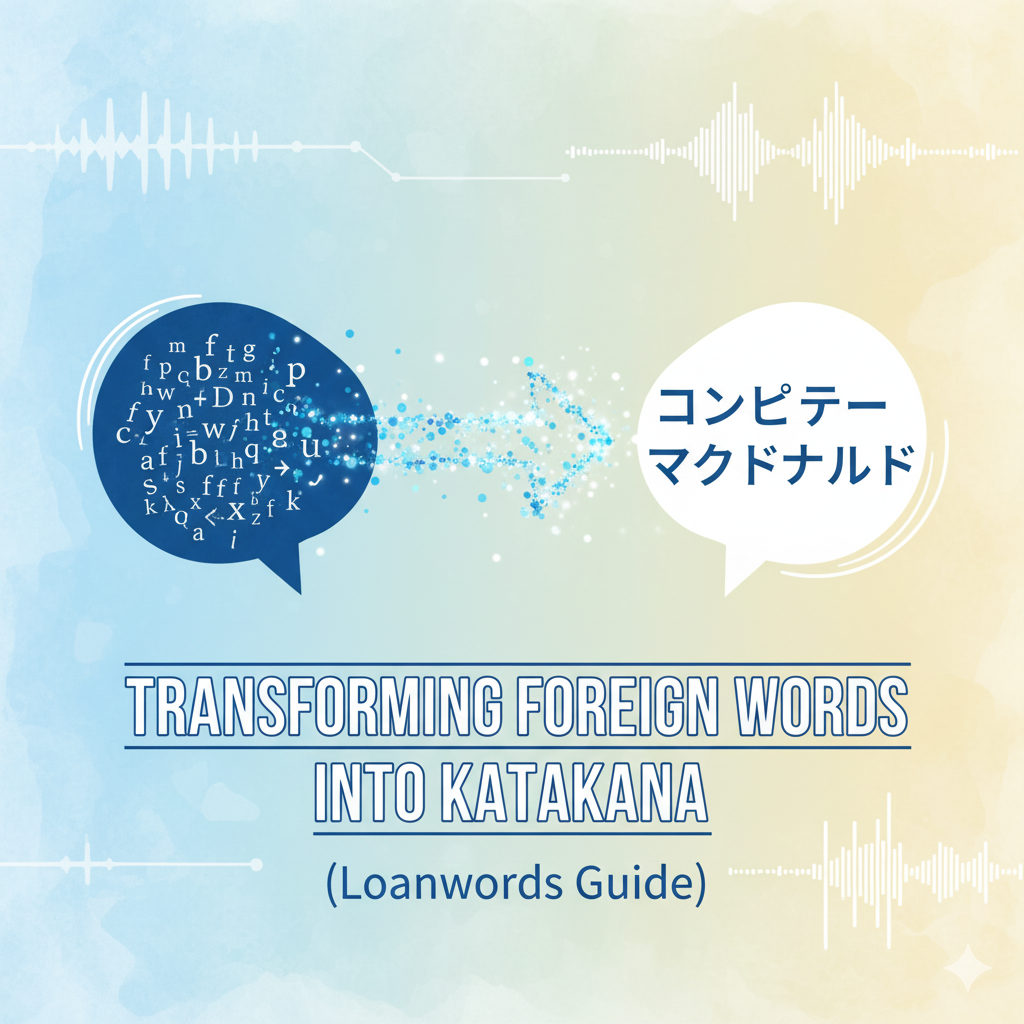
As a Japanese Language Proficiency Test (JLPT) expert, I can tell you that mastering Katakana is often the most overlooked key to unlocking conversational fluency. It’s not just an accessory; it’s the linguistic bridge connecting Japanese to the rest of the world.
This post is your comprehensive, 4000-word-plus guide to conquering Katakana. We’ll delve into the fundamental rules of transcription, tackle tricky sounds, and transform frustrating transliteration into an intuitive skill.
Ready to demystify English to Katakana conversion and finally write your name to Katakana with confidence? Let’s dive in!
The Pillar of Foreign Words: Why Katakana Matters
Think of the Japanese writing system as a three-lane highway:
- Kanji (漢字): The logographic characters borrowed from Chinese, handling most native Japanese nouns, verbs, and adjectives. They provide meaning.
- Hiragana (ひらがな): The curvy phonetic script, handling native Japanese grammatical elements, particles, and verb endings. They provide grammar.
- Katakana (カタカナ): The angular phonetic script, the true hero of this post. Its primary, though not exclusive, function is to handle loanwords (外来語 – gairaigo)—words borrowed from languages other than ancient Chinese, mainly English, but also Portuguese, German, and French.
Katakana: The Bridge Between Cultures
For the modern learner, Katakana is indispensable. Why? Because the modern world is interconnected, and Japanese absorbs new concepts, technologies, and products at a rapid pace. Every time a new piece of tech (like intānetto – インターネット), a new sport (like basukettobōru – バスケットボール), or a new food (like aisukurīmu – アイスクリーム) enters Japan, Katakana is there to capture its sound.
If you struggle with vocabulary, you’ll find that a significant chunk of the JLPT N3, N2, and N1 vocabulary sections is composed of loanwords. Mastering the conversion process allows you to guess the meaning of many words just by hearing them!
Section 1: The Core Rules of English to Katakana Transcription
The biggest mistake learners make is trying to perform a direct letter-for-letter translation. Japanese is a syllable-based language, mainly consisting of Consonant-Vowel (CV) units. This means foreign sounds must be “slotted” into the closest available Japanese syllable.
Rule 1: Every Consonant Must Be Followed By a Vowel
This is the golden rule of romaji to Katakana conversion. Japanese generally does not allow standalone consonants (with the exception of the syllabic ン (n)).
- English Word: “Bed”
- Analysis: The final ‘d’ cannot stand alone. The closest Japanese syllable that preserves the ‘d’ sound is do (ド).
- Katakana: ベッド (beddo) – Note the small ッ (tsu) to emphasize the double consonant, which we’ll cover in a moment.
- Practical Example: Let’s look at bed in Katakana: beddo (ベッド). The ‘d’ is forced into the ‘do’ sound.
Rule 2: Syllable Elongation: The Long Vowel Mark (ー)
In Katakana, a long vowel sound is indicated by a horizontal dash (ー), often called a chōonpu (長音符). This is the key difference from Hiragana, which typically repeats the vowel sound (e.g., おかあさん – okaasan).
- English Sound: Long ‘A’ sound as in ‘air’ or ‘car’.
- Practical Application: Let’s find air Katakana: ea (エア) is used for the concept of air, but for a word like “car,” the long vowel is critical.
- English Word: “Beer”
- Katakana (Beer in Katakana): ビール (bīru). The ‘ee’ sound becomes the long i vowel represented by the dash.
- Practical Example: The phrase “dash in Japanese Katakana” usually refers to this very symbol, the ー!
Interlink 1: Dive Deeper into Punctuation
For an exhaustive guide on this crucial symbol and other Katakana punctuation, including the small tsu and middle dots, check out our guide: Punctuation and Symbols in Katakana (Including the Japanese Dash and Long Vowels).
Rule 3: Handling Consonant Clusters (Special Syllables)
English is full of consonant clusters (like st, tr, pr, bl). Japanese handles these by using a smaller version of one of the five y-vowel characters (ャ, ュ, ョ) combined with the ‘i’ column characters (like ki, shi, chi, etc.) to form new sounds.
- The “L” and “R” Sounds: This is where most learners stumble. Japanese does not have a pure ‘L’ sound. It is always approximated by the Japanese ‘R’ sound, which is an alveolar tap (somewhere between an English ‘L’, ‘R’, and ‘D’).
- The “L” Problem: If you’re wondering about the L in Japanese Katakana, the answer is that it’s rendered using the ra, ri, ru, re, ro (ラ, リ, ル, レ, ロ) column.
- The “V” Sound: The ‘V’ sound is tricky. It is most commonly approximated with the b sounds (バ, ビ, ブ, ベ, ボ) or sometimes the u-vowel with the dakuten (dots) over it to create ヴ (vu), though this is often only used for academic or very specific transcriptions. Example: Vitamin is almost always bitamin (ビタミン).
- The “F” Sound: The ‘F’ sound is often represented by フ (fu). To make fa, fi, fe, fo, a small vowel is added: ファ, フィ, フェ, フォ.
Interlink 2: The Tricky Consonants
The specific challenges of ‘H’ and ‘L’ are common pain points. We dedicated an entire guide to this: The H and L Consonants in Japanese Katakana (Pronunciation and Usage).
Section 2: Transcribing Names and Places (The Personal Touch)
This is perhaps the most frequent and humanizing application of Katakana: putting your identity into Japanese. The principles we just covered are the foundation for any name to Katakana conversion.
How to Transcribe Your Foreign Name
Your name must be broken down phonetically, not orthographically (by spelling).
| Step | Action | Example: “Sarah” | Example: “Robert” |
| 1. Identify Syllables | Break the name into distinct, pronounceable sounds. | Sa-rah | Ro-ber-to (Japanese naturally adds a vowel) |
| 2. Match to Katakana | Find the closest-sounding CV unit. | Sa (サ) + ra (ラ) | Ro (ロ) + bā (バー – long vowel for “ber”) + to (ト) |
| 3. Handle Final Consonants | Always add a vowel (usually ‘u’ or ‘o’). | The ‘h’ is dropped. | The ‘t’ requires a vowel (ト). |
| 4. Use Long Vowels (ー) | Insert the dash for stressed or drawn-out vowels. | – | The ‘er’ sound in Rober often becomes a long ā or ō sound. |
| Result (Katakana Converter Name): | サラ (Sara) | ロバート (Robāto) |
Pro-Tip for SEO and Clarity: If you are looking for a quick katakana converter name, remember that the best converter is your ear. Say the name aloud and try to imitate that sound using only Japanese syllables.
How Countries and Places are Transcribed
Transcription of major place names follows established conventions. Two of the most common searches are for major Western nations:
- United States (Amerika Katakana):
- America: A-me-ri-ca
- Katakana: アメリカ (Amerika)
- Insight: Notice the ‘L’ in ‘America’ is handled by the ‘R’ sound, and the final ‘a’ remains intact.
- Australia (Australia in Katakana):
- Australia: O-su-to-ra-ri-a
- Katakana: オーストラリア (Ōsutoraria)
- Insight: The initial ‘Au’ becomes the long ‘Ō’ (オー). The ‘str’ cluster is approximated by su-to-ra (スト ラ). This demonstrates the need for extra syllables (su and to) to break up the consonant cluster.
Interlink 3: A Deeper Dive into Names
For a full workshop on converting a wide array of foreign names (including those with very tricky sounds like ‘Th’, ‘Sh’, and ‘Z’), be sure to read our detailed guide: Translating Foreign Names into Katakana (A Step-by-Step Workshop).
Section 3: Essential Katakana Vocabulary and Examples
If you feel like Katakana is a constant puzzle, start with the most common words. These words are used in daily conversation, advertisements, and nearly every Japanese drama or anime. This will help you master the necessary building blocks for the JLPT.
Building Blocks: 50 Common Katakana Words
To get you started, here is a small sample of essential katakana examples that demonstrate the core transcription rules we’ve discussed.
| English Word | Katakana | Romaji (Transcription) | Rule Highlighted |
| Anime | アニメ | Anime | No special rule; it is a Japanese wasei eigo (Japan-made English) term. |
| Air Conditioner | エアコン | Eakon | Abbreviation (air + con) is extremely common. |
| Basketball | バスケットボール | Basukettobōru | Basketball in Katakana uses the small ッ for the double ‘t’ and the ー for the long ‘all’ sound. |
| Camera | カメラ | Kamera | Direct CV-match. |
| Computer | コンピューター | Konpyūtā | Uses ュ for the pyu sound and ー for the long ta sound. |
| Service | サービス | Sābisu | Long vowel ー for the er sound. |
| Taxi | タクシー | Takushī | Long vowel ー for the i sound. |
| Virus | ウイルス | Uirusu | ‘V’ sound is often dropped or becomes ‘U’. |
Interlink 4: Expanding Your Vocabulary
Ready to tackle a full list? We’ve compiled the most critical vocabulary to get you JLPT-ready. Check out: Mastering Katakana Loanwords: 50 Common Examples to Build Your Vocabulary.
Insights from a JLPT Expert
When studying 50 Katakana words for the JLPT, don’t just memorize the meaning and the Katakana. Focus on the sound pattern.
For example:
- The ‘er’ sound (as in “computer,” “server,” “driver”) is almost always transcribed as a long vowel dash (ー) followed by ru or rā (e.g., konpyūtā – コンピューター).
- The ‘t’ and ‘d’ at the end of a word (as in “bed,” “ticket,” “suit”) is almost always followed by a small tsu (ッ) and then to or do (e.g., ベッド – beddo).
By recognizing these sound patterns, you can drastically improve your score on listening and reading sections involving loanwords.
Section 4: The Complexities of Numbers, Time, and Brands
Katakana isn’t only for vocabulary; it’s also used for numbers, specific time phrases, and, most importantly, brand names, which are a daily encounter in Japan.
Katakana for Numbers and Digits
While Japanese has native numbers (using Kanji and Hiragana, ichi, ni, san), foreign numbers or digit references often appear in Katakana for clarity, especially in lists, codes, or when spoken with a foreign accent.
- Single Digits:
- 5 in Katakana: ファイブ (Faibu)
- 6 in Katakana: シックス (Shikkusu)
- 7 in Katakana: セブン (Sebun)
- 8 in Katakana: エイト (Eito)
- 9 in Katakana: ナイン (Nain)
- Larger Numbers and Codes:
- 56 in Katakana: フィフティシックス (Fifuti shikkusu)
- 500 in Katakana: ファイブハンドレッド (Faibu handoreddo)
- 600 in Katakana: シックスハンドレッド (Shikkusu handoreddo)
- 800 in Katakana: エイトハンドレッド (Eito handoreddo)
Time and Brands in Katakana
Time expressions often combine native counter words with Katakana digits:
- 7 O’clock in Japanese Katakana: You would typically see the native time format 7時 (shichi-ji). However, if expressing it as a foreign concept or in a casual, highly Westernized context, the digit 7 might be transliterated. The expression for “o’clock” itself is ji (時).
- A common Katakana time phrase like タイム (taimu – “time”) is more frequent.
The most fascinating use is in branding.
- 7-Eleven in Katakana: The convenience store chain is written as セブン-イレブン (Sebun-Irebun).
- Insight: The number 7 is Sebun, and 11 (eleven) is Irebun. This showcases how name to Katakana conversion is vital for global marketing. Brands often optimize their Katakana name to sound natural to Japanese speakers.
Interlink 5: Numbers, Charts, and Digits
For a full breakdown of every number, from 1 to 1000, and how they are used, consult our complete resource: Your Comprehensive Katakana Number Chart (From 1 to 1000 and Beyond).
Section 5: Beyond Transliteration: Katakana’s Other Roles
To be a true JLPT master, you need to recognize that Katakana does more than just handle loanwords. It’s also used for stylistic emphasis, onomatopoeia, and specialized jargon. Understanding these uses is key to differentiating Katakana from Kanji.
Onomatopoeia and Mimesis
Japanese is rich in words that mimic sounds or states (like “pitter-patter” or “shimmering”). These are almost always written in Katakana.
- Example: キラキラ (kirakira) means “sparkling” or “glittering.”
- Example: ワンワン (wanwan) is the sound a dog makes (“woof woof”).
Scientific and Technical Terms
In biology, botany, and medicine, species names and foreign terminology are frequently written in Katakana to separate them clearly from the surrounding native Japanese text (Kanji and Hiragana). This is a practical application for clarity.
Emphasis and Stylistic Choice
Just like an English writer might use italics to emphasize a word, a Japanese writer might switch to Katakana for strong emphasis or to give a word a “harder,” more foreign feel. This is very common in manga, advertising, and online writing.
Interlink 6: Differentiating the Scripts
If you’re still confused about when to use which script, read our guide that clearly defines the roles of all three: How to Differentiate Katakana from Kanji (And When to Use Each Script).
Practical Application and Unique Insights
For an advanced learner, the real power of Katakana lies in being able to hear a new loanword and instantly know what foreign word it came from. This is not rote memorization; it’s a skill built on phonological awareness.
Insight 1: The Principle of Least Effort
Transcription in Japanese often follows the “Principle of Least Effort.” They aren’t trying to capture the sound with 100% accuracy, but rather with the easiest-to-pronounce approximation using the 46 base syllables.
- Example: “Christmas.” The Japanese word is クリスマス (Kurisumasu). Notice how the difficult Chr- cluster becomes the simple Ku-ri-su. The final s requires a final su. It’s a simplification!
Insight 2: Wasei Eigo (Japan-Made English)
Be careful of words that look like Katakana loanwords but have a completely different meaning in Japanese. These are known as wasei eigo (和製英語).
| Katakana Word | Romaji | Literal English | True Japanese Meaning |
| マンション | Manshon | Mansion | High-rise condominium or apartment. |
| スマート | Sumāto | Smart | Slender, stylish, or fashionable. |
| キャリア | Kyaria | Carrier | Career (job progression). |
This is a significant hurdle for the JLPT N2 and N1! Your ability to distinguish a true loanword from a wasei eigo term is a mark of advanced fluency.
Conclusion: From Foreigner to Fluent
Katakana is more than just an “extra” script; it is the living, breathing element of the Japanese language that shows its incredible capacity for growth and global engagement. By moving past the initial confusion and embracing the simple, structural rules of English to Katakana conversion, you are not only memorizing vocabulary—you are learning the very phonology of the Japanese language.
To truly master this pillar of Japanese, continuous exposure is key. Read Japanese newspapers, watch ads, and pay attention to foreign brand names when you are in Japan (or looking up Japanese content).
Further Resources and Study Tools
To continue your journey as a language expert and conquer the JLPT, I highly recommend leveraging these excellent external resources for deeper dives into grammar, kanji, and listening practice.
- For the most comprehensive database of Japanese vocabulary and kanji required for all levels of the JLPT, a reliable and well-organized site is the JLPT Study Portal. This resource is invaluable for structured study.
- When you are ready to tackle advanced Japanese grammar concepts that are often written in Katakana for emphasis, a site like Tofugu offers accessible, in-depth explanations that go far beyond textbooks.
- For listening practice, which is vital for recognizing loanwords in spoken form, practicing with native material is best. A fantastic source for a variety of difficulty levels is NHK News Web Easy, which provides news written in simpler Japanese with phonetic guides.