Hello there, language detective!
You’ve successfully navigated the charming curves of Hiragana and are now face-to-face with the seemingly infinite world of Kanji and the sharp angles of Katakana. If you’re like most learners, you’ve probably felt a momentary panic when looking at a Japanese text, wondering: Which one is which? And why are there three scripts anyway?
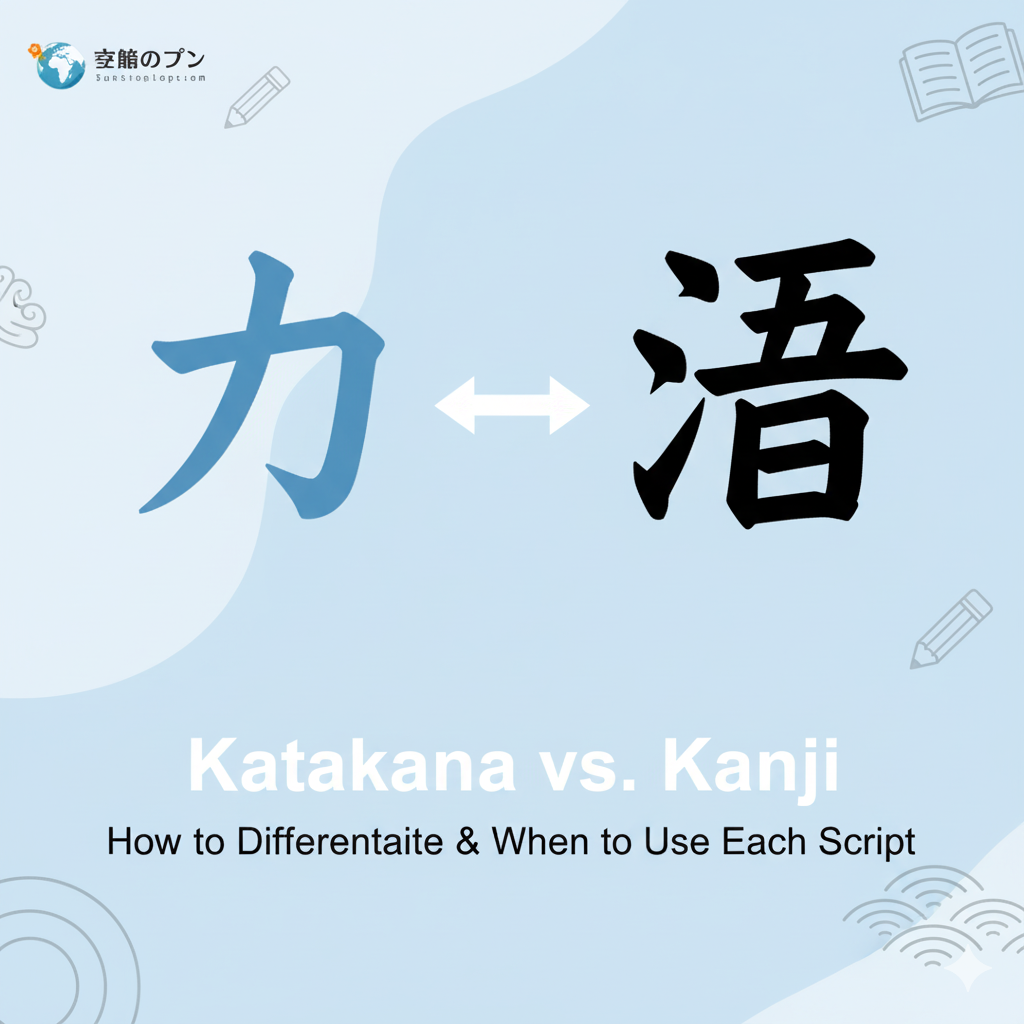
This confusion—differentiating the two non-Hiragana scripts—is totally normal and is the first big step toward advanced fluency. As a JLPT expert, I can tell you that understanding the function and form of Kanji and Katakana isn’t just an academic exercise; it’s the key to reading Japanese text efficiently—which is critical for the timed reading sections of the JLPT N3 and N2.
This comprehensive guide will peel back the layers, showing you the unique visual identity of each script, explaining their distinct linguistic roles, and giving you practical, real-world examples of when to use one over the other. Forget the notion of simple translation (like a direct kanji to katakana swap); we’re talking about understanding the soul of Japanese writing.
Ready to gain the visual acuity of a native speaker? Let’s decode the two most challenging Japanese scripts!
Section 1: Form and Function – The Fundamental Distinction
The most immediate difference between Kanji and Katakana is not their meaning, but their origin and visual structure. Learning to spot this difference quickly will dramatically increase your reading speed.
1. The Visual Identity: Recognizing the Script’s Shape
Imagine two different types of architecture: one built for meaning, the other built for sound.
A. Kanji (漢字: Chinese Characters)
- Origin: Borrowed from Chinese writing over centuries.
- Structure: They are logographic, meaning each character represents an idea or concept (a word, a part of a word, or a morpheme), not just a sound.
- Visual Characteristics (The Quick Spot):
- Complexity: Kanji are visually complex. They often have many strokes (from 1 to over 20).
- Containment: They frequently feature recognizable radicals (smaller component parts) contained within an outer frame or structure. Think of little boxes, enclosures, and layered elements (e.g., 語 – word, 場 – place, 森 – forest).
- Shape: They feel dense, balanced, and sometimes square-ish, like mini-pictures.
B. Katakana (カタカナ: Fragmentary Kana)
- Origin: Derived by taking fragments of complex Kanji characters. This is why they are called kana (borrowed or tentative characters).
- Structure: They are phonetic (or syllabic), meaning each character represents a single syllable sound (e.g., ka, ki, ku, ke, ko). They carry no inherent meaning.
- Visual Characteristics (The Quick Spot):
- Simplicity: Katakana characters are much simpler, typically having only 2 to 4 strokes.
- Angles: They are characterized by straight lines, sharp angles, and distinct corners. They feel angular, spiky, and more “mechanical” than Hiragana’s curves (e.g., カ – ka, キ – ki, ロ – ro).
- Uniformity: The entire set of 46 characters shares this visual, angular quality.
| Feature | Kanji (漢字) | Katakana (カタカナ) |
| Primary Function | Meaning (Concepts, Nouns, Verbs) | Sound (Foreign Words, Emphasis) |
| Visual Appearance | Complex, many strokes, radicals, dense. | Simple, few strokes, sharp angles, straight lines. |
| Number of Characters | Thousands (2,136 required for general use) | 46 basic characters |
| Example | 海 (umi – sea) | カメラ (kamera – camera) |
Practical Tip: When skimming a text, look for large clusters of simple, angular symbols—that’s Katakana! If you see dense, multi-stroke blocks, that’s Kanji.
Section 2: The Core Linguistic Roles – When to Use Katakana vs. Kanji
The key to fluency is understanding why the author chose one script over the other. The choice is a deliberate linguistic signal.
1. The Primary Role of Kanji: Meaning & Efficiency
Kanji is used for the content words of the Japanese language.
- Nouns: 本 (hon – book), 車 (kuruma – car), 電 (denki – electricity).
- Verb Stems: The core meaning part of verbs (e.g., 読む – yomu, to read).
- Adjective Stems: The core meaning part of adjectives (e.g., 高い – takai, high/expensive).
- Native Compound Words: Combining two or more concepts (e.g., 日本語 – Nihongo, Japanese language).
The Efficiency Insight: In Japanese, spaces between words aren’t common. Kanji acts as a visual separator, making long sentences much easier to read and parse than if they were written only in Hiragana. Imagine reading English if every single word were written in lowercase and had no spaces—that’s what a lack of Kanji would feel like!
2. The Primary Role of Katakana: Sound & Foreignness
Katakana’s function is centered on sound, particularly non-native sounds. This is the heart of the differentiation process.
- Loanwords (外来語 – Gairaigo): This is the most famous and frequent use. Any word borrowed from a foreign language (other than ancient Chinese) is written in Katakana. This includes words like:
- パソコン (pasokon – personal computer)
- コーヒー (kōhī – coffee)
- バスケットボール (basukettobōru – basketball)
- アイスクリーム (aisukurīmu – ice cream)
Interlink to Pillar: To truly master this core function, you must understand the rules of transcription. Dive into our main guide:Transcribing Foreign Words and Names with Katakana (Loanwords Guide).
- Foreign Names: Names of people, countries, and places that originated outside of Japan (アメリカ – Amerika, ジョン – Jon).
- Self-Correction Insight: When you look up a foreign place name, you’ll sometimes find a Kanji version (called ateji – 宛字), but this is old-fashioned, academic, or used for historical context. For modern communication, Katakana reigns supreme (e.g., The UK is almost always イギリス (Igirisu), not the rare 英吉利).
Interlink: Ready to write your own name? We have a step-by-step workshop:Translating Foreign Names into Katakana (A Step-by-Step Workshop).
- Onomatopoeia and Mimesis: Sound effects and words describing states are written in Katakana to make them stand out.
- Example: ドキドキ (dokidoki) – heart beating fast.
- Example: シーン (shīn) – silence (like “shhh” or an empty sound stage).
- Emphasis, Slang, and Voice: Katakana is used like italics in English, often to draw attention to a word, make a word sound “cool” or foreign, or convey a robot’s voice.
- Example: Writing メシ (meshi – meal) in Katakana (メシ) can make it look more aggressive or slangy than the native Kanji (飯).
Section 3: The Rare Overlap – When Kanji Becomes Katakana (and Vice Versa)
The true linguistic challenge is not differentiating them when they are used normally, but understanding the rare situations when a word that should be in Kanji is written in Katakana, or when an old Katakana word is replaced by Kanji. This requires advanced contextual knowledge, often tested at JLPT N2 and N1.
1. Katakana Substituting Kanji (The Most Common ‘Kanji to Katakana’ Scenario)
Why would a writer choose Katakana for a word that has a perfectly good Kanji? It’s almost always for one of these practical reasons:
- The Kanji is too Difficult/Rare: If the Kanji is very complex or rarely used, the author might substitute it with Katakana for readability. This is particularly common in children’s books or subtitles.
- Example: The word for “cigarette” is 煙草. Often, you’ll see it written as タバコ (tabako) in Katakana, which is much easier.
- The Author’s Intention: The author wants to give the word a hard, cold, or technical feel, often seen in official documents or instruction manuals.
- Example: 癌 (gan – cancer) is a complex Kanji. In medical journals, it is frequently written as ガン in Katakana to reduce emotional impact and maintain clinical neutrality.
2. Kanji Substituting Katakana (Ateji – 宛字)
Ateji (meaning “assigned characters”) is the use of Kanji purely for their sound, not their meaning, to write a foreign or native word. This is usually archaic, poetic, or historical.
- Example: Cigarette (again): While often written タバコ, the original Kanji 煙草 literally means “smoke grass.” This is an example of ateji that eventually became the established, albeit complex, Kanji form.
- Example: The Netherlands: The official name for the Netherlands is オランダ (Oranda) in Katakana. The historical ateji is 和蘭, using Kanji that mean “peace” and “orchid” for their sound.
Unique Insight for JLPT Learners: When you see a word you know is native Japanese (like sakana – fish) but it’s written in Katakana (サカナ), it’s almost always a deliberate stylistic choice by the author to make the word stand out, or because the author assumes the reader might not know the complex Kanji (魚). Pay attention to this clue—it tells you something about the author’s target audience.
Section 4: Practical Application for Reading and Writing
Mastering the differentiation of Kanji and Katakana is not just about identifying the characters; it’s about applying this knowledge in real time to improve your reading and writing.
Reading Strategy: The “Three-Script Scan”
When looking at a Japanese sentence, develop a three-script mental scan:
- Scan for Hiragana: This is the glue. It tells you the grammatical structure (particles like は, を, が, and verb conjugations).
- Scan for Katakana: If you spot a cluster of angular characters, your brain should immediately switch to Loanword/Foreign Name Mode. You are looking for a borrowed word. (e.g., “Ah, コンピューター—that’s ‘computer’!”)
- Scan for Kanji: This is the core meaning. When you see a Kanji, you are looking for the noun, verb stem, or core concept. This is how you find the main subjects and actions of the sentence.
This strategy allows you to parse a complex sentence much faster than trying to read it word-by-word.
Writing Strategy: Avoiding “Katakana-ism”
A common mistake among intermediate Japanese learners is overuse of Katakana—a kind of “Katakana-ism.” They might write native Japanese words in Katakana because it’s simpler than the Kanji, leading to unnatural text.
- The Rule: Always use the appropriate Kanji for common words. Use Katakana only when the word is a true loanword, onomatopoeia, or when you specifically intend to create stylistic emphasis (which should be rare).
- Incorrect: わたしは センセイ に あいました。 (I met the teacher.)
- Correct: わたしは 先生 に 会いました。
Section 5: The Overlap with Numbers and Specialized Characters
The role of Katakana extends to numbers, symbols, and specialized characters that often overlap with things traditionally written in Kanji.
1. Numbers and Digits
While Kanji has characters for numbers (一, 二, 三, 四), Katakana is often used to represent foreign numbers or counts in a highly Westernized or technical context.
- Example: When typing a simple digit (like 5, 6, 7, 8, or 9), you are usually just using the Arabic numeral. However, if you are transcribing the pronunciation of the English digit (e.g., ‘five’), you must use Katakana.
- 5 in Japanese Katakana: ファイブ (faibu)
- 6 in Katakana: シックス (shikkusu)
Interlink: Need the full list of numbers and how they translate? Check out our complete guide:Your Comprehensive Katakana Number Chart (From 1 to 1000 and Beyond).
2. Symbols and Punctuation
Kanji is not used for punctuation. Punctuation (commas, periods) are shared across all scripts. However, Katakana has specialized symbols that set it apart, which must not be confused with simple Kanji.
- The Long Vowel Mark (ー): This horizontal dash is only found in Katakana loanwords to extend a vowel sound. It has no meaning and is not a Kanji character.
- Example: ビール (bīru – beer)
- The Small Tsu (ッ): Used only in Katakana and Hiragana to indicate a double consonant.
Interlink: To fully master the punctuation specific to this script, read our guide:Punctuation and Symbols in Katakana (Including the Japanese Dash and Long Vowels).
Conclusion: A Three-Script Symphony
Learning to differentiate Kanji and Katakana is not the end of a chapter; it’s the beginning of being able to read Japanese with native-like intuition. Kanji handles the what (meaning), Hiragana handles the how (grammar), and Katakana handles the who/where/when (foreign context, sound, and emphasis).
By paying attention to the angular shapes of Katakana and the dense structures of Kanji, you will soon stop translating and start thinking in Japanese. This skill will pay enormous dividends when you face the complex, multi-script paragraphs of the JLPT.
Keep practicing the distinction! Your brain will start doing the script identification automatically before you even consciously read the word.
Further Resources and Study Tools
To move from mere differentiation to true mastery, you need resources that connect all three scripts and provide deep contextual understanding. Here are three excellent external resources:
- For an immersive experience that allows you to see both Kanji and Katakana used in natural contexts, reading Japanese news articles is essential. The Asahi Shimbun Digital offers a huge archive of current events, which is invaluable for seeing these scripts in action. (Note: A subscription may be required for full access).
- To fully understand the linguistic history and the complex relationship between Kanji and the Kana scripts, I highly recommend consulting The Online Japanese Dictionary (Jisho). Use their character search function to explore the evolution of radicals and compare their complexity.
- For practical, gamified study that can help you rapidly improve your ability to distinguish Katakana loanwords from native Kanji vocabulary, WaniKani is an extremely popular and effective system that drills you on reading both scripts.