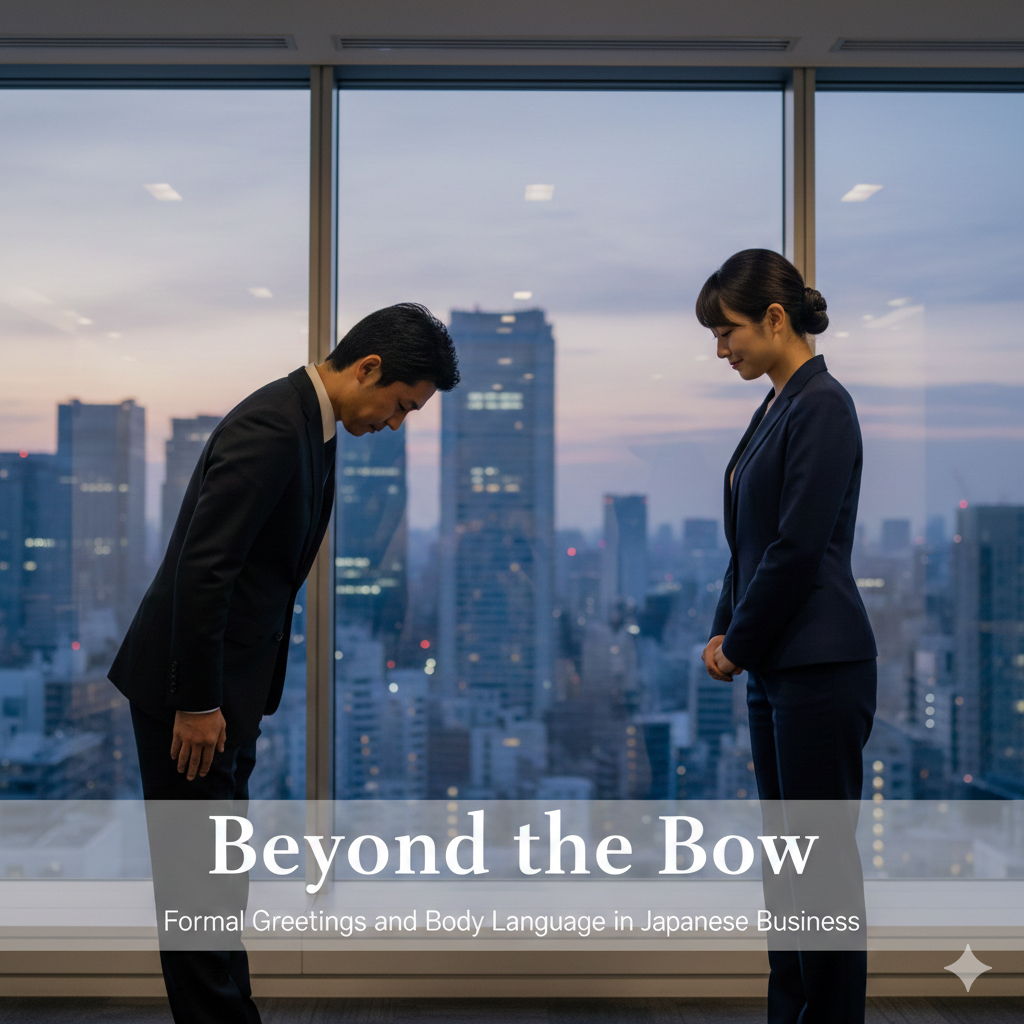
If you have ever stepped into a boardroom in Tokyo or joined a high-stakes Zoom call with a Japanese corporation, you know that the atmosphere feels different. It’s a choreographed dance of respect, silence, and subtle physical cues. Most Westerners know about bowing—it’s the “face” of Japanese business etiquette bowing—but many fail to realize that the bow is just the opening note of a complex symphony.
As someone who has spent years navigating the JLPT (Japanese Language Proficiency Test) and working directly with Japanese executives, I’ve seen many brilliant professionals lose a deal not because of their product, but because their body language signaled a lack of “Kyoshu” (humility) or “Kigakiku” (anticipation of needs).
In this guide, we are going deeper than the 15-degree tilt. We are exploring the non-verbal soul of Japanese commerce.
The Philosophy of “Reigi”: Why Body Language Matters
In Japan, your physical presence speaks louder than your resume. The concept of Reigi tadashii (correct etiquette) is rooted in Confucian values where hierarchy and harmony (Wa) are paramount. When you master a formal Japanese business greeting, you aren’t just being polite; you are demonstrating that you understand your place in the social fabric and that you are a reliable, disciplined partner.
To truly understand this, you should start with our foundational resource: The Ultimate Guide to Japanese Business Etiquette & Culture (2025-26 Edition).
1. The Geometry of the Bow (Ojigi)
Bowing is more than just bending your waist. It is a measurement of the relationship between two people. If you use the wrong angle, you might come across as overly subservient or, worse, dismissive.
- Eshaku (15°): This is for casual greetings or passing someone in the hallway. It’s a “hello” in motion.
- Keirei (30°): This is the standard for japanese business introduction etiquette. Use this when meeting clients, entering a meeting room, or thanking a partner.
- Saikeirei (45°): Reserved for deep apologies or showing profound respect to high-ranking officials.
Pro-Tip from a JLPT Expert: When bowing, keep your back straight and your hands at your sides (for men) or clasped in front (for women). Do not look the other person in the eye while bowing—it can be perceived as aggressive or suspicious. Follow the line of your nose toward the floor.
2. The First 60 Seconds: Formal Japanese Business Greetings
The verbal component of the greeting is just as vital as the physical. You will rarely hear a simple “Konnichiwa” in a professional setting. Instead, you must master the “Teineigo” (polite language) phrases that define the formal Japanese business greeting.
The Golden Phrase: “Yoroshiku Onegaishimasu”
There is no direct English translation for this. It roughly means “Please treat me well” or “I am in your hands.”
- When to say it: Immediately after exchanging business cards.
- How to say it: Combined with a 30-degree bow.
The “Osewa” Acknowledgement
If you are meeting someone you have worked with before, the standard opening is “O-sewa ni natte orimasu” (I am in your debt for your continued support). Even if you haven’t done much together, this phrase establishes a bond of mutual obligation.
To learn how to translate these verbal cues into written form, check out our guide on How to Write Professional Japanese Business Emails: Etiquette, Phrases, and Zoom Rules.
3. Business Card Exchange: The “Meishi” Ritual
While we have a dedicated guide for this, you cannot talk about body language without mentioning the Meishi Koukan. Your body language during this exchange should be fluid.
- Height Matters: Always try to offer your card at a level lower than the person of higher status.
- The Two-Handed Rule: Never give or receive a card with one hand. It suggests that the person (and their company) isn’t worth your full attention.
For the full breakdown of this ritual, read Mastering the Meishi: The Essential Guide to Japanese Business Card Etiquette.
4. Posture and Presence: The “Silent” Language
In the West, we are taught that “power posing” or taking up space shows confidence. In Japan, the opposite is often true. Silence and stillness are signs of strength and self-control.
Seating and Standing
- The “Ki” of Standing: When standing in a group, avoid crossing your arms or putting your hands in your pockets. This is seen as “barricading” yourself or being lazy.
- The Power of Stillness: Fidgeting—tapping a pen, shaking your leg, or looking at your watch—is highly distracting in a Japanese meeting. It suggests you lack Gaman (endurance/patience).
Eye Contact: The Delicate Balance
Direct, prolonged eye contact in the West signifies honesty. In Japan, it can be seen as a challenge or an invasion of privacy. Aim for “soft” eye contact—look at the person’s neck or their tie knot occasionally to break the intensity.
5. Navigating the Meeting Room
Once the greetings are over, your physical movement within the room continues to communicate your understanding of hierarchy.
The concept of Kamiza (the “upper seat”) is crucial. The person of the highest rank sits furthest from the door. As a guest, you will likely be guided to the Kamiza, but you should wait to be told where to sit.
For a deep dive into the physical layout of a Japanese office, see Decoding the Japanese Meeting: Seating Charts (Kamiza), Hierarchy, and Decision Making.
6. Practical Application: A Checklist for Success
If you are preparing for a trip to Japan or a meeting with a Japanese delegation, use this checklist to ensure your body language aligns with japanese business introduction etiquette:
- Mirroring: Pay attention to the depth of the host’s bow and try to match it.
- Handshakes: If a Japanese professional offers a handshake, keep it gentle. Do not try to “crush” their hand to show dominance.
- Gestures: Avoid pointing with a single finger. Use an open palm to indicate a direction or a person.
- The “No” Signal: Japanese people rarely say “no” directly. If someone tilts their head and says “Sore wa chotto…” (That is a little…), while rubbing the back of their neck, they are saying “no.” Don’t push further.
7. Beyond the Office: Social Body Language
Business in Japan doesn’t end at 5:00 PM. Much of the real bonding happens at the Nomikai (drinking party) or through gift-giving. Even in these “relaxed” settings, your body language and etiquette remain under observation.
- For dining etiquette, visit: The Nomikai Survival Guide: Japanese Business Dining and Drinking Etiquette.
- For the nuances of gift presentation, read: The Art of Giving: Japanese Business Gift Etiquette (Omiyage and Temiyage).
- And finally, ensure your attire matches the gravity of the occasion: What to Wear: The Modern Japanese Business Dress Code for Men and Women.
Insights from the Field
As a JLPT expert, I often tell students that learning the language is only 50% of the battle. You can pass the N1 exam, but if you sit with your legs crossed in a meeting with a CEO, you have failed the “cultural N1.”
The most successful foreign business people in Japan are those who are “high-context.” They observe more than they speak. They notice when the tea is being served and use that moment to pause the conversation. They understand that a slight nod doesn’t always mean “I agree,” but rather “I am listening.”
Conclusion
Mastering japanese business etiquette bowing and the nuances of a formal Japanese business greeting is about showing that you value the relationship more than the transaction. By adopting these physical cues, you bridge the cultural gap and build a foundation of trust that words alone cannot achieve.
Take the Next Step in Your Journey: If you want to sharpen your technical language skills alongside your etiquette, I highly recommend checking out official resources. For those preparing for exams or looking for formal vocabulary structures, visiting the official JLPT – Japanese-Language Proficiency Test website is an essential step. Additionally, for a broader understanding of international business standards, JETRO (Japan External Trade Organization) offers incredible insights into the current economic landscape of Japan.