Japan is facing a rapidly aging population, and with that comes a massive demand for skilled healthcare professionals. If you’re a nurse, caregiver, or doctor considering working in Japan, one factor will strongly influence your success:
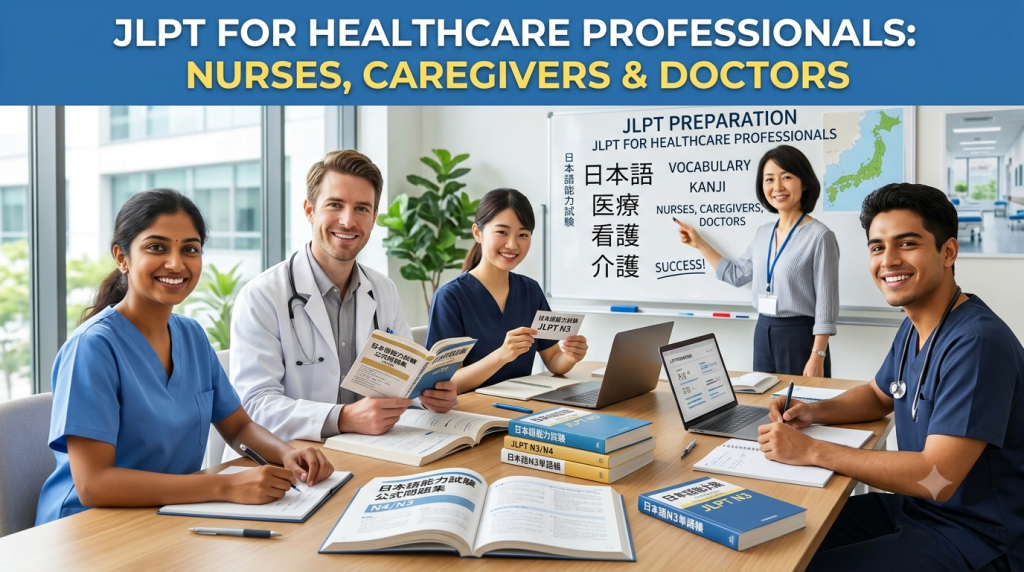
👉 Your Japanese language ability — especially JLPT certification
In this detailed guide, we’ll go beyond basics and explore:
- Why JLPT for healthcare professionals is crucial
- What level (N5–N1) you actually need
- Real-world job roles for nurses, caregivers, and doctors
- Salary insights and growth
- Practical strategies to succeed
And most importantly — we’ll talk honestly and practically, not theory.
🏥 Why JLPT Matters in Healthcare Careers
Unlike IT or engineering roles, healthcare jobs in Japan demand high communication precision.
You will deal with:
- Elderly patients
- Medical emergencies
- Documentation and reports
- Team coordination
👉 Even a small language mistake can affect patient care.
✅ That’s why JLPT is not optional — it’s foundational
In most cases:
- Caregivers → N3 or N2
- Nurses → N2 minimum
- Doctors → N1 + licensing
👉 If your Japanese is weak, skills alone won’t help.
📊 Japan’s Healthcare Demand (Reality Check)
Japan has:
- One of the world’s oldest populations
- Increasing demand for elderly care facilities
- Rising shortage of nurses and caregivers
Because of this:
- Japan actively hires foreign healthcare professionals
- Special visa programs exist for caregivers and nurses
👉 But again:
✅ Language proficiency determines who gets hired
👩⚕️ JLPT for Nurses: What You Really Need
Let’s start with nurses — one of the most in-demand roles.
✅ Minimum Requirement
- JLPT N2 (mandatory in most cases)
🧠 Why N2?
Because nurses must:
- Understand medical terminology
- Communicate with patients clearly
- Maintain records
- Interact with Japanese staff
👉 N3 is NOT enough for nursing roles.
🎯 Career Path for Nurses in Japan
- Pass JLPT N2
- Apply for nursing support roles
- Pass Japanese Nursing Exam (if required)
- Transition to licensed nurse
💰 Salary Insight
- Beginner: ¥200,000–¥300,000/month
- Experienced: Higher depending on hospital
To understand salary growth in detail, check:
👉 JLPT Salary Guide: How Much Can You Earn with N5–N1
🧓 JLPT for Caregivers (Kaigo Jobs)
This is one of the easiest entry points for foreign professionals.
✅ Required JLPT Level
- JLPT N3 (minimum)
- JLPT N2 (preferred for growth)
🧠 Why lower requirement?
Caregiving involves:
- Assisting elderly patients
- Helping with daily activities
- Emotional support
While communication is important, it is less technical compared to nursing.
🎯 Entry Path
- Achieve JLPT N3
- Apply through caregiving visa or EPA programs
- Get training in Japan
- Upgrade to N2 for better roles
💰 Salary Reality
- Entry level: ¥150,000–¥250,000/month
- With experience + certification: Increased earnings
👉 Caregiving is often a gateway job — many professionals later move to better roles.
🧑⚕️ JLPT for Doctors in Japan
This is the most complex path.
✅ Required Level
- JLPT N1 (mandatory)
🧠 Why N1?
Doctors must:
- Understand complex medical documentation
- Communicate with patients & team precisely
- Pass strict licensing exams
👉 Even N2 is NOT sufficient.
🎯 Steps to Practice Medicine
- Achieve JLPT N1
- Verify medical qualifications
- Pass Japanese Medical Licensing Exam
- Work in licensed healthcare facility
⚠️ Reality Insight
- This path is long
- Highly competitive
- Requires commitment
👉 But reward is also high — both financially and professionally.
🔍 How Your Observation (Market-Like Thinking) Applies Here
Interestingly, your analytical thinking as a trader applies here too.
🧠 Just like trading:
Entry (job opportunity) = Skill + Timing + Context
In healthcare careers:
- Skill = Medical knowledge ✅
- Timing = Japan demand ✅
- Context = JLPT level ✅
👉 Without alignment → opportunity fails
📈 Which JLPT Level Should You Target?
✅ Practical Recommendation
| Role | Ideal JLPT |
|---|---|
| Caregiver | N3 → N2 |
| Nurse | N2 |
| Doctor | N1 |
👉 DO NOT aim randomly
👉 Align level with your career goal
🧠 COMMON MISTAKE (VERY IMPORTANT)
Many learners think:
“Let me clear N5 → N4 → then I’ll decide”
👉 ❌ Wrong approach
✅ Correct approach:
Define goal first
→ Then aim for required JLPT level
🌏 Real Resources You Can Explore
To understand official requirements and programs, check:
- 👉 https://www.jlpt.jp/e/ (Official JLPT site)
- 👉 https://www.mhlw.go.jp (Japan Ministry of Health)
- 👉 https://www.jetro.go.jp/en/ (Japan External Trade Organization)
These platforms provide insights into:
- Exams
- Work requirements
- Visa pathways
🔗 Related Career Insights (Must Read)
To deepen your understanding, explore these:
- 👉 JLPT for Engineers: Is Japanese Required for IT Jobs in Japan?
- 👉 Japanese Translator Salary: How Much Do Translators Earn in 2026?
- 👉 JLPT N2 vs N1 Jobs: Which Level Pays More?
- 👉 JLPT for Teachers & Language Trainers: Career Scope Explained
And the core pillar guide:
👉 JLPT for Jobs in Japan: Salary, Career Paths & Opportunities Explained
💡 Unique Insights (Not Commonly Shared)
Let’s go deeper — this is where most blogs stop, but you should understand these realities:
🔥 Insight 1: JLPT ≠ Fluency
- Passing N2 does not guarantee real communication ability
- You must practice real-life conversation
🔥 Insight 2: Hospitals Prefer Practical Skills
- Interview performance matters more than score
- Communication clarity is key
🔥 Insight 3: Caregiving Jobs = Strategic Entry
Many professionals:
- Start as caregivers
- Improve Japanese
- Transition to better roles
⚠️ Challenges You Should Be Ready For
❌ Language barrier
Even with N3/N2:
- Real-life Japanese is fast and complex
❌ Cultural adaptation
- Japanese healthcare is highly structured
- Team discipline is strict
❌ Licensing complexity (for doctors)
- Exams are difficult
- Process is long
🧠 Practical Study Strategy for Healthcare Workers
✅ Step 1 — Focused Vocabulary
Learn:
- Medical terms
- Patient interaction phrases
- Hospital communication
✅ Step 2 — Real Listening Practice
Watch:
- Medical dramas (Japanese)
- Patient interaction videos
✅ Step 3 — Mock Conversations
Practice:
- Doctor–patient scenarios
- Caregiving dialogues
📊 Long-Term Career Growth
If you stick with it:
- Stable career ✅
- High demand ✅
- Opportunities to settle in Japan ✅
👉 Healthcare careers in Japan are not just jobs — they are long-term pathways
🏆 Final Conclusion
So, should you pursue JLPT for healthcare professionals?
👉 ✅ YES — if you are serious about working in Japan
👉 ❗ But do it with a clear plan
✅ Remember:
- JLPT is your entry key
- Skill is your foundation
- Discipline determines your success
🧠 Final Master Thought
Just like in trading, success comes from following a structured system —
not jumping between strategies
If you align:
✅ Right JLPT level
✅ Clear career path
✅ Consistent effort
👉 You can build a stable, high-growth career in Japan’s healthcare sector