How JLPT Points Work for Japanese Immigration: The Fast-Track to Residency
If you are planning to work, live, or settle permanently in Japan, you have likely come across Japan’s Highly Skilled Professional (HSP) points system. Introduced by the Ministry of Justice to attract global talent, this points-based system offers preferential immigration treatment, longer visa terms, and a fast-track pathway to Japanese Permanent Residency (PR).
While factors like your salary, age, academic degrees, and professional background form the core of your immigration score, Japanese language proficiency acts as one of the most cost-effective and controllable point boosters available. Specifically, passing the Japanese-Language Proficiency Test (JLPT) at higher levels can award you 10 to 15 critical bonus points.
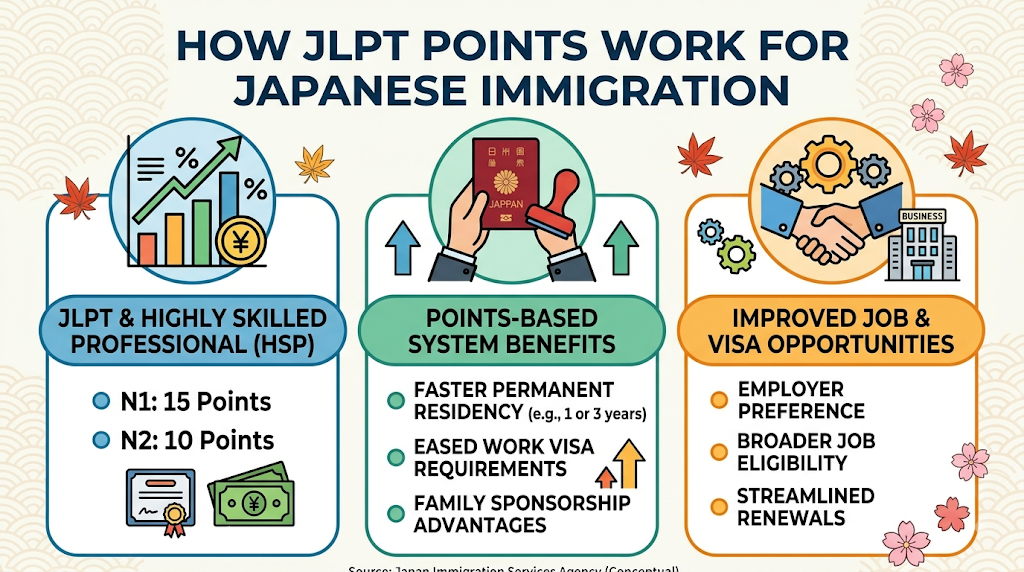
Whether you are trying to reach the 70-point threshold for a 3-year residency shortcut or hitting 80 points to get Permanent Residency in just 12 months, understanding how JLPT immigration points are calculated—and how to document them properly—is essential.
In this comprehensive guide, we will break down the exact point allocations for JLPT levels, how language points interact with university degrees, how the BJT compares, and how you can leverage your Japanese skills to fast-track your life in Japan.
1. What Is Japan’s Highly Skilled Professional (HSP) Point System?
Japan’s immigration framework classifies foreign professionals under various visa statuses. While standard work visas (such as the Engineer / Specialist in Humanities / International Services visa) require standard renewals and a 10-year physical residency requirement before applying for Permanent Residency, the Highly Skilled Professional status (Koudo Senmon Shoku) works on a merit system.
To qualify for the HSP visa framework or its fast-track benefits, applicants must achieve a calculated score across main categories:
- Academic Background (Bachelor’s, Master’s, Ph.D., multiple degrees)
- Professional Career / Experience (3, 5, 7, or 10+ years)
- Annual Salary (Base contract income, scaled by age)
- Age (Under 30, 30–34, 35–39)
- Special Bonus Categories (Top university graduates, company designations, licenses, and Japanese language ability)
The Magic Numbers: 70 Points and 80 Points
The point system has two major thresholds:
- 70 Points Threshold: Grants eligibility for the 5-year HSP visa status and opens the accelerated 3-year Permanent Residency route.
- 80 Points Threshold: Unlocks the ultra-fast-track 1-year Permanent Residency route.
[ Your Professional Base Points ]
(Age + Salary + Education + Experience)
               │
               ▼
[ Add JLPT Bonus Points ] ───► JLPT N2 (+10 pts) or JLPT N1 (+15 pts)
               │
               ▼
[ Total Immigration Score ]
 ├── 70–79 Points ──► 3-Year Fast-Track to Japanese PR
 └── 80+ Points   ──► 1-Year Fast-Track to Japanese PR
Because raising your salary bracket or gaining years of work experience takes time, achieving a passing score on the JLPT is often the fastest way to gain 10 to 15 additional points when you are sitting just below a threshold.
To understand how language fits into the broader visa ecosystem, review our comprehensive JLPT for Immigration to Japan: Visa, PR & Work Permit Guide, which outlines all major visa categories and long-term residency options.
2. Exact Breakdown: How JLPT Points Are Awarded
Under the official point calculation table established by the Immigration Services Agency of Japan (ISA), points for Japanese language proficiency are granted under the special bonus section as follows:
| JLPT Certification Level | Official HSP Bonus Points Awarded | Notes & Conditions |
| JLPT N1 | 15 Points | Max points for language certification alone. Cannot be combined with N2. |
| JLPT N2 | 10 Points | Granted to applicants who have passed N2. |
| JLPT N3 | 0 Points | No bonus points awarded under the HSP matrix. |
| JLPT N4 | 0 Points | No bonus points under HSP (used mainly for Specified Skilled Worker 1). |
| JLPT N5 | 0 Points | No bonus points under HSP. |
Key Takeaways from the Official Allocation:
- N1 vs. N2 Point Spread: JLPT N1 provides 15 points, while N2 provides 10 points. The 5-point difference between N2 and N1 might seem small on paper, but in the HSP point system, 5 points can be the exact gap between 75 points (3-year PR track) and 80 points (1-year PR track).
- N1 and N2 are Non-Cumulative: You cannot stack N1 (+15) and N2 (+10) together for 25 points. You receive points only for your highest passing qualification.
- No Points for Lower Levels: While N3 and N4 are helpful for daily life and basic work environments, they yield 0 points in the HSP evaluation table. If your goal is strictly points-based immigration acceleration, target N2 as your baseline milestone.
3. Advanced Interactions: Stacking Japanese Language & University Bonuses
One common point of confusion among foreign professionals is how language bonus points interact with higher education degrees obtained in Japan or abroad.
A. Graduating from a Japanese Higher Education Institution (+10 Points)
If you graduated with a degree (Bachelor’s, Master’s, or Doctorate) from an accredited university or vocational college in Japan, you receive a 10-point bonus under the academic bonus section.
Can you stack a Japanese University Degree with JLPT N1 or N2?
Yes! The bonus for graduating from a Japanese university (+10 points) is classified under a separate criteria section from Japanese language proficiency.
- Scenario: You earned a Master’s degree from a Japanese university (+20 for Master’s, +10 for Japanese university graduation) and passed JLPT N1 (+15).
- Total stack: 45 points from education and language alone!
B. Foreign University Japanese Language Majors (+15 Points)
If you did not take the JLPT exam, but you graduated from a foreign university with a major in Japanese Language or Culture, Japanese immigration treats this degree as equivalent to JLPT N1 (15 points). However, you cannot claim both a Japanese major bonus and a JLPT N1 bonus simultaneously (they fall into the same 15-point capacity bucket).
C. What About the BJT (Business Japanese Proficiency Test)?
If you missed the JLPT testing window or prefer a computer-based test that is offered more frequently throughout the year, the BJT is explicitly recognized by Japanese immigration as an alternative:
- BJT Score of 480 or higher: Equivalent to JLPT N1 (15 Points)
- BJT Score of 400 or higher: Equivalent to JLPT N2 (10 Points)
If you are deciding between different testing frameworks, read our detailed comparison on JLPT vs JFT: Which Test Is Better for Visa Applications? to see how various tests map to immigration and work visa categories.
4. The Retrospective Rule: How JLPT Points Fast-Track PR Without an HSP Visa
Many expat professionals in Japan assume they must formally apply for and hold an “Highly Skilled Professional” visa status to benefit from the 1-year or 3-year Permanent Residency shortcuts.
This is a common misconception.
Under the regulations managed by the Immigration Services Agency of Japan, you can remain on a standard work visa (such as Engineer / Specialist in Humanities) and apply directly for Permanent Residency via the HSP point system using the Retrospective Rule.
┌────────────────────────────────────────────────────────────────────────┐
│                        THE RETROSPECTIVE RULE                          │
├────────────────────────────────────────────────────────────────────────┤
│ You DO NOT need to hold a formal HSP Visa to get Fast-Track PR!        │
│                                                                        │
│ Option A: Prove you scored 70+ points continuously over past 3 years.   │
│ Option B: Prove you scored 80+ points continuously over past 1 year.   │
└────────────────────────────────────────────────────────────────────────┘
How the Retrospective Assessment Works
When submitting a Permanent Residency application under the points pathway:
- For the 3-Year Route (70 Points): You must prove that you scored at least 70 points at the time of application AND that you already scored at least 70 points 3 years ago.
- For the 1-Year Route (80 Points): You must prove that you scored at least 80 points at the time of application AND that you already scored at least 80 points 1 year ago.
Here is where your JLPT certificate becomes crucial. If you passed JLPT N2 or N1 two or three years ago, that official certificate serves as proof that your language points were active throughout that lookback period.
For step-by-step instructions on converting your points into long-term residency status, see our complete handbook: JLPT for Permanent Residence in Japan: Full Guide.
5. Case Studies: How JLPT Points Change the Immigration Equation
To visualize how JLPT points work in practice, let us analyze two realistic scenarios of foreign professionals living in Tokyo.
Case Study A: Alex – Mid-Level Software Engineer (Age 28)
Alex works for an IT firm in Tokyo on a standard Engineer visa. Let’s calculate Alex’s base score without language credentials:
- Age: 28 years old (15 points)
- Education: Bachelor’s Degree in Computer Science from a foreign university (10 points)
- Work Experience: 4 years (5 points)
- Annual Salary: ¥6.5 Million JPY (20 points)
- Base Score: 50 Points
At 50 points, Alex falls well short of the 70-point threshold required for fast-track residency. Under standard rules, Alex would need to wait 10 full years in Japan to apply for Permanent Residency.
The JLPT Impact:
Alex studies diligently and passes the JLPT N2 exam, earning 10 bonus points. Later that year, Alex passes a Japanese National IT Exam (such as the Fundamental Information Technology Engineer Examination), earning another 5 bonus points.
- New Total Score: 50 + 10 (JLPT N2) + 5 (IT License) = 65 Points
Recognizing they are close to 70 points, Alex prepares for and passes JLPT N1, replacing the N2 score with 15 points.
- Final Score with N1: 50 + 15 (JLPT N1) + 5 (IT License) = 70 Points
By achieving JLPT N1, Alex immediately crosses the 70-point mark, cutting the waiting time for Japanese Permanent Residency from 10 years down to 3 years!
Case Study B: Sophia – Marketing Specialist (Age 34)
Sophia is a mid-career marketing manager working at an international firm in Osaka.
- Age: 34 years old (10 points)
- Education: Master’s Degree (20 points)
- Work Experience: 7 years (15 points)
- Annual Salary: ¥8.2 Million JPY (30 points)
- Base Score: 75 Points
Sophia already has 75 points, which easily clears the 70-point threshold for 3-year PR. However, Sophia wants to secure Permanent Residency as fast as possible to apply for a home mortgage in Japan.
The JLPT Impact:
Sophia already holds a JLPT N2 certificate (10 points, already factored into her base profile score). Sophia decides to dedicate six months to intensive study and successfully passes JLPT N1.
- Point Gain: Upgrading from N2 (+10) to N1 (+15) adds +5 net points.
- New Total Score: 75 + 5 = 80 Points
That 5-point boost from passing N1 elevates Sophia into the 80-point tier, unlocking the 1-year Permanent Residency route. Passing N1 saved Sophia two full years of waiting.
6. Do You Need JLPT for Standard Japanese Work Visas?
While JLPT N1 and N2 are vital for accumulating immigration points under the HSP points framework, it is important to distinguish point-based visas from standard entry requirements.
If you are entering Japan on a regular status of residence (such as Engineer / Specialist in Humanities / International Services or Instructor), Japanese immigration law does not legally mandate a JLPT certificate for visa issuance in most categories.
┌─────────────────────────────────────────────────────────────────────────┐
│                    VISA TYPES & LANGUAGE REQUIREMENTS                   │
├─────────────────────────────────────────────────────────────────────────┤
│ Standard Work Visa (Engineer/Humanities):  JLPT Not Legally Mandatory    │
│ Specified Skilled Worker 1 (SSW):         JLPT N4 or JFT-Basic Mandatory │
│ Highly Skilled Professional (HSP):         JLPT N2/N1 optional for BONUS│
└─────────────────────────────────────────────────────────────────────────┘
However, employers frequently require N2 or N1 for recruitment, and having these certificates simplifies the background verification process conducted by immigration officials.
For a complete breakdown of when language certificates are legally mandatory versus when they are purely advantageous, read our detailed analysis on Japanese Visa Language Requirements: Do You Really Need JLPT? as well as our guide on JLPT Required for Japanese Work Visa (Explained Clearly).
7. Required Proof and Documentation for Submitting JLPT Points
Claiming points on your official HSP calculation sheet without acceptable documentary evidence will result in zero points awarded for that item.
When submitting your immigration file to the Regional Immigration Services Agency of Japan, ensure you include the correct official proof:
Acceptable Proof of Language Ability:
- JLPT Official Certificate of Result and Scores (合格結果通知書): The original score report issued by Japan Educational Exchanges and Services (JEES) or the Japan Foundation.
- JLPT Certificate of Proficiency (日本語能力認定書): The formal decorative passing certificate.
- BJT Official Score Report: Official score transcript showing a score of 400+ (for 10 points) or 480+ (for 15 points).
- University Diploma/Transcript: If claiming the 15-point equivalent for majoring in Japanese language at a foreign university, you must provide your official diploma and an official course transcript explicitly showing “Japanese Language Major.”
Expert Tip: Keep physical copies of your score reports. If you passed the test several years ago and lost your paper certificate, you must request a reissue from theOfficial JLPT Websitewell before filing your visa or PR application, as certificate reissue can take several weeks.
8. Practical Strategy: How to Get Your JLPT Points Efficiently
If you need 10 or 15 points to hit your target immigration threshold, follow this practical roadmap to maximize your study efficiency:
Step 1: Perform an Accurate Points Audit
Calculate your base score using your current age, contract salary, education, and years of relevant work experience. Determine whether you need 10 points (N2 goal) or 15 points (N1 goal).
Step 2: Evaluate the Exam Timeline
The JLPT is held only twice a year (July and December) in most parts of the world and within Japan. Registration usually opens 3 to 4 months before the exam date.
- If you need points immediately and cannot wait for the bi-annual JLPT schedule, consider registering for the BJT (Business Japanese Proficiency Test), which offers computer-based testing slots almost every week.
Step 3: Focus on High-Yield Language Areas
- N2 Strategy (10 Points): Focus heavily on mastering core kanji (approx. 1,000 characters) and intermediate grammar structures used in workplace communication. Reading speed is the primary bottleneck for foreign professionals taking N2.
- N1 Strategy (15 Points): Focus on formal written prose, official newspaper commentary, and specialized vocabulary (approx. 2,000 kanji). Listening comprehension in N1 requires fast audio processing of formal spoken business contexts.
Summary Checklist for JLPT Immigration Points
To make sure your language strategy aligns with your long-term Japan residency goals, double-check these key rules:
- JLPT N1 gives you 15 points on the HSP points table.
- JLPT N2 gives you 10 points on the HSP points table.
- JLPT N3, N4, and N5 give 0 points on the HSP points table.
- JLPT points can be combined with the bonus points awarded for graduating from a Japanese university (+10 points).
- You can use your JLPT points retroactively to apply for Permanent Residency in 1 year (80+ points) or 3 years (70+ points) without ever holding a formal HSP visa.
- Always maintain physical passing certificates issued by JEES/Japan Foundation to prove your eligibility to immigration authorities.