Getting to the advanced level of Japanese feels incredible—until you open your first official test prep book for the N1. You glance at a reading section, see a dense wall of kanji with practically zero spaces, and realize that conversational fluency won’t save you.
Many learners hit a massive brick wall at this stage. You might comfortably watch anime without subtitles, chat with Japanese friends, or even live in Tokyo, yet still fail the N1 exam twice.
Passing the highest level of the Japanese Language Proficiency Test requires a complete shift in strategy. Here is an honest breakdown of why the N1 is notoriously brutal, along with the exact framework needed to clear it.
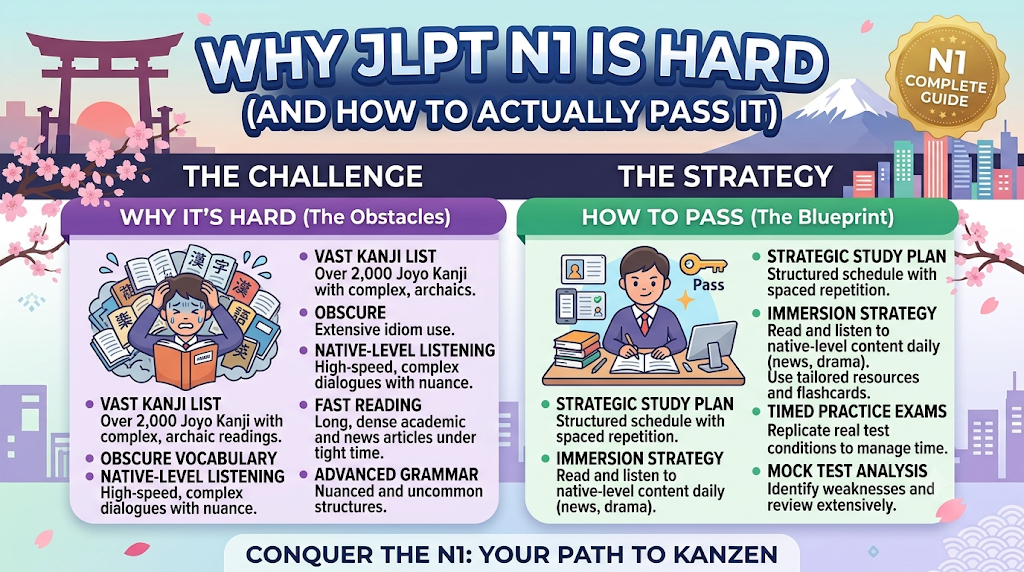
Why JLPT N1 Is Harder Than You Think
The jump from N2 to N1 isn’t just an incremental step; it’s a exponential leap in breadth and nuance.
- The Trap of Pure Speed: The reading comprehension section (dokkai) demands that you process native-level editorials, philosophical essays, and corporate notices at an incredibly fast pace. If you pause to decipher every single kanji, you will run out of time.
- Abstract and Formal Vocabulary: N1 vocabulary heavy on formal idioms (yojijukugo), nuance-driven adverbs, and abstract concepts rarely used in casual spoken Japanese.
- Grammar of Context and Tone: At the N1 level, grammar points rarely test simple functional meaning. Instead, they test subtle differences in attitude, formal register, and literary tone.
- Intentionally Tricky Distractors: The listening section includes complex conversations where speakers constantly change their minds, drop subtle hints, or use passive-aggressive business Japanese (keigo) to convey meaning.
Step-by-Step Guide: How to Pass JLPT N1
To crack this exam, you must move away from generic flashcards and start training like a native reader.
1. Upgrade Your Vocabulary Strategy
Passive recognition is fine for lower levels, but N1 requires fast, active recall under pressure.
- Learn words in compound groups rather than isolated terms.
- Focus on collocations—which verbs naturally pair with specific abstract nouns.
- Pay close attention to subtle shades of meaning between near-synonyms.
2. Attack the Reading Section (Dokkai)
Reading speed is usually the primary reason advanced students fail. You cannot read word-for-word on exam day.
- Practice scanning for core thesis statements in the first and final paragraphs of long texts.
- Train yourself to recognize logical connectors like ga, shikashi, or nani yori mo, which signal an author’s shift in perspective.
- Read actual Japanese editorials daily on sites like Asahi Shimbun or essays published on NHK News Web.
3. Master Business and Nuanced Keigo
A significant portion of N1 grammar and listening tests your comprehension of high-level Japanese workplace communication. Understanding the intricacies of formal interactions is essential, particularly if you are aiming for advanced career placement. You can explore our comprehensive Business Japanese for JLPT N1 Candidates guide to master these nuances.
Structuring Your Preparation Realistically
Balancing your study routine around daily responsibilities can be one of the hardest aspects of test prep.
| Study Focus Area | Recommended Time | Core Study Resource / Strategy |
| Kanji & Vocabulary | 30 Mins / Day | Spaced repetition systems (Anki) & native news reading |
| Grammar Nuance | 20 Mins / Day | Targeted sentence production and textbook drills |
| Speed Reading | 45 Mins / Day | Timed essays, native books, and editorial columns |
| Audio Processing | 30 Mins / Day | Native podcasts, business dialogues, and 1.2x speed audio |
If you are trying to balance full-time work while studying, generic study schedules won’t work. Check out our detailed JLPT N1 Study Plan for Working Professionals for practical strategies on squeezing maximum efficiency out of limited time.
Is the JLPT N1 Worth the Effort?
Taking on this level of study requires a significant time commitment. It helps to keep your long-term goals in clear focus.
Achieving N1 certification opens up specialized employment visas, executive-level corporate roles in Japan, and a major pay jump compared to N2 certification. If you are debating whether to stop at N2 or push forward to N1, check out our break down of the ROI in JLPT N2 vs N1: Difficulty, Salary & Career Comparison.
For tech workers specifically, passing advanced tests requires a tailored approach. You can review our JLPT N2 Study Plan for Engineers & IT Professionals to build a solid foundation before tackling N1 level materials.
Final Mindset Shift for Test Day
The N1 does not test how well you know about Japanese—it tests how fluently you process complex Japanese under extreme time constraints.
Stop viewing study sessions as memorization tasks. Treat every reading passage and listening track as a chance to understand real-world native thinking. Once you shift your focus from passing a test to processing native-level content seamlessly, the N1 becomes entirely winnable.
For a full step-by-step breakdown covering syllabus structures, study resources, and exam registration, refer to our complete JLPT N1 & N2 Preparation Guide for Advanced Learners.