Taking on the JLPT N1 is a major milestone. You have spent hundreds of hours memorizing complex kanji combinations, drilling intricate grammar structures, and training your ear to catch tiny details in fast-paced audio passages. Passing the N1 is widely recognized across corporate Japan as the benchmark for advanced proficiency.
However, many language learners run into an unexpected wall after passing the exam: passing the JLPT N1 does not automatically make you fluent in corporate Japanese.
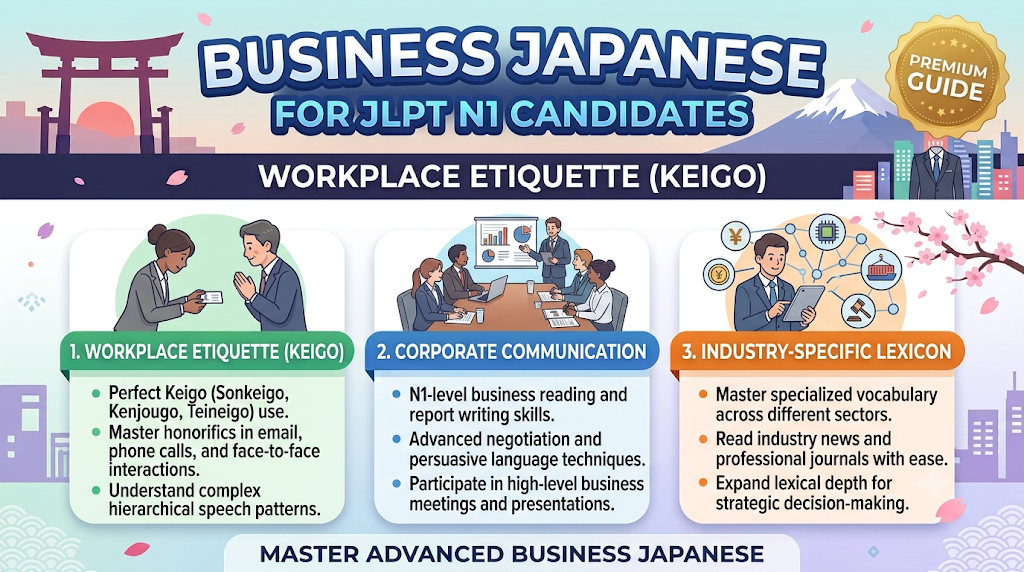
The N1 evaluates your ability to read academic essays, comprehend news editorials, and grasp abstract concepts. But when you step into a boardroom, write an email to a key client, or navigate internal office politics, the language changes significantly. Workplace Japanese relies heavily on nuanced honorific systems (keigo), implicit communication styles (kuuki wo yomu), and specific industry vocabulary that the standard N1 textbook rarely covers in depth.
Bridging the gap between exam-level grammar and executive-level workplace communication is essential. Developing practical business Japanese skills alongside your N1 preparation will help you excel in professional environments.
The Gap Between JLPT N1 Theory and Professional Practice
To understand why N1 candidates often struggle in corporate settings, it helps to examine how test preparation differs from daily workplace demands.
+-----------------------------------------------------------------------------------+
|                            JLPT N1 vs. Business Practice                          |
+-----------------------------------------------------------------------------------+
| Core Focus      | Academic reading, abstract logic, complex grammar patterns      |
| Workplace Need  | Concise messaging, swift email responses, precise client keigo  |
+-----------------------------------------------------------------------------------+
| Key Challenge   | Identifying subtext in texts | Managing live dynamic conversations |
+-----------------------------------------------------------------------------------+
- Passive Comprehension vs. Active ProductionThe JLPT is a multiple-choice exam. It tests whether you can recognize correct usage, not whether you can produce it under pressure. In a business meeting, you do not have two minutes to analyze a sentence structure—you need to respond naturally using the right level of politeness.
- Academic Japanese vs. Business HonorificsN1 reading passages often pull from philosophical essays, scientific reports, and literary commentary. While these build a strong vocabulary, they rarely teach you how to write a polite line-item rejection letter to a long-term supplier or deliver a project status update to senior management.
- In-Group (Uchi) vs. Out-Group (Soto) DynamicsWorkplace communication in Japan depends entirely on social context. The language you use with a direct colleague differs from what you use with your manager, which is distinct from how you address an external partner or potential client.
If you are structuring your study schedule alongside a busy workload, review our practical guide on the JLPT N1 Study Plan for Working Professionals to balance high-level study with daily work commitments.
Mastering Workplace Keigo: Moving Beyond Basic Rules
Keigo (polite/honorific speech) is often the biggest hurdle for international professionals in Japan. While N1 study requires learning standard honorific patterns, business execution demands precise accuracy across three distinct categories:
                  +----------------------------------------------+
                  |               WORKPLACE KEIGO                |
                  +----------------------------------------------+
                                         |
         +-------------------------------+-------------------------------+
         |                               |                               |
  [ Teineigo ]                    [ Sonkeigo ]                     [ Kenjougo ]
(Polite Speech)                (Respectful Form)                 (Humble Form)
Adds desu/masu to               Elevates the listener's           Lowers your own actions
standard speech.                actions and status.               to show respect.
1. Sonkeigo (尊敬語) – Elevating the Other Party
Use Sonkeigo when discussing the actions of clients, external partners, or senior leaders. You are raising their status relative to your own.
- Standard Verb: 言う (iu – to say) $\rightarrow$ Sonkeigo: おっしゃる (ossharu)
- Standard Verb: 行く / 来る (iku / kuru – to go/come) $\rightarrow$ Sonkeigo: いらっしゃること / お越しになる (oshiro ni naru)
- Standard Verb: 見る (miru – to see) $\rightarrow$ Sonkeigo: ご覧になる (goran ni naru)
2. Kenjougo (謙譲語) – Humbling Yourself and Your In-Group
Use Kenjougo when speaking about your own actions, or the actions of your team members, when addressing someone outside your immediate group (Uchi vs. Soto).
- Standard Verb: 言う (iu – to say) $\rightarrow$ Kenjougo: 申す (mousu) / 申し上げる (moushiage ru)
- Standard Verb: 行く (iku – to go) $\rightarrow$ Kenjougo: 伺う (ukagau) / 参る (mairu)
- Standard Verb: 見る (miru – to see) $\rightarrow$ Kenjougo: 拝見する (haiken suru)
Common Workplace Keigo Missteps
- Double Honorifics (Nijuu Keigo): Over-politeness can sound unnatural or incorrect. For example, combining O-koshi ni naru with irassharu creates redundant phrasing. Stick to standard honorific forms.
- Misplacing In-Group Boundaries: When speaking to a client about your own manager (e.g., Section Chief Tanaka), do not use Sonkeigo for Tanaka. To external clients, your entire company is part of your uchi (in-group). Refer to your manager simply as “Tanaka” without titles like -san or -bucho.
Practical Business Communication: Key Phrases and Email Structure
Written communication in Japanese business settings follows established structural conventions. Mastering these patterns builds professional credibility quickly.
+-----------------------------------------------------------------------------------+
|                        Standard Japanese Business Email Flow                      |
+-----------------------------------------------------------------------------------+
| 1. Company & Recipient Name  | [Company Name] [Department] [Name]-sama            |
| 2. Standard Opening Greeting | いつもお世話になっております。(Thank you for your support) |
| 3. Speaker Identification    | [Your Company] の [Your Name] でございます。         |
| 4. Main Purpose / Subject    | ~の件について、ご連絡いたしました。                 |
| 5. Detailed Body / Request   | 恐れ入りますが、ご確認のほどよろしくお願いいたします。  |
| 6. Sign-off                  | 引き続き何卒よろしくお願い申し上げます。             |
+-----------------------------------------------------------------------------------+
Key Essential Workplace Phrases
- お世話になっております (O-sewa ni natte orimasu)Meaning: “Thank you for your continued support.”Usage: The mandatory standard greeting for almost every business email or external phone conversation.
- 承知いたしました (Shouchi itashimashita)Meaning: “Understood / I acknowledge your request.”Usage: Use this instead of 了解しました (Ryōkai shimashita) when confirming instructions from supervisors or clients.
- 恐れ入りますが (Osore irimasu ga)Meaning: “I am sorry to bother you, but…”Usage: A cushion phrase (kushon kotoba) used before making a request or asking for a favor to soften the tone.
- 検討させていただきます (Kentou sasete itadakimasu)Meaning: “We will carefully consider / review this matter.”Usage: A diplomatic way to acknowledge a proposal without committing to an immediate answer.
Integrating N1 Grammar into Real-World Business Contexts
Many advanced N1 grammar points appear frequently in business correspondence, formal reports, and executive presentations. Here is how advanced N1 grammar functions in real-world scenarios:
1. ~を踏まえて (~wo fumaete) – “In light of…” / “Based on…”
- Context: Used in strategy meetings or proposal presentations when leveraging research data.
- Example: 前期の営業実績を踏まえて、来期のマーケティング戦略を再構築いたします。(In light of the previous quarter’s sales performance, we will restructure next quarter’s marketing strategy.)
2. ~を余儀なくされる (~wo yoginaku sareru) – “To be forced to…”
- Context: Used in formal risk management reports or announcements regarding unavoidable operational adjustments.
- Example: 原材料費の高騰に伴い、価格改定を余儀なくされました。(Due to the soaring costs of raw materials, we were forced to revise our pricing.)
3. ~を兼ねて (~wo kanete) – “Serving a dual purpose of…”
- Context: Used when planning corporate events, networking sessions, or multipurpose meetings.
- Example: 新プロジェクトのキックオフを兼ねて、懇親会を開催いたします。(We will hold a social gathering, which will also serve as the kick-off for the new project.)
Strategic Career Steps: Leveraging Your JLPT Certification
If you are deciding between language milestones, review our comparative analysis on JLPT N2 vs N1: Difficulty, Salary & Career Comparison to understand the professional benefits of each level.
If you are transitioning into specialized technical roles, explore our targeted resource on the JLPT N2 Study Plan for Engineers & IT Professionals.
Understanding the difficulty curve is part of long-term planning. For a realistic breakdown of candidate challenges and effective study strategies, read our analysis on Why JLPT N1 Is Hard (And How to Actually Pass It).
For comprehensive preparation advice spanning both advanced levels, consult our overarching guide on the JLPT N1 & N2 Preparation Guide for Advanced Learners.
Official Resources & Professional Standards
To stay up to date with official testing guidelines, schedule updates, and syllabus changes, reference the Official Worldwide JLPT Website. For candidates interested in how language qualifications map to global framework standards, the Japan Foundation provides updates on aligning language levels with international metrics like the CEFR.
Moving Beyond the Test Score
Passing the JLPT N1 demonstrates dedication, discipline, and strong analytical language skills. However, long-term success in the Japanese business environment comes from applying those skills effectively in daily professional life.
Focus on mastering the underlying nuances of workplace communication—such as contextual courtesy, proper honorific structures, and polished written etiquette. Combining formal N1 proficiency with practical workplace capability will help you communicate clearly, build strong working relationships, and advance your career in Japan.
Frequently Asked Questions
Is JLPT N1 required to work in a Japanese company?
Not always. Many roles, particularly in technology, global business, and international sales, accept JLPT N2 or equivalent practical proficiency. However, N1 is often required for management roles, legal functions, consulting, and positions requiring extensive native-level reading and writing.
What is the best way to practice business Japanese while studying for N1?
Read business publications like Nihon Keizai Shimbun (Nikkei), listen to corporate podcasts, practice writing formal business emails, and shadow workplace conversation tapes to build natural phrasing and cadence.
How does business Japanese differ from conversational Japanese?
Conversational Japanese relies heavily on informal structures, direct expressions, and colloquial terms. Business Japanese relies on contextual politeness (keigo), indirect phrasing to preserve diplomacy, and standardized terminology tailored for professional efficiency.