Learning Japanese comes with unique challenges: three distinct writing systems, context-heavy sentence structures, complex honorifics (keigo), and grammar patterns that shift based on social hierarchy.
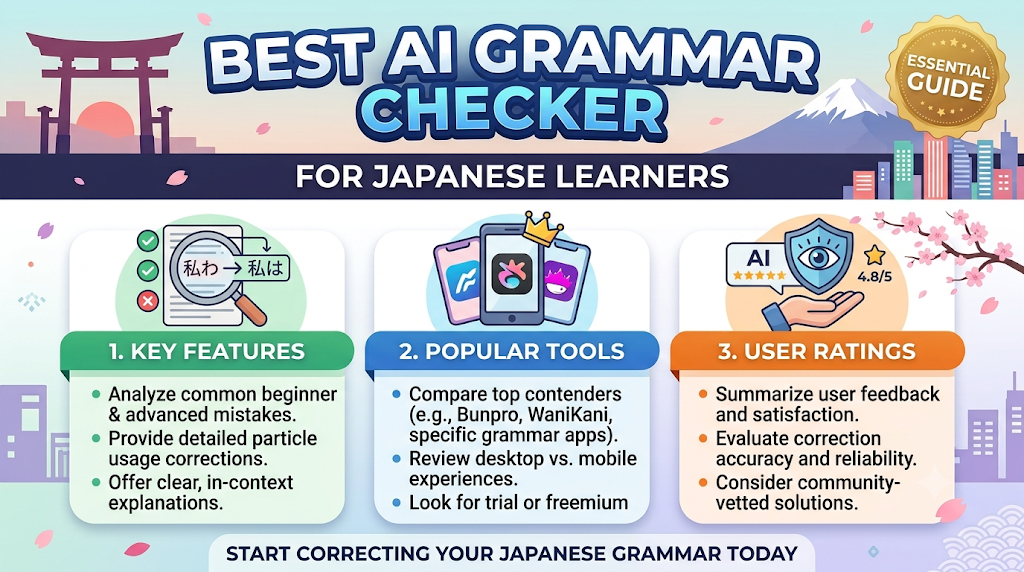
Standard spell-checkers catch typos, but they routinely miss subtle nuance errors—like mixing up the topic marker wa (は) and the subject marker ga (が), or choosing an overly casual verb form in a professional email.
AI writing assistants have fundamentally changed self-study. To figure out which tools actually deliver, we evaluated the leading platforms to find the best AI grammar checker for Japanese learners, looking at accuracy, nuance detection, and practical everyday usability.
Key Comparison: Top AI Japanese Grammar Checkers
| Feature / Tool | ChatGPT (GPT-4o / O3) | DeepL Write / Translator | Grammarly (Japanese Support) | Specialized AI Apps |
| Grammar Correction | Exceptional | High (Translation-focused) | Basic to Moderate | High (Targeted) |
| Nuance & Nuance Explanation | In-depth, customizable | Limited explanations | Minimal | Fixed/Preset |
| Keigo (Politeness) Check | Outstanding | Good automatic shifts | Basic | Moderate |
| Best For | Deep learning & active practice | Quick polished writing | Quick online drafts | Structured JLPT prep |
The Challenge of Japanese Grammar Checkers
English spell-checkers simply match words against a dictionary and evaluate clear SVO (Subject-Verb-Object) rules. Japanese uses a SOV (Subject-Object-Verb) structure where subjects are frequently omitted entirely, making automated grammar checking far more complex.
A reliable AI grammar checker for Japanese must process four key elements:
- Particle Context: Distinguishing subtle shifts between は (wa), が (ga), に (ni), and で (de).
- Politeness Levels: Navigating plain form, teineigo (polite), kenjougo (humble), and sonkeigo (respectful).
- High-Context Omissions: Understanding who is acting even when the subject isn’t explicitly stated.
- Kanji vs. Kana Choice: Knowing when a word should be written in kanji or left in hiragana for natural flow.
Top AI Japanese Grammar Checkers Evaluated
1. ChatGPT (GPT-4o) – Best Overall for Deep Learning & Explanations
ChatGPT is one of the most flexible tools available for checking Japanese grammar. Rather than just making corrections silently, you can prompt it to explain why a particle was wrong or suggest alternative phrasing based on formality.
- Strengths: Explains nuances in plain English, adjusts politeness dynamically, and formats custom corrections.
- Weaknesses: Requires clear prompting to avoid over-correcting natural phrasing.
- Pro Tip: Ask it to analyze your text line-by-line using structured prompts. For tailored setup ideas, check out our guide on [Using ChatGPT to Learn Japanese (Best Prompts)].
2. DeepL Write & Translator – Best for Natural Flow and Quick Fixes
DeepL is widely recognized for its natural-sounding Japanese translations. Its contextual engine catches awkward phrasing that traditional dictionary checkers miss.
- Strengths: Produces natural phrasing and offers instant alternative translations.
- Weaknesses: Doesn’t provide grammatical explanations or break down rule violations.
- Best Use Case: Cross-checking custom sentences against native equivalents to build structural intuition.
3. Specialized AI Japanese Learning Apps – Best for Structured Practice
Dedicated language apps pair AI correction engines with structured curriculum paths. Instead of blank prompt boxes, they provide targeted exercises with real-time feedback.
- Strengths: Structured paths, native audio generation, built-in spaced repetition (SRS).
- Weaknesses: Less flexibility for open-ended journal entries or complex essays.
- Further Reading: Compare the top platforms in our detailed round-up of the [Best AI Apps to Learn Japanese (2025 Review)].
How to Use AI Grammar Checkers for JLPT Prep
When preparing for the Japanese Language Proficiency Test (JLPT), accuracy matters. Misinterpreting subtle grammar points like ~としたら (to shitara) versus ~にしても (ni shitemo) can cost points on reading comprehension.
To check official test structures, test dates, and level requirements, consult the official JLPT – Japanese-Language Proficiency Test website.
While AI is great at spotting errors in your written practice, relying on it entirely for exam prep has its limits. To see where AI succeeds and where traditional study methods are still required, read our analysis: [Can AI Help You Pass JLPT? Reality vs Hype].
Step-by-Step Workflow to Fix Your Japanese Sentences
1.Draft Your Raw Japanese Sentence:Write without checking references.
Draft your sentence naturally in hiragana, katakana, and kanji without stopping to look up rules.
2.Run Through an AI Grammar Engine:Prompt for corrections and explanations.
Input your text into ChatGPT or your preferred AI tool using a prompt like:
“Please correct any grammar or particle mistakes in this Japanese text, point out awkward phrasing, and explain the changes in simple English.”
3.Compare Formality Levels:Verify politeness and tone.
Ask the AI to show your sentence in both casual (tameguchi) and formal (keigo) forms to see how verb endings and vocabulary shift.
4.Log Errors in an Anki Deck:Prevent repeat mistakes.
Save corrected sentences alongside their explanations in a flashcard deck to reinforce correct particle usage and grammar structures over time.
Practical Example: Correcting Real Student Errors
Here is how an AI grammar checker handles common particle and formality mistakes:
Incorrect Draft:
わたしは きのう レストランが たべました。
(Watashi wa kinou resutoran ga tabemashita.)
AI Breakdown & Correction:
- Error Identified: The particle が (ga) marks restaurant as the subject performing the action (the restaurant ate).
- Particle Fix: Change が (ga) to で (de) to mark the location where the action took place, or に (ni) depending on context.
- Direct Fix: わたしは きのう レストランで たべました。
- Natural Polished Native Form: きのう、レストランで食事をしました。 (Kinou, resutoran de shokuji wo shimashita.)
Choosing the Right Tool for Your Goals
- For Everyday Journaling & Essays: Use ChatGPT to get detailed breakdowns of particle placement and formality adjustments.
- For Fast Email & Work Writing: Use DeepL to quickly confirm natural phrasing.
- For JLPT Prep & Vocabulary Building: Pair dedicated apps with targeted AI prompts. Explore broader setup options in our master overview of [AI Tools to Learn Japanese Faster in 2026].