I still remember the exact moment traditional language learning broke for me.
I was sitting at my desk, staring down at a textbook open to a grammar pattern for intermediate learners. The explanation was three sentences long, dry, and left me with more questions than answers. I tried searching online, but all I found were forum threads from years ago where people argued over nuanced edge cases that didn’t help me build a single sentence in real life.
Then, I tried prompting ChatGPT.
I didn’t ask it to “teach me Japanese”—a prompt that usually returns a generic, useless list of greetings. Instead, I asked it to act as a native Japanese tutor, break down the grammar pattern, compare it to a similar phrase, and generate five natural sentences used in everyday office situations.
Within five seconds, I had a tailored lesson better than anything in my textbook.
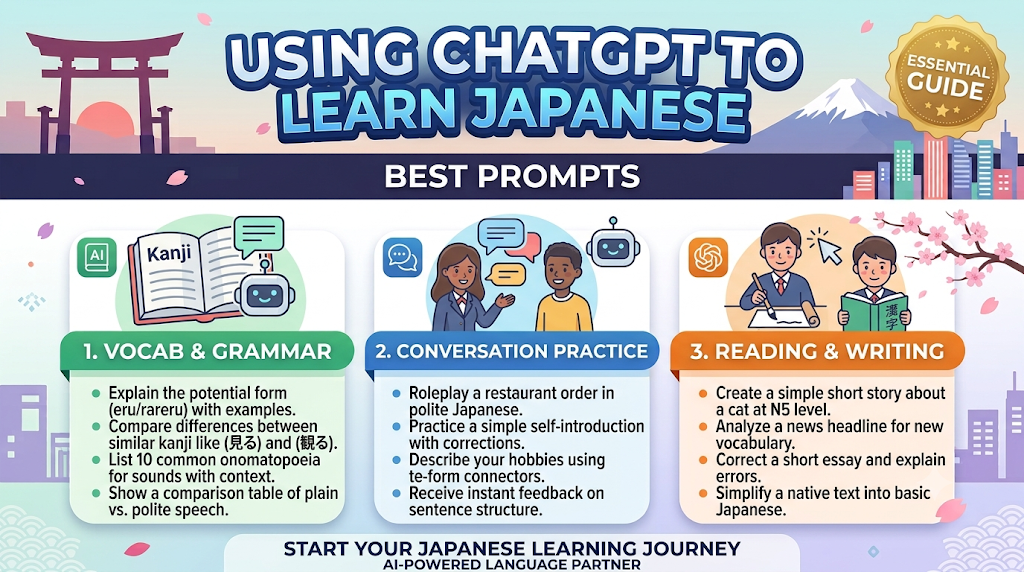
If you are trying to learn Japanese, AI isn’t just a gimmick—it’s like having a patient native tutor available 24/7. But here is the catch: ChatGPT is only as good as the instructions you give it. Ask it a vague question, and it gives you textbook robotic fluff. Feed it a structured, high-context prompt, and it turns into a personalized language engine.
Below is the complete guide to using ChatGPT for Japanese learning, packed with the exact prompts I use daily.
Why ChatGPT Changes the Game for Japanese Learners
Learning Japanese presents unique challenges: thousands of kanji, complex pitch accents, distinct formality registers (like keigo), and sentence structures that mirror nothing in Western languages.
Traditional apps give you pre-packaged flashcards, but they fail to answer the critical question: “Why do native speakers say it this way instead of that way?”
ChatGPT bridges that gap by offering:
- Instant Context & Nuance: It doesn’t just define a word; it explains when not to use it.
- Infinite Custom Reading Material: You can generate stories at your exact vocabulary level based on topics you actually care about (like anime, cooking, or Japanese history).
- Safe Conversation Practice: You can practice speaking or typing without the social anxiety of making mistakes in front of a real person.
If you want to evaluate how ChatGPT fits into the broader ecosystem of language tools, check out our roundup of the Best AI Apps to Learn Japanese (2025 Review) to see how various platforms compare.
System Prompts: Turning ChatGPT into a Native Japanese Tutor
Before asking ChatGPT specific questions, set up a System Prompt. This sets the persona and rules for how the AI responds throughout your chat session.
Paste this prompt at the very beginning of a new chat:
The Native Tutor Prompt:
“Act as a patient, native Japanese language teacher and JLPT expert. Whenever I ask a question or input Japanese text, please structure your responses as follows:
- Correct any mistakes in my Japanese gently.
- Provide the corrected text in Kanji/Kana, followed by Furigana in parentheses, and an English translation.
- Explain the underlying grammar rule or cultural context simply.
- End with one quick follow-up question in Japanese suited to my level to keep the conversation going.”
By setting these boundaries, you stop the AI from falling into long, dense English lectures and keep your practice focused on reading and interacting in Japanese.
1. Breaking Down Complex Grammar Patterns
Japanese grammar relies on nuances that direct dictionary translations miss. For instance, explaining the difference between ~場合 (baai) and ~たら (tara) can take pages in a textbook. ChatGPT can explain these differences instantly using contrasting examples.
If you are struggling with sentence structure or automated corrections, using dedicated tools like the Best AI Grammar Checker for Japanese Learners can also help catch subtle errors in your writing before you review them with AI.
The “Grammar Breakdown” Prompt
Copy & Paste Prompt:
“Please explain the Japanese grammar structure [Insert Structure, e.g., ~に違いない].
- What JLPT level is this?
- What is the subtle nuance behind it?
- Contrast it with [Insert Similar Structure, e.g., ~はずだ].
- Provide 3 realistic example sentences: one casual, one polite (desu/masu), and one business (keigo). Include Japanese, Romaji, and English.”
Why this works:
It forces ChatGPT to highlight the nuance rather than giving a flat definition. Understanding when to use a phrase makes the difference between sounding like a translation program and sounding like a native speaker.
2. Mastering Kanji in Real-World Context
Rote memorization of kanji through isolated flashcards often leads to a wall where you recognize the character alone, but fail to read it inside a full sentence. ChatGPT helps you learn kanji inside natural context blocks.
The “Kanji Context Builder” Prompt
Copy & Paste Prompt:
“I am learning the Kanji [Insert Kanji, e.g., 偏].
- Show its primary Onyomi and Kunyomi readings.
- List the 4 most common compound words (Jukugo) using this Kanji that appear in real-life Japanese.
- Write a short, 3-sentence story using all 4 compound words. Format the story with Kanji on top, Furigana on the next line, and English translation at the end.”
Practical Application:
When you study kanji inside a story, your brain links the character to a scene or concept rather than a random stroke order.
3. Simulating Real Conversations and Roleplay
One of the hardest parts of learning Japanese outside of Japan is finding natural ways to practice conversation. You can turn ChatGPT into a roleplay partner for everyday scenarios—from ordering ramen in Shibuya to asking for directions in Kyoto.
For real-world immersion outside of AI prompts, you can also practice reading authentic, simplified news on NHK News Web Easy, which provides native reading practice paired with audio.
The “Scenario Roleplay” Prompt
Copy & Paste Prompt:
“Let’s do a roleplay in Japanese.
Scenario: I am trying to return an item at a convenience store in Tokyo, and you are the store clerk.
Rules:
- Speak ONLY in natural Japanese suitable for a convenience store clerk.
- Keep your turns short (1-2 sentences).
- After your Japanese reply, add a hidden section inside a blockquote with the English translation and brief feedback on my previous sentence.
- Start the roleplay by greeting me as I approach the counter.”
[Example Output format you will receive]

いらっしゃいませ!本日はどのようなご件でしょうか?

> Translation: Welcome! How can I help you today?
> Feedback: Perfect entry! Next, explain what item you wish to return.
4. Smart JLPT Test Preparation
If you are preparing for the Japanese-Language Proficiency Test (JLPT), speed and reading comprehension are critical. ChatGPT can generate custom mock questions that target your specific weak points.
While AI is a powerful tool for generation and practice, it is important to understand its boundaries. Read our analysis on Can AI Help You Pass JLPT? Reality vs Hype to see where AI excels and where traditional study methods are still required.
For official test dates, testing locations, and level requirements, always reference the official Japanese-Language Proficiency Test (JLPT) Website.
The “JLPT Reading Comprehension” Prompt
Copy & Paste Prompt:
“Create a short JLPT [Insert Level, e.g., N3] level reading comprehension passage about [Insert Topic, e.g., Japanese tea culture].
- The passage should be around 150-200 words.
- Follow it with 2 multiple-choice questions testing reading comprehension.
- Do not show the answers immediately. Put the answer key and explanations at the bottom under a spoiler warning.”
5. Tailoring Japanese Content to Your Exact Level
When you read Japanese content that is too difficult, you spend all your time looking up words in a dictionary and lose the flow. When it is too easy, you don’t learn. ChatGPT allows you to level-adjust any text.
The “Text Simplification / Level Up” Prompt
Copy & Paste Prompt:
“Here is a paragraph of Japanese text:
[Paste Japanese Text Here]
Please rewrite this passage to make it accessible for a [Insert Level, e.g., JLPT N4] learner.
Replace complex kanji with simpler vocabulary, shorten sentence structures, and provide a vocabulary list of key words at the bottom.”
Prompt Cheat Sheet for Japanese Learners
Here is a quick summary table of prompt strategies based on what you need to study:
| Study Goal | Best Strategy | Key Prompt Command |
| Grammar Nuance | Contrastive Analysis | “Explain the difference between X and Y with examples.” |
| Vocabulary | Contextual Stories | “Write a 3-sentence story using these 5 words.” |
| Speaking Practice | Interactive Roleplay | “Act as a local bartender in Osaka. Keep responses short.” |
| Reading Prep | Level-Specific Material | “Generate an N3-level passage about modern technology.” |
| Politeness / Keigo | Register Shifting | “Rewrite this casual sentence into formal Sonkeigo.” |
Where AI Fails (and How to Avoid Common Pitfalls)
While ChatGPT is an incredible study assistant, relying on it blindly can cause issues. Here are three things to watch out for:
- Hallucinated Pitch Accent: ChatGPT struggles with pitch accent accuracy. Do not rely on it to tell you whether a word is heiban (flat) or atamadaka (head-high). Use specialized dictionaries like OJAD for pitch.
- Over-politeness: Left unguided, ChatGPT tends to default to extremely formal, textbook Japanese that can sound unnatural in casual settings. Always specify the register you want (casual, casual-polite, or business).
- Furigana Misalignments: Sometimes AI places furigana over the wrong kanji character in complex sentences. Always double-check readings using a verified dictionary tool.
To build a complete, balanced study stack that combines AI with traditional flashcards and audio input, read our master guide on AI Tools to Learn Japanese Faster in 2026.
Final Thoughts: Make AI Your Daily Study Partner
ChatGPT is not a substitute for speaking with real people or consuming real Japanese media. But as an interactive, zero-judgment learning environment, it accelerates comprehension faster than traditional self-study alone.
Start small. Pick one prompt from this guide today—whether it’s running a quick grammar comparison or simulating a conversation at a Japanese cafe. Paste it into ChatGPT, test the output, and adjust it to fit your workflow.