
Japanese Expressions for Recent Actions: How to Say “Just Did” Something Naturally
If you have been studying Japanese for a while, you know that translating sentences word-for-word from English rarely works. Time-based nuances in Japanese are particularly tricky. In English, the phrase “I just ate” covers everything from swallowing your last bite five seconds ago to finishing lunch an hour ago.
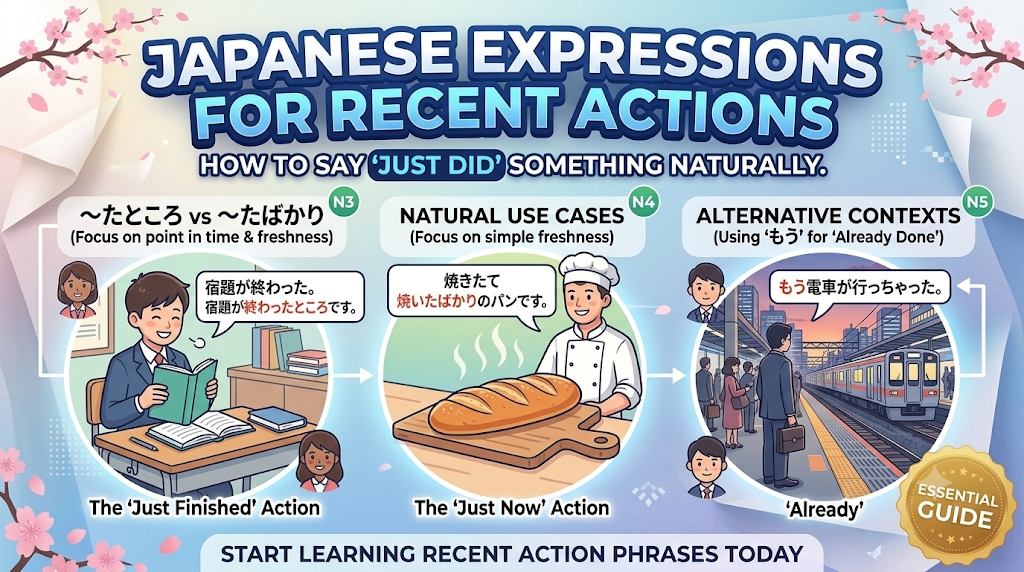
In Japanese, however, your choice of grammar depends heavily on psychological distance and exact timing. Expressing that an action occurred recently requires choosing between two primary structures: 〜たばかり (ta bakari) and 〜たところ (ta tokoro).
Using the wrong pattern won’t necessarily stop a native speaker from understanding you, but mastering the distinction will make your Japanese sound remarkably natural.
The Core Grammar Patterns: Formations and Basics
Before diving into the deeper nuances, let’s review how to construct both patterns grammatically. Both structures require the informal past tense form (the 〜た form) of a verb.
1. 〜たばかり (Ta Bakari)
- Formation: Verb ( Informal Past / 〜た form ) + ばかり
- Literal Meaning: “Only just did [action]”
- Core Concept: Expresses subjective recency. The speaker feels that not much time has passed since the action occurred.
Example:
- 日本に来たばかりです。 (Nihon ni kita bakari desu.)I just came to Japan. (Whether you arrived yesterday or three months ago, it feels recent to you.)
2. 〜たところ (Ta Tokoro)
- Formation: Verb ( Informal Past / 〜た form ) + ところ
- Literal Meaning: “At the exact moment of having done [action]”
- Core Concept: Expresses objective recency. The action literally finished seconds or minutes ago.
Example:
- 昼ご飯を食べたところです。 (Hirugohan o tabeta tokoro desu.)I just finished eating lunch. (You are likely still holding your chopsticks or clearing the table.)
To build a strong foundation in Japanese verb conjugations before applying these patterns, you can check out the comprehensive grammar resources on Tofugu’s Japanese Grammar Guide.
Understanding Subjective vs. Objective Time
The key difference between 〜たばかり and 〜たところ boils down to subjective perception versus physical reality.
[ Objective Reality (Clock Time) ] --------------> 〜たところ (Immediate Past)
[ Subjective Perception (Mindset) ] -------------> 〜たばかり (Can extend across months/years)
Physical Time: 〜たところ
〜たところ refers to a literal point on a timeline. Think of tokoro (所/所) as a spatial location applied to time. You are standing right on the spot where the action ended.
- Scenario: Your phone rings while you walk out the front door.
- 今、家を出たところです。 (Ima, ie o deta tokoro desu.)I just left the house this very second.
Because it relies on exact timing, you will frequently pair 〜たところ with words like 今 (ima – now) or たった今 (tatta ima – just now).
Psychological Time: 〜たばかり
〜たばかり focuses on how the event lingers in your mind. The physical clock matters much less than your personal feeling about the event.
- Scenario: You bought a car three weeks ago, but to you, it still feels brand new.
- この車は買ったばかりです。 (Kono kuruma wa katta bakari desu.)I just bought this car.
If you want a deeper dive into how subjective perception shapes this specific phrase, read our detailed guide on たばかり Explained: More Than Just “I Just Did It”.
Direct Comparison: たばかり vs. たところ
To see how these two patterns perform side-by-side, take a look at the key distinctions below:
| Feature | 〜たばかり (Ta Bakari) | 〜たところ (Ta Tokoro) |
| Timeframe | Minutes, days, months, or years ago | Seconds to a few minutes ago |
| Nature of Time | Subjective (Speaker’s feeling) | Objective (Actual clock time) |
| Common Modifiers | 浮ついた (feeling fresh), まだ (still) | 今 (now), たった今 (just this moment) |
| Follow-up Particles | 〜たばかりの [Noun], 〜たばかりだ | 〜たところです, 〜たところに/へ/を |
| Native Feel | “It feels like I just…” | “I literally just…” |
For a complete breakdown of edge cases and nuances between these two, explore our comprehensive comparison in たばかり vs たところ: Which One Sounds More Natural?.
Practical Applications and Real-World Examples
Let’s examine how these grammar points behave in everyday conversations, workplaces, and practical scenarios.
Scenario A: At the Office
Your colleague asks if you have read the project proposal update sent by the manager.
- Incorrect / Unnatural: 1か月前に会社に入ったところです。(Too much time has passed for tokoro.)
- Natural: 先月会社に入ったばかりなので、まだ分かりません。(Sengetsu kaisha ni itta bakari nano de, mada wakarimasen.)Since I just joined the company last month, I don’t know yet.
If you want to explain that you literally just finished reading the report a minute ago:
- Natural: 今、レポートを読み終わったところです。(Ima, repōto o yomiowatta tokoro desu.)I just finished reading the report this second.
To master how tokoro changes meaning when paired with different verb tenses, see our guide on たところ Grammar: Describing Your Exact Point in Time.
Scenario B: Unexpected Events
A unique feature of 〜たところ is its ability to take particles like に (ni), へ (he), or を (wo) to set up a secondary event that interrupts or immediately follows an action.
- 警察が来たところに、犯人が逃げ出した。(Keisatsu ga kita tokoro ni, hannin ga nigedashita.)Just as the police arrived, the suspect broke out and ran.
When you want to express that an action occurred immediately after another, you can also use alternative structures. Compare these nuances in our article on 〜た直後 vs 〜たばかり: Is There Any Difference?.
Surprising Usage: When “Just Did” Happened Years Ago
One of the most confusing aspects for JLPT learners is encountering 〜たばかり in reference to events that took place years in the past.
Consider this sentence spoken by a homeowner:
- この家は10年前に建てたばかりです。(Kono ie wa jū-nen mae ni tateta bakari desu.)This house was built just 10 years ago.
How can ten years count as “just did”?
In the context of real estate—where houses are expected to last 50 to 100 years—a ten-year-old house is still relatively new. The speaker views 10 years as a short period within the lifecycle of a building.
Understanding this psychological frame of reference is essential for natural comprehension. Read more about this phenomenon in Why Native Speakers Use たばかり for Events That Happened Long Ago.
Beyond the Basics: Advanced Time Patterns
As you progress to intermediate and advanced levels (JLPT N3 and N2), you will encounter variations of these patterns that express contradiction, frustration, or precise timing.
1. 〜たところで (Ta Tokorode)
Adding the particle で (de) to 〜たところ completely shifts the meaning from time to a conditional expression meaning “even if [action] is done, it’s no use.”
- 今から走ったところで、電車には間に合わない。(Ima kara hashitta tokorode, densha ni wa maniawanai.)Even if you run right now, you won’t make the train.
Learn how to use this advanced structure in たところで Explained: Meaning, Exceptions, and Natural Examples.
2. Time-Based Progression
Understanding how to talk about actions before they start, while they happen, and after they finish gives you complete conversational flexibility.
1. V-辞書形 + ところ (About to do)   --> これから食べるところです。
2. V-ている + ところ (In the middle) --> 今食べているところです。
3. V-た + ところ   (Just finished)  --> たった今食べたところです。
We cover this entire spectrum step-by-step in Talking About Progress in Japanese: Before, During, and After an Action.
For structured lists of grammar rules across all ability levels, reference the official test resources on the JLPT Official Website.
Key Takeaways for Natural Japanese
To summarize how to choose the right pattern in speech:
- Use 〜たところ when the action finished moments ago, or when you are using time-marking words like 今 or たった今.
- Use 〜たばかり when you want to emphasize that an event feels fresh, regardless of how much clock time has elapsed.
- Watch the particles after ところ: Adding に, を, or で changes the grammatical function entirely.


