Learning Japanese is a marathon, not a sprint. Yet, most self-learners approach the Japanese Language Proficiency Test (JLPT) like a 100-meter dash. You spend months cramming thousands of kanji flashcards, grinding Anki decks at 1:00 AM, and forcing your brain through dense grammar patterns until the characters start swimming across the page. Then, suddenly, the wall hits.
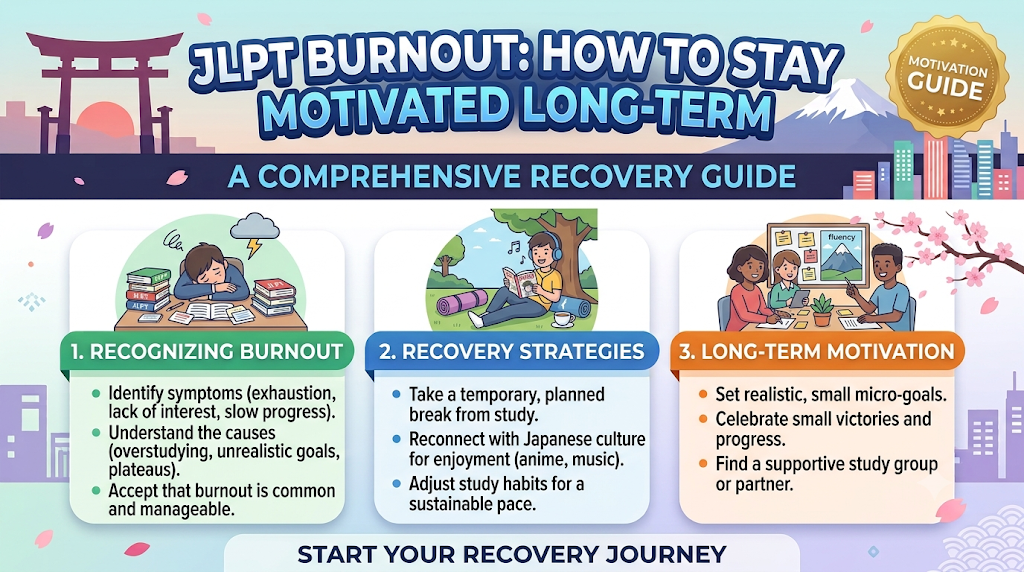
You open your textbook, and your brain simply refuses to process the information. The thought of doing your daily flashcard reviews fills you with dread. You are experiencing JLPT burnout—a very real, incredibly common state of mental, emotional, and physical exhaustion caused by prolonged study stress.
As a long-time Japanese language educator and JLPT coach, I see this exact pattern every single testing cycle. Learners hit N3 or N2, hit a plateaus, push twice as hard, and crash.
Here is how to diagnose JLPT burnout, recover your mental energy, and build a resilient study system that sustains your motivation all the way to N1.
1. The Anatomy of JLPT Burnout: Why Japanese Fatigue Hits Differently
Burnout can happen in any field, but Japanese language acquisition carries a unique risk profile due to three major structural challenges:
- The Kanji Wall: Japanese requires learning multiple writing systems alongside thousands of logographic characters. Memory retention for kanji requires active recall, which demands significantly more cognitive load than reading an alphabetic script.
- The Intermediate Plateau (N3 to N2 Shift): Moving from N4 to N3 feels like a step up; moving from N3 to N2 feels like jumping off a cliff. The vocabulary becomes abstract, the listening tracks use natural native pacing, and the sheer volume of material triples.
- The High-Stakes Test Cycle: Because the JLPT is offered only once or twice a year depending on your location, missing a pass mark means waiting up to 12 months for another attempt. This artificial pressure turns everyday studying into a high-anxiety environment.
If you find yourself constantly doubting your abilities or feeling overwhelmed by your prep, pause and reflect on your mental frame. Developing a resilient JLPT Exam Mindset: Anxiety, Failure & Motivation Guide is just as essential to your success as memorizing grammar structures.
2. Recognizing the Signs: Are You Burnt Out or Just Unmotivated?
Before changing your routine, you need to diagnose what you are actually experiencing. Simple laziness requires a gentle push; burnout requires a complete systemic pause.
| Feature | Low Motivation / Procrastination | Active JLPT Burnout |
| Physical Feeling | Restless, easily distracted by phone/TV | Chronic fatigue, headaches, brain fog, heavy chest |
| Emotional State | Guilt about not studying | Resentment toward the Japanese language |
| Cognitive Capacity | Can focus once you finally start | Cannot retain information even when trying hard |
| Study Reaction | Boredom | Anxiety, dread, or complete emotional numbness |
If your symptoms align with the right-hand column, pushing through using raw willpower will only deepen the damage. You cannot discipline your way out of neural exhaustion.
3. Immediate Triage: The 7-Day Reset Protocol
When you are in the thick of severe exhaustion, step away from the test prep immediately. You will not forget all your kanji in a week. Your brain needs time to consolidate information and repair depleted dopamine reserves.
Step 1: Implement an Absolute Anki/Flashcard Freeze
Turn off notification badges. The fear of accumulating 500 overdue cards causes more psychological distress than taking a brief break. Most modern spaced-repetition software allows you to pause reviews or adjust retention parameters.
Step 2: Shift to “Zero-Effort” Immersion
Replace practice tests and drills with low-stakes enjoyment. Watch your favorite anime with English subtitles, listen to Japanese city pop, or re-watch a cozy slice-of-life show you already know well. The goal here isn’t active learning; it’s reminding yourself why you fell in love with the culture in the first place.
Step 3: De-Link Your Identity from Test Results
A test score measures your familiarity with a specific exam format on a given Sunday—it does not define your intelligence or your relationship with Japan. If a past failure is feeding your current exhaustion, take time to learn How to Bounce Back After Failing JLPT so you can process the disappointment constructively rather than internalizing it.
4. Restructuring Your Study System for the Long Haul
Once your baseline energy returns, do not go back to the exact system that broke you. Rebuild your routine using sustainable learning principles.
       [ Sustainable JLPT Study Architecture ]
                         │
     ┌───────────────────┴───────────────────┐
     ▼                                       ▼
  Active Learning (30%)                  Passive Immersion (70%)
  • Target Kanji                         • Native Podcasts
  • Grammar Drills                       • Audiobooks
  • Active Recall                        • Manga / Novels
Transition from “Test Prep” to “Native Consumption”
The biggest mistake test-takers make is treating the JLPT as an isolated academic subject. If 100% of your Japanese exposure comes from prep manuals like Shin Kanzen Master or Try!, you will burn out.
Target a ratio of 30% test-specific study and 70% native content engagement. Read manga, listen to podcasts while commuting, or follow Japanese creators on YouTube. For authentic reading practice beyond textbooks, explore real-world news outlets like NHK News Web Easy, which provides daily news written in accessible Japanese with optional furigana.
Micro-Dosing Active Study
Instead of massive weekend study marathons, limit focused work to 25-minute Pomodoro blocks:
- Block A (25 min): Focused grammar work or reading comprehension exercises.
- Break (5 min): Complete physical separation from screens and books.
- Block B (25 min): Vocabulary review or target listening practice.
Stopping while you still have energy left preserves your motivation for the next day.
5. Psychological Tools for Long-Term Resilience
Expect and Plan for the “Plateau of Latent Potential”
Language acquisition is not linear. You will experience long stretches where your score stays flat despite hours of hard work.
Skill / Proficiency
   ^
   |                      / Actual Growth Trend
   |                     /
   |             _______/  <-- Breakthrough Phase
   |            /
   |    _______/  <-- The Plateau (Where Burnout Happens)
   |   /
   +--------------------------------------------> Time spent studying
During these plateaus, your brain is quietly building non-conscious neural pathways. Progress typically shows up in sudden jumps rather than steady slopes.
Reduce High-Stakes Pressure
When the exam day draws near, anxiety often disguises itself as fatigue. If test-day nerves routinely derail your performance, review practical techniques on How to Stay Calm During the JLPT Exam to keep your mind clear under pressure.
If the worst happens and you do not pass your target level, treat it as a diagnostic metric rather than a defeat. You can systematically analyze your weak areas using a structured guide on Failed JLPT? What to Do Next (Step‑by‑Step) to turn a setback into a roadmap for your next attempt.
6. Curated Resources for Balanced Learning
Maintaining momentum requires high-quality resources that don’t rely solely on dry drills. Here are two excellent tools to keep your study varied:
- Grammar Reference & Practice: Use comprehensive databases like JLPT Sensei to quickly look up grammar points with clear example sentences and downloadable cheat sheets.
- Immersion Reading: Read native articles and stories leveled for non-native speakers on platforms like Tadoku free books, which support extensive reading without forcing you to look up every single word.
Long-Term Consistency Beats Short-Term Intensity
Overcoming JLPT burnout requires accepting a simple truth: consistency will always beat intensity. Studying 20 focused minutes every day for two years will take you vastly further than studying 4 hours a day until you collapse and quit for six months.
Be kind to yourself throughout this process. Take breaks when your body demands them, celebrate small wins, and remember that the end goal isn’t just a paper certificate—it’s gaining access to a rich language and culture.