
When you move beyond conversational Japanese and step into the world of Japanese news broadcasts, business emails, academic writing, or upper-intermediate JLPT preparation, you quickly realize that simple grammar rules like 〜について (ni tsuite) no longer carry all the weight. You need expressions that convey precision, respect, and professional polish.
Enter 〜に関して (ni kanshite).
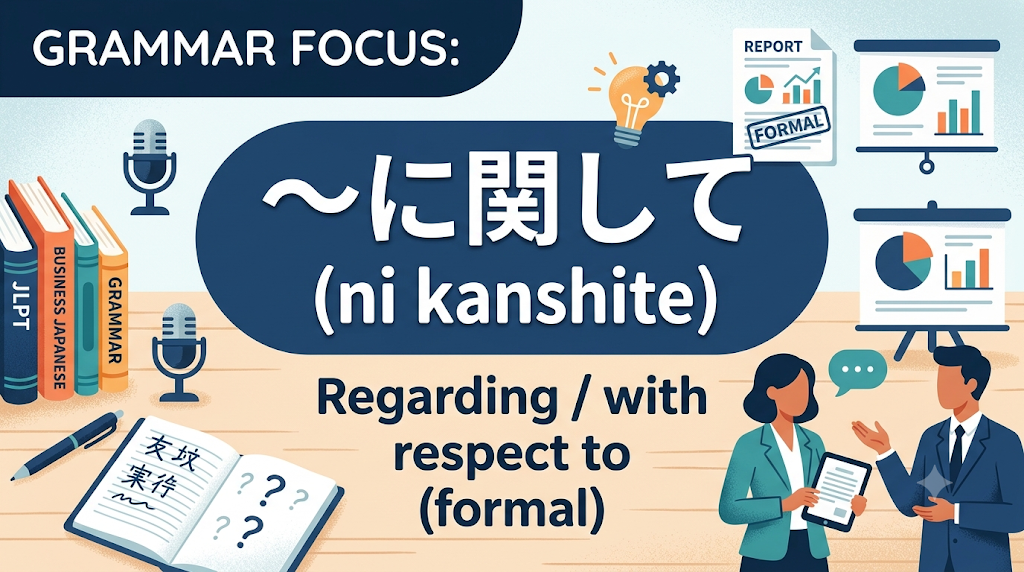
This essential grammar point—frequently tested on both the JLPT N3 and N2 exams—is the bedrock of formal communication in Japan. Translated as “regarding,” “concerning,” “with respect to,” or “in relation to,” mastering this pattern allows you to sound composed, authoritative, and natural in structured environments.
In this deep-dive guide, we will break down the exact mechanics of 〜に関して, explore its structural variations, contrast it against similar Japanese grammar points, analyze native nuance, and look at practical applications for business and exam success.
What Does 〜に関して Mean?
At its core, 〜に関して (ni kanshite) is used to introduce a specific topic, subject, or field of inquiry about which information, discussion, or action takes place.
- Kanji Breakdown: 関 (kan – connection/relation) + 係 (kei – connection) forms the verb 関わる (kakawaru, to be related to). When combined with して (shite), the continuous form of する (suru), it forms に関して (ni kanshite).
- Meaning: “Regarding X,” “Concerning X,” “With reference to X,” or “In connection with X.”
- Formality Level: Formal to Semi-Formal (Written Japanese, Business Correspondence, Academic Papers, Formal Speeches, News Reports).
While it functions very similarly to the everyday phrase 〜について (ni tsuite), 〜に関して elevates the tone of your language. It signals that the subject being discussed is a matter of clear focus, investigation, or official record.
How to Form 〜に関して: Connection Rules
The structural beauty of 〜に関して lies in its simplicity. Unlike many Japanese grammar points that require complex verb conjugations, 〜に関して connects primarily with Nouns.
Here are the primary forms you will encounter:
1. Linking to a Verb or Sentence: [Noun] + に関して
When 〜に関して modifies a verb, adjective, or the overall action of a sentence, use this standard form.
- Pattern: Noun + に関して + Action / Verb
- Example:
- この問題に関して、もう少し話し合いが必要です。
- Kono mondai ni kanshite, mou sukoshi hanashiai ga hitsuyou desu.
- (Regarding this issue, further discussion is necessary.)
2. Linking to another Noun: [Noun A] + に関する + [Noun B]
When you want to use the phrase to directly modify a subsequent noun, change して (shite) to the dictionary form 連体形 (rentaikei) する (suru).
- Pattern: Noun A + に関する + Noun B
- Example:
- 環境問題に関するレポートを提出しました。
- Kankyou mondai ni kansuru repooto o teishutsu shimashita.
- (I submitted a report regarding environmental issues.)
3. Sentence-Ending Form: [Noun] + に関しては / に関しても
To add emphasis or contrast, you can attach topic markers such as は (wa) or も (mo).
- に関して+ は (ni kanshite wa): Used to contrast the target topic with other topics (“As far as X is concerned…”).
- に関して+ も (ni kanshite mo): Used to mean “Even regarding X” or “Also with respect to X.”
- Example:
- 新製品のデザインに関しては問題ありませんが、価格について検討が必要です。
- Shinseihin no dezain ni kanshite wa mondai arimasen ga, kakaku ni tsuite kentou ga hitsuyou desu.
- (As far as the design of the new product is concerned, there are no issues, but we need to consider the price.)
〜に関して vs. 〜について: The Nuance Breakdown
The single most common question learners ask is: “What is the actual difference between 〜について (ni tsuite) and 〜に関して (ni kanshite)?”
While dictionary translations often render both as “about” or “regarding,” native Japanese speakers pick up on clear differences in tone, scope, and context.
| Feature | 〜について (ni tsuite) | 〜に関して (ni kanshite) |
| Formality Level | Conversational to Standard Formal | High Formal / Business / Academic |
| Primary Context | Casual chats, everyday questions, general topics | Business reports, news, policies, research |
| Scope of Subject | Direct focus on a specific, isolated item | Broad scope, including surrounding context |
| Common Verbs Following | 話す, 聞く, 調べる, 思う | 調査する, 研究する, 発表する, 議論する |
Scope and Depth Difference
Think of 〜について as pointing a flashlight directly at a single spot, whereas 〜に関して lights up the whole room surrounding that spot.
- 彼について話しましょう。 (Kare ni tsuite hanashimashou.)
- “Let’s talk about him.” (Focuses directly on his personality, actions, or details.)
- 彼に関して調査を進めています。 (Kare ni kanshite chousa o susumete imasu.)
- “We are conducting an investigation regarding him.” (Focuses on him, his environment, his potential connections, background, and related implications.)
To review detailed comparative grammar breakdowns and core vocabulary lists, you can reference the comprehensive guides on Tofugu’s Japanese Grammar Dictionary or test your foundational structure knowledge with Maggie Sensei’s Japanese Lessons.
Real-World Examples in Action
To truly internalize a grammar pattern, you must see it applied across different situations. Below are detailed categorical examples ranging from business environments to news reports.
Category 1: Business Correspondence & Emails
In professional Japanese (Keigo context), clarity and formal tone are essential. Using 〜に関して demonstrates respect and professionalism.
- 今回のプロジェクトの進捗状況に関して、ご報告いたします。
- Konkai no purojekuto no shinchoku joukyou ni kanshite, go-houkoku itashimasu.
- (I am writing to report on the progress status of the current project.)
- お問い合わせの件に関して、担当部署より折り返しご連絡申し上げます。
- O-toiawase no ken ni kanshite, tantou busho yori orikaeshi go-renraku moushiage masu.
- (Regarding your inquiry, our responsible department will contact you shortly.)
- 新しい契約条件に関するご質問がございましたら、遠慮なくお申し付けください。
- Atarashii keiyaku jouken ni kansuru go-shitsumon ga gozaimashitara, enryo naku o-moushitsuke kudasa.
- (If you have any questions regarding the new contract terms, please do not hesitate to ask.)
Category 2: News, Announcements, and Official Statements
Public announcements and journalistic writing rely heavily on 〜に関して to state subjects objectively.
- 政府はエネルギー政策に関して、新たな方針を発表しました。
- Seifu wa enerugii seisaku ni kanshite, aratana houshin o happyou shimashita.
- (The government announced a new policy concerning energy policy.)
- 事件の詳細に関しては、現在警察が捜査を行っています。
- Jiken no shousai ni kanshite wa, genzai keisatsu ga sousa o okonatte imasu.
- (As for the details of the incident, the police are currently conducting an investigation.)
Category 3: Everyday Formal Situations
Even outside of corporate settings, formal interactions (such as university inquiries, customer service desk interactions, or public seminars) call for this construction.
- 奨学金に関する案内パンフレットは事務室で配布しています。
- Shougakukin ni kansuru annai panfuretto wa jimushitsu de haifu shite imasu.
- (Information pamphlets regarding scholarships are being distributed at the office.)
- この健康法に関して、何かご不明な点はありますか。
- Kono kenkouhou ni kanshite, nanika go-fumei na ten wa arimasu ka.
- (Do you have any unclear points regarding this health method?)
Related Formal Grammar Points to Watch Out For
As you progress through upper-intermediate Japanese (JLPT N3 to N1), you will encounter several grammar points that share similar functional territory. Understanding how they differ prevents confusion during exams and writing.
1. 〜について (Ni Tsuite)
- Meaning: About / Concerning.
- Key Difference: Less formal than 〜に関して. Expresses direct thought, statement, or inquiry about a specific subject.
2. 〜をめぐって (O Megutte)
- Meaning: Concerning / Surrounding (a conflict, debate, or competition).
- Key Difference: Specifically used when multiple parties have differing opinions, arguments, or disputes over a central topic.
- Example: 遺産相続をめぐって、親族間で争いが起きた。 (A dispute arose among relatives concerning the inheritance.)
3. 〜に応じた / 〜に応じて (Ni Oujite)
- Meaning: In accordance with / Depending on / According to.
- Key Difference: Focuses on adapting or responding to changes in circumstances, demand, age, or need.
- Example: 予算に応じてプランを選べます。 (You can choose a plan according to your budget.)
4. 〜にともなって / 〜に伴い (Ni Tomonatte / Ni Tomonai)
- Meaning: Along with / As a consequence of.
- Key Difference: Describes a secondary change or action occurring simultaneously alongside a primary event.
JLPT Exam Strategy: How 〜に関して is Tested
If you are preparing for the JLPT N3 or N2 exams, test makers love to confuse candidates by placing lookalike grammar structures in the multiple-choice section.
Here are three golden rules for identifying 〜に関して on test day:
- Check the Preceding Word: Ensure the word directly preceding the blank is a Noun. Verbs or adjectives must be nominalized (e.g., using の or こと) before attaching 〜に関して.
- Identify the Following Modifier: If the blank sits directly before a Noun, the answer must be に関する (ni kansuru), not に関して (ni kanshite).
- Analyze the Context Tone: If the surrounding sentence contains polite business forms (Keigo) or objective investigative verbs like 調査する (chousa suru), 発表する (happyou suru), or 審議する (shingi suru), lean toward 〜に関して over 〜について.
For official exam practice questions and test registration details, check out the official JLPT Official Website.
Practical Exercise: Practice What You’ve Learned
Test your understanding of 〜に関して and its forms by filling in the blanks below.
Questions
- 社長は来期の予算 ( _______ ) 重要な発表を行いました。
- a) に応じて
- b) に関して
- c) をめぐって
- 個人情報の取り扱い ( _______ ) ルールを修正する必要があります。
- a) に関する
- b) に関して
- c) に関しては
- 事故の原因 ( _______ )、現在専門家が分析を進めています。
- a) に関する
- b) に関しては
- c) にともなって
Answer Key & Explanations
- Correct Answer: b) に関して
- Explanation: The sentence describes making an official announcement regarding a subject (next term’s budget). 〜に関して fits the action verb 発表を行いました.
- Correct Answer: a) に関する
- Explanation: The blank directly precedes the noun ルール (ruuru / rule). Therefore, you must use the noun-modifying form に関する (ni kansuru).
- Correct Answer: b) に関しては
- Explanation: The topic marker は (wa) is used here to set “as for the cause of the accident” as the central subject of the ongoing investigation.
Final Thoughts: Elevating Your Japanese Polish
Transitioning from casual fluency to professional competence in Japanese requires attention to tone and nuance. The grammar pattern 〜に関して (ni kanshite) is one of the most effective tools for upgrading your language style from casual conversation to professional, natural Japanese.


