
Introduction
So, you’ve decided to take the Japanese-Language Proficiency Test (JLPT) N5—the first step in your Japanese learning journey. Exciting, right? But if you’re feeling a bit nervous about what to expect, don’t worry! I’m here to walk you through the complete format of JLPT N5, so you know exactly what’s coming on test day.
Whether you’re self-studying or taking classes, understanding the test structure is key to passing. In this guide, we’ll cover:
- The three main sections of the JLPT N5
- Time limits for each part
- Question types and what they test
- Tips to manage time and avoid common mistakes
- How to prepare effectively in the weeks before the exam
By the end, you’ll feel much more confident and ready to tackle the test. Let’s dive in!
What is the JLPT N5?
The JLPT (Japanese-Language Proficiency Test) is the most widely recognized exam for non-native Japanese speakers. The N5 level is the easiest, designed for beginners who have studied around 100-150 hours of Japanese.
At this level, you’re expected to:
- Understand basic phrases and expressions
- Read and write hiragana, katakana, and some kanji (around 80-100)
- Comprehend short, simple conversations about daily life
If you’ve been using textbooks like Genki I or Minna no Nihongo, you’re likely on the right track.
🔗 Want to know if you’re ready? Check out JLPT N5 Practice Test Guide
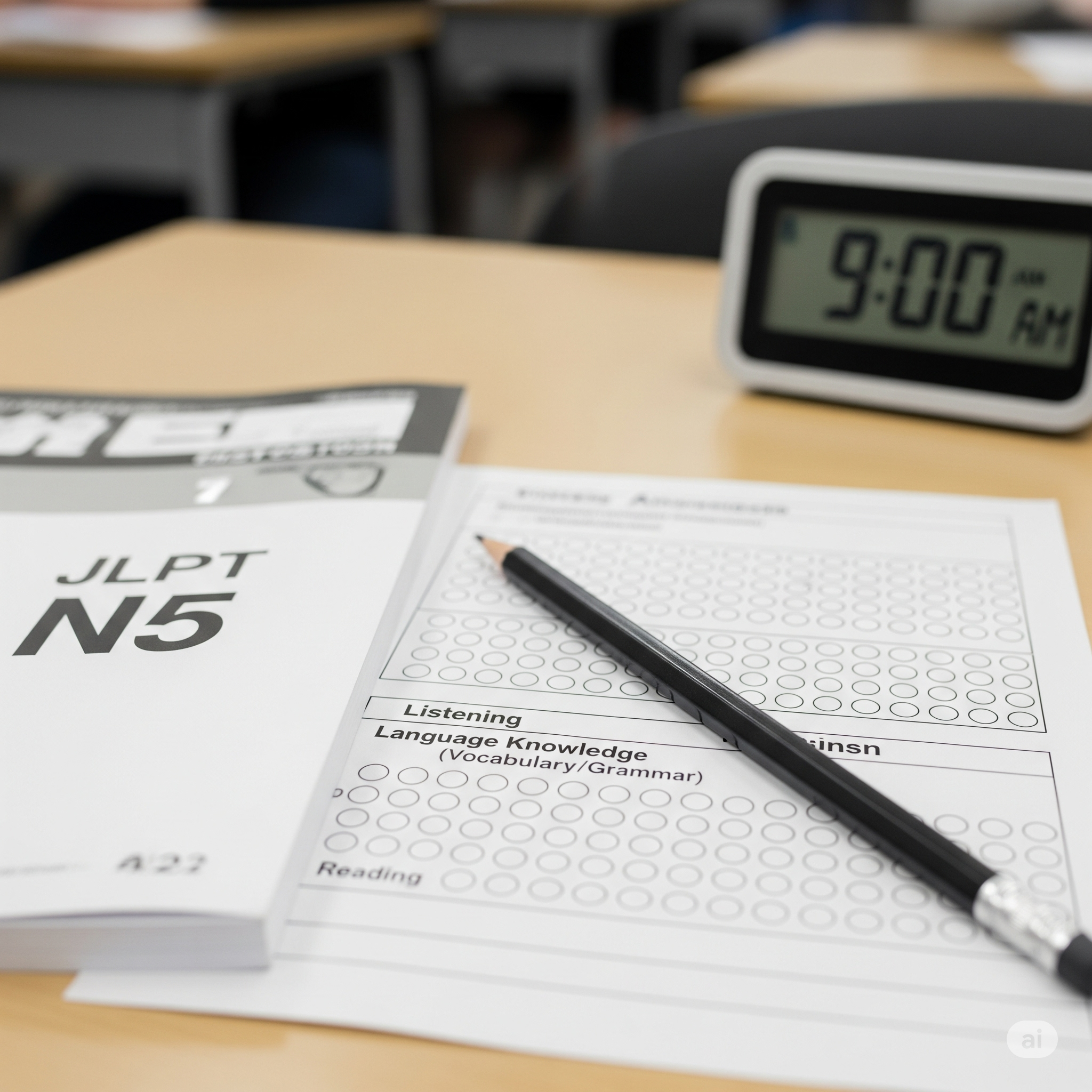
JLPT N5 Test Format: Breakdown of Each Section
The JLPT N5 is divided into three main sections:
- Language Knowledge (Vocabulary & Kanji)
- Language Knowledge (Grammar) & Reading
- Listening
Let’s break each one down in detail.
1. Language Knowledge (Vocabulary & Kanji) – 25 Minutes
This section tests your basic word recognition and kanji understanding. You’ll encounter four types of questions:
A. Kanji Reading (漢字読み) – 12 Questions
You’ll see a word written in kanji and must choose the correct hiragana reading.
Example:
山 (やま・さん・き・み) → Correct answer: やま
B. Vocabulary in Context (語彙) – 8 Questions
You’ll need to pick the right word to complete a sentence.
Example:
わたしは まいあさ ____ を のみます。
a) みず
b) ごはん
c) ほん
d) でんわ
(Correct answer: a) みず (water))
C. Word Meaning (言葉の意味) – 5 Questions
You’ll match a Japanese word with its English meaning.
Example:
大きい means:
a) Small
b) Big
c) Fast
d) Slow
(Correct answer: b) Big)
D. Word Usage (言葉の使い方) – 5 Questions
You’ll identify how a word is used correctly in a sentence.
Example:
Which sentence uses はし (chopsticks) correctly?
a) わたしは はしで ごはんを たべます。
b) わたしは はしで みずを のみます。
(Correct answer: a))
🔗 Struggling with kanji? Our a covers all the essential characters you need.
2. Language Knowledge (Grammar) & Reading – 50 Minutes
This section checks your grammar understanding and reading comprehension.
A. Grammar (文法) – 16 Questions
You’ll fill in the blanks with the correct particle, verb form, or phrase.
Example:
わたしは がっこう ____ いきます。
a) を
b) に
c) で
d) へ
(Correct answer: b) に)
B. Sentence Formation (文の組み立て) – 5 Questions
You’ll rearrange mixed-up words to form a correct sentence.
Example:
Order these words: で / えんぴつ / かきます / わたし / を
→ わたしは えんぴつで かきます。
C. Reading Comprehension (読解) – 3 Short Passages
You’ll read simple texts (emails, notices, or short paragraphs) and answer questions.
Example Passage:
「きょうは あめです。わたしは かさを もって いきます。」
Question: What does the person bring?
a) かばん
b) かさ
c) ほん
(Correct answer: b) かさ (umbrella))
🔗 Need grammar help? Our JLPT N5 Grammar Guide explains all the key structures.
3. Listening Section – 30 Minutes
The listening part tests your ability to understand spoken Japanese in everyday situations.
A. Task-Based Listening (課題理解) – 7 Questions
You’ll hear a short conversation and answer what happens next.
Example:
A: 「あした なにを しますか?」
B: 「えいがを みます。」
Question: What will Person B do tomorrow?
B. Comprehension Listening (ポイント理解) – 6 Questions
You’ll listen to a slightly longer dialogue and pick the correct detail.
C. Quick Response (発話表現) – 5 Questions
You’ll choose the best reply to a short phrase.
Example:
A: 「ありがとうございます。」
Possible answers:
a) いいえ
b) どういたしまして
c) すみません
(Correct answer: b) どういたしまして)
D. Dialogue Listening (即時応答) – 6 Questions
You’ll hear a conversation and answer who, what, or where questions.
🔗 Improve your listening skills with our JLPT N5 Listening Practice Tips.
How to Prepare for JLPT N5: Study Tips
Now that you know the format, here’s how to study effectively:
1. Master Hiragana & Katakana First
Since N5 assumes you know kana, make sure you can read and write both fluently.
2. Learn Essential Kanji (80-100 Characters)
Focus on basic kanji like numbers, days, and common nouns.
3. Practice with Mock Tests
Taking timed practice tests helps you get used to the exam pressure.
4. Listen to Simple Japanese Daily
Try Japanese podcasts for beginners or watch kids’ shows to improve listening.
5. Review Common Grammar Patterns
Know basic structures like:
- ~ます / ~ません (polite verbs)
- ~が あります / います (existence)
- ~てください (requests)
🔗 For a full study plan, check out our 3-Month JLPT N5 Study Schedule.
Test Day Tips: What to Bring & Expect
What to Bring:
✔ Admission ticket & ID
✔ Pencils (HB or #2) & eraser
✔ A watch (no smartphones allowed!)
During the Exam:
- Skip hard questions and come back later.
- Guess if unsure—there’s no penalty for wrong answers!
- Stay calm during listening—you’ll hear each clip only once.
Final Thoughts
The JLPT N5 is a great milestone for beginners. By understanding the test format, practicing regularly, and staying confident, you’ll be well-prepared to pass!
🔗 Ready for the next level? Explore our JLPT N4 Preparation Guide for more advanced tips.


