Konnichiwa, fellow language warriors!
So, you’ve decided to take on the JLPT N5. Fantastic! This is where the beautiful journey begins. You’re probably excited, maybe a little overwhelmed by all the new hiragana, katakana, and those first few kanji. You’re collecting resources, maybe you’ve even got your trusty Genki textbook (outbound link to Amazon) by your side.
But there’s one question I hear all the time: “There’s so much to memorize! How do I make it stick?”
My answer is always the same: You need a system. And for memorization, there is no better system than a Spaced Repetition System (SRS). The king of SRS apps is Anki.
I know, I know. Anki can look intimidating. It’s not all rainbows and cute animations; it’s a no-nonsense, powerful tool. But think of it like a katana—a simple, elegant weapon that requires practice and discipline to master. And that’s what I’m here for. I’ll be your sensei, showing you how to wield Anki to cut through the N5 syllabus with precision.
What is Anki and Why is it a Game-Changer for JLPT N5?
Let’s get this out of the way first. Anki (暗記) is the Japanese word for “memorization.” The app, which is free on most platforms (except iOS, where it’s a paid app), is a digital flashcard program powered by a Spaced Repetition System.
Here’s the magic in simple terms: Your brain forgets things on a schedule. The SRS algorithm predicts when you’re about to forget a piece of information and shows it to you just before that happens. This strengthens the memory in your brain, making it harder and harder to forget over time.
Instead of cramming 50 words the night before a test and forgetting 40 of them a week later, Anki ensures you learn them forever with minimal, highly efficient daily effort. For JLPT N5, where you need a solid foundation of about 700-800 vocabulary words and 80-100 grammar points, this is nothing short of revolutionary.
Step 1: Setting Up Your Dojo (Installing and Configuring Anki)
First, download Anki (outbound link) on your computer. I highly recommend starting on desktop; it’s easier to set up and manage. You can then sync your progress to your phone for reviews on the go.
Once installed, let’s change one critical setting to supercharge your Japanese learning. Go to Tools > Preferences > Network and check the box that says “Download audio and images when available.” This will allow Anki to automatically add pronunciation audio to your cards, which is crucial for learning correct pitch accent from the start.
Now, create a new deck. Let’s call it something clear: “JLPT N5 – [Your Name]”.
The Heart of the Matter: Building Your Flashcards
This is where most people go wrong. They download a massive, pre-made deck with 10,000 cards and get burned out in a week. For N5, I advocate for a different approach: creating your own cards.
Why? The act of creating the card is the first step of learning. You engage with the word, you choose the example sentence, you actively process it. It becomes yours.
You have two main paths:
- The Pure DIY Path: You add every new word and grammar point you encounter in your textbook or lessons.
- The Modified Path: You download a good pre-made N5 deck (a popular one is the “Core 2.3k” optimized for beginners) and then edit, modify, and personalize the cards as you go. This saves time but still allows for active engagement.
Whichever you choose, the structure of your cards is key. Don’t just make boring front-and-back cards.
Anatomy of a Perfect Vocabulary Card
For a word like たべます (tabemasu – to eat), don’t just have:
- Front: たべます
- Back: to eat
That’s weak. Your brain needs context. Here’s a powerful model using Anki’s “Basic (and reversed card)” type:
- Front (Recognition): A simple prompt.
- Expression: たべます
- Back (Recognition): The full information.
- Expression: たべます
- Reading: たべます (Anki will often auto-add audio here thanks to our setting!)
- Meaning: to eat
- Pitch Accent: (Heiban) たべます
- Example Sentence: 私は朝ごはんにパンを食べます。
- (Watashi wa asagohan ni pan o tabemasu.)
- I eat bread for breakfast.
(Hint: You can find great example sentences on Jisho.org (outbound link))
The reversed card will show you the English meaning (“to eat”) and ask for the Japanese. This trains recall, which is harder but more important.
Anatomy of a Perfect Grammar Card
Grammar is about pattern recognition and usage. For a point like ~ませんか (~masen ka – won’t you…? / let’s…), a simple definition isn’t enough.
- Front: The pattern in a sentence.
- Sentence: 一緒に昼ごはんを食べませんか。
- (Issho ni hirugohan o tabemasen ka.)
- Back: The breakdown and explanation.
- Grammar Point: ~ませんか (Invitation)
- Meaning: “Won’t you…?” / Used to extend a polite invitation.
- Breakdown: 一緒に (together) + 昼ごはんを (lunch) + 食べません (eat – negative polite) + か (question particle)
- Full Translation: “Won’t you eat lunch with me?” / “Would you like to have lunch together?”
- Note: A more natural English translation is “Would you like to…”
This forces you to understand the mechanics, not just memorize a translation. For a deeper dive on mastering these patterns, check out our post on how to approach JLPT N5 grammar.
The Samurai’s Routine: How to Review Your Cards Daily
Consistency is your greatest weapon. 20 minutes every day is infinitely better than 2 hours once a week.
- Set a Daily Goal: Start small. 10 new cards per day and all your reviews. This is sustainable.
- Do Your Reviews Every. Single. Day. This is non-negotiable. Anki’s algorithm only works if you do your reviews when they are due. Miss a day, and the pile becomes a mountain.
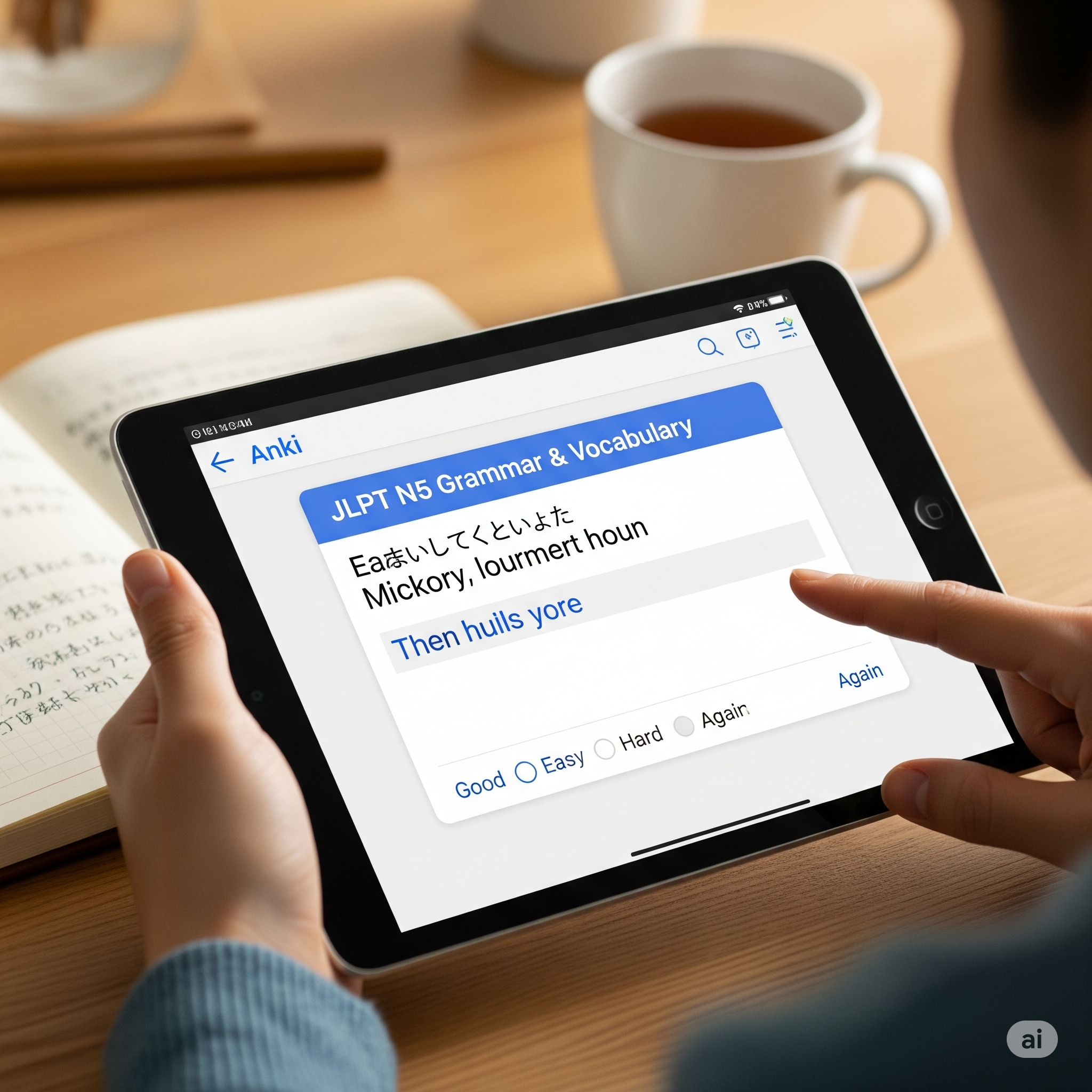
- Answer Honestly: When a card appears, don’t cheat. If you didn’t instantly recall it, hit “Again.” If it was easy but took a moment, “Good.” If it was laughably easy, “Easy.” This feedback is what tunes the algorithm to your brain.
- Embrace the Struggle: Seeing a card you marked “Easy” yesterday pop up as a total blank today is normal! It’s called the forgetting curve, and it’s exactly what Anki is designed to fight. Don’t get discouraged.
Pro Tips from a Seasoned Warrior
- Add Pictures: For concrete nouns (猫 – neko – cat), add a picture to the back of the card. It creates a stronger mental link than the English word “cat.”
- Keep it Simple: Don’t overload cards with 5 definitions and 10 example sentences. One clear meaning and one great example are all you need.
- Learn Your Kanji in Context: For N5, don’t get bogged down trying to learn every kanji’s 10 different readings upfront. Learn words. You’ll see the kanji 食 (shoku) in 食べます (tabemasu), 食事 (shokuji – meal), and 食堂 (shokudou – cafeteria). You’ll naturally absorb its meaning (“eat”) and common readings (た、く、ショク) over time.
- Sync Everywhere: Use AnkiWeb to sync between your computer and phone. This lets you crush your reviews while waiting in line or on your commute.
The Payoff: Why This Grind is Worth It
When you walk into that JLPT N5 exam room, something incredible will happen. The vocabulary won’t feel like a test; it will feel like meeting old friends. The grammar patterns will click into place not as rules you memorized, but as familiar paths your brain has walked a hundred times.
You won’t be scrambling to remember what いぬ (inu) means. You’ll know it’s “dog” as effortlessly as you know your own name. That confidence, that solid, unshakable foundation, is what Anki builds. It’s the rock upon which you will build the rest of your Japanese language castle, all the way to N1 and beyond.
Remember, the path of the samurai is one of persistence and discipline. Anki is your digital training ground. Use it well, be consistent, and you will not only pass the JLPT N5—you will truly own the knowledge.
Now, stop reading and go make your first card! 頑張ってください!(Ganbatte kudasai! – Do your best!)
Ready for the next challenge? Once you’ve mastered N5, learn how to build on your success for the JLPT N4.