
So, you’ve set your sights on the JLPT N3. Excellent choice! This level is the thrilling bridge between basic survival Japanese (N5, N4) and true, functional fluency (N2, N1). It’s where you stop being a tourist and start becoming a participant. You’ll learn to express opinions, understand the main points of everyday conversations, and follow more complex narratives.
But let’s be real: the jump from N4 to N3 is significant. The grammar gets trickier, the kanji count more than doubles, and listening sections suddenly feature natural-speed conversations. This is where a haphazard approach will fail you. You need a strategy, and that strategy begins with the right tools—your books.
As your guide, the JLPT Samurai, I’ve tested countless resources. The following list isn’t just a compilation of popular titles; it’s a battle-tested arsenal categorized for a specific purpose.
Part 1: The Foundation – Your Core Textbook Series
You wouldn’t build a castle on sand. Similarly, you need a structured core curriculum to build your knowledge systematically. These series are designed to take you from the end of N4 right through to N3 competence.
1. 新完全マスター Shin Kanzen Master (New Complete Master) Series
- The Keyphrase Here: Shin Kanzen Master N3
- Why it’s a Samurai’s Choice: This is often considered the gold standard for a reason. It’s comprehensive, rigorous, and incredibly thorough. It’s written entirely in Japanese, which is intimidating at first but ultimately immerses you in the language and forces your brain to think in Japanese definitions.
- Grammar (文法 Bunpou): This is arguably the best in its class. It groups similar grammar points together, allowing you to understand the subtle nuances between them. The example sentences are practical and the practice questions are perfectly pitched for the exam.
- Reading (読解 Dokkai): This book teaches you how to read for the test. It breaks down different reading comprehension skills—finding main ideas, parsing opinion pieces, understanding cause and effect—which is crucial for the N3’s challenging reading section.
- Listening (聴解 Choukai): Comes with a CD and focuses on the specific types of questions (quick response, task-based comprehension, point comprehension) you’ll encounter. The audio is clear and at exam speed.
- How to Use It: Don’t try to binge this series. Use it as your weekly lesson plan. Do a little grammar, a little reading, and a little listening each week.
2. TRY! 日本語能力試験 N3
- Why it’s a Great Alternative: If Shin Kanzen Master feels too intense to start with, TRY! N3 is a fantastic and slightly gentler introduction. Its main strength is its integrated approach. Each chapter introduces a grammar point, followed by reading and listening exercises that use that very grammar, reinforcing your learning in context.
- How to Use It: This is a perfect starter book. Work through it from beginning to end to get a solid overview of all the N3 grammar points before diving into the more detailed practice of Shin Kanzen Master.
Part 2: Sharpening Your Blades – Specialized Skill Books
Once your foundation is set, you need to sharpen individual skills to a razor’s edge.
For Grammar Mastery:
- ソムリエ Sommelier Series (N3 文法問題集): This book is a hidden gem. It doesn’t just list grammar; it “pairs” it like a fine wine, helping you understand which grammatical structures naturally go together. This is invaluable for making your Japanese sound more natural, not just textbook-correct.
- 新にほんご500問 Nihongo 500 Mon (N4-N5): Wait, isn’t this for lower levels? Yes! And that’s the secret. A huge part of N3 success is having N4 and N5 knowledge down cold. This book of 500 questions is perfect for daily review to ensure your foundational knowledge is rock solid. Speed and accuracy on easier questions free up mental energy for the harder N3 material.
For Kanji Conquest:
- 新完全マスター漢字 Shin Kanzen Master Kanji (N3): This book brilliantly groups kanji by topic (e.g., health, environment, politics) rather than just by JLPT list. This thematic approach helps with memory and vocabulary building, as you learn related words together.
- ベストなのを選んだ 日本語能力試験N3漢詞 Best Guide to JLPT Kanji: A great choice if you want a more traditional, list-based approach. It’s clear, concise, and provides plenty of example words for each kanji.
For Reading Speed & Comprehension:
- 新完全マスター読解 Shin Kanzen Master Reading (N3): As mentioned above, this is essential. It’s not just practice passages; it’s a course on how to dissect Japanese sentences and paragraphs.
- Practical Suggestion: Supplement your textbook reading with real-world materials. Read NHK News Web Easy (an outbound link to a fantastic free resource: https://www3.nhk.or.jp/news/easy/) or children’s articles. Don’t worry about understanding every word; focus on grasping the main idea. This builds stamina.
For Listening Precision:
- 新完全マスター聴解 Shin Kanzen Master Listening (N3): The best dedicated listening practice you can get. The audio is excellent and the exercises are designed to train your ear for the test’s format.
- Practical Application: Turn your commute into a dojo. Listen to the CDs or audio files repeatedly until you can transcribe what’s being said. Shadowing (repeating aloud immediately after the speaker) is a powerful technique for improving pronunciation and rhythm. For more on this, check out our blog post on Mastering JLPT Listening: From Panic to Precision.
- Best JLPT N3 Books Every Learner Should Use in 2025
- Best JLPT N3 Books for Self-Study and Exam Preparation
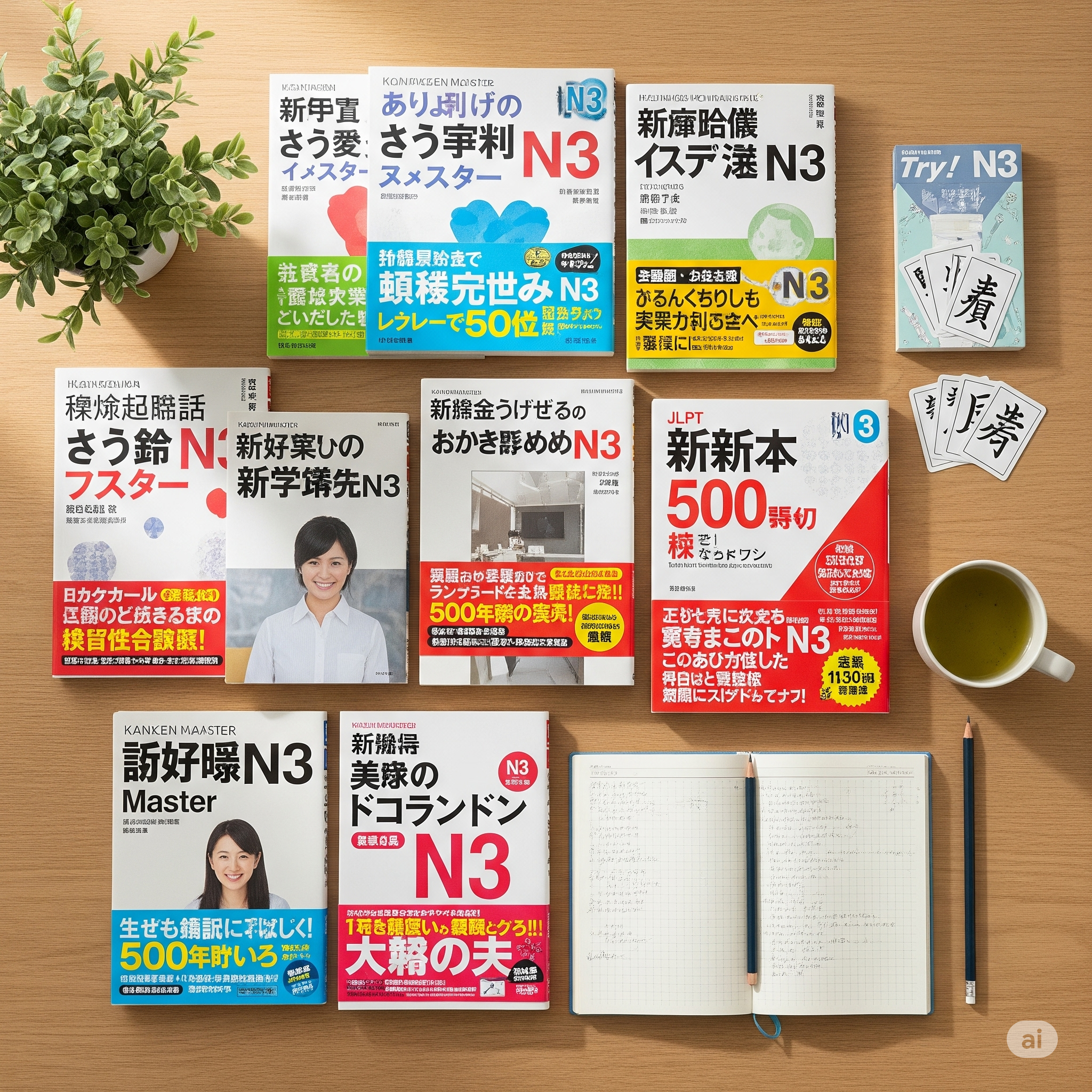
Part 3: The Final Battle – Mock Exams & Review
You can know all the material, but if you can’t apply it under timed, exam conditions, you will struggle. This is where mock tests become non-negotiable.
- 日本語能力試験公式問題集 JLPT Official Practice Workbook: This is the holy grail. Published by the makers of the test themselves, it contains a past exam paper. Save this for the last month of your study. Use it to simulate the exact test environment—timing, answer sheets, everything. There is no better indicator of your readiness.
- Pattern-Betzu Taisaku Moshi-to Atarasii JLPT N3: Various publishers put out high-quality mock exams. Aim to complete at least 2-3 full mock tests before your exam day. Your goal is not just to check answers, but to analyze your mistakes. Did you run out of time? Misread a question? Get fooled by a listening distraction? This analysis is where the real learning happens.
The Samurai’s Study Strategy: How to Wield Your Arsenal
A master swordsman doesn’t just own a sword; they know how to use it. Here’s a proposed 3-month battle plan:
- Month 1: Foundation. Work through your core textbook (TRY! N3 or the Shin Kanzen Master grammar book). Simultaneously, do 15-20 minutes of kanji study daily and 2-3 reading/listening exercises per week.
- Month 2: Intensification. Dive deep into the other Shin Kanzen Master books (Reading, Listening). Start doing timed practice sections. Begin reviewing N4/N5 grammar with a book like Nihongo 500 Mon to keep it fresh.
- Month 3: Exam Conditioning. Start taking full-length mock exams every other weekend. On the off weeks, intensely review your mistakes. Revisit problem areas in your textbooks. Your focus should shift from learning new material to perfecting and speeding up your application of known material.
A Final, Human Word of Encouragement
The JLPT N3 journey is a marathon, not a sprint. There will be days when the kanji won’t stick and the grammar points all sound the same. That’s normal. It’s not a sign of failure; it’s a sign of progress.
Your books are your senseis, but you are the samurai wielding the knowledge. Trust your resources, stick to your plan, and remember why you started this journey in the first place: to connect with a beautiful language and culture on a deeper level. The N3 certificate is just a milestone on that incredible path.
Now, go forth and conquer! 頑張ってください!(Ganbatte kudasai!)


