
Konnichiwa, dedicated Japanese learner!
If you’re reading this, you are committed to conquering the Japanese-Language Proficiency Test (JLPT) N3. This level is often called the “bridge” because it moves you firmly from the beginner stages into true intermediate functional fluency, unlocking real-world understanding and richer connections with the language.
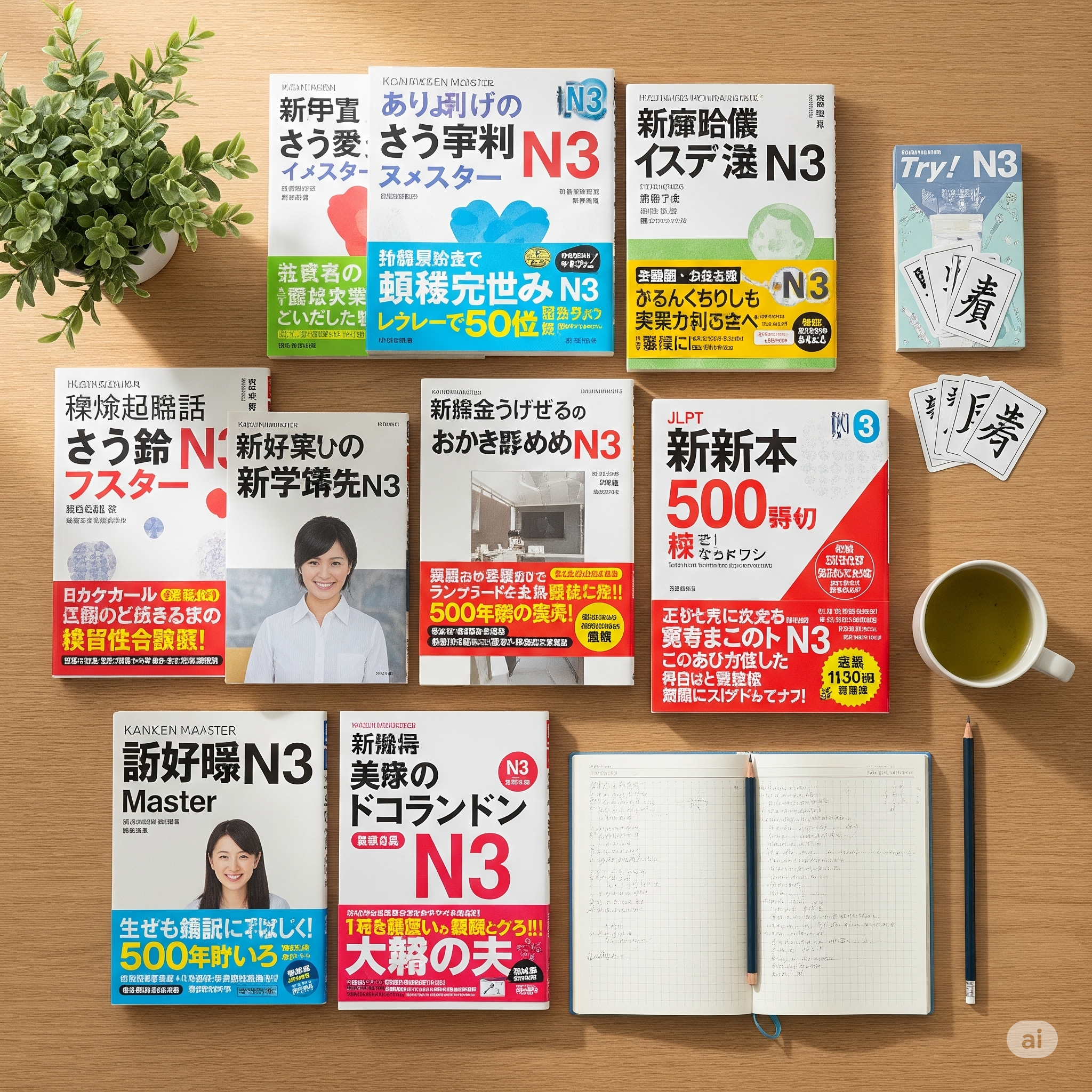
Success at the N3 level demands a focused, structured study plan. While top-tier paid textbooks offer structure, a disciplined self-studier can build an equally powerful foundation using high-quality, free resources. The secret is knowing where to find them and how to use them effectively.
Before you dive into the specifics of study materials, make sure you understand the battlefield. For a comprehensive overview of the entire examination, from section times to passing scores, bookmark our pillar guide: [Your Ultimate JLPT N3 Full Test Guide: Structure, Scoring, and Success Strategies]
This guide provides your essential toolkit, focusing specifically on free resources. Once you’ve mastered these, you might consider supplementing with premium materials. If you are looking for a complete curriculum review, including paid options, see our guide on the [Best JLPT N3 Books for Self-Study and Exam Preparation].
The Essential Toolkit: Your Free N3 Resource Arsenal
The N3 exam tests three distinct areas: Language Knowledge (Vocabulary/Kanji/Grammar), Reading, and Listening. Your free resource arsenal must cover all three with depth and quality.
1. The Grammar Grimoire (文法 – Bunpou)
Grammar is the skeleton of the language. Without a strong structure, everything else falls apart. At the N3 level, the focus shifts from simple conjugation to understanding nuance, formality, and context-specific usage.
Tae Kim’s Guide to Learning Japanese (Grammar Guide)
This is a legendary resource for a reason. While it’s not only for N3, its explanations of intermediate grammar points are incredibly clear and logical. Tae Kim focuses on how grammar is actually used, not just on passing a test. It’s perfect for building a deep understanding.
- How to Use It: Don’t just read it passively. After each section, try to create two original sentences using the new grammar point. This active recall is what cements it into your brain.
- Outbound Link: [Tae Kim’s Grammar Guide]
JLPT Sensei’s N3 Grammar List
This is your quick-reference dictionary. It provides a comprehensive list of all grammar points likely to appear on the N3, complete with example sentences and rough English explanations.
- How to Use It: Use this as a checklist. Mark the points you’ve mastered and revisit the ones you find tricky. It’s excellent for last-minute review sessions.
- Outbound Link: [JLPT Sensei N3 Grammar List]
Satori Reader: Reading with Built-in Grammar Tools
While not entirely free, Satori Reader offers a handful of free series and articles that are perfect for N3 learners. Each sentence is clickable, showing detailed breakdowns of the grammar and vocabulary. This is the best way to see grammar in a natural, narrative context.
- How to Use It: Read one free article a week. Don’t just understand the main idea; click on every sentence you’re even slightly unsure about and read the explanation.
- Outbound Link: [Satori Reader]
2. The Vocabulary Vault (語彙 – Goi)
Building a robust vocabulary is about consistent, daily effort. Cramming won’t work here. The N3 requires approximately $3,700$ total words, roughly $2,200$ new words after N5 and N4.
Anki: The Spaced Repetition Superpower
This free, powerful spaced repetition system (SRS) flashcard app is non-negotiable for serious learners. The best part? The community-shared decks.
- How to Use It: Search the Anki shared decks for “JLPT N3” and you’ll find several pre-made decks with thousands of words, often with example sentences and audio. Download one and make it a habit to review your cards every single day. Even 15 minutes on your commute makes a huge difference. For specific recommendations, check our dedicated guide: [Best JLPT N3 Anki Decks for Vocabulary, Kanji & Grammar (Free Download)]
Jisho.org: The Ultimate Japanese Dictionary
This is the best online Japanese-English dictionary. It’s incredibly powerful. You can search by JLPT level (e.g., search jlpt:n3), by radical, or even by drawing a kanji you don’t know.
- How to Use It: Whenever you encounter a new word in your reading, look it up on Jisho. Add it to your Anki deck. Use Jisho to explore related words and compounds.
Deep Dive on Anki: We highly recommend automating your review process using Anki. Consistency is everything when managing a vocabulary load this large. To truly master the system and customize it for your needs, read our step-by-step tutorial: [How to Use Anki for JLPT N3: Study Smarter With Spaced Repetition]
3. The Kanji Codex (漢字 – Kanji)
N3 requires knowledge of around $650$ kanji. It’s not just about recognition; it’s about understanding the common compounds they form. This is crucial because the Language Knowledge section tests both the reading (Kanji Yomi) and the selection of the correct Kanji (Hyōki).
The Kanji Map: Visualizing Connections
This fantastic website breaks down kanji by JLPT level and shows you the most common words that use each kanji. This context is invaluable.
- How to Use It: If you’re struggling with a particular kanji, look it up here. See what other words it’s used in. This creates mental connections that make memorization easier.
- Outbound Link: [Kanji Map]
Remembering the Kanji (RTK) Method & Anki
James Heisig’s “Remembering the Kanji” book is famous, but you can apply its principle of learning kanji through stories with free Anki decks. Search for “RTK” or “Kanji Koohii” decks.
- How to Use It: This method is great for learners who struggle with rote memorization. It helps you differentiate between visually similar kanji by assigning a unique story to each one.
4. The Listening Lodge (聴解 – Choukai)
This section is often the most challenging for self-learners. You need to train your ear to process natural speed and nuance. The N3 listening section is $\approx 40$ minutes long and plays only once.
Nihongo no Mori (YouTube Channel): The Goldmine
An absolute goldmine. Native Japanese teachers explain N3 (and other level) grammar, vocabulary, and provide listening practice—all in clear, manageable Japanese. This is listening practice and a lesson all in one.
- How to Use It: Watch one or two videos a day. Don’t use English subtitles if they’re available. Focus on listening. Repeat phrases out loud to practice shadowing, a technique where you mimic the speaker’s intonation and rhythm.
- Outbound Link: [Nihongo no Mori YouTube Channel]
JLPT Official Practice Workbook: The Authentic Test
The official JLPT site offers one free practice test for each level, including the audio for the listening section. This is the most accurate representation of the test’s format and speed you will find.
- How to Use It: Save this for a mock exam day. Simulate the real test conditions to get a true feel for the timing and pressure. Crucially, review the section-specific timing rules outlined in our primary guide on the [JLPT N3 Format Explained: Your Ultimate Guide to Sections, Time, and Question Types]
5. The Reading Dojo (読解 – Dokkai)
Reading at the N3 level requires stamina. You need to get comfortable with longer texts and information retrieval. The Reading section is $\approx 70$ minutes long, testing both grammar context and comprehension.
Tadoku (Extensive Reading) Free Graded Readers
Tadoku provides free, beautifully illustrated stories written for specific language levels. Their Level 3 and 4 readers are perfect for N3 learners.
- How to Use It: Read for fun! Don’t stop to look up every word. The goal is to build fluency and learn to guess meaning from context. It’s about enjoying the story, not studying it.
- Outbound Link: [Tadoku Free Graded Readers]
NHK Web Easy: Real-World Topics
This site provides simplified news articles in Japanese, complete with furigana and audio narration. The topics are real-world, which is exactly what the N3 reading section includes.
- How to Use It: Try to read one article a day. First, read it without the audio. Then, listen to the audio while reading along. Finally, try to summarize the main points out loud in Japanese.
- Outbound Link: [NHK Web Easy]
The Role of Free Apps and Digital Tools
While Anki is the powerhouse, don’t overlook other free applications that can provide variety, gamification, and targeted drilling. Variety helps prevent burnout.
| App/Tool | Focus Area | Free Offering | Related Cluster Post |
| Kanji Study (App) | Kanji drawing, recognition, and compounds. | Basic kanji sets and quizzes. | [Best App for JLPT N3 Prep: Top Recommendations for Learners](Best App for JLPT N3 Prep: Top Recommendations for Learners Link) |
| Bunpro | Grammar drilling and spaced repetition (SRS). | Limited free access to grammar points. | [Best JLPT N3 Books for Self-Study and Exam Preparation](Best JLPT N3 Books for Self-Study and Exam Preparation Link) |
| Quizlet | User-created flashcard sets for vocabulary. | Basic flashcard review and testing modes. | N/A |
Integrating these digital tools effectively is key to modern self-study. To see how these and other apps compare to traditional methods, read our comprehensive review: [Best App for JLPT N3 Prep: Top Recommendations for Learners]
Forging Your Study Plan: The Samurai’s Schedule
Having resources is one thing; using them effectively is another. Here’s a sample weekly schedule to integrate these free tools into your life. This plan assumes $\approx 1$ hour of study per day, five days a week, plus a longer session on Saturday.
| Day | Focus Area | Free Tool/Activity | Duration |
| Daily | Vocabulary & Kanji Review | Anki (Review all due cards) | 15-20 mins |
| Monday | New Grammar & Writing | Tae Kim/JLPT Sensei + Write 5 original sentences | 40 mins |
| Tuesday | Listening Immersion | Nihongo no Mori/NHK Web Easy (Shadowing) | 40 mins |
| Wednesday | New Vocabulary & Kanji | Jisho.org/Kanji Map (Add 10 new words to Anki) | 40 mins |
| Thursday | Reading Fluency | Tadoku/Satori Reader (Extensive reading) | 40 mins |
| Friday | Deep Review & Testing | Quizlet or Kanji Study App (Target weak points) | 45 mins |
| Saturday | Mock Exam | JLPT Official Practice Workbook (Timed Section) | 60-90 mins |
| Sunday | Rest & Passive Immersion | Watch Japanese drama/anime/listen to podcasts | Flexible |
A Samurai’s Insight: The Hidden Challenge of Self-Study
The biggest hurdle isn’t the grammar or the kanji—it’s consistency and motivation. When you study alone, no one is holding you accountable.
My advice? Find a community. Join online forums like Reddit’s r/LearnJapanese, find a study partner on a language exchange app, or follow Japanese learners on social media. Sharing your struggles and successes makes the journey feel less lonely and keeps the fire of motivation burning. Remember why you started this path. Was it to understand anime without subtitles? To talk to friends? To work in Japan? Keep that goal at the forefront of your mind.
Bridging the Textbook Gap: Are Free Resources Enough?
While free resources are excellent for targeted drilling and supplementary practice, they often lack the cohesive, step-by-step curriculum of a major textbook series.
- The Genki Question: Many students start with the Genki series (outbound link). While it is highly regarded, it only covers material up to the N4 level. If you used Genki through Book 2, you have a solid foundation but a significant gap remains before N3. We tackle this specific question—whether this classic resource can carry you to N3—in our analysis: [Genki and JLPT N3: Is This Classic Textbook Enough to Pass the Exam?]
- The Minna no Nihongo Path: Similarly, if your foundation is based on the Minna no Nihongo series, the transition to N3 can feel disjointed. We have a guide to help you leverage your existing knowledge for N3: [JLPT N3 Minna no Nihongo Book: How to Use It for N3 Preparation]
Ultimately, your success hinges on how you use the resources, not whether they cost money. A well-organized plan using the free resources above will always outperform a disorganized plan using expensive textbooks.
The Final Boss: Practice Tests
As your exam date approaches, your most valuable resource is past papers. While complete recent exams are not publicly released, you can find many “JLPT N3 practice tests” or 模試 (moshi) online from schools and websites. These are crucial for:
- Building your test-taking stamina, especially for the lengthy $\approx 140$ minute exam.
- Practicing time management, which is the secret weapon for the combined Language Knowledge/Reading section.
- Identifying your weakest areas, which tells you exactly where to focus your final weeks of review.
Treat each practice test like the real thing. Grade yourself harshly, analyze your mistakes, and then go back to your resources to review those specific points. For a list of the best materials to use for a comprehensive simulation, including paid workbooks, see our guide: [Top JLPT N3 Books for Passing the Exam in 2025 – The Ultimate Guide]
Conclusion: Your Journey Awaits
The path to passing the JLPT N3 is challenging but immensely rewarding. Remember, the goal isn’t just to pass a test; it’s to genuinely improve your ability to communicate in and understand Japanese.
Use these tools wisely, create a consistent schedule, and don’t forget to enjoy the process. You are building a skill that will open doors for a lifetime.
Ready to start your structured study? For a full review of all study options, both free and paid, and to map out your long-term plan, click back to our definitive resource: [Your Ultimate JLPT N3 Full Test Guide: Structure, Scoring, and Success Strategies]
がんばってください, 未来の侍 (Good luck, future samurai)!


