
Konnichiwa, fellow Japanese language learners!
If you’re reading this, you’re ambitious. You’ve been grinding through textbooks, binge-watching anime without subtitles, and maybe even having stilted but wonderful conversations with native speakers. And now you’re facing a big question, one I get asked all the time in my classes:
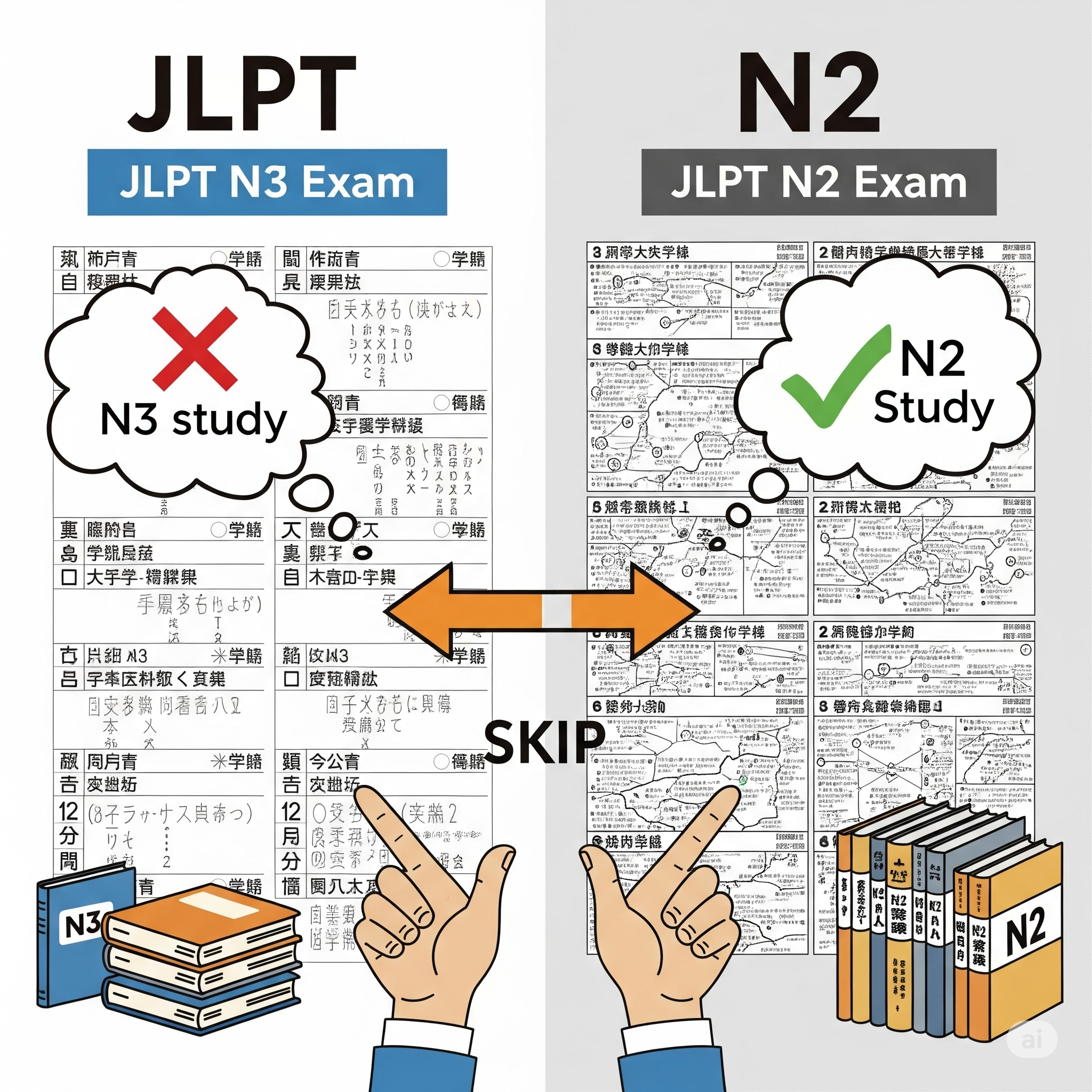
“Sensei, can I just skip the JLPT N3 and go straight for the N2?”
It’s a tempting thought. The N2 is the golden ticket—the qualification that really opens doors for jobs, scholarships, and university admissions in Japan. N3 can feel like a tedious, expensive stepping stone.
So, let’s cut to the chase. The official answer is yes, you absolutely can. The Japan Foundation imposes no rules stopping you from registering for any level you want. You could, in theory, wake up tomorrow, sign up for the N1 having never studied a day, and go in cold. (Spoiler: I do not recommend this).
The real question isn’t about permission; it’s about practicality. Is skipping JLPT N3 a clever shortcut or a recipe for a costly, demoralizing failure?
As someone who has both taken these exams and guided hundreds of students through them, I’m here to give you the unvarnished truth. Let’s dive in.
Understanding the Monumental Gap: N3 vs. N2
This is the most critical part to grasp. The jump from N4 to N3 is significant, but the chasm between N3 and N2 is enormous. It’s not just “more of the same”; it’s a different league altogether.
Think of it like this:
- N3 (Intermediate): You’re a tourist who can navigate daily life. You can read menus, ask for directions, and understand the general topic of a slow conversation.
- N2 (Upper-Intermediate/Advanced): You’re approaching functional fluency. You can follow news broadcasts, read newspaper articles and most novels, and work in a Japanese office environment.
The JLPT itself provides a rough guide on required study hours, and it’s telling:
- N3: Requires approximately 600-900 hours of study (from zero).
- N2: Requires approximately 1000-1600 hours of study (from zero).
You’re not just looking at a few hundred more words. You’re looking at nearly doubling your knowledge and skill. Let’s break down what that means in each section.
1. Vocabulary (語彙 – Goi)
- N3: ~3,750 words
- N2: ~6,000 words (and they get much more specific and nuanced)
The N2 vocabulary shifts from everyday survival to academic, business, and abstract topics. You’ll encounter compound verbs and Sino-Japanese words that are crucial for reading complex texts.
2. Kanji (漢字)
- N3: ~650 characters
- N2: ~1,000 characters
Mastering 350 new kanji is a massive undertaking. But the real challenge isn’t just recognition; it’s knowing the numerous readings (音読み – onyomi and 訓読み – kunyomi) and compounds (熟語 – jukugo) they form.
3. Grammar (文法 – Bunpou)
- N3: ~150 grammar patterns
- N2: ~200+ grammar patterns
N2 grammar is where things get subtle. You’ll encounter patterns that express delicate nuances of opinion, assumption, and circumstance—the kind of language used in essays, reports, and formal discussions. Confusing 〜につれて (ni tsurete) with 〜にしたがって (ni shitagatte) might not break a conversation, but it will cost you points on the exam.
4. Reading & Listening
The reading passages become longer, denser, and more abstract. N3 texts might be a few paragraphs; N2 texts are full-length essays, editorials, and reviews. The listening sections get faster, feature more natural conversational flow (with pauses, fillers, and interruptions), and often require you to infer the speaker’s true intent, not just the literal meaning.
So, Who Can Realistically Skip the N3?
While I generally advise against it for most, some learners might be in a position to make the jump successfully. You might be a candidate if:
- You’re a “Heritage Learner”: You grew up in a Japanese-speaking household or community. You might have a strong passive understanding (listening) and now need to formalize your reading and writing skills to match. Your innate feel for the language can compensate for gaps.
- You’ve Already Immersed Yourself for Years: Maybe you lived in Japan for a year or two without formal study. You’ve been consuming raw Japanese media—NHK News, Japanese novels, podcasts, and YouTube channels—for hours every day. Your comprehension is likely already hovering around the N2 level; you just need to learn the test’s format.
- You’re a Study Machine with a Clear Deadline: You have 6-8 months of dedicated, full-time study ahead of you (think 3-4 hours per day, every day). You’re incredibly disciplined and are using a structured plan with quality resources like the Sou Matome or Shin Kanzen Master N2 series.
If you don’t see yourself in these categories, don’t worry. It doesn’t mean you can’t achieve N2; it just means taking the N3 first is a smarter strategic move.
The Hidden Benefits of Taking N3 (That Nobody Talks About)
I urge my students to see N3 not as a barrier, but as a dress rehearsal. Here’s why:
- The Exam is a Beast (Itself): The JLPT is a unique, grueling 3-hour marathon. It tests your endurance and focus as much as your Japanese. Taking N3 is a low-stakes way to experience the pressure, the timing, the answer sheet format, and the mental fatigue. Walking into N2 already knowing what to expect is a huge advantage.
- A Confidence Booster, Not a Demotion: Passing any JLPT level is a fantastic feeling. It validates your hard work and gives you a concrete certificate of achievement. This boost in morale is fuel for the much longer N2 journey ahead. Failing N2, on the other hand, can be brutally discouraging.
- A Structured Learning Path: The N3 syllabus provides a perfectly curated checklist of the foundational knowledge you absolutely must have for N2. You can’t build a skyscraper (N2) on a weak foundation (skipping N4/N3). Studying for N3 ensures no critical gaps in your core grammar or kanji knowledge.
Think of it as investing in a solid foundation. It might seem slower now, but it will make building your N2 knowledge faster and more stable.
Your Action Plan: The Self-Assessment Test
Still determined to try? Let’s be smart about it. Before you spend ¥6,500 (approx. $65) on the exam fee, give yourself a honest diagnostic test.
- Take a Official Practice Test: The Japan Foundation releases official practice workbooks. This is the single best way to gauge your level. Time yourself strictly. If you’re not scoring at least 60-70% on the N2 practice test, you are not ready.
- Try an N2 Reading Passage: Grab a Shin Kanzen Master N2 Reading book. Open to a random passage. Can you read it and understand the author’s core argument and most details without using a dictionary? If it’s complete gibberish, you’re likely still at an N4/N3 level.
- Listen to a Podcast: Listen to an episode of Nihongo Con Teppei (for advanced learners) or a news clip from NHK News Easy (then regular NHK). If Teppei is too fast or NHK regular news is incomprehensible, your listening skills need more work.
My personal recommendation? Aim to take the N3 first. Use it as a motivating milestone. The structure will make you a stronger, more well-rounded learner. The confidence you gain will power you through the undeniably tough N2 study grind.
Recommended Resources for Your Journey
Whether you choose N3 or N2, here are my go-to resources:
- For Grammar: The Shin Kanzen Master series is the gold standard. It’s thorough, challenging, and written entirely in Japanese, which is great immersion. (Backlink: Official Sekai Books Store)
- For Kanji: WaniKani is a fantastic, SRS-based web app that makes kanji stick. Alternatively, the Kanji Look and Learn workbook is excellent.
- For Reading Practice: Start reading simple news on NHK Web Easy daily. When that gets easy, move to regular NHK. For fun, try reading manga or novels you enjoy.
- For Listening Practice: Nihongo Con Teppei (podcast), Japanese YouTube vloggers (料理 channels are great!), and of course, anime and dramas without subtitles.
For more tips on building a study plan, check out my post on How to Create a JLPT Study Schedule That Actually Works. If you’re struggling with motivation, you might find this article on Overcoming the Japanese Language Plateau helpful.
The Final Verdict
So, can you directly give JLPT N2 without N3? Yes, you are allowed to.
Should you? For most learners, no. The jump is tremendous, and the risk of wasting time, money, and motivation is high.
View the JLPT not as a series of hoops to jump through, but as a structured curriculum designed by experts to guide you to fluency. Embracing each level is the most efficient and rewarding path to mastering this beautiful language.
Whatever you decide, 頑張ってください!(Ganbatte kudasai! – Do your best!)
Internal Blog Post Links (to be added to your site):
- How to Create a JLPT Study Schedule That Actually Works
- Overcoming the Japanese Language Plateau: A Sensei’s Guide
- 5 Common Mistakes JLPT N2 Test-Takers Make (And How to Avoid Them)
Outbound Links (For Authority & User Value):
- Official JLPT Website – For official guidelines and sample questions.
- NHK News Web Easy – For free reading practice.
- Japan Foundation – The cultural arm that administers the JLPT.
- WaniKani – A highly recommended kanji learning platform.


