Alright, let’s settle this once and for all.
You’re here because you love anime. The thrilling stories, the unforgettable characters, the sheer emotion of it all got you hooked. And somewhere between Luffy’s latest gear and Eren’s… well, everything, a thought popped into your head:
“Hey, I’m picking up some words! Kawaii! Sugoi! Baka! Maybe I can actually learn Japanese from anime?”
It’s a seductive idea. Turning your favorite pastime into a productive study session? Sign me up!
But as a Japanese language sensei and someone who has guided hundreds of students through the JLPT (Japanese-Language Proficiency Test), I have to give you my honest, no-BS answer.
It’s a resounding “Yes, but…”
Anime is an incredible supplement, a fantastic sidekick to your main learning journey. But if you try to make it your only sensei, you’re going to end up sounding like a samurai who just arrived from 1603, or worse, a total baka.
Let’s break down why, and more importantly, how you can use anime to genuinely boost your Japanese skills without developing some… questionable speaking habits.
The Allure and The Trap: Why Anime Japanese is… Different
First, you need to understand what you’re listening to. Anime Japanese is not textbook Japanese. It’s a performance. It’s characterized by:
- Exaggerated Emotion: Characters scream, whine, and declare their love with an intensity you’d rarely (hopefully never) see in real life. This affects pronunciation, pitch accent, and word choice.
- Fictional Register: You’ll hear archaic samurai speech (
-de gozaru), over-the-top masculine rough talk (-ssu,-ze), and hyper-feminine cute speech (-wa,-nyo). Using these in a Tokyo convenience store will turn heads for all the wrong reasons. - Slang and Made-up Words: Anime, especially modern settings and fantasy, is a playground for slang and jargon. It’s great for comprehension, but a minefield for production.
Think of it like this: if someone learned English only from watching Marvel movies, they might walk into a coffee shop and yell, “FOUL MORTAL! I shall vanquish this latte and claim this muffin for my own!”
You’d back away slowly, right? The same principle applies.
The Surprising Benefits: What Anime Does Incredibly Well
Now, let’s flip the script. When used correctly, anime is a powerful weapon in your language-learning arsenal. Here’s what it excels at:
1. Training Your Ear to Natural Speed
Textbook audio dialogues are painfully slow and clear. Anime throws you into the deep end of native-speed Japanese, complete with contractions, slurring, and rapid-fire delivery. This is brutal but excellent for tuning your ear.
2. Learning Vocabulary in Context
Hearing a word like 頑張れ (ganbare – “Do your best!”) in a pivotal, emotional scene etches its meaning and feeling into your brain far deeper than any flashcard ever could. You learn the nuance, not just the definition.
3. Picking Up Cultural Nuances
Language is culture. Anime is dripping with cultural touchstones: how to behave in an 銭湯 (sento – public bath), the importance of いただきます (itadakimasu – said before eating), and unspoken social hierarchies. This is invaluable knowledge you can’t get from a grammar point. For a deeper dive into this, check out my post on 3 Unspoken Japanese Cultural Rules You Learn Through Language.
4. Keeping You Motivated
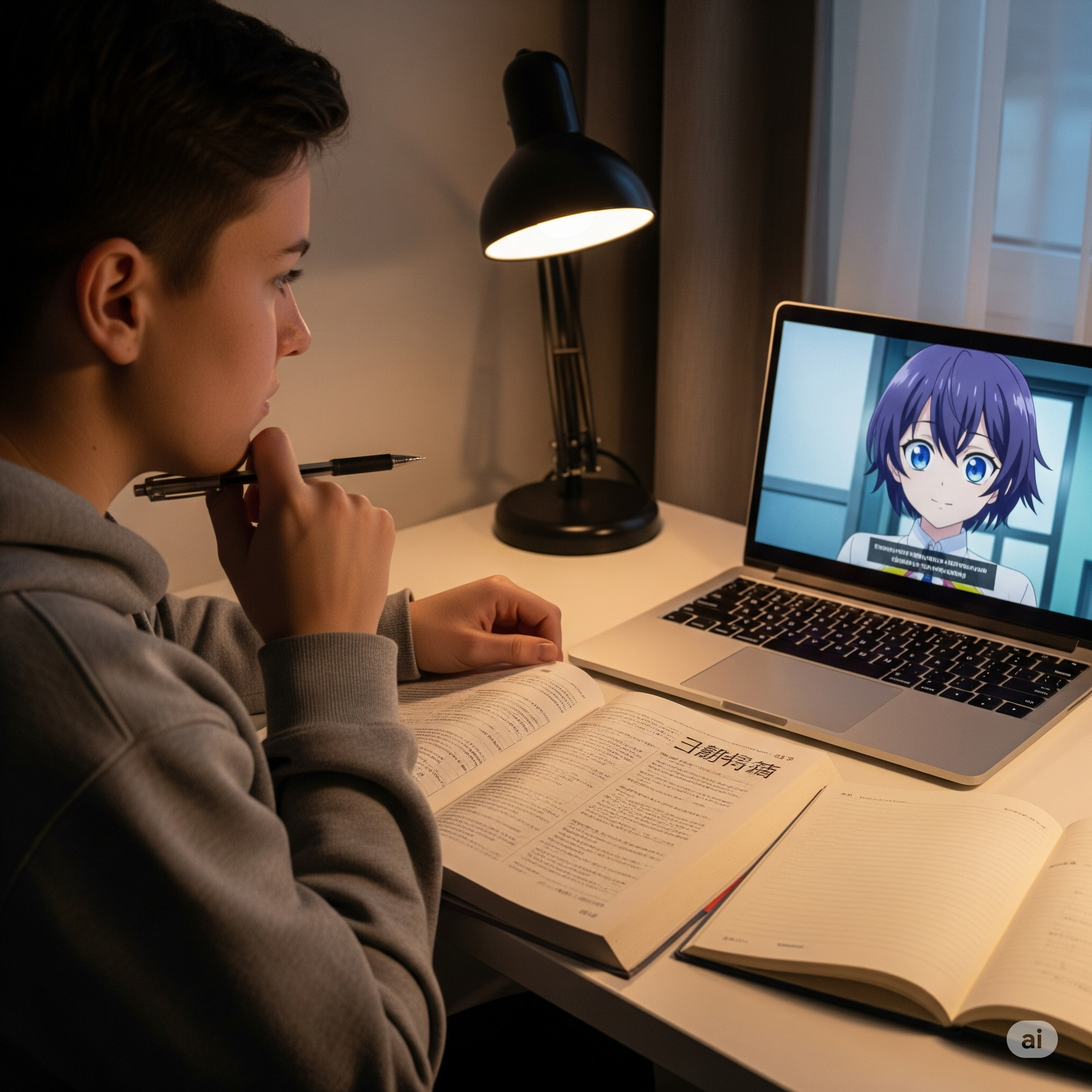
Let’s be real: grinding through Kanji worksheets can burn you out. Anime reminds you why you’re learning. It connects you to the joy, humor, and drama of the language, which is the best motivation booster there is.
My Practical 5-Step Method to Learn Japanese from Anime (The RIGHT Way)
Okay, enough theory. Let’s get to the good stuff. How do you actually do this? Here is the method I recommend to my students.
Step 1: Choose the RIGHT Anime
Not all anime are created equal for language learning. You want shows that mirror real-life Japanese as much as possible.
- Beginner-Friendly (Slice of Life): Start here. Shows like
Shirokuma Cafe(Polar Bear Cafe),Sazae-san, orK-On!feature everyday situations, slower dialogue, and common vocabulary. - Intermediate (Drama/Rom-Com): Move to shows like
ご注文はうさぎですか?(Is the order a rabbit?) or君の名は。(Your Name.). The dialogue is more natural but still within the realm of reality. - Advanced (Everything Else): Once you have a solid base, you can tackle the fantasy epics and sci-fi. You’ll be able to appreciate the weird slang and identify what not to say.
AVOID as a primary learning tool as a beginner: Shows with heavy dialects (Osaka-ben in Lucky Star), excessive jargon (e.g., Attack on Titan), or those set in entirely fictional worlds.
Step 2: Active Watching (No More Passive Binging)
This is the key. You’re not just watching; you’re studying.
- First Watch: Watch an episode with English subtitles. Just enjoy the story.
- Second Watch: Now, switch to Japanese subtitles. This is non-negotiable. You can find them on platforms like Animelon or use a subtitle extension like Language Reactor for Netflix. Your goal is to connect the sounds you hear to the words you see.
- Listen for Gaps: Where did the spoken Japanese differ from the subtitles? Where did they use a contraction? This is where the real learning happens.
Step 3: The “Sentence Mine” Gold Rush
When you hear a useful, common word or phrase, pause! Don’t just let it slide.
- Grab the sentence and add it to a SRS (Spaced Repetition System) like Anki.
- Your flashcard should have the audio clip (you can extract it with tools), the sentence in Japanese, and a screenshot for context.
- You’re not just learning a word; you’re learning a chunk of language used in a real situation. For a detailed guide on this technique, read my article on How to Use Anki to Finally Conquer Japanese Vocabulary.
Step 4: Shadow the Speech ( carefully!)
Pick a short, clear line of dialogue. Play it. Pause. Try to imitate the speaker exactly—their rhythm, their pitch, their emotion. This builds muscle memory for your mouth and ears. But be selective! Maybe don’t shadow a berserk character’s maniacal laughter.
Step 5: Supplement and Verify
This is the most crucial step. When you learn something new from anime, verify it.
- Is this word actually used by real people? A quick search on Jisho.org or a question on a forum like HiNative can save you from embarrassment.
- Cross-reference with your textbook or a grammar guide. Does this sentence structure align with what you’ve learned in formal studies?
Anime shows you the language in the wild; your textbooks provide the field guide to understand it.
The Non-Negotiables: What You MUST Do Alongside Anime
Anime is the side dish, not the main course. To build a balanced Japanese diet, you need:
- A Structured Curriculum: Use a textbook series like Genki or Minna no Nihongo. They provide the foundational grammar and vocabulary in a logical order. This is your backbone.
- Kanji Study: You can’t escape it. You need a dedicated plan for learning Kanji. Anime can help you recognize them in subtitles, but it won’t teach you how to write them.
- Real Human Interaction: Eventually, you must speak with real people. Use iTalki, find a language exchange partner, or join a local class. This is the only way to bridge the gap between understanding anime and holding a conversation. If you’re nervous about this step, I wrote a guide on Overcoming the Fear of Speaking Japanese: A Beginner’s Guide.
The Final Verdict
So, can you learn Japanese from anime?
Yes, absolutely. It will supercharge your listening skills, build a vibrant and contextual vocabulary, and, most importantly, keep the fire of your motivation burning bright.
But no, not by itself. It is a fantastic supplement, a wonderful tool, and a rewarding way to apply your studies. But it cannot replace the fundamentals.
Use anime as the incredible resource it is, but always keep one foot firmly planted in the world of structured learning. Do that, and you’ll not only understand your favorite characters—you’ll be able to have a real conversation with the people who created them.
今すぐ始めましょう! (Ima sugu hajimemashou! – Let’s start right now!)
What was the first word or phrase you learned from anime? Share your story in the comments below
Life After JLPT N1: Career, Study, and Personal Growth Opportunities
Anki JLPT N1: The Ultimate Flashcard System for Advanced Japanese
How to Use Anki for JLPT N1 Success: Decks, Strategies, and Study Hacks