o, you’ve set your sights on the JLPT N2. 優秀ですね!(Excellent!) That’s a huge step, moving from intermediate to advanced territory. It’s the gateway to university admission in Japan, a major resume booster, and a true testament to your dedication to Japanese.
But let’s be honest, the exam’s scoring system can feel like a mysterious black box. You know you need a “passing score,” but what does that actually mean? Why can’t they just give you a percentage? If you’ve found yourself scratching your head over the score report or worrying about how many questions you can get wrong, you’re not alone.
As someone who has both taken and coached students through the JLPT for years, I’m here to demystify it all. Think of this as your sensei’s guide to not just passing, but understanding your JLPT N2 score.
The Golden Rule: It’s Not Just One Score, It’s Four
This is the most common misconception. People ask, “What’s the passing score for JLPT N2?” expecting a single number. The answer is a little more nuanced.
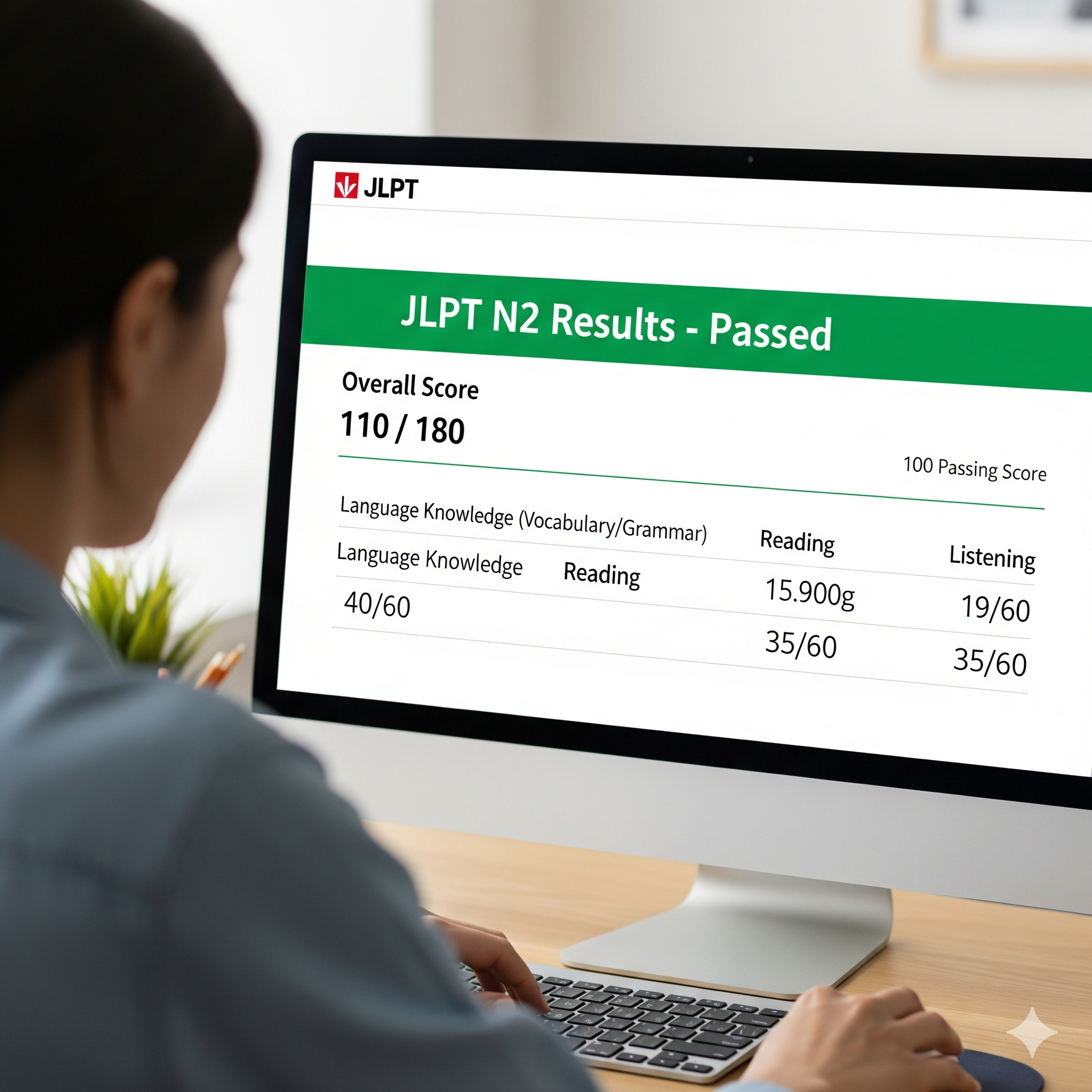
To pass the JLPT N2, you must achieve TWO things simultaneously:
- An Overall Pass Mark: You must score at least 90 points out of 180.
- Sectional Pass Marks: You must also score at least 19 points (out of 60) in each of the three test sections.
Fail to meet any one of these four requirements (the overall score OR any one sectional score), and you fail the entire exam. It’s a strict system designed to ensure well-rounded ability. You can’t completely bomb the listening section and expect your stellar kanji knowledge to save you.
Breaking Down the JLPT N2 Sections
The test is divided into two sections, which are further split into three scored parts:
- Section 1: Language Knowledge (言語知識) & Reading (読解)
- Time: 105 minutes
- Score: 0-60 points (This is one sectional score)
- This section combines your vocabulary, grammar, and reading comprehension. It tests the breadth and depth of your “book knowledge.”
- Section 2: Listening (聴解)
- Time: 50 minutes
- Score: 0-60 points (This is the second sectional score)
- This is often the make-or-break section for many test-takers. It requires quick processing and real-world comprehension skills.
Wait, that’s only two sections, but you mentioned three scores? Ah, here’s the inside scoop! While presented as two sections on test day, the “Language Knowledge & Reading” part is actually graded as two separate sub-sections behind the scenes: Language Knowledge (Vocabulary/Grammar) and Reading Comprehension. However, for the purpose of the sectional pass mark, they are combined into a single 0-60 point score.
The Magic Behind the Scenes: Scaled Scoring
“But I counted 15 questions in that part! How is that worth 60 points?!”
This is the heart of the JLPT mystery. The JLPT does not use a simple “number correct = your score” system. Instead, it uses a statistical process called scaled scoring.
What is Scaled Scoring?
In simple terms, scaled scoring adjusts the value of each question based on its difficulty. The test makers use data from every single person who takes the exam that day to evaluate how hard each question was.
- A very difficult question that almost everyone gets wrong might be worth more points if you get it right.
- An easy question that almost everyone gets right might be worth fewer points if you get it right, and cost you more if you get it wrong.
Why do they do this? It ensures fairness across different test versions. If you get a July test that has a brutal reading passage and I get a December test with a simpler one, scaled scoring adjusts our results so that a 90-point score represents the same level of ability, regardless of which test we took. It’s actually a very fair system, even if it feels opaque.
What This Means For You Practically:
- You Can’t Skip Hard Questions. Because difficult questions are potentially worth more, guessing is always in your best interest. Never leave a bubble blank!
- Don’t Get Hung Up. If you encounter a nightmarishly difficult question, don’t panic and waste 10 minutes on it. It’s probably hard for everyone. Take your best guess, mark it in your booklet, and move on. Protecting your time to answer all the questions you do know is far more important.
The Human Element: What Your Score Report Tells You (And What It Doesn’t)
When that score sheet arrives, it doesn’t just say “Pass” or “Fail.” It gives you a Score Report (得点通知書) with a beautiful bar graph. This is a treasure trove of information if you know how to read it.
- Your Section Scores: You’ll see your exact score for each section (e.g., Language Knowledge/Reading: 48/60, Listening: 38/60).
- The Reference Information: Below the graph, you’ll see letters (A, B, C) for sub-sections like “Vocabulary” or “Grammar.” This is NOT a score. It’s an indicator of your percentage correct in that area.
- A: Means you answered correctly 67% or more of the time. (You’re strong here!)
- B: Means you answered correctly between 34% and 66% of the time. (You’re okay, but need review.)
- C: Means you answered correctly 33% or less of the time. (This is a major weak spot that needs focus.)
This feedback is invaluable. If you passed, it tells you where to focus next for N1. If you failed, it’s your personalized study plan for the next attempt. Pro Tip: Even if you pass, look at these letters. A ‘C’ in “Conversational Expressions” (会話表現) even with a passing listening score is a huge flag that you need more practical listening practice before living in Japan.
From Theory to Practice: A Strategy for Passing
Knowing the rules is one thing; using them to your advantage is another. Here’s how to build a strategy around the scoring system.
- Aim Higher Than 90/180. Your target should be at least 100 points. This gives you a comfortable buffer and accounts for any one section having a particularly bad day. It also forces you to become truly proficient, not just barely adequate.
- Protect Your Sectional Scores. This is crucial. You must regularly practice all sections. If you hate listening, you can’t ignore it. Devise a study plan that gives each section its due attention. Consistency is key. Even 20 minutes of listening practice daily is far better than a 2-hour cram session once a month.
- Practice with Timed Mock Tests. This is non-negotiable. The JLPT N2 is a marathon of mental stamina. You need to know what it feels like to work under the 105-minute time pressure of the first section. Use official practice workbooks or reputable sources like the Japan Foundation’s official JLPT resources to get the most accurate feel.
- Master the Art of Guessing. Since you lose nothing for a wrong answer and scaled scoring rewards you for tough questions, educated guessing is a powerful tool. Learn to eliminate obviously wrong answers quickly. The odds are in your favor.
- Build Reading Stamina. The N2 reading section is long. The passages are complex. To improve, you need to read authentic material. Don’t just stick to textbook dialogues. Read Japanese news articles on NHK News Web Easy (a fantastic resource!), browse Japanese blogs on your hobbies, or try a manga or novel without furigana. The goal is to get comfortable with processing large amounts of Japanese text quickly. For a deeper dive into this, check out my post on How to Improve Your Japanese Reading Comprehension for the JLPT.
Beyond the Score: What Passing N2 Really Means
Passing the N2 is a phenomenal achievement. But what does it translate to in the real world?
- In the Workplace: You can handle everyday business communication. You can read emails, understand meetings (mostly!), and write coherent reports with some dictionary help. You’re functional in a Japanese office environment.
- In Academia: You can apply to many Japanese universities and technical schools. You’ll be able to follow lectures and read academic texts, though with considerable effort at first.
- In Daily Life: This is where you feel the biggest difference. You can watch Japanese TV dramas and follow the plot without subtitles. You can have in-depth conversations with friends about politics, culture, or your dreams. You stop surviving in Japan and start living in it.
Final Words of Sensei Wisdom
The JLPT N2 is a challenge, but it’s a conquerable one. Don’t let the scoring system intimidate you. Understand its rules, respect its structure, and use that knowledge to craft a smarter study plan.
Focus on building balanced skills, practice under real conditions, and remember that every minute of study is bringing you closer to not just a certificate, but to genuine mastery of the Japanese language.
頑張ってください!(Ganbatte kudasai!) Give it your best shot!
JLPT N2 Duration & Exam Time: What to Expect
JLPT N2 Exam Format Explained: Sections & Scoring
JLPT N2 Exam Fees: Costs in Japan and Abroad