So, you’ve started learning Japanese. Maybe you’re drilling hiragana on your commute, you’ve finally wrapped your head around は and が, or you can proudly order a coffee in Japanese. Congratulations! That first step is a huge achievement.
Now, you’ve heard about the JLPT—the Japanese-Language Proficiency Test—and you’re eyeing the first level: N5. But a little voice in your head asks: “Is this even worth it? Will anyone care about a beginner’s certificate?”
It’s a fantastic question. As someone who has both taken and taught for the JLPT for years, I’m here to give you the straight talk. No sugar-coating, no corporate fluff—just an honest breakdown of what the JLPT N5 can and cannot do for you.
Let’s settle this once and for all.
What is the JLPT N5, Really?
First, let’s ground ourselves. The JLPT N5 is the lowest of the five levels (N5 to N1). To pass, you need a basic understanding of Japanese. We’re talking:
- Reading: You can read and understand hiragana, katakana, and about 100 kanji. You can parse simple sentences from familiar, everyday topics (like a postcard or a short notice).
- Listening: You can catch slow, short conversations about topics you know (like classroom talk or basic daily life) and glean the essential information.
Think of it as proof that you’ve mastered the absolute fundamentals. You’re not conversing about philosophy yet, but you’ve successfully navigated the first—and often most daunting—part of the language learning journey: getting started.
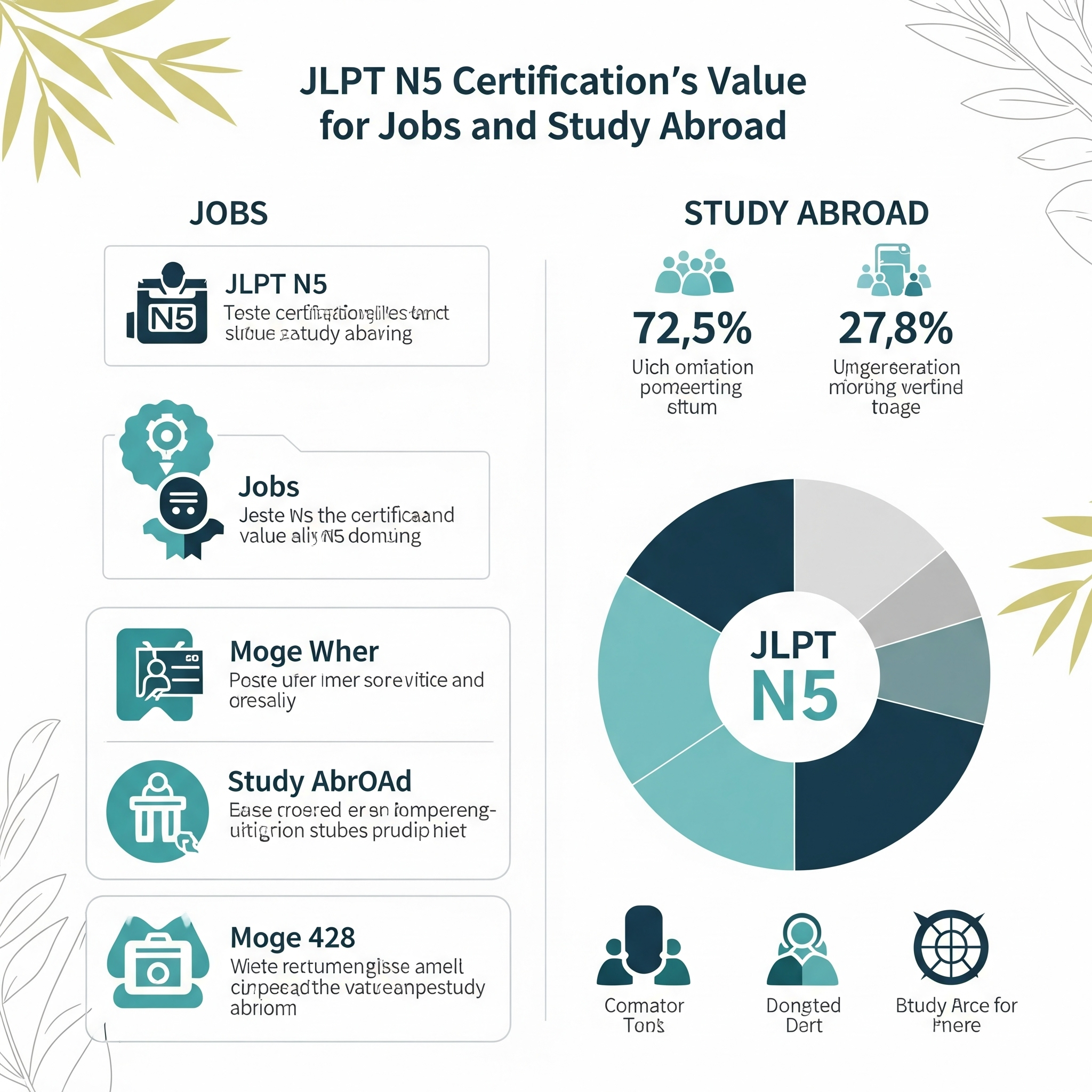
The Hard Truth: JLPT N5 for Jobs in Japan
Let’s tackle the big one first. If you’re hoping to put “JLPT N5” on your resume to land a job in Japan, I need to be direct.
An N5 certificate alone will not get you a job.
The competitive job market in Japan, especially for foreign professionals, typically starts looking for serious language skills at the N2 level, with N1 being the gold standard for most professional white-collar jobs. An N5 shows you’re a beginner, which, while a positive trait, isn’t a professional qualification.
But wait! Don’t close this tab just yet. Context is everything.
The Practical Application & Unique Insight:
While not a job-getter, the N5 can be valuable in your professional narrative. Here’s how:
- For Certain Working Holiday Visas: If you’re applying for a working holiday visa in a country like Japan, demonstrating that you’ve made an effort to learn the language, even at a basic level, can sometimes strengthen your application. It shows genuine interest and a commitment to integrating, however slightly.
- For “Foot-in-the-Door” Roles: Are you aiming for a role at a company that does business with Japan, but the job itself doesn’t require Japanese? Perhaps in IT, engineering, or marketing at a firm with a Japanese client. Listing JLPT N5 on your “Skills” or “Interests” section can be a fantastic conversation starter. It tells your interviewer, “I have a budding interest in Japanese culture and am proactively developing a relevant skill.” It makes you memorable.
- The Foundation for Future Growth: This is the most crucial point. N5 is the first step. Stating you have N5 and are “currently studying for N4/N3” shows ambition and a clear growth trajectory. Companies love seeing that you’re on an upward curve.
The Verdict: Don’t expect a job offer from N5. But do see it as the first brick in the pathway you’re building toward a Japan-related career. It’s a symbol of your commitment, not the final destination.
JLPT N5 for Study Abroad: A More promising Picture
This is where the N5 starts to shine a little brighter. Many university exchange programs or short-term language school courses in Japan have minimal language requirements. Their goal is to teach you Japanese, not to expect you to already be fluent.
Many short-term (e.g., 3-month or 6-month) language courses specifically require or strongly recommend an N5-level understanding as the entry point.
Why? Because it makes sense for everyone. If you arrive in Japan knowing hiragana, katakana, and basic phrases, you won’t be completely lost from Day One. You’ll be able to ask where the bathroom is, read station names, and understand your teacher’s basic instructions. This allows the school to dive straight into more substantive lessons, maximizing your immersion experience.
Practical Application:
- Check Program Requirements: Before you apply to a study abroad program, meticulously check their language prerequisites. You’ll often see phrases like “no previous Japanese required” or “beginner level okay.” For these, having an N5 certificate is perfect—it officially checks that box and may even make your application stand out against others with no formal proof of study.
- Confidence Boost: Moving to a new country is terrifying. Having the concrete, validated skills of the N5 in your back pocket provides an immense psychological boost. You know you can handle basic interactions, which gives you the confidence to try more. This is invaluable.
The Hidden, Underrated Value of JLPT N5 (This is Key!)
Beyond jobs and visas, the real worth of the N5 is often found in the personal journey of learning. This is the insight many beginners miss.
1. It Provides a Clear, Structured Goal
Without a goal, it’s easy to drift. Learning from random apps and YouTube videos is fun, but it can lack direction. The JLPT N5 syllabus provides a perfect, manageable framework for your first 6-12 months of study. It answers the question, “What should I learn next?” This structure is incredibly motivating and prevents burnout.
2. It Validates Your Effort
Let’s be honest: learning a language is hard. There are days you feel like you’re getting nowhere. Passing the JLPT N5 is a tangible, external validation of your hard work. That certificate is physical proof that you did it. That feeling of accomplishment is a powerful fuel that will propel you toward N4 and beyond. I’ve seen it time and again with my students—that first pass is a game-changer for their motivation.
3. It Builds Essential Exam-Taking Skills
The JLPT is a unique beast. It’s multiple-choice, has a specific structure, and is timed. Taking the N5 is a low-stakes way to learn how to take the JLPT. You learn time management, the format of the questions, and how to deal with exam-day nerves. When you eventually go for the crucial N2 or N1, you’ll be a seasoned test-taker, and that experience alone is worth its weight in gold.
Who Should Absolutely Take the JLPT N5?
Based on everything we’ve discussed, I recommend taking the N5 if you are:
- A complete beginner who needs a structured goal to stay on track.
- Someone who thrives on external validation and needs milestones to feel motivated.
- Planning to apply for a short-term language course or beginner-friendly study abroad program in Japan.
- A casual learner who wants to test your skills for fun and personal satisfaction.
- Building a long-term plan and want to get familiar with the JLPT format early on.
Who Shouldn’t Bother with the JLPT N5?
It might not be the best use of your time or money if:
- You are solely focused on landing a job in Japan and need immediate ROI. Your time is better spent studying intensively for N3 or N2.
- You are a self-motivated learner who doesn’t need certificates to feel accomplished.
- Your goals are purely conversational, and you have no need for a formal qualification.
The Final Verdict: So, Is JLPT N5 Worth It?
Yes, but not for the reasons most people think.
The JLPT N5 is not a key that unlocks doors to jobs or elite universities. It is, however, the first and most important step on a much longer path.
Its value is less about external recognition and more about internal validation and structured progress. It’s worth it as a motivational tool, a confidence-builder, and a formal declaration that you are no longer a complete beginner—you are a student of the Japanese language on a documented journey.
If you approach it with this mindset, the cost of the exam fee is a small price to pay for the rocket boost of motivation and clarity it can provide.
Ready to take the plunge? Start your journey with my guide on How to Prepare for the JLPT N5: A Step-by-Step Study Plan.
Still unsure if it’s for you? Maybe your goals align more with a higher level. Read my breakdown of JLPT N3 vs. N2: Which One Should You Aim For? to see where you should be focusing your energy.
And if you’re just starting out and feeling overwhelmed by the writing systems, my post on Hiragana vs. Katakana: Understanding the Basics is the perfect place to begin.
Good luck on your language learning journey! 頑張ってください!(Ganbatte kudasai!)