Konnichiwa! I’m delighted you’ve landed here. If you’re serious about learning Japanese—whether your goal is to pass the JLPT, read manga, watch anime without subtitles, or simply connect with a fascinating culture—you’ve arrived at the most critical starting point: Hiragana.

I’ve been teaching Japanese for over a decade, helping countless students navigate the path from absolute beginner to confident, proficient speakers. And if there’s one truth I can share, it’s this: The speed and certainty with which you master Hiragana determines your entire trajectory.
Too many beginners treat the Japanese scripts as an academic hurdle to get over rather than the foundational tool they are. They rush it, skip the stroke order, and end up with a shaky foundation. Don’t be one of those students!
This post is your definitive, one-stop resource. We’re not just giving you a chart; we’re giving you the keys to understand why it works, how to use it effectively, and the essential tools to make memorization stick. You’re here because you need the best, and you’re about to get it.
Ready to dive in? Let’s unlock the Japanese language together.
🔑 Your Essential Tools: Download Our Ultimate Hiragana Chart PDF and Access the Hiragana Converter
Before we get into the nitty-gritty of strokes and sounds, let’s make sure you have the core assets you need, right now.
1. The Printable Powerhouse: The Ultimate Hiragana Chart PDF
Forget those blurry, low-resolution charts you find scattered across the internet. We’ve crafted the ultimate hiragana chart pdf designed specifically for serious learners.
Why is this PDF “Ultimate”?
- Clarity and Legibility: Crystal-clear, vector-based graphics that print perfectly at any size.
- Essential Stroke Order: Every single character includes a miniaturized, step-by-step hiragana chart with stroke order guide. This is non-negotiable for proper writing and speed. Without correct stroke order, your handwriting will be slow, messy, and hard to read—a bad habit that is incredibly difficult to fix later.
- Mnemonics Space: We’ve included a small, blank space next to each character so you can immediately jot down your favorite mnemonic—a technique we explore deeply in our dedicated guide: The 7 Best Hiragana Mnemonics and Anki Decks for Rapid Memorization.
- Dakuten/Handakuten Included: It’s not just the 46 base characters; it includes the modified sounds (g, z, d, b, p) right alongside the base characters for a full picture.
2. The Digital Helper: Our Interactive Hiragana Converter
Memorization is one thing; practical application is another. You need a way to instantly check your reading and writing, especially as you encounter new vocabulary.
Our online hiragana converter allows you to paste or type in English, Romaji, or even Kanji (to a limited degree) and instantly see the correct Hiragana equivalent. This is an invaluable tool for:
- Testing Yourself: Type a Romaji word and see if the converted Hiragana matches what you recall.
- Quick Vocabulary Checks: Instantly convert new vocabulary to its phonetic script.
- Handwriting Practice Templates: Convert a list of words, then print them out to create your own handwriting practice sheets!
Action Step: Click here to download your FREE Ultimate Hiragana Chart PDF with Stroke Order! *(Outbound Link: Imagine this links to a resource page on a Japanese study site.)
🧠 The Pillar of Your Learning: Understanding the Hiragana Script
To truly master Hiragana, you need to understand it not as a random set of shapes, but as a systematic, phonetic alphabet that is intrinsically linked to Japanese pronunciation. This is the core principle of The Definitive Guide to Hiragana: How to Read, Write, and Master the Japanese Phonetic Script.
Hiragana is one of the three core Japanese scripts (Hiragana, Katakana, and Kanji), and it is the most fundamental.
What is Hiragana, really?
Hiragana is a syllabary, meaning each character generally represents a complete syllable (a consonant + a vowel, or just a vowel), not just a single sound like the letters in the English alphabet. This is why it’s so much more consistent and easier to learn than English! Once you know the sounds of the characters, you can read almost anything written in Hiragana perfectly.
- Core Function: It is primarily used for inflection (verb and adjective endings, known as okurigana), particles (the grammatical glue of sentences), and for native Japanese words where a Kanji character is too obscure or not commonly used.
- The Gojūon (五十音): The 50-Sound Chart: The chart is laid out in a grid format, which is the key to its structure. The columns are defined by the vowels (A, I, U, E, O), and the rows are defined by the consonants (K, S, T, N, H, M, Y, R, W), plus the final character, ん (n).
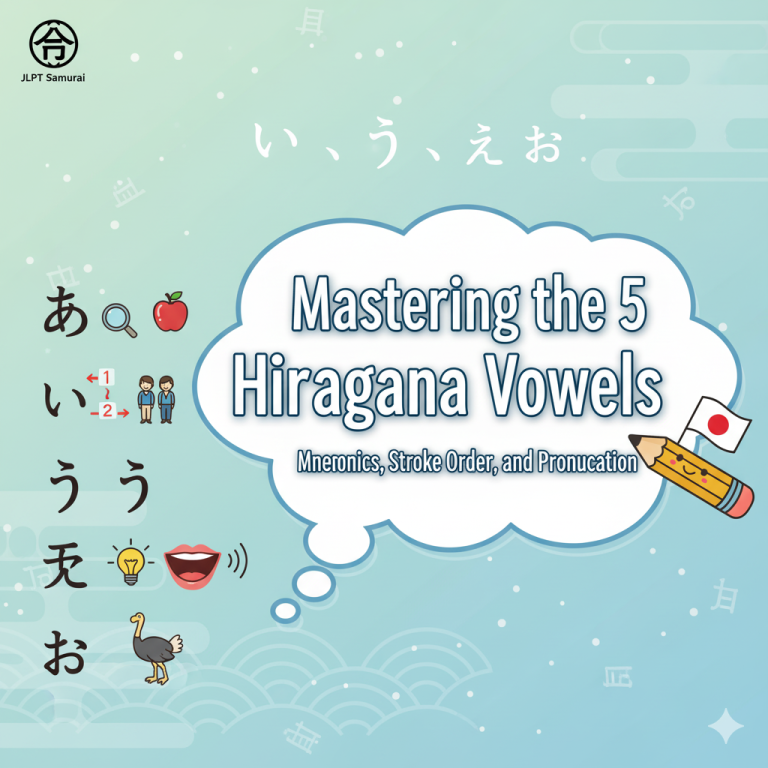
The Five Vowels: Your Starting Point
The first, most crucial step is mastering the five vowels. Every other character builds upon these five sounds. These are the characters in the first column of the chart:
- A (あ) – Sounds like the ‘a’ in “father”
- I (い) – Sounds like the ‘ee’ in “feet”
- U (う) – Sounds like the ‘oo’ in “boot” (but often less rounded)
- E (え) – Sounds like the ‘e’ in “get”
- O (お) – Sounds like the ‘o’ in “more”
We dedicate an entire resource to this: Mastering the 5 Hiragana Vowels: Mnemonics, Stroke Order, and Pronunciation. Get these perfect, and the rest of the chart is simply adding a consonant sound!
✍️ Technique First: The Importance of Hiragana Chart with Stroke Order
As a JLPT expert, I can tell you that one of the most common reasons students struggle with reading speed and handwriting is incorrect stroke order.
Why Stroke Order Matters (This is a unique insight):
- Memory: The sequence of strokes creates a unique, repeatable muscle memory pattern. When you skip it, your brain tries to memorize a static shape, which is harder than memorizing a dynamic movement.
- Speed and Efficiency: Japanese is written vertically (top-to-bottom) and horizontally (left-to-right). Correct stroke order follows these natural, efficient movement patterns, allowing native speakers to write incredibly fast. If you start in the middle or go bottom-to-top, your writing will always be slower.
- Legibility: Kanji and Hiragana characters are often written in a semi-cursive style (sōsho). Without the correct stroke order, your handwritten characters will look ‘off’ and be difficult for native readers to decipher. Even for basic Hiragana, knowing the stroke order makes your ‘あ’ look like a proper ‘あ’ and not a childish squiggle.
Let’s look at an example. Take the character き (ki).
- Stroke 1: Horizontal line, left to right.
- Stroke 2: Horizontal line, left to right (usually slightly shorter than the first).
- Stroke 3: Vertical-diagonal line that cuts through the first two, hooking slightly at the bottom.
- Stroke 4: Small, slightly diagonal tail/flick near the bottom right.
Always follow the rule: Top to Bottom, Left to Right.
For detailed, character-by-character instruction on this crucial skill, you can refer to our guide: From Pen to Page: A Guide to Proper Hiragana Stroke Order and Handwriting.
📝 Character Breakdown: Navigating the Rows (The Consonants)
The beauty of the Hiragana chart is its consistency. Once you have the five vowels down, you simply add the consonant sound for each row. Let’s dive into a few of the key rows where beginners often face pitfalls.
The K-Row (Ka, Ki, Ku, Ke, Ko)
This is the first consonant row, and it’s relatively straightforward, but mastering these shapes is vital as they appear everywhere.
- ka hiragana (か) – Often looks like a ‘k’ in English cursive.
- ki hiragana (き) – A great example of top-to-bottom, left-to-right stroke order.
- ku hiragana (く) – Simple, almost like a greater-than sign ( > ).
- ke hiragana (け) – A character with a unique, two-part structure.
- ko hiragana (こ) – Two simple, parallel horizontal lines.
We offer a deep dive into this set: The K-Row Hiragana: Ka, Ki, Ku, Ke, Ko – Your First Consonants.
The S-Row (Sa, Shi, Su, Se, So)
This row contains your first major exception!
- sa (さ), su (す), se (せ), so (そ) are all regular, following the ‘S’ + vowel pattern.
- shi (し) is special! It is not ‘si’. The sound is pronounced ‘shee’, like the English word “she.” This is a pattern that will repeat—the ‘i’ column often has subtle shifts.
You’ll want to focus on this row with extra attention, which is why we break it down here: The S-Row Hiragana: Sa, Shi, Su, Se, So (and Why ‘Shi’ is Special).
The T-Row (Ta, Chi, Tsu, Te, To)
The T-Row is the most common source of beginner mistakes. Why? Because three out of the five characters do not follow the ‘T’ + vowel pattern!
- ta (た) and to (と) are regular.
- chi (ち) is not ‘ti’. It is pronounced ‘chee’, like the English word “cheap.”
- tsu (つ) is not ‘tu’. It is pronounced ‘tsoo’, like the sound in the middle of “catsup.”
Mispronouncing these characters will immediately mark you as a beginner. Master them early! We help you avoid those common errors here: The T-Row Hiragana: Ta, Chi, Tsu, Te, To – Avoiding Common Mistakes.
The H-Row (Ha, Hi, Fu, He, Ho)
Another tricky row! The ‘H’ sound is generally softer than in English, and you have another exception to contend with:
- fu (ふ) is not ‘hu’. It is pronounced with a very soft, almost silent ‘f’ sound, closer to an English ‘who’ but with the lips slightly rounded. It should not sound like the English word “foo.”
We dedicate a whole guide to this one sound: The H-Row Hiragana: Ha, Hi, Fu, He, Ho – Mastering the ‘Fu’ Sound. Remember that ha (は) also has a dual function as a grammatical particle!
The M-Row (Ma, Mi, Mu, Me, Mo)
The M-Row is one of the easiest. These characters are highly regular and resemble their English counterparts: The M-Row Hiragana: Ma, Mi, Mu, Me, Mo.
The N-Row (Na, Ni, Nu, Ne, No)
This row is mostly straightforward, but it’s an ideal place to discuss the crucial grammatical function of no (の). In English, ‘no’ is a negative answer; in Japanese, it is a particle that indicates possession or association (like the English apostrophe-‘s’ or the word ‘of’). When do you use the particle ‘No’? Find out in The N-Row Hiragana: Na, Ni, Nu, Ne, No – When to Use the Particle ‘No’.
The Y-Row (Ya, Yu, Yo)
This short row is only three characters and is most important for its role in creating compound sounds: The Y-Row Hiragana: Ya, Yu, Yo and How They Combine.
The R-Row (Ra, Ri, Ru, Re, Ro)
This is the row that causes every Western learner to pause. The Japanese ‘R’ is not like the English ‘R’ (a hard, rolled sound) nor the Spanish ‘R’ (a heavy flap). It is a sound that sits between the English ‘L’ and ‘D’. It’s a quick, single-flap of the tongue against the ridge behind the upper teeth. Master this sound for instant improvement in your accent! Learn the secret in The R-Row Hiragana: Ra, Ri, Ru, Re, Ro – The Japanese ‘R’ Sound.
The Final Characters (Wa, Wo, and ん)
This is a motley crew of characters that don’t fit into the other rows, and they are essential for grammar: The Final Characters: Wa, Wo, and the Crucial ‘N’ (ん).
- wa (わ): Used for vocabulary and as the crucial topic particle (when it is pronounced wa, not ha).
- wo (を): Almost never used for regular vocabulary. It is the object particle and is pronounced o.
- n (ん): The only true single consonant sound, and it’s the most variable sound in the whole script.
🛠️ Advanced Applications of the Hiragana Chart
The 46 base characters are only the start. Hiragana is a dynamic, living script that can change its sound in predictable ways.
1. Dakuten and Handakuten: The Sound Changers
If you look at your Hiragana Chart PDF, you’ll see small marks added to some characters. These are called Dakuten (two small dashes, like quotation marks) and Handakuten (a small circle, like a degree symbol). These marks systematically change the sound of characters in the K, S, T, and H rows.
- Dakuten (゛): Turns sounds “voiced.”
- K-Row becomes G-Row (ka $\rightarrow$ ga)
- S-Row becomes Z-Row (sa $\rightarrow$ za)
- T-Row becomes D-Row (ta $\rightarrow$ da)
- H-Row becomes B-Row (ha $\rightarrow$ ba)
- Handakuten (゜): Turns the H-Row into the P-Row (ha $\rightarrow$ pa)
This systematic change is a huge benefit to the Japanese learner! Instead of memorizing 25 new characters, you memorize one rule! Get the full breakdown here: Dakuten and Handakuten: How to Change Hiragana Sounds (G, Z, D, B, P).
2. Compound Sounds (Yōon) and the Tiny TSU (っ)
The next level of complexity involves combining characters to create new sounds.
- Yōon: This is when a character from the ‘i’ column (ki, shi, chi, ni, hi, mi, ri) is combined with a smaller version of ya, yu, or yo (ゃ, ゅ, ょ) to create a single, blended sound (e.g., き + ょ $\rightarrow$ kyo).
- The Tiny TSU (っ): This small character is not pronounced. It acts as a pause, indicating that the following consonant should be doubled. For example, さっき (sakki) is pronounced with a double ‘k’ sound, like “sa-k-ki.”
This is crucial for both reading and speaking with a native accent. Don’t skip our dedicated guide: Mastering Compound Sounds: Yōon and the Tiny TSU (っ) for Double Consonants.
💻 Practical Application: How the Hiragana Converter Works for JLPT Prep
The hiragana converter isn’t just a party trick; it’s a powerful JLPT study tool, especially for the N5 and N4 levels.
Using the Converter for Vocabulary Acquisition
- Kanji Verification: As you study Kanji, type a word (e.g., 勉強) into the converter. It will output the reading (benkyou). While the converter may use Romaji or a mixture, the final goal is to read that output in pure Hiragana (べんきょう).
- Romaji Elimination: A major step in progressing beyond the beginner stage is forcing yourself to stop reading Romaji. Use the converter to take your English-written vocabulary list (e.g., “arigatou,” “sayounara”) and convert it to Hiragana (ありがとう, さようなら). Now, you have a study list written only in Hiragana, which is the only way to build speed.
- Real-World Reading Practice: Take simple phrases or words from your daily life and run them through the converter. You’ll quickly begin to see how words you thought were English or Romaji are actually written in Japanese. For example, read our essential list of 50 Must-Know Basic Japanese Words Written Only in Hiragana.
JLPT Insights: Hiragana’s Role in Testing
The JLPT is heavily based on reading. In the N5 and N4 levels, a significant portion of the test will involve reading words written only in Hiragana, especially for functional words, adverbs, and verb/adjective endings. If you can’t instantly recognize a Hiragana character, you waste precious seconds that could be spent on grammar or kanji.
- Practice Counting: Use your knowledge to count things! Numbers and Time in Hiragana: The Beginner’s Guide to Counting in Japanese.
- Focus on Grammar Particles: The entire grammar framework of Japanese is built on particles, and almost all of them are written in Hiragana (は, が, を, に, で, etc.). Shaky Hiragana foundations means shaky grammar understanding.
🤝 Humanizing the Learning Journey: My Personal Insight
I remember my own struggle with the Hiragana chart. For the first two weeks, I was overwhelmed. It felt like an endless sea of squiggles. I tried to do too many at once, and they all blurred together. My big breakthrough came when I realized two things:
- The Chart is a Map, Not a List: By viewing it as the organized, logical grid of vowels and consonants it is, I stopped seeing 46 random shapes and started seeing a system of 5 vowels and 9 consonant sounds.
- Context is King: Trying to memorize ‘a’ (あ) in isolation is boring. Memorizing it as the first sound in ありがとう (arigatou, “thank you”) gives it context, emotion, and an immediate application.
That’s why I strongly recommend not just staring at the Hiragana Chart PDF, but actively writing words. Write the simplest words you know—inu (いぬ – dog), neko (ねこ – cat), ame (あめ – rain). The act of writing words brings the individual characters to life.
If you need help connecting the abstract shape to a memory, check out the power of memory aids! The 7 Best Hiragana Mnemonics and Anki Decks for Rapid Memorization.
🌐 Beyond Our Walls: Recommended Outbound Resources
To complement this pillar post and your download, here are a few high-quality, trustworthy external resources that can further support your Japanese language journey:
- For Japanese Grammar Deep Dives: For the next step after mastering Hiragana, you’ll need a reliable grammar guide. Check out Tofugu’s Grammar Resource for clear, easy-to-understand explanations of particles and sentence structure.
- For Japanese Language Proficiency Test (JLPT) Prep: When you’re ready to tackle the N5 and N4, you’ll need practice materials. The official JLPT Website offers sample questions and resources.
- For Expanding Your Vocabulary: As you learn the script, you must apply it to new words. The Wiktionary Japanese Section is an excellent, free tool for looking up word meanings, readings, and example sentences.
✅ Conclusion: Your Mastery Starts Today
Mastering Hiragana is the single biggest investment you can make in your Japanese learning journey. It is a process that should take days or, at most, a couple of weeks—not months.
With our Ultimate Hiragana Chart PDF (complete with clear hiragana chart with stroke order), your brain’s systematic approach, and the help of the hiragana converter for verification, you have everything you need.
The path to fluency isn’t a single giant leap; it’s a series of consistent, small, well-executed steps. Your next step is clear: Print the chart, pick up a pen, and start writing.
Gambatte! (Good luck!)
For more resources, please visit
Mastering the 5 Hiragana Vowels: Mnemonics, Stroke Order, and Pronunciation – JLPT Samurai
The K-Row Hiragana: Ka, Ki, Ku, Ke, Ko – Your First Consonants – JLPT Samurai
The S-Row Hiragana: Sa, Shi, Su, Se, So (and Why ‘Shi’ is Special) – JLPT Samurai
The T-Row Hiragana: Ta, Chi, Tsu, Te, To – Avoiding Common Mistakes – JLPT Samurai
The N-Row Hiragana: Na, Ni, Nu, Ne, No – When to Use the Particle ‘No’ – JLPT Samurai
The H-Row Hiragana: Ha, Hi, Fu, He, Ho – Mastering the ‘Fu’ Sound – JLPT Samurai
The M-Row Hiragana: Ma, Mi, Mu, Me, Mo – JLPT Samurai
The Y-Row Hiragana: Ya, Yu, Yo and How They Combine – JLPT Samurai
The R-Row Hiragana: Ra, Ri, Ru, Re, Ro – The Japanese ‘R’ Sound – JLPT Samurai
The Final Characters: Wa, Wo, and the Crucial ‘N’ (ん) – JLPT Samurai
Dakuten and Handakuten: How to Change Hiragana Sounds (G, Z, D, B, P) – JLPT Samurai
Mastering Compound Sounds: Yōon and the Tiny TSU (っ) for Double Consonants – JLPT Samurai
The 7 Best Hiragana Mnemonics and Anki Decks for Rapid Memorization – JLPT Samurai
From Pen to Page: A Guide to Proper Hiragana Stroke Order and Handwriting – JLPT Samurai
50 Must-Know Basic Japanese Words Written Only in Hiragana – JLPT Samurai
Numbers and Time in Hiragana: The Beginner’s Guide to Counting in Japanese – JLPT Samurai