Hello, language adventurer! Welcome back to the heart of Japanese study. If you’ve already conquered the five fundamental vowels, congratulations! You’ve laid the cornerstone of your entire Japanese journey. You understand the very soul of the language’s sounds. (If you haven’t yet, make sure to check out Mastering the 5 Hiragana Vowels: Mnemonics, Stroke Order, and Pronunciation—it’s essential!)
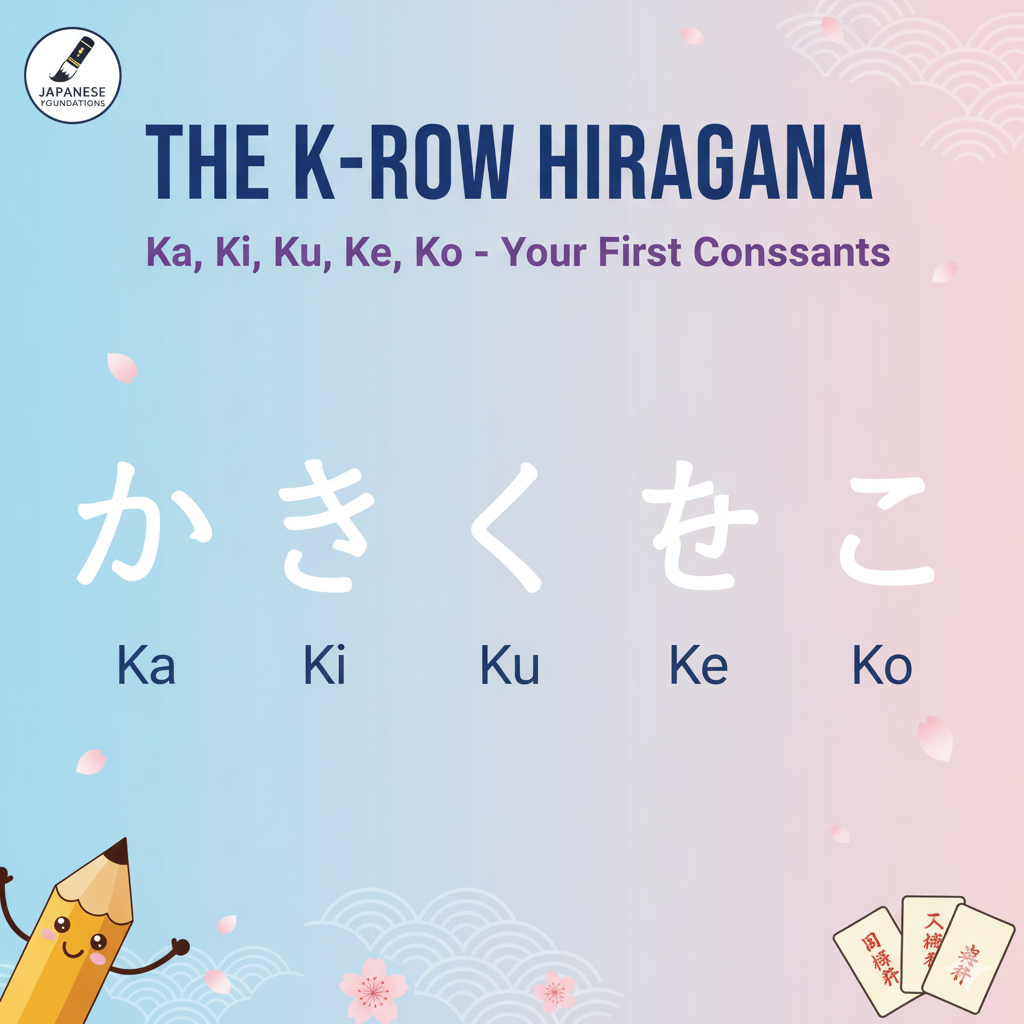
Today, we take the next, incredibly exciting step: introducing your first major consonant group, the K-Row. This row, consisting of ka hiragana ($\text{か}$), ki hiragana ($\text{き}$), ku hiragana ($\text{く}$), ke hiragana ($\text{け}$), and ko hiragana ($\text{こ}$), is a total game-changer. Why? Because you’re moving from simple vowels to the more complex, syllable-based structure that defines the Japanese phonetic script.
This pillar post is designed to be your comprehensive guide—a deep dive into the K-Row that goes beyond just memorization. We’ll explore the nuances of their pronunciation, break down the correct stroke order for elegant handwriting, and give you practical applications that will instantly boost your vocabulary. Everything you learn here feeds into the ultimate goal: mastering The Definitive Guide to Hiragana: How to Read, Write, and Master the Japanese Phonetic Script and beyond!
Let’s grab our pencils and dive into the satisfying sound of the ‘K’ in Japanese. Ready? Iza, ikō! (いざ、行こう! – Let’s go!)
💡 Why the K-Row is a Crucial Milestone
In the world of Hiragana, the K-Row is the first row where a consonant ($\text{k}$) consistently pairs with the five vowels ($\text{a, i, u, e, o}$). Mastering this group is the proof that you’ve understood the core syllabic structure of Japanese—the “consonant + vowel” pattern that makes up the majority of the language.
For my fellow JLPT aspirants, especially those aiming for the N5 level, these five characters are not just individual sounds; they are building blocks for hundreds of core vocabulary words. Getting them wrong, whether in pronunciation or writing, can be a major hurdle down the line. We’re here to make sure you start strong and confident.
The Structure of the K-Row
| Hiragana | Rōmaji | Pronunciation (IPA) | Closest English Sound |
| か | ka | $[\text{ka}]$ | ‘ca’ in car |
| き | ki | $[\text{ki}]$ | ‘key’ |
| く | ku | $[\text{ku}]$ | ‘coo’ in cook |
| け | ke | $[\text{ke}]$ | ‘ke’ in keg |
| こ | ko | $[\text{ko}]$ | ‘co’ in coin |
1. ka hiragana ($\text{か}$): The Foundation
The $\text{ka}$ sound is the anchor of the K-Row. It’s clean, crisp, and arguably one of the most common syllables you’ll encounter.
✍️ Stroke Order & Handwriting Insight
Stroke Order: 3 strokes.
- A horizontal line from left to right.
- A vertical line that crosses the first one, ending with a small hook.
- A short, slightly curved diagonal line to the right.
Humanizing the Handwriting: Notice that final, short stroke? It’s often written a bit separated from the main ‘cross’ shape. This separation is crucial. It’s a little like a small, elegant flourish, transforming the shape from a simple cross to the balanced character $\text{か}$. When you write it, imagine a playful little tail flicking out at the end. Getting your From Pen to Page: A Guide to Proper Hiragana Stroke Order and Handwriting right here sets a good precedent for the rest of your study!
👂 Pronunciation & Common Mistakes
The ka hiragana sound is simply a ‘k’ combined with the vowel ‘a’ (like ‘ah’ in ‘father’).
- Tip for English Speakers: Resist the urge to aspirate (add a puff of air) it too heavily, like the ‘c’ in the English word ‘cat’. In Japanese, it should be a bit softer and closer to the ‘k’ in ‘skip’.
📚 Practical Application: Vocabulary
| Japanese Word | Rōmaji | Meaning | JLPT N5 Relevance |
| かさ | kasa | Umbrella | High (Core word) |
| かお | kao | Face | High (Core word) |
| おかね | okane | Money | High (Essential) |
2. ki hiragana ($\text{き}$): The Key to Japanese
The ki hiragana ($\text{き}$) is a beautiful, angular character that holds the ‘k’ consonant with the ‘i’ vowel.
✍️ Stroke Order & Handwriting Insight
Stroke Order: 4 strokes.
- A top horizontal line, slightly angled up.
- A second horizontal line, parallel to the first.
- A vertical line that crosses the two horizontal lines and curves slightly at the bottom, finishing with a small loop or hook.
- A short, curved, diagonal line on the right side.
Humanizing the Handwriting: I love writing $\text{き}$. It looks a bit like a key (a handy mnemonic!) with a little knot tied at the bottom of the stem. In printed fonts, the vertical line (stroke 3) often doesn’t touch the two horizontal lines. However, in handwriting, it’s completely acceptable—and even common—for the vertical line to connect or even slightly cross the horizontal ones. Just make sure the final, separate stroke (4) is distinct and doesn’t look like an afterthought!
👂 Pronunciation & Common Mistakes
The sound is ki, identical to the English word “key.”
- Insight: Unlike the English ‘k’ sound which often requires a full stop of airflow, the Japanese ‘k’ in this context, like all Japanese syllables, is very quick and pure, flowing immediately into the ‘i’ vowel. Remember the pure vowel sound from the A-Row!
📚 Practical Application: Vocabulary
| Japanese Word | Rōmaji | Meaning | JLPT N5 Relevance |
| き | ki | Tree/Wood | High (Core word) |
| きのう | kinou | Yesterday | High (Essential) |
| きいろ | kiiro | Yellow | Medium |
3. ku hiragana ($\text{く}$): Simplicity Itself
If you’re looking for a break, the ku hiragana ($\text{く}$) is it. This is arguably the simplest character in the entire Hiragana chart!
✍️ Stroke Order & Handwriting Insight
Stroke Order: 1 stroke.
- A single, sweeping, angled stroke that starts high and to the left, and finishes low and to the right, looking like a wide-open mouth or a ‘beak’.
Humanizing the Handwriting: Imagine a cuckoo bird making its call, “Coo!” The $\text{く}$ shape looks like its open mouth. Because it’s one stroke, the flow is everything. It shouldn’t be two sharp, straight lines, but one continuous, slightly rounded movement. When you write it, focus on a smooth, elegant curve at the angle.
👂 Pronunciation & Common Mistakes
The sound is ku, like the ‘coo’ in ‘cuckoo’ or ‘cook’. It is paired with the Japanese ‘u’ vowel, which is often pronounced more like the ‘oo’ in ‘book’ than the ‘oo’ in ‘boot’.
- Crucial Insight (The Devoicing Phenomenon): This is one of the first places you’ll encounter devoicing. In many Japanese words, particularly at the end of a word or when it falls between two unvoiced consonants (like $\text{k, s, t, p, h}$), the ‘u’ sound in $\text{く}$ is often barely pronounced—it’s whispered or dropped entirely.
- Example: $\text{す**く**ない}$ (sukunai, meaning ‘few’). Native speakers will often pronounce this closer to s’knai or skunai, not su-ku-nai.
- This is a crucial insight that will make your Japanese sound instantly more natural!
📚 Practical Application: Vocabulary
| Japanese Word | Rōmaji | Meaning | JLPT N5 Relevance |
| くる | kuru | To come | High (Core verb) |
| くち | kuchi | Mouth | Medium |
| くるま | kuruma | Car | High (Core word) |
4. ke hiragana ($\text{け}$): The Sword Hilt
The ke hiragana ($\text{け}$) brings a little complexity back, but it’s another character with a simple, strong shape.
✍️ Stroke Order & Handwriting Insight
Stroke Order: 3 strokes.
- A horizontal line from left to right.
- A long vertical line that crosses the first line, then drops straight down, finishing with a small, sharp hook to the left.
- A final, slightly curved, diagonal line to the right of the main vertical stroke, starting from the level of the first horizontal line.
Humanizing the Handwriting: This character looks remarkably like a straight-line drawing of a keg, or, more elegantly, the hilt and guard of a Japanese sword (katana). Ensure your vertical line (stroke 2) is a single, clean motion that comes down straight before hooking. The right-side stroke (3) should be parallel and slightly shorter than the main vertical line, providing balance.
👂 Pronunciation & Common Mistakes
The sound is ke, which is a combination of ‘k’ and the vowel ‘e’ (like the ‘e’ in ‘get’ or ‘keg’).
- Tip: This is a pure ‘e’ sound, unlike the English ‘e’ in ‘eat’ which is an ‘ee’ sound. Be careful to keep the sound short and clipped, connecting the ‘k’ and ‘e’ in a single, smooth syllable.
📚 Practical Application: Vocabulary
| Japanese Word | Rōmaji | Meaning | JLPT N5 Relevance |
| けす | kesu | To erase/turn off | High (Core verb) |
| いけ | ike | Pond | Medium |
| けいさつ | keisatsu | Police | Medium |
5. ko hiragana ($\text{こ}$): Twin Fish
The final character in the row, ko hiragana ($\text{こ}$), is another two-stroke wonder that often trips up beginners because of its similarity to other kana like $\text{さ}$ (sa) or $\text{そ}$ (so).
✍️ Stroke Order & Handwriting Insight
Stroke Order: 2 strokes.
- A slightly curved horizontal line from left to right.
- A second, parallel line below the first one. It starts a little to the left of the top line’s start and finishes with a small hook that extends slightly past the end of the top line.
Humanizing the Handwriting: Imagine two little fish swimming—one above the other. The two lines should be close but never touch or cross. The key is that the bottom line should be slightly longer and have that distinctive hook at the end, giving the character a sense of grounding and direction.
👂 Pronunciation & Common Mistakes
The sound is ko, which is the consonant ‘k’ and the vowel ‘o’ (like the ‘o’ in ‘go’ or ‘koala’).
- Tip: The Japanese ‘o’ is a pure, single sound, unlike the English ‘o’ in ‘go’ which is actually a diphthong (a blend of two vowel sounds, ‘oh-oo’). Keep your lips rounded and the sound pure for a truly authentic ko.
📚 Practical Application: Vocabulary
| Japanese Word | Rōmaji | Meaning | JLPT N5 Relevance |
| こども | kodomo | Child/Children | High (Core word) |
| こと | koto | Thing (abstract concept) | High (Grammar/Word) |
| あこがれ | akogare | Longing/Admiration | JLPT N4 (Good word) |
🔑 Unique Insight: The Voiced K-Row (Dakuten)
As a Japanese language and JLPT expert, I can tell you that the true mastery of the K-Row doesn’t end with $\text{か, き, く, け, こ}$. It’s just the beginning!
Japanese has a brilliant, simple mechanism to generate new sounds from existing ones: the dakuten (濁点, literally “voiced mark”), which looks like two tiny vertical dashes ($\text{“}$) in the upper right corner of the character.
When you add a dakuten to the K-Row, you transform the ‘k’ sound into a ‘g’ sound, creating the G-Row: $\text{が, ぎ, ぐ, げ, ご}$.
- か (ka) becomes が (ga)
- き (ki) becomes ぎ (gi)
- く (ku) becomes ぐ (gu)
- け (ke) becomes げ (ge)
- こ (ko) becomes ご (go)
This is a concept so important that we dedicate a whole cluster post to it: Dakuten and Handakuten: How to Change Hiragana Sounds (G, Z, D, B, P).
🧠 An Advanced Pronunciation Trick
While $\text{が}$ is usually pronounced like the ‘ga’ in “gate,” a fascinating and often-missed feature of Japanese phonology is the nasalization of $\text{が}$ (and $\text{ぎ, ぐ, げ, ご}$) when it appears in the middle of a word.
Sometimes, the ‘g’ sound in the middle of a word, like in $\text{か**が**み}$ (kagami, meaning ‘mirror’), is pronounced more like the ‘ng’ in ‘sing’ (an unvoiced nasal stop $[\text{ŋ}]$) rather than a hard ‘g’. So, $\text{か**が**み}$ can sound closer to ka-ng-a-mi. This is a small but powerful detail that makes a massive difference in your listening comprehension and natural flow.
🌟 Practical Application & Study Methods
Learning the K-Row is simple, but truly mastering it requires consistent practice. Here are a few tried-and-true methods I recommend to my JLPT students:
1. Mnemonics (Memory Aids)
Mnemonics are my favorite tool to help characters stick in your brain.
- $\text{か}$ (ka): Looks like a kite with a ka-ite tail.
- $\text{き}$ (ki): Looks like a key you are turning, or the two crossing strokes form a key.
- $\text{く}$ (ku): Looks like a hungry cuckoo bird’s open cup of a beak saying “Koo!”
- $\text{け}$ (ke): Looks like a keg stand, or the hilt and guard of a katana.
- $\text{こ}$ (ko): Two little co-joined fish, or ko-rners of a square that hasn’t been closed.
If you’re a mnemonic enthusiast, dive deeper with The 7 Best Hiragana Mnemonics and Anki Decks for Rapid Memorization.
2. Immediate Word Practice
Don’t just practice the isolated character! As soon as you learn the five K-Row characters, start combining them with the Vowel-Row characters you already know:
- $\text{か}$ + $\text{い}$ = $\text{かい}$ (kai, shell/ocean)
- $\text{こ}$ + $\text{え}$ = $\text{こえ}$ (koe, voice)
- $\text{あ}$ + $\text{か}$ + $\text{い}$ = $\text{あかい}$ (akai, red)
This combination practice is the bridge from character recognition to true reading fluency. You can find more of these basic words in 50 Must-Know Basic Japanese Words Written Only in Hiragana.
3. Sentence Structure & Particles
The K-Row introduces you to essential vocabulary that often acts as the subject or object of a sentence. This naturally leads you to the next major rows, like the The S-Row Hiragana: Sa, Shi, Su, Se, So (and Why ‘Shi’ is Special) and the The T-Row Hiragana: Ta, Chi, Tsu, Te, To – Avoiding Common Mistakes.
Consider the particle $\text{を}$ (o), which marks a direct object:
- $\text{お**か**ね}$ (okane) $\text{を}$ $\text{かえす}$ (kaesu). $\to$ “I return the money.”
This is how individual characters start to form meaningful, functional Japanese sentences.
🌎 Outbound Resources for the Japanese Learner
No single blog post can contain all the wisdom of a language. As a dedicated student, you should always be seeking out high-quality external resources to supplement your learning. Here are a few links I find invaluable for beginners, especially those working towards the JLPT:
- For an in-depth, structured approach to Japanese grammar, including how these kana connect into sentence patterns, I highly recommend checking out Tae Kim’s Guide to Learning Japanese—a fantastic, free online resource that breaks down complex concepts logically.
- The best way to solidify your pronunciation is to hear native speakers. For authentic listening practice and to check the correct pitch accent (which is crucial!), a resource like The Japanese Online Accent Dictionary (OJAD) is an indispensable tool.
- As you move beyond Hiragana, you’ll be aiming for the JLPT N5 and N4. To get a feel for the exam structure and to find official study materials, the Official JLPT Website is the definitive source for all test-related information.
What’s Next in Your Hiragana Journey?
You’ve successfully navigated the K-Row, moving from vowels to consonants, and even glimpsed the future of the script with the dakuten!
Your next steps will involve tackling the other major consonant rows:
- The tricky The S-Row Hiragana: Sa, Shi, Su, Se, So (and Why ‘Shi’ is Special), where a special exception character breaks the pattern.
- The essential The T-Row Hiragana: Ta, Chi, Tsu, Te, To – Avoiding Common Mistakes, which contains the notorious $\text{ち}$ and $\text{つ}$.
- The foundational The N-Row Hiragana: Na, Ni, Nu, Ne, No – When to Use the Particle ‘No’, which introduces one of the most important grammatical particles.
- The fascinating The H-Row Hiragana: Ha, Hi, Fu, He, Ho – Mastering the ‘Fu’ Sound, which introduces another unique sound ($\text{ふ}$).
- The simpler The M-Row Hiragana: Ma, Mi, Mu, Me, Mo.
- The compact The Y-Row Hiragana: Ya, Yu, Yo and How They Combine, which is your introduction to compound sounds, a topic later expanded upon in Mastering Compound Sounds: Yōon and the Tiny TSU (っ) for Double Consonants.
- The essential The R-Row Hiragana: Ra, Ri, Ru, Re, Ro – The Japanese ‘R’ Sound.
- Finally, the completion of the chart with The Final Characters: Wa, Wo, and the Crucial ‘N’ (ん).
You can also accelerate your memorization using resources like the Download the Ultimate Hiragana Chart PDF (Printable & Interactive Converter).
Keep practicing your ka hiragana, ki hiragana, ku hiragana, ke hiragana, and ko hiragana until you can write them flawlessly and read them at a glance. Consistency is the real secret to Japanese fluency!