When you first dive into the Japanese language, the sheer number of characters can feel like staring up at a mountain. But every expert climber started with a single step! You’ve successfully conquered the vowels, navigated the K-Row Hiragana: Ka, Ki, Ku, Ke, Ko – Your First Consonants, and even the tricky S-Row Hiragana: Sa, Shi, Su, Se, So (and Why ‘Shi’ is Special) and the T-Row Hiragana: Ta, Chi, Tsu, Te, To – Avoiding Common Mistakes. Now, we arrive at a truly pivotal part of the Hiragana chart: the ‘N’ row.
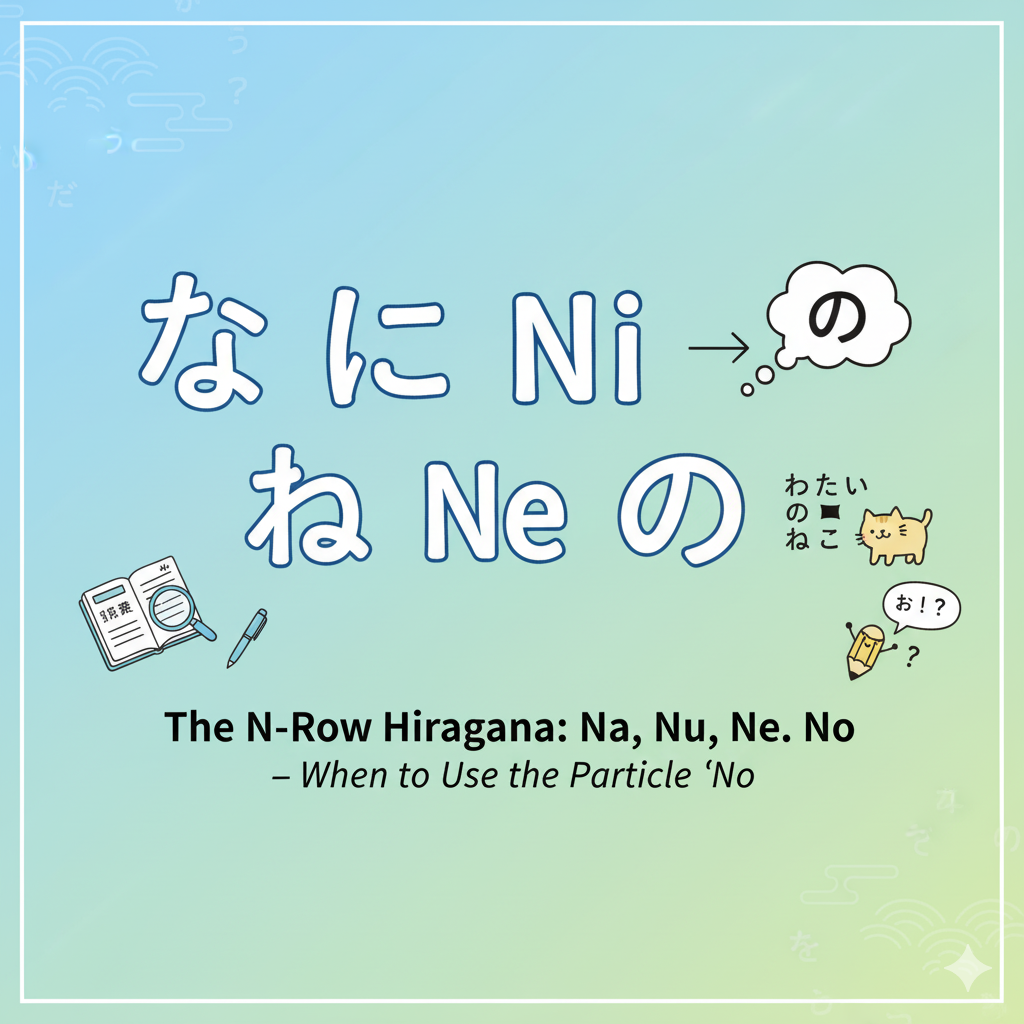
This is more than just five new characters. This row, particularly the final character, no hiragana (の), introduces us to one of the most fundamental and versatile grammatical particles in the entire language. Mastering na hiragana, ni hiragana, nu hiragana, ne hiragana, and no hiragana is not just about expanding your reading skill; it’s about unlocking the very structure of Japanese sentences.
As a JLPT expert, I can tell you that understanding the nuances of the particle ‘No’ (の) will propel you from simply memorizing vocabulary to actually constructing fluid, natural Japanese. It’s an N5 staple with N3-level complexity in its practical application. Ready to make these characters and this tiny particle your own? Let’s begin.
📝 The N-Row Hiragana Characters: な, に, ぬ, ね, の
The ‘N’ row, pronounced with the initial consonant sound /n/ followed by the five core Japanese vowels, is generally straightforward to pronounce for English speakers. However, the unique shapes and stroke orders are crucial for legibility and memory.
1. Na (な) – The Kind-Hearted Character
- Pronunciation: Pronounced like the ‘na’ in “nap.”
- Stroke Order Insight: な has four strokes. Think of it as a cross, followed by a little hook, and finally a large, looping curve. The third stroke (the tiny hook) is often the most forgotten. A good stroke order for legible Japanese handwriting is crucial, which you can explore further in From Pen to Page: A Guide to Proper Hiragana Stroke Order and Handwriting.
| Hiragana | Mnemonic Idea |
| な | A narwhal with a tusk (the vertical stroke) and a looping tail. |
2. Ni (に) – The Elegant Curve
- Pronunciation: Pronounced like the ‘ni’ in “nickel.”
- Stroke Order Insight: Two strokes. It looks like a capital ‘H’ that has been slightly tilted, but its proper structure is one vertical stroke, followed by the two horizontal/slanted lines drawn as one continuous stroke.
| Hiragana | Mnemonic Idea |
| に | Two nid-dles resting against a vertical line. |
3. Nu (ぬ) – The Looping Knot
- Pronunciation: Pronounced like the ‘nu’ in “nuisance” (without the ‘i’ sound).
- Stroke Order Insight: A complex, two-stroke character. The key is the final, elaborate loop that finishes the second stroke. This loop should pass through itself just slightly—it is one of the most decorative characters.
| Hiragana | Mnemonic Idea |
| ぬ | A nu-doodle with a curly tail (or an angler’s line with a knot). |
4. Ne (ね) – The Root of the Earth
- Pronunciation: Pronounced like the ‘ne’ in “nest.”
- Stroke Order Insight: A challenging two-stroke character, like ぬ. The first three parts are similar to ぬ‘s first stroke, but the final, dramatic stroke wraps around and finishes with a closed loop (unlike ぬ’s open, decorative tail).
| Hiragana | Mnemonic Idea |
| ね | A nest with a little egg inside its loop. |
5. No (の) – The Universal Connector
- Pronunciation: Pronounced like the English word “no.”
- Stroke Order Insight: This is the easiest character of the row, written in a single, beautiful stroke. It starts at the top, curves down and around, and then loops inward. The shape is instantly recognizable and very satisfying to write.
| Hiragana | Mnemonic Idea |
| の | A No-parking sign, or a loop of noodle. |
💡 Unique Insight: The Art of the Loop
Notice the difference between ぬ (nu) and ね (ne). Both have a similar start, but ぬ ends with a graceful, unattached tail, while ね finishes with a fully closed loop. This distinction is vital for proper handwriting and avoiding confusion. If you’re struggling, revisit The 7 Best Hiragana Mnemonics and Anki Decks for Rapid Memorization for more memory tricks.
🔑 Application: Putting the N-Row to Work
Now that you know the shapes, let’s see the na hiragana, ni hiragana, nu hiragana, ne hiragana, and no hiragana in action.
| Word (Romaji) | Meaning | Characters in Focus |
| なまえ (Namae) | Name | な (na) |
| にほん (Nihon) | Japan | に (ni) |
| いぬ (Inu) | Dog | ぬ (nu) |
| ねこ (Neko) | Cat | ね (ne) |
| おのこ (Onoko) | Boy | の (no) |
| な****に (Nani) | What | な (na), に (ni) |
These are essential words for beginners. For a deeper dive, check out 50 Must-Know Basic Japanese Words Written Only in Hiragana.
🧐 Deconstructing the Particle ‘No’ (の): The Universal Connector
While all five characters are important, no hiragana (の) is arguably the most grammatically significant of the N-row. It doesn’t just represent a sound; it’s a particle, a grammatical glue that connects elements in a sentence and gives them meaning.
In the JLPT N5 and N4 levels, の is one of the first particles you must master. It’s simple in form, but vast in function. Let’s break down its essential roles, from beginner basics to more advanced applications.
1. The Core Function: Possession and Association (JLPT N5)
This is the most common use of の. It functions much like the English possessive ‘s or the preposition ‘of’.
Structure: Noun 1 の Noun 2
In this structure, Noun 1 modifies or describes Noun 2. It means “Noun 2 of Noun 1” or “Noun 1’s Noun 2.” The crucial insight here is that the important thing is always the word after の.
| Example | Breakdown | Meaning |
| わたし の ほん | わたし (I/me) + の + ほん (book) | My book (The book of me) |
| とうきょう の だいがく | とうきょう (Tokyo) + の + だいがく (university) | A university in Tokyo |
| やまださん の くるま | やまださん (Mr./Ms. Yamada) + の + くるま (car) | Yamada-san’s car |
2. General Modification and Categorization (JLPT N4/N3)
Beyond simple possession, の turns Noun 1 into an attribute or descriptor for Noun 2. This is where the English translation of ‘of’ or simply connecting two nouns becomes more accurate.
- Materials: きん の ゆびわ (Kin no yubiwa) – A ring of gold (Gold ring).
- Topic/Subject: にほんご の せんせい (Nihongo no sensei) – A teacher of Japanese (Japanese teacher).
- Affiliation/Type: スポーツ の Tシャツ (Supōtsu no T-shatsu) – A T-shirt for sports (Sports T-shirt).
💡 Practical Application: The Adjectival Function
When you use の to link a category (like スポーツ-sports) to an object (Tシャツ-T-shirt), you are essentially making the first noun function like an adjective. This is incredibly common in Japanese and a huge step toward natural fluency.
3. ‘No’ as a Pronoun: Replacing a Noun (JLPT N5)
When the context is clear, の can stand in for a noun that has already been mentioned, acting like the English word “one” or “thing.” This avoids clunky repetition.
| Context | Japanese | Meaning |
| A: どのかばんですか。 | B: あかい の です。 | A: Which bag is it? B: It’s the red one. |
| A: えんぴつはどれですか。 | B: わたし の がそれです。 | A: Which pencil is it? B: Mine (my one) is that one. |
4. The Nominalizer: Turning Phrases into Nouns (JLPT N4/N3)
This is one of the most powerful and often overlooked uses of の. It can take a verb or an entire clause and turn it into a noun phrase, allowing it to become the subject or object of a sentence. This is the Nominalizer function.
Structure: [Verb (Plain Form)] の [Particle]
- たべる の が すきです (Taberu no ga suki desu) – “The act of eating is liked.” (I like eating.)
- にほん に いく の を やめました (Nihon ni iku no wo yamemashita) – “I stopped the thing of going to Japan.” (I stopped going to Japan.)
Here, の creates a conceptual noun from the preceding action. This is similar to the grammatical concept of gerunds in English. You can also achieve this with the word こと (koto), but の often feels more direct and casual.
5. Casual Explanatory ‘No’ at the End of a Sentence
In very informal, often conversational or feminine speech, の (usually followed by だ or ですか/です) can appear at the end of a sentence to provide explanation, clarification, or a soft question. This is often written as ~の? or ~のだ/んです.
- しゅくだい、おわった の? (Shukudai, owatta no?) – Asking for an explanation: Did you finish your homework? (Why is it not finished/done?)
- きょうは あめ なの。(Kyou wa ame na no.) – Providing explanation/reason: It’s because it’s raining today. (Requires ‘na’ before ‘no’ with a noun or na-adjective).
A Word of Caution from a JLPT Expert: While you will hear this casual explanatory の constantly in Japanese media and daily conversation, it’s best to use the more formal ~んです/~のです (n desu/no desu) structure for the JLPT and formal speaking until you are confident with its nuanced, often gendered use.
🛠️ Common Mistakes and How to Avoid Them (The JLPT Trap)
The simplicity of the no hiragana (の) shape hides its complexity, leading to some very common learner errors. Avoiding these is key to a smooth JLPT journey:
Mistake 1: Confusing Order
Learners sometimes place the possessor and the possessed in the wrong order.
- ❌ Incorrect: ほん の わたし (Hon no watashi)
- ✅ Correct: わたし の ほん (Watashi no hon) – Possessor の Possessed
The Rule: The modifier (the person/place/thing doing the describing) always comes first, followed by の, and then the modified noun.
Mistake 2: Overusing ‘No’ for Adjectives
You only use の to link two nouns. You do not use it to link an i-adjective or na-adjective to a noun.
- ❌ Incorrect: あかい の くるま (Akai no kuruma)
- ✅ Correct (i-adjective): あかい くるま (Akai kuruma – Red car)
- ❌ Incorrect: ゆうめい の がくせい (Yuumei no gakusei)
- ✅ Correct (na-adjective): ゆうめい な がくせい (Yuumei na gakusei – Famous student)
If you need a refresher on adjectives, check out our earlier guide on Mastering the 5 Hiragana Vowels: Mnemonics, Stroke Order, and Pronunciation (which covers i- and na- endings).
Mistake 3: Confusing の with が (Ga)
Beginners often confuse the Nominalizer の with the Subject Marker が. While が is a subject marker, the structure [Verb] + の + が is very specific.
- が marks the subject of a clause: わたし が いきます (Watashi ga ikimasu – I go).
- の nominalizes a phrase: いく の が すきです (Iku no ga suki desu – I like going).
In the second example, the entire phrase いくの (the act of going) is the subject, and が marks it as such.
🌍 The Human Element: Why ‘No’ is the Glue of Japanese Conversation
When you listen to native Japanese speakers, you’ll hear の everywhere. Why? Because it’s the linguistic tool for softening and contextualizing information.
Japanese culture values indirectness and nuance. Instead of saying things abruptly, の helps to build descriptive layers, making your speech richer and more considerate.
Example:
- Abrupt (less natural): わたしはせんせい。(Watashi wa sensei – I am a teacher.)
- Descriptive (natural): わたし の せんせい。 (Watashi no sensei – My teacher.)
The second phrase isn’t just about possession; it creates a clear relationship, a small piece of context that makes the interaction smoother. It’s about establishing connection—whether that’s a connection between two nouns, a person and an object, or a person and a concept.
To truly understand this flow, you need to have a solid base in all Hiragana, which is why we created The Definitive Guide to Hiragana: How to Read, Write, and Master the Japanese Phonetic Script.
🔗 Expanding Your Horizons: Next Steps in Grammar
Mastering the na hiragana row and the particle の is a huge achievement! But the world of Japanese grammar is vast, and every character leads to the next exciting lesson.
To continue your journey from beginner to JLPT-ready, you’ll need to understand how the Na-row characters interact with the full writing system:
- Dakuten and Handakuten: The ‘N’ row is one of the few that doesn’t take a dakuten (the two dots) or handakuten (the small circle). However, the rows that do are crucial for understanding the full phonetic scope, so make sure to check out Dakuten and Handakuten: How to Change Hiragana Sounds (G, Z, D, B, P).
- The Next Row: Ready for the next consonant? Head on over to The H-Row Hiragana: Ha, Hi, Fu, He, Ho – Mastering the ‘Fu’ Sound.
- Compound Sounds: The N-row characters do not typically combine with the smaller ya, yu, yo to form yōon (compound sounds). However, this rule is vital for rows like Ki and Shi. Read up on Mastering Compound Sounds: Yōon and the Tiny TSU (っ) for Double Consonants.
📚 Outbound Resources for Further Study
As you move beyond the basics, you’ll want to test your skills and look at the Japanese writing system in a broader context. We recommend checking out these high-quality resources for an external perspective and to solidify your knowledge of particles and stroke order:
- Kanji Look and Learn: As you progress, you’ll need to know which of the na hiragana row words have corresponding Kanji. This site offers an excellent resource for connecting your kana knowledge to the more advanced characters.
- Tofugu’s Guide to Japanese Particles: The particle の is just one of many essential particles in Japanese. This guide provides a deep dive into the other particles that will be crucial for your N4 and N3 studies.
- NHK World Easy Japanese: To hear the na, ni, nu, ne, no sounds and the particle の used in natural, conversational context, the NHK Japanese language program is a fantastic auditory resource that will help you practice your listening comprehension.
Conclusion: You’ve Mastered the N-Row and the Particle ‘No’!
The N-Row Hiragana is a cornerstone of your learning, and mastering na hiragana, ni hiragana, nu hiragana, ne hiragana, and especially no hiragana means you’re not just learning a script—you’re learning the grammatical foundation of the Japanese language. You now have the key to link nouns, show possession, and create complex noun phrases!
Keep practicing your handwriting and stroke order. Download the Ultimate Hiragana Chart PDF (Printable & Interactive Converter) for your study wall. With consistent effort, the fluidity of Japanese will become second nature.
For more resources please refer
Mastering the 5 Hiragana Vowels: Mnemonics, Stroke Order, and Pronunciation – JLPT Samurai
The K-Row Hiragana: Ka, Ki, Ku, Ke, Ko – Your First Consonants – JLPT Samurai
The S-Row Hiragana: Sa, Shi, Su, Se, So (and Why ‘Shi’ is Special) – JLPT Samurai
The T-Row Hiragana: Ta, Chi, Tsu, Te, To – Avoiding Common Mistakes – JLPT Samurai
The H-Row Hiragana: Ha, Hi, Fu, He, Ho – Mastering the ‘Fu’ Sound – JLPT Samurai
The M-Row Hiragana: Ma, Mi, Mu, Me, Mo – JLPT Samurai
The Y-Row Hiragana: Ya, Yu, Yo and How They Combine – JLPT Samurai
The R-Row Hiragana: Ra, Ri, Ru, Re, Ro – The Japanese ‘R’ Sound – JLPT Samurai
The Final Characters: Wa, Wo, and the Crucial ‘N’ (ん) – JLPT Samurai
Dakuten and Handakuten: How to Change Hiragana Sounds (G, Z, D, B, P) – JLPT Samurai
Mastering Compound Sounds: Yōon and the Tiny TSU (っ) for Double Consonants – JLPT Samurai
Download the Ultimate Hiragana Chart PDF (Printable & Interactive Converter) – JLPT Samurai
The 7 Best Hiragana Mnemonics and Anki Decks for Rapid Memorization – JLPT Samurai
From Pen to Page: A Guide to Proper Hiragana Stroke Order and Handwriting – JLPT Samurai
50 Must-Know Basic Japanese Words Written Only in Hiragana – JLPT Samurai
Numbers and Time in Hiragana: The Beginner’s Guide to Counting in Japanese – JLPT Samurai