Japanese Business Email Format: The Complete Guide (With Real Examples)
If you have ever opened your inbox at a Japanese company, you might have felt a wave of immediate panic.
Standard Japanese business emails do not look like English emails. There is no quick “Hi Alex, hope you’re well!” or “Thanks, talk soon.” Instead, Japanese business communication follows a rigid, highly structured framework built around corporate hierarchy, mutual respect, and precise linguistic etiquette.
Failing to adhere to the proper Japanese business email format can make you appear untrustworthy or careless—even if your actual Japanese vocabulary is fluent. On the flip side, getting the structure right shows your colleagues, clients, and superiors that you understand professional norms (shakaijin no reigi).
Whether you are preparing for a job in Tokyo, communicating with overseas partners, or studying for higher levels of the JLPT, this comprehensive guide breaks down the standard layout, key vocabulary, nuances of business polite language (keigo), and real-life templates you can copy and paste today.
The Core Architecture of a Japanese Business Email
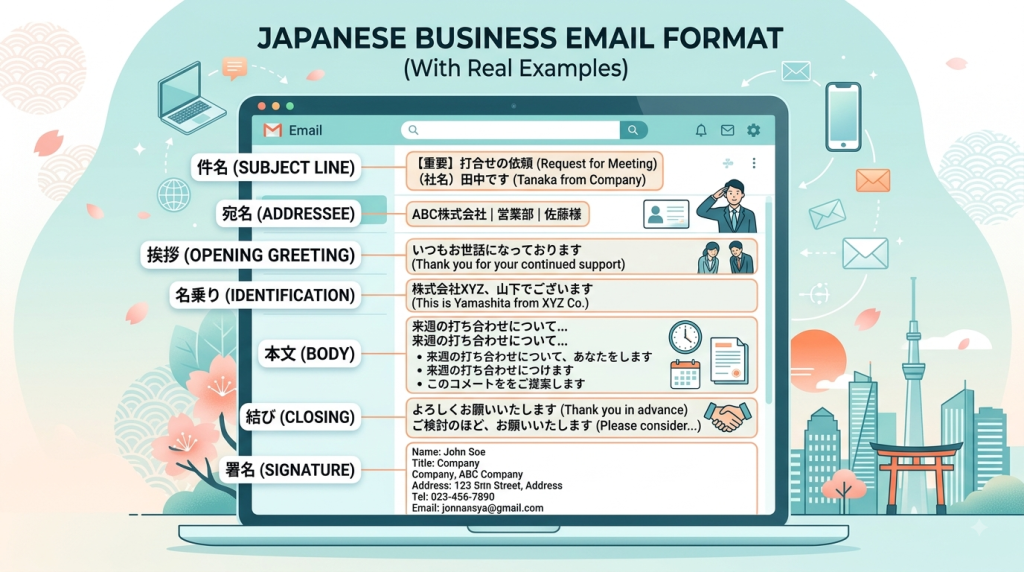
Every professional email sent in Japan follows a strict 6-part anatomy. Deviating from this order instantly flags your message as non-standard.
1. Subject Line (件名 - Kenmei)
   ↓
2. Recipient Name & Company (宛名 - Atena)
   ↓
3. Opening Greeting (挨拶 - Aisatsu)
   ↓
4. Main Body Text (本文 - Honbun)
   ↓
5. Closing Greeting (結びの挨拶 - Musubi no aisatsu)
   ↓
6. Email Signature (署名 - Shomei)
Let us look closely at each component and how to build them step-by-step.
Step 1: The Subject Line (件名 – Kenmei)
In Japanese corporate culture, workers receive dozens (sometimes hundreds) of emails a day. A vague subject line like Question (質問) or Hello (こんにちは) is a major faux pas.
Your subject line must be concise, specific, and actionable.
Structure:
[Action/Category] Core Message (Your Name / Company)
Key Conventions:
- Use standard Japanese brackets
【 】or[ ]to categorize the email type right away. - Always include your company name or full name in brackets at the end so the recipient knows who sent it before opening.
Examples:
| Goal | English Equivalent | Good Japanese Subject Line |
| Meeting Request | Request regarding ABC project meeting | 【ご相談】ABCプロジェクトの打ち合わせについて(株式会社XYZ・山田) |
| Sending Documents | Submission of monthly estimate | 【送付】4月度お見積書のご送付(山田) |
| Urgent Request | [Urgent] Confirmation regarding contract | 【緊急】契約書確認のお願い(株式会社XYZ・山田) |
| Thank You | Thank you for yesterday’s meeting | 【お礼】昨日の面談のお礼(山田) |
Step 2: The Recipient Name (宛名 – Atena)
Never start a business email with Konnichiwa (こんにちは). Instead, the very first line of the body must identify the recipient using their full professional details in hierarchical order:
- Company Name (会社名)
- Department Name (部署名)
- Title (役職) – Optional depending on closeness
- Name + Honorific (氏名 + 様/様等)
Formatting Rules:
- Write the full official company title (e.g., 株式会社, not Kabushikigaisha abbreviations).
- Never attach Sama (様) to a job title directly if the title already implies respect (e.g., write Tanaka Shacho or Shacho Tanaka-sama, never Tanaka Shacho-sama).
- If addressing an entire department or company, use Onchu (御中).
Formatting Examples:
Addressing a Client or External Partner:
株式会社ABC
営業部
山田 太郎 様
(ABC Co., Ltd. / Sales Department / Mr. Taro Yamada)
Addressing an Internal Superior:
高橋部長
(Department Manager Takahashi – Note: Do not add “Sama” to internal superiors)
Addressing a Department (No Specific Person):
株式会社ABC
開発部 御中
(ABC Co., Ltd. / Development Department)
Step 3: The Opening Greeting (挨拶 – Aisatsu)
Before launching into your request, you must build rapport with an opening phrase. The exact phrase depends on whether you are writing to an external contact or an internal colleague.
1. Writing to External Clients & Partners
The default golden phrase for external emails is:
- お世話になっております。(Osewa ni natte orimasu.)Literal translation: “Thank you for your ongoing support/cooperation.”
If it is your first time contacting them, use:
- 突然のご連絡にて失礼いたします。(Totsuzen no gorenraku ni te shitsurei itashimasu.)“Please excuse me for contacting you out of the blue.”
- 初めてご連絡させていただきます。[Company]の[Name]と申します。(Hajimete gorenraku sasete itadakimasu. [Company] no [Name] to moushimasu.)“I am contacting you for the first time. My name is [Name] from [Company].”
2. Writing to Internal Colleagues & Bosses
For internal company emails, do not use Osewa ni natte orimasu. Instead, use:
- お疲れ様です。(Otsukaresama desu.)“Thank you for your hard work.”
Step 4: The Main Body Text (本文 – Honbun)
The body text requires clear organization and appropriate level of honorific language (keigo).
To dive deeper into the nuances of humble and honorific verbs used in professional settings, make sure to read our complete guide on Keigo for Business Emails: Polite Japanese Made Simple.
Golden Rules for the Body Text:
- State the Purpose First: Start with a transition line like ~の件でご連絡いたしました (…no ken de gorenraku itashimashita – “I am writing to you regarding…”).
- Keep Paragraphs Short: Break text into 2–3 sentence blocks. In Japanese business culture, visual readability on both PC and mobile screens is critical.
- Use Bullet Points for Details: Dates, locations, and list items should be formatted with
記(Ki – Details follow) and以上(Ijou – End of details).
Formatted List Example:
打ち合わせの詳細は以下の通りです。
記
- 日時:2026年9月15日(火)14:00~15:00
- 場所:弊社 第2会議室
- 議題:新プロジェクトの進捗確認
以上
Step 5: The Closing Greeting (結びの挨拶 – Musubi no aisatsu)
Just as you cannot start without a greeting, you cannot close an email abruptly with just your name. You must use a standardized closing request.
Standard External Closings:
- よろしくお願いいたします。(Yoroshiku onegai itashimasu.)“Thank you for your cooperation.”
- 今後とも、何卒よろしくお願い申し上げます。(Kongo tomo, nanitozo yoroshiku onegai moushiage masu.)“I humbly ask for your continued favor moving forward.” (More formal)
Closings When Expecting a Response:
- ご検討のほど、よろしくお願い申し上げます。(Gokentou no hodo, yoroshiku onegai moushiage masu.)“Thank you in advance for considering this matter.”
- ご確認のほど、よろしくお願いいたします。(Gokakunin no hodo, yoroshiku onegai itashimasu.)“Thank you in advance for checking/reviewing this.”
Closings When Apologizing:
- ご迷惑をおかけいたしますが、何卒ご容赦ください。(Gomeiwaku wo okake itashimasu ga, nanitozo goyousho kudasai.)“We apologize for any inconvenience caused and kindly ask for your understanding.”
Step 6: The Email Signature (署名 – Shomei)
Every Japanese business email concludes with a structured signature separated by decorative borders like ---------------------------------- or ==================================.
Standard Template:
--------------------------------------------------
株式会社ABC  営業部
山田 太郎(Taro Yamada)

〒100-0001
東京都千代田区1-1-1 ABCビル 5F
TEL:03-1234-5678 / FAX:03-1234-5679
携帯:090-1234-5679
Email: t.yamada@abc-corp.co.jp
URL: https://www.abc-corp.co.jp
--------------------------------------------------
Real-Life Business Email Examples
Let us apply these structural components to real business scenarios you will face in Japan.
Example 1: Requesting a Meeting with an External Client
Subject: 【ご相談】新サービスのご案内およびお打ち合わせのお願い(株式会社XYZ・山田)
Body:
株式会社ABC
営業部
佐藤 健太 様
いつもお世話になっております。
株式会社XYZの山田でございます。
この度は、弊社で新しくリリースいたしました「クラウド管理システム」のご案内のため、ご連絡いたしました。
貴社の業務効率化に役立つご提案ができると考えております。
つきましては、一度オンラインにて30分ほどお時間をいただくことは可能でしょうか。
候補日時をいくつか挙げさせていただきます。
記
- 9月10日(木)11:00~12:00
- 9月11日(金)14:00~15:00
- 9月14日(月)15:00~16:00
以上
上記の日程でご都合が悪い場合は、お手数ですがご希望の日時をお知らせいただけますと幸いです。
ご多忙のところ恐縮ですが、ご検討のほどよろしくお願い申し上げます。
株式会社XYZ 営業部
山田 太郎
TEL: 03-0000-0000
Email: yamada@xyz.co.jp
Example 2: Thanking a Client After an In-Person Meeting
Following up after a face-to-face meeting is critical. Mastering digital follow-ups goes hand-in-hand with physical etiquette; ensure you are also familiar with Japanese Business Card Etiquette: Meishi Rules Explained to leave a lasting professional impression.
Subject: 【お礼】本日のお打ち合わせのお礼(株式会社XYZ・山田)
Body:
株式会社ABC
開発部
鈴木 花子 様
いつもお世話になっております。
株式会社XYZの山田でございます。
本日はご多忙の折、お時間をいただき誠にありがとうございました。
お打ち合わせの中でご質問いただきました資料につきましては、来週月曜日(9月14日)までに準備の上、送付させていただきます。
引き続き、貴社のお役に立てるよう努めてまいります。
探している情報などございましたら、お気軽にお申し付けください。
今後とも、何卒よろしくお願い申し上げます。
株式会社XYZ 営業部
山田 太郎
TEL: 03-0000-0000
Email: yamada@xyz.co.jp
Example 3: Apologizing for a Delay or Mistake (Asubi / Xie)
When handling mistakes, tone is everything. In Japanese culture, taking clear ownership quickly prevents larger issues. If you are participating in high-stakes negotiations or group discussions, you can review Business Meeting Etiquette in Japan: Do’s & Don’ts to avoid miscommunications before they happen.
Subject: 【お詫び】見積書記載内容の誤りについて(株式会社XYZ・山田)
Body:
株式会社ABC
購買部
田中 誠 様
いつもお世話になっております。
株式会社XYZの山田でございます。
先ほどお送りいたしました見積書(件名:10月度お見積書)につきまして、記載価格に一部誤りがございました。
多大なご迷惑をおかけしましたことを、深縮してお詫び申し上げます。
正しい見積書を本メールに添付いたしましたので、ご確認いただけますと幸いです。
再発防止に向け、確認体制を徹底してまいります。
何卒ご容赦賜りますようお願い申し上げます。
株式会社XYZ 営業部
山田 太郎
TEL: 03-0000-0000
Email: yamada@xyz.co.jp
Key Vocabulary Cheatsheet for Japanese Emails
To build your own emails, keep this cheat sheet of common phrases nearby:
| Situation | Japanese Phrase | Pronunciation | English Meaning |
| Opening | お世話になっております。 | Osewa ni natte orimasu. | Thank you for your continued support. |
| Inquiry | ~について伺いたく存じます。 | …ni tsuite ukagaitaku zonjimasu. | I would like to ask about… |
| Attachment | 資料を添付いたしました。 | Shiryou wo tenpu itashimashita. | I have attached the document. |
| Request | ご確認いただけますと幸いです。 | Gokakunin itadakimasu to saiwai desu. | I would appreciate it if you could confirm. |
| Apology | 大変申し訳ございません。 | Taihen moushiwake gozaimasen. | I am deeply sorry. |
| Urgency | 取り急ぎご連絡まで。 | Toriisogi gorenraku made. | Just a quick note / In haste. |
Cultural Context: Broader Workplace Norms
mastering the Japanese business email format is only one branch of professional success in Japan. Written correspondence reflects your real-world workplace behavior, respect for rank, and attention to subtle social boundaries.
To build a complete foundation for working with Japanese clients or in a Japanese corporate setting, explore our master guide on Japanese Business Etiquette: Culture Rules You Must Know.
For further language practice and official study tools, you can also consult external educational hubs such as the JLPT Official Website to test your reading proficiency or visit the Japan National Tourism Organization Business Resources for corporate cultural contexts.
Practical Tip for Non-Native Speakers
When in doubt, err on the side of caution and extra politeness. It is almost never viewed poorly in Japanese corporate culture to be slightly too polite, whereas being overly casual can jeopardize a business relationship. Keep templates of common email patterns saved in your notes, update the recipient details carefully, and always double-check the honorific forms of names before pressing send!