Japanese Business Etiquette: Culture Rules You Must Know
Navigating the waters of international commerce can be tricky, but doing business in Japan presents a uniquely intricate set of cultural expectations. Beneath the surface of Tokyo’s modern skyscrapers lies a corporate culture deeply rooted in tradition, mutual respect, and harmony (Wa).
For foreigners, mastering Japanese business etiquette isn’t just about avoiding awkward social slip-ups—it is a strategic asset. Demonstrating a foundational understanding of Japanese professional culture shows your partners that you respect their values, take the relationship seriously, and are committed to long-term success.
Whether you are preparing for your first business trip to Osaka or drafting an email to a potential Japanese partner, this ultimate guide covers the foundational rules, nuanced practices, and actionable insights you need to build trust in Japanese corporate spaces.
The Cultural Philosophy Behind Japanese Professional Life
To truly understand why Japanese business culture functions the way it does, you must look beyond the surface actions. Japanese corporate behavior is driven by three core cultural concepts:
1. Wa (和) – Harmony and Cohesion
Wa refers to social harmony and the preservation of group unity. Japanese workplace culture values the collective over the individual. Disrupting team dynamics, expressing overt anger, or forcing a direct confrontation violates Wa. In business, this translates to decision-making processes that seek consensus across all levels before moving forward.
2. Omotenashi (おもてなし) – Selfless Hospitality
Often translated as hospitality, Omotenashi is the art of anticipating someone’s needs before they even voice them. In corporate contexts, host companies go to extreme lengths to ensure guests are comfortable, well-informed, and treated with respect. Reciprocating this mindfulness is a major key to building business relationships.
3. Meiwaku (迷惑) – Avoiding Inconvenience
Avoid causing meiwaku (trouble or inconvenience) to others at all costs. Punctuality, thorough preparation, and clear communication are directly tied to this principle. Arriving late to a meeting or turning in incomplete work forces others to adjust, which is viewed as a breach of respect.
1. The Art of the Japanese Business Card Exchange (Meishi Koukan)
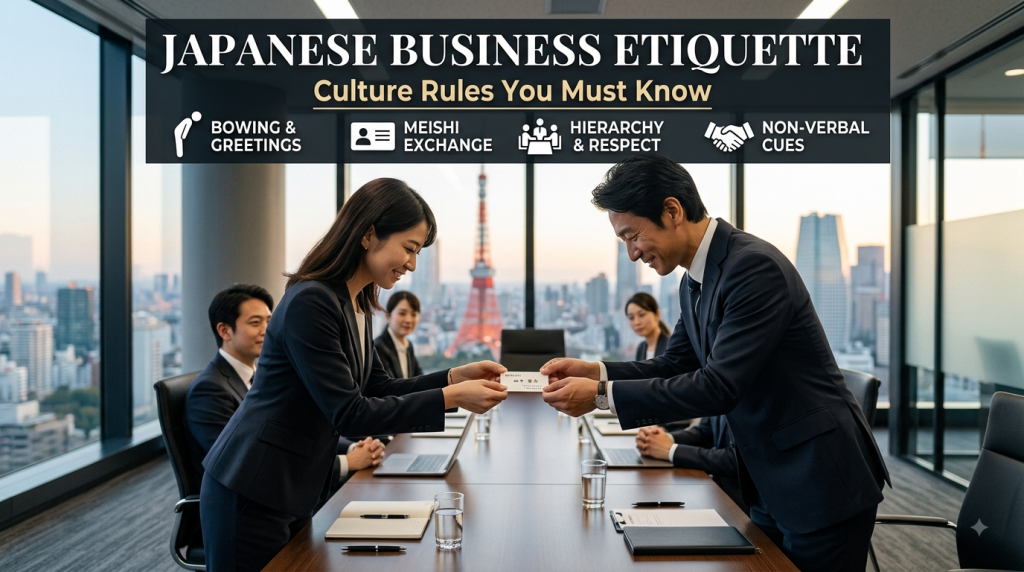
In the West, a business card is simply a piece of paper with contact details. In Japan, your business card (meishi) is treated as an extension of your physical identity and professional honor. Failing to treat a card with respect is seen as a direct slight to the person who gave it to you.
       ACCEPTING A MEISHI (Proper Form)

   [ Sender ]                      [ You ]
      |                               |
      |==== Two Hands Holding Card ==>|
      |    "Yoroshiku onegai shimasu" |
      |                               |
Essential Rules for Handing Out and Receiving Cards:
- Always Use Both Hands: Hold the card by the top corners when giving or receiving it so you do not cover the company logo or name.
- Orient the Card Correctly: Face the card toward the recipient so they can read it without turning it around.
- Bow Lightly: Accompany the handoff with a polite bow and introduce yourself: “Hajimemashite, [Your Name] to申します (to mōshimasu). Yoroshiku onegai shimasu.”
- Inspect the Card Carefully: Upon receiving a card, spend a few seconds reading it attentively. Do not immediately pocket it or shove it into a wallet.
- Arrangement During Meetings: Place the received cards neatly on the conference table in front of you on top of your business card case. Arrange them to match the seating positions of the people across from you.
For a step-by-step walkthrough of card holder selection and handoff dynamics, explore our dedicated breakdown on Japanese Business Card Etiquette: Meishi Rules Explained.
2. Navigating Seating Hierarchy (Kamiza and Shimoza)
Hierarchy dictates almost every physical arrangement in Japanese business settings, from meeting rooms to taxis and elevators. The highest-ranking person is given the most comfortable and honorable position (Kamiza), while junior team members sit near the entrance (Shimoza).
| Transport / Room Type | Kamiza (Honorary Seat) | Shimoza (Junior Seat) |
| Meeting / Conference Room | Furthest from the door (often in front of a artwork or view) | Closest to the entrance/door |
| Taxi (Driver Hired) | Directly behind the driver | Middle of the back seat |
| Taxi (Driven by Host) | Front passenger seat | Middle of the back seat |
| Elevator | Rear center | Right next to the button panel |
Key Takeaway for Guests:
Never sit down immediately upon entering a room. Wait for your host to direct you to a seat. If they invite you to sit at the Kamiza, accept gracefully with a brief bow of gratitude (Dōmo arigatō gozaimasu).
3. Communication and Language Etiquette
Understanding High-Context Communication
Japan is a high-context culture, meaning much of the true communication relies on subtle cues, tone, and context rather than explicit words.
- The Meaning of “Yes” (Hai): When a Japanese partner says “Hai”, it usually means “I hear you” or “I understand,” not “I agree to your proposition.”
- Indirect Refusals: Direct refusals (“No” or “I can’t”) are considered harsh. Instead, you might hear phrases like:
- “Chotto muzukashii desu…” (It is a bit difficult…)
- “Kento shimasu” (We will consider it / think about it)
- “Ma, so desu ne…” (Well, yes, but…)
When you hear these subtle cues, pushing for an immediate “yes” or “no” will cause discomfort. Acknowledge the constraint and offer to provide additional information later.
Mastering Professional Language (Keigo)
When communicating in Japanese, using standard casual language is improper for professional settings. Business conversations require Keigo (honorific Japanese), which is split into three main registers:
- Teineigo (丁寧語): Polite language using -desu and -masu forms. Standard for general interactions.
- Sonkeigo (尊敬語): Respectful language used to elevate the actions of your clients, guests, or superiors (e.g., using O-goshi kudasai instead of Kite kudasai).
- Kenjougo (謙譲語): Humble language used to lower your own actions or those of your company to show respect to the recipient (e.g., using Mairimasu instead of Ikimasu).
If you are drafting communications or communicating across teams, make sure to read Keigo for Business Emails: Polite Japanese Made Simple to ensure your written tone hits the right balance of respect and clarity.
To deepen your understanding of official language benchmarks and grammar forms, you can review official guidelines on the Japan Foundation JLPT Language Portal.
4. Professional Written Communication: Email Protocols
Business emails in Japan follow a distinct structure that differs significantly from Western emails. A Japanese business email prioritizes context, appreciation, and structured respect over blunt brevity.
+-------------------------------------------------------+
|  1. Recipient Company & Name (with -sama)             |
|  2. Standard Opening Greeting (Aisatsu)               |
|  3. Sender Identification (Company & Name)            |
|  4. Clear, Well-structured Body Text                  |
|  5. Call to Action / Next Steps                      |
|  6. Polite Closing Formula (Yoroshiku...)              |
|  7. Professional Email Signature Block (Meishi-style)  |
+-------------------------------------------------------+
Key Elements of a Japanese Business Email:
- Recipient Name: Always address the client with their company name, department, title, and last name appended with -sama (様).
- Opening Greeting (Aisatsu): Never jump straight to the request. Always open with standard phrases like:
- O-sewa ni natte orimasu. (Thank you for your ongoing support/cooperation.)
- Self-Introduction: State your company name and your full name clearly.
- Closing Line: Always wrap up with a formal request for ongoing goodwill:
- Kongo tomo yoroshiku onegai itashimasu.
For concrete email templates, subject line examples, and real-world corporate samples, consult our guide on Japanese Business Email Format (With Real Examples).
5. Meeting Dynamics: Preparation, Execution, and Follow-up
Meetings in Japanese companies (Kaigi) serve a different functional purpose than in Western firms. In many Western cultures, meetings are brainstorm sessions where debate happens live. In Japan, meetings are often designed to formalize decisions that were already negotiated behind the scenes through Nemawashi (informal consultation).
   [ Nemawashi ]  ===>  [ Formal Meeting ]  ===>  [ Ringi System ]
(1-on-1 Discussions)     (Confirm Consensus)      (Official Sign-off)
Essential Rules for Business Meetings:
- Punctuality is Non-Negotiable: Arrive 5 to 10 minutes prior to the scheduled start time. If you expect to be even 2 minutes late, notify your hosts immediately via phone call or high-priority email.
- Dress Professionally: Stick to conservative business attire. Dark suit colors (navy, dark gray, black), white shirts, subdued ties, and clean shoes are expected for formal meetings.
- Bowing Etiquette: Match the depth of your bow to the degree of respect required:
- Eshaku (15°): Casual greeting for colleagues.
- Keirei (30°): Standard business bow for clients and superiors.
- Saikeirei (45°): Deep bow reserved for formal apologies or utmost respect.
For a complete checklist of meeting protocols from prep to post-meeting follow-ups, read Business Meeting Etiquette in Japan: Do’s & Don’ts.
6. After-Hours Bonding: Nomikai Culture
Building professional trust in Japan doesn’t end when the office clock stops. Business drinking gatherings (Nomikai) play a crucial role in building interpersonal relationships (Ningen Kankei) and unwinding after intensive work projects.
Nomikai Rules to Remember:
- Never Drink Before the Kampai: Wait for everyone’s glass to be filled, and wait for the group host to lead the collective toast (Kampai!).
- Pour for Others, Not Yourself: Keep an eye on your neighbors’ glasses. When their drink runs low, offer to pour for them. They will reciprocate by filling yours.
- Mind the Hierarchy: Hold the bottle or pitcher with both hands when pouring for a senior colleague. When they pour for you, hold your glass with both hands and take a small sip before placing it back down.
- What Happens at Nomikai Stays There: Known as Girei, the informal conversations, jokes, or confessions shared at a Nomikai are rarely brought up in the cold light of the office the next morning.
To learn more about working effectively with Japanese firms or preparing for official certifications like the Business JLPT, review information resources at the JETRO Business Support Portal.
Conclusion: Mastering Japanese Business Etiquette
Adapting to Japanese business etiquette takes time, acute observation, and active practice. You don’t need to be completely fluent in Japanese on day one to impress your colleagues or foreign partners. What matters most is showing genuine humility, attention to detail, and a commitment to preserving harmony (Wa).
By treating business cards with care, mastering seating hierarchies, writing structured business emails, and respecting team consensus, you will lay a solid foundation for lasting professional relationships in Japan.
Deepen Your Knowledge (Related Guides)
Explore our related cluster guides to master every pillar of Japanese corporate life:
- Return to Main Pillar: Japanese Business Etiquette: Culture Rules You Must Know
- Email Essentials: Keigo for Business Emails: Polite Japanese Made Simple
- Templates & Samples: Japanese Business Email Format (With Real Examples)
- Business Card Protocols: Japanese Business Card Etiquette: Meishi Rules Explained
- Meeting Guidelines: Business Meeting Etiquette in Japan: Do’s & Don’ts