Study in Japan with JLPT: Universities, Admission & Requirements
Few academic decisions transform your personal and professional path like choosing to higher-educate in Japan. With world-class universities, generous research funding, and a booming job market eager to retain global talent, Japan has positioned itself as one of the premier study-abroad destinations in Asia.
However, navigating the Japanese higher education system requires clarity regarding language requirements. Whether you are aiming for a traditional Japanese-medium degree, a specialized research master’s, or an English-taught undergraduate program, understanding how the Japanese Language Proficiency Test (JLPT) fits into the admissions landscape is critical.
Having coached hundreds of international students through the university application process and JLPT exam prep, I can tell you that language certificates are more than just items on an application checklist—they dictate your daily classroom survival, internship prospects, and social integration.
The Strategic Role of JLPT in Japanese Higher Education
When planning to study in Japan with JLPT, students often ask whether the test is mandatory. The honest answer is: it depends on your degree medium, university tier, and long-term goals.
The JLPT is a standardized exam administered by the Japan Educational Exchanges and Services (JEES) and the Japan Foundation. It evaluates non-native speakers across five levels—from N5 (basic) to N1 (advanced).
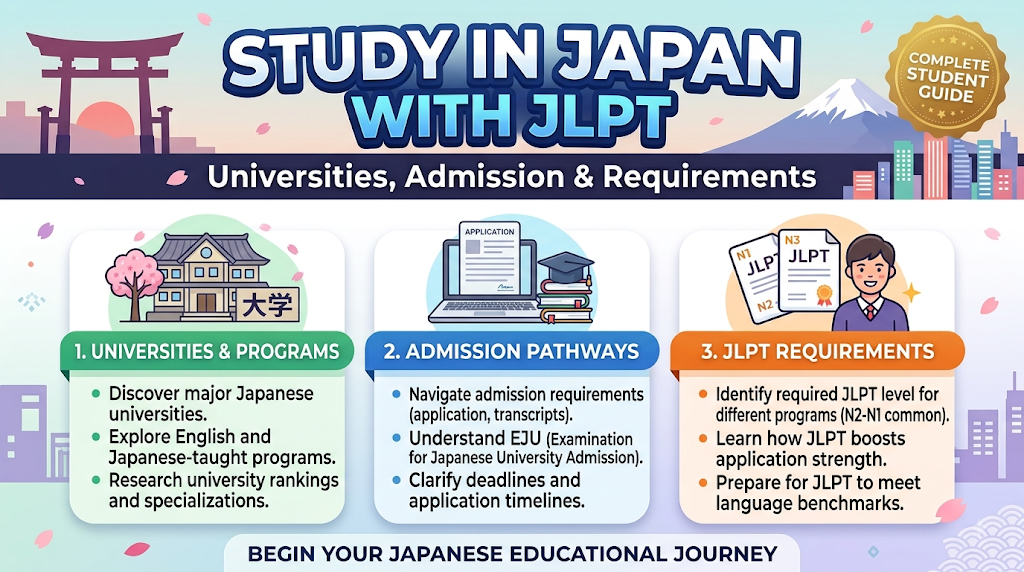
For international applicants, your JLPT certificate serves three primary functions:
- Admissions Proof: Demonstrates to admissions committees that you can comprehend lectures, write academic papers, and participate in seminar discussions (ゼミ, zemi).
- Visa Processing Safety: Proves to Japanese Immigration (ISA) that you possess the requisite background to undertake study in Japan.
- Scholarship Eligibility: Opens doors to merit-based financial aid from government bodies, municipal grants, and private foundations.
You can verify official exam dates, test sites, and scoring criteria directly on the Official JLPT Website.
JLPT Levels Breakdown: What Each Level Unlocks
To build a realistic timeline, you must understand what each level on the JLPT scale actually represents in the context of academic life in Japan.
For an in-depth breakdown of each proficiency band, explore our detailed cluster guide: JLPT Level Needed to Study in Japan (N5–N1 Explained).
| JLPT Level | Target Focus | Real-World Academic Capability | University & Visa Application Context |
| N5 | Basic Hiragana, Katakana, ~100 Kanji, ~800 words | Survival Japanese. Reading basic signs and store menus. | Minimum threshold for language school enrollment and basic student visa approval. |
| N4 | Basic daily grammar, ~300 Kanji, ~1,500 words | Basic daily interactions. Simple conversational exchanges. | Satisfies baseline visa language requirements; suitable for prep-year language immersion. |
| N3 | Intermediate grammar, ~650 Kanji, ~3,700 words | Everyday independence. Understanding main ideas in spoken Japanese. | Minimum for select vocational schools (Senmon Gakkō) and English-medium programs with minor Japanese tracks. |
| N2 | Advanced intermediate, ~1,000 Kanji, ~6,000 words | Reading general news, participating in standard university discussions. | Standard minimum threshold for most Japanese-taught undergraduate and graduate degrees. |
| N1 | Full proficiency, ~2,000 Kanji, ~10,000 words | Reading dense academic papers, writing essays, debate. | Required by top-tier national universities (e.g., University of Tokyo, Kyoto University) and competitive humanities programs. |
The Academic Expectation Gap
Passing N2 proves you understand grammar structures like ~にともなって (as/along with) or ~にあたって (on the occasion of). However, actual university life demands real-time processing: listening to a professor lecture at full speed while taking notes in Kanji and reading 40 pages of research material every week.
JLPT vs. EJU: Understanding the Difference
A common point of confusion for prospective international students is whether they should take the JLPT or the EJU (Examination for Japanese University Admission for International Students).
To get a comprehensive breakdown of when each exam is required, read our dedicated resource: JLPT Required for Japanese University Admission.
Here is how the two exams compare:
JLPT (Japanese Language Proficiency Test)
- Format: Multiple-choice test evaluating Reading, Vocabulary, Grammar, and Listening.
- Focus: General Japanese language proficiency in daily and social contexts.
- No Writing/Speaking: Does not test direct handwriting, academic essay composition, or oral skills.
- Primary Use: Graduate school applications, vocational schools, job hunting in Japan, and general credentialing.
EJU (Examination for Japanese University Admission)
- Format: Multiple-choice plus a mandatory hand-written Japanese essay section (記述, kijutsu).
- Focus: Academic Japanese tailored specifically for lecture comprehension and textbook reading, plus academic subject tests (Math, Science, or Japan & the World).
- Primary Use: Undergraduate admission to national, public, and top private universities.
For official updates on EJU examination schedules, testing locations, and participating institutions, consult the Study in Japan Official Portal (JASSO).
Key Rule of Thumb: If you are applying directly to a Japanese-medium undergraduate degree, most public and top private universities will ask for the EJU (Japanese section). If you are applying to graduate programs, vocational schools, or preparatory courses, the JLPT (N2 or N1) is usually the gold standard certificate.
Student Visa Language Requirements for Japan
Before a university can issue your final enrollment papers, you must secure a Japanese Student Visa. Immigration Services Agency of Japan (ISA) enforces strict guidelines regarding language background to prevent visa fraud and ensure students do not drop out due to academic failure.
For an exhaustive guide on visa documentation and language evidence, check: Student Visa Language Requirements for Japan.
What Immigration Requires for Visa Approval:
- Documented Study Hours: A minimum of 150 hours of formal Japanese language study at an accredited institution.
- Official Certificate: In lieu of 150 study hours, providing a JLPT N5 certificate (or equivalent test result like NAT-TEST or J.TEST) satisfies immigration requirements.
If you plan to enter a Japanese Language School before transferring to a university, securing JLPT N5 or N4 before arrival significantly reduces visa processing friction and accelerates your pathway toward N2.
Scholarships in Japan Tied to JLPT Scores
Studying abroad is a major financial commitment, but Japan offers one of the most robust scholarship ecosystems for international students. Higher JLPT scores open doors to significant financial aid.
Learn how to leverage your test scores for funding in our guide: Scholarships in Japan That Accept JLPT Scores.
Primary Scholarship Opportunities
1. MEXT (Monbukagakusho) Government Scholarship
The most prestigious scholarship available to international students, covering full tuition, round-trip airfare, and a monthly living stipend (¥117,000–¥145,000).
For exact details on language requirements for research and undergraduate tracks, read: JLPT for MEXT Scholarship: Eligibility Guide. You can also verify official guidelines via the Ministry of Education, Culture, Sports, Science and Technology (MEXT).
2. JASSO Honors Scholarship
Provides a monthly stipend of ¥48,000 for self-funded international students attending universities or junior colleges in Japan. Candidates who achieve high scores on the EJU or hold JLPT N2/N1 receive priority recommendation during institutional selection.
3. University-Specific Tuition Reduction Scholarships
Many top private universities (such as Waseda, Keio, Ritsumeikan, and Doshisha) offer 30%, 50%, or 100% tuition reductions for international students. Possessing an N1 or N2 certificate at the time of application heavily strengthens your profile for these institutional awards.
Admission Requirements Across Education Tracks
Different academic levels in Japan evaluate Japanese proficiency differently. Here is how requirements break down across program types.
1. Undergraduate Programs (Japanese Medium)
- Primary Requirement: EJU Japanese Section (typically score 220–300+) OR JLPT N2/N1.
- Secondary Screening: On-campus written examination (小論文, shōronbun – short essay) and an oral interview (面接, mensetsu).
- Timeline: Applications open between September and January for April intake.
2. Graduate Programs (Master’s & PhD)
- Primary Requirement: JLPT N2 minimum, though JLPT N1 is strongly preferred for Humanities, Social Sciences, Business, and Law.
- Research Proposal (研究計画書, kenkyū keikakusho): A 1,500–2,000 word proposal written in academic Japanese detailing your research objectives, methodology, and literature review.
- Professor Contact: Securing a supervisor before applying requires formal communication in polished, polite Japanese (Keigo).
3. Vocational Colleges (Senmon Gakkō)
- Primary Requirement: JLPT N2 certificate OR proof of 6+ months of study at an accredited Japanese language institute in Japan.
- Goal: Direct placement into technical careers in Japan (game design, culinary arts, automotive engineering, hospitality).
4. English-Taught Degree Programs (SGU / Global 30)
- Primary Requirement: TOEFL / IELTS scores.
- JLPT Requirement: None for admission.
- Practical Advice: While not required for entry, reaching N3/N2 by your final year is crucial if you intend to seek employment (Shūshoku Katsudō) in Japan post-graduation.
Realistic Roadmap: From Beginner to University-Ready
If your goal is to study at a Japanese-medium university, here is a practical timeline for preparing your language credentials:
[Month 0-6]   --> Learn Kana, Basic Kanji, Complete N5 & N4 Foundations
[Month 6-12]  --> Intensive N3 Prep, Transition to Monolingual Dictionaries
[Month 12-18] --> N2 Exam Preparation, Academic Essay Writing Practice
[Month 18-24] --> Pass N2/N1, Take EJU, Submit University Applications
Actionable Study Tips for Aspiring University Students
- Master Kanji Early: Aim for 1,000 Kanji (up to N2 level) as fast as possible. Kanji recognition accelerates reading speed, which is the primary bottleneck during university entrance exams and the JLPT.
- Practice Hand-Writing Essays (原稿用紙, genkō yōshi): Japanese university written exams require writing essays on grid paper using proper punctuation and formal written style (Dearu/Da style: である・だ).
- Immerse in Academic Content: Move beyond standard anime and casual media. Read editorials from Japanese news outlets like Asahi Shimbun or NHK News Web Easy, and listen to lectures on YouTube or Japanese educational podcasts.
Summary Checklist for Applying to Study in Japan
Before submitting your university applications, review this quick readiness checklist:
- [ ] Identified whether target programs require JLPT (N2/N1) or EJU (or both).
- [ ] Checked application submission deadlines (typically 6–9 months prior to entry).
- [ ] Verified passport validity and official academic transcripts with translated copies.
- [ ] Prepared financial documentation (bank balance proof showing ~¥2,000,000 for visa application).
- [ ] Contacted potential graduate research supervisors (if applying for Master’s/PhD).
Equipping yourself with the right JLPT credential opens doors not just to Japanese universities, but to a transformative international experience. Plan early, set clear goals for each test level, and take structured steps toward your academic journey in Japan!


![[Vocabulary] 800 Essential Words: Best JLPT N5 Vocabulary Anki Decks](https://jlptsamurai.com/wp-content/uploads/2026/03/j2-768x429.png)